A J o u r n a l of L i t e r a t e
a n d L i t e r a r y A n a l y s i s
2.4 (Fall 2002)
Special Issue (Continued): The Decline and Fall of Literacy
A quarterly publication of The Center for Moral Reason
Board of Directors:
John R. Harris, Ph.D. (President)
Thomas F. Bertonneau, Ph.D. (Secretary)
Helen R. Andretta, Ph.D.; York College-CUNY
Ralph S. Carlson, Ph.D.; Azusa Pacific University
Kelly Ann Hampton
Michael H. Lythgoe, Lt. Col. USAF (Rtd.)
The previous issue of Praesidium (Summer 2002) may be viewed by
© All contents of this journal (including poems, articles, fictional works, and short pieces by staff) are copyrighted by The Center for Moral Reason of Tyler, Texas (2002), and may not be cited at length or reproduced without The Center's express permission.
CONTENTS
Post-literacy is not illiteracy: it is a vast cultural shift away from objectivity, duty, and responsibility.
A Sampling of Pronouncements from Our Cultural Elites
Over the past three decades, academic ideologues have grown so fatuous that they have "declared" the Pequod a slave ship and Beethoven a racket-monger.
Steve Kogan
Poetry is both pushed out on the street here and shouted down… a cool reception, indeed! R.S. Carlson
Literature and Literacy: The Decline of Reading and the Stultification of Student Prose
In this sequel to his analysis of how American college students are thinking in more oral patterns every day, Professor Bertonneau begins by reviewing ancient Greece’s arduous ascent to literacy.
Thomas F. Bertonneau
"And Choice of Sides or Pronoun"
Who needs a poorly reproduced cartoon sketch with Professor Carlson’s humor to keep us going?
R.S. Carlson
This poem gently chides theological intransigence.
R.S. Carlson
Who Needs Enemies? The Peculiar Struggle of Literary Studies at Christian-Affiliated Colleges
Protestant colleges, especially the "fundamentalist" variety, are thriving, and at first glance they offer hope in the fight for our literate heritage. Such optimism wilts, however, under closer inspection.
John R. Harris
Mr. Davies again lays his crosshairs upon academic folderol, this time the ever-popular conference. Yet this short story takes a wistful turn with the autumn leaves.
Ivor Davies
A Few Words from the Editor
Imagine that you are in a position where you must simply take someone’s word—where you must entrust to him a great deal of cash, say, or a secret whose divulging would give his company an unfair advantage in the marketplace. You wish to do the right thing, but you cannot avoid the risk that this second party may be less punctilious. Now imagine that your confidant does not believe in any reality beyond the immediately visible or tangible. He scoffs at the notion of metaphysics, of principles whose rigor endures beyond the dissolution of the body. The odds of getting your cash back, of having your secret preserved, are not looking good! For what could possibly restrain this person from seeking material profit except the prospect of a greater profit—or a greater loss? Unless he senses further, better opportunities to exploit you if he proves true on this occasion, or unless he fears being disgraced among a common circle of friends in whose high esteem he basks, or unless he sees a veiled threat of dismissal or prosecution for malfeasance, his treachery is money in the bank.
Such situations abound in our post-literate society. They are enough in themselves to justify a follow-up issue on the subject which we addressed in the summer: the decline and fall of literacy. Look at it this way. Literacy makes you talk to yourself, as opposed to the oral give-and-take of campfire and communal hearth. You choose the book, you read it at your pace, you pause to draw connections with your experiences… over a period of several years, you open up and explore psychological chambers whose echoes scarcely break the surface of your gestures or habits. You are different, separate: you are an independent agent fully responsible for his or her choices. Of course, such responsibility would be meaningless if some of your internal corridors did not ring with a resonance whose note you overhear in others and whose scarcely marred cry, indeed, commands that you respect its presence in others. Moral philosophy is born of these paradoxical strains, the individual assuming the burden of his difference, the difference itself but a license to seek deeper unity through all of one’s personal resources. Without a keen awareness of the subjective—of oneself as distinct—one could have no complementary awareness of the objective, the ultimate purpose drawing freedom toward duty and redeeming it from chaos.
The unique, the many, the whole… is it an accident that mathematics is also born in human culture at about the same time as moral philosophy: is literacy not the midwife who delivers both? Writing not only names things (as oral language also does); it fixes their names (as orality struggles to do), and it fixes the relationships between them in the form of grammar. Just as the moral thinker moves through the cycle of "I… not I… my common destination with others", so the mathematical thinker ponders the relationships which bind atomic units into harmonious collaboration. In either case, the activity of labeling things, formalizing how the labels may be connected in sentences, and contemplating those formulas at leisure can only have fostered other activities of naming and arranging. Mathematics is literate reflection distilled to its most naked form, just as any thoughtful attempt at written communication dramatizes conscientious moral struggle.
This all smacks of nominalism, some will warn. Ockham’s theory that names create perceived reality is often said by moral traditionalists to have poisoned the West’s well with a "nothing is real, all definitions are arbitrary" kind of relativism. The same charges are leveled at Immanuel Kant, among others. The truth is that both thinkers were only describing how we think about reality, not questioning the existence of something real to think about. I very much fear that such self-styled traditionalists today are again missing the point. Reality is there, they say ingenuously. God created the world and all within it: hence whether we handle creation with printed tomes or oral chatter, with algebraic equations in search of geometric figures or blunt computer binarism reducing all to "yes" or "no", is irrelevant. We must simply accept on faith that a firm arm is always there to lean on, and be at peace. The truth will always be there for us, if I may borrow one of those post-literate clichés which escapes tautology by means of vacuity.
What such false traditionalism, at once pugnacious and quietist, wholly and clearly lacks is the literate sense of duty, of the need to get up and do something. Indeed, it is already neo-tribal in its blurring of self-and-other distinctions and its surrender to prevailing trend. To be fair, the amoralist with whose portrait I opened these comments is a late-literate construct. The vaccination of his literacy did not "take": it has sent him into a sophistical fever of splitting hairs and counting parts from which no heightened sense of wholeness—of purpose—emerges. In a way, this person is better than those genuinely post-literate tribesmen who dance whenever they hear the drum—better because he is worse, because he is still capable of choice. Our moral dilemmas will be much simpler in tomorrow’s revived yesterday. Leave your cash with your blood-brother: if he pilfers it, call a village meeting. The elders will put your two hands in the fire and see who flinches first.
My delight at having assembled such a rare array of perceptive works as we have in this issue is thus faintly overshadowed by my knowing why such works have become rare. Contributors often tell me that this or that publisher could not understand an essay which I find extremely worthwhile. Both of the creative writers featured in this issue warned me that certain religious audiences might find their work offensive—a staggering thought when I consider the obvious spiritual dimensions of their pieces. I can only exhort, Live in the truth, and take pride in saying it!
~JH
**********************************
A Sampling of Pronouncements
from Our Cultural Elites
by
Steve Kogan
Steve Kogan debuted in Praesidium 1.3 with "Express Train to 1929" (18-26). A native of Brooklyn and educated at Columbia, Mr. Kogan has taught English for over three decades at the Borough of Manhattan Community College.
Note: The following passages are a fair sampling of the mindset in American cultural criticism for the past twenty-five years. My extracts are drawn from prominent writers, critics, and journals, and the claims put forward in these passages are based on influential ideas that have filtered down from modern literary theory, postcolonial and ethnic studies, new historicism, and Marxist cultural critique. Some of the founding fathers are listed with honorable mention in the eleventh extract below. I could as well have chosen passages from any of these authors or from other writers among their legion of followers. Readers will note that some of the pronouncements are patently absurd, and, as I demonstrate in my comments and questions, all of them represent a species of propaganda that masquerades as thought.
Edward Said:
1) There is no such thing as a direct experience, or reflection, of the world in the language of a text.
2) ... neither Conrad nor Marlow gives us a full view of what is outside the world-conquering attitudes embodied by Kurtz, Marlow, the circle of listeners on the deck of the Nellie, and Conrad…. Heart of Darkness works so effectively because its politics and aesthetics are, so to speak, imperialist . . .
3) Without empire, I would go so far as saying there is no European novel as we know it.
4) [In Kim], Kipling… firmly places [the Lama] within the protective orbit of British rule in India. This is symbolized in Chapter 1, when the elderly British museum curator gives the Abbot his spectacles, thus adding to the man’s spiritual prestige and authority, consolidating the justness and legitimacy of Britain’s benevolent sway.
5) … as Paul Robinson has convincingly argued in Opera and Ideas—[Verdi’s operas] were almost all intended as political operas, replete with rhetorical stridency, martial music, and unbuttoned emotions. "Perhaps the most obvious component of Verdi’s rhetorical style—to put the matter bluntly—is sheer loudness. He is with Beethoven among the noisiest of all major composers…. Drop the needle at random on a recording of a Verdi opera, and you will usually be rewarded with a substantial racket."
6) Many good things have justifiably been said about [Orwell’s plain] style, although it is curious how they have often tended to prevent other things from also being said. For instance, the plain reportorial style coerces history, process, knowledge itself into mere events being observed.
7) Orwell’s sustained political writing career coincides not with his down-and-out-years… but with his re-admission to and subsequent residence inside bourgeois life. Politics was something he observed, albeit as an honest partisan, from the comforts of bookselling, marriage, friendship with other writers,… dealing with publishers and literary agents.
8) Even the homey terms that were usually Orwell’s preference over genuinely historical or theoretical explanation—"England in a phrase: a family with the wrong people in control"—derive from this essentially humdrum background.
9) Far from having earned the right to denounce socialism from within Orwell had no knowledge either of Marx or of the massive Marxist and socialist traditions.
10) When he was not verbally abusing people he considered opponents or competitors, he was holing up as a reviewer of more or less unchallenging books. True, he had courage and humanity, but, we must now say, he also had security and protection.
11) Along with Sartre and Merleau-Ponty, Georges Canguihelm, Jean-Pierre Vernant, Lucien Goldmann, Althusser, Derrida, Lévi-Strauss, Roland Barthes, Gilles Deleuze, and Bourdieu himself, Foucault emerged out of a strange revolutionary concatenation of Parisian aesthetic and political currents, which for about thirty years produced such a concentration of brilliant work as we are not likely to see again for generations.
12) No one today is purely one thing. Labels like Indian, or woman, or Muslim, or American are not more than starting-points, which if followed into actual experience for only a moment are quickly left behind.
From Culture and Imperialism and Reflections on Exile
Observations and Questions
1) The disjunction between reality and the written word is one of the key concepts of modern literary theory, yet it undercuts its own claim when applied to itself. If Said is right and the world cannot be reflected in writing, then his statement cannot reflect the reality of the written word. Cf. Stanley Fish’s dictum that no text can be read objectively, which, if true, means that we can never know if it is true.
2) The statement is meaningless in its present form, since a) no one can give us even a partial view of what lies "outside" his point of view, and b) if Conrad and Marlow do not give us "a full view", they must still be giving us a rather large view of other perspectives than their own. Has anyone ever given us a "full view" of anything? As for "their world-conquering attitudes", from the first page of Heart of Darkness to the last, Conrad and his narrator portray reason and civilization as fragile structures that are surrounded by darkness and confusion. How does this world view echo the sentiments of real world-conquerors, such as Napoleon and Adolf Hitler?
3) There is also "no European novel as we know it" without the development of the printing press, the revival and translation of classical romances in the Renaissance, the popularity of romance novellas and pastoral epics in Elizabethan England, Sir Thomas Malory’s integration of chivalric literature in "a series of self-contained stories.. drawn tightly and firmly around the protagonist’s life" (Eugène Vinaver), and the rise of Protestant thought and institutions. Orwell was not alone in observing that "the novel is practically a Protestant form of art; it is a product of the free mind, of the autonomous individual" ("Inside the Whale").
4) This is what actually happens in Chapter 1 of Kim: wishing, as he says, "to acquire merit", the curator gives the Lama a notebook and sharpened pencils, "all good for a scribe", and then asks to see the Lama's old spectacles. He notes that they have almost the same power as his own and asks the Lama to exchange gifts with him. The Lama gives the curator an iron pencase with an ancient Chinese design. "That is for a memory between thee and me—my pencase. It is something old—even as I am." The curator even wishes that the Lama would stay and teach him some secrets of Chinese brushwork. If I thought like Said, I could say from the other side that "this chapter symbolizes the benevolent sway of Buddhism over British rule in India, and it also reflects Britain’s desire to learn as much as possible from the wisest men of Asia."
5) Cf. the dialogue in "Fawlty Towers" where Fawlty is listening to Brahms’ Third Symphony in his office and his wife rushes in yelling, "What’s that racket you’re listening to?" Fawlty comes out of his trance and shouts back, "It’s Brahms’ Third Racket!" Note Said’s implication that Robinson has "convincingly" redefined fortes and crescendos as "noise".
6) Critical praise of Orwell’s prose has never "prevented other things from being said." The idea that the "plain style coerces" history "into mere events being observed" has in fact been said a hundred times by his critics on the left. The underlying attack is against "Anglo-American empiricism" (Frederic Jameson), as opposed to Marxist theory. The characterization of Orwell’s "plain style" is itself erroneous. There is not a single essay, review, or article by Orwell where observations are not bound up with judgments about history, society, and human nature.
7) Said implies that being a genuine leftwing writer requires one to live in poverty, but it is difficult to see how Orwell could have had a "sustained political writing career" while sleeping in cardboard boxes in Trafalgar Square, working as a hop-picker, washing dishes in slum restaurants, etc. As for the "comforts" of bookselling, Orwell described this stint as a wretched experience. On a personal level, Said’s remark that Orwell "observed" politics from the ease of "bourgeois life" is particularly reprehensible, in light of the fact that he has spent his entire career as a superbly comfortable English professor at one of the wealthiest universities in the world. On a scholarly level, Said’s picture of Orwell’s life is seriously flawed, since he never mentions Orwell’s going from Eton to seven years in the Royal police force in Burma, his eking out a living in the 1930s, or his pursuit of writing amid recurring bouts of tuberculosis and pneumonia, which hardly qualify as a quest for security and protection. As for the implication that "security" minimizes "courage", even Marines, firemen, bridgebuilders, fighter pilots, etc. all have networks of "security and protection". Elsewhere in his essay, Said remarks that Orwell’s career is marked by "unexamined bourgeois values", although Orwell explicitly states in "Why I Write" that "I am not able, and I do not want, completely to abandon the world-view that I acquired in childhood." Regarding Orwell’s enlistment with the Anarchists in Spain and nearly fatal wound, Said merely refers to them as "Orwell’s Spanish entrance and exit". Note the insinuation that Orwell was only play-acting in a minor role, as though neither his convictions nor the bullets were real.
8) The idea that Orwell’s direct and intimate language "derive" from his "humdrum background" is stupid in the literal dictionary sense of "obtuse" and "showing a lack of sense or intelligence", since it assumes that a writer’s milieu somehow seeps into his pages and creates his style. By the same logic, writers who were also doctors (Chekhov, Conan Doyle, William Carlos Williams) ought to sound medical, and all English professors ought to sound even homier than Orwell, since their lives are far more middle class than his ever was. There is no need to speculate about Orwell’s background, however, since he is conspicuously open about the influences on his work, as in "Such, Such Were the Joys", "Inside the Whale", the "Autobiographical Note" of 1941, and "Why I Write".
9) Said betrays an essentially academic view of life by suggesting that one cannot be a socialist and critique Marxism unless one has gained the proper credentials. Orwell, however, was keenly aware of his relationship to Marxist ideology, and in his preface to the Ukrainian edition of Animal Farm writes that "I became pro-Socialist more out of disgust with the way the poorer section of the industrial workers were oppressed and neglected than out of any theoretical admiration for a planned society." He also writes in his wartime diaries that he knew enough of Soviet writing to intuit the true nature of Stalin’s rule ("such horrors as the Russian purges never surprised me, because I had always felt that—not exactly that, but something like that—was implicit in Bolshevik rule. I could feel it in their literature"). Most working-class socialists who broke with Stalinism would have also failed Said’s test. On the other hand, the theoreticians of Bolshevism who did meet Said’s requirements were not only excommunicated by Stalin but also murdered, as were thousands of other Bolsheviks who took part in the October Revolution. Orwell’s escape with his wife from the Communist purges in Barcelona earned him all the right anyone would ever need "to denounce socialism from within."
10) "Verbally abusing people." Orwell’s terms of contempt never rise above the level of "sandal-wearing, pansy left intellectuals". For real verbal abuse, Said ought to take another look at Marx and "the massive Marxist and socialist traditions", whose pages are filled with sectarian hatreds and cries for the "liquidation of capitalist bloodsuckers, bourgeois vermin", etc. On Orwell as "a reviewer of more or less unchallenging books", here is a partial list of the books that he reviewed: Lewis Mumford, Herman Melville; Karl Adam, The Spirit of Catholicism; Henry Miller, Tropic of Cancer; Franz Borkenau, The Spanish Cockpit and The Communist International; Adolf Hitler, Mein Kampf; T. S. Eliot, Burnt Norton, East Coker, The Dry Salvages; F. A. Hayek, The Road to Serfdom; Jean-Paul Sartre, Portrait of the Antisemite; and Winston Churchill, Their Finest Hour.
11) Note that, for Said, Orwell’s clear prose is somehow coercive, whereas French literary theory is "brilliant", even though it is filled with exaggerations, unverifiable claims, and pedantic abstractions (e.g., "the death of the author", "I is nothing other than the instance saying I," and "the absence of the transcendental signified"). "As we are not likely to see again for generations." Let us hope so.
12) Even if people are more than their gender, religion, and nationality, why should they stop being women, Muslims, or Americans the moment we get to know them? If we followed Said himself "into actual experience", would his "labels" as a Columbia professor or a spokesman for the PLO be "quickly left behind"? The underlying premise is false. No one was ever "purely one thing".
Chinua Achebe:
1) Marlow comes through to us not only as a witness of truth, but one holding those advanced and humane views appropriate to the English liberal tradition which required all Englishmen of decency to be deeply shocked by atrocities in Bulgaria or the Congo of King Leopold of the Belgians or wherever.
Thus Marlow is able to toss out such bleeding-heart sentiments as these:
They were dying slowly—it was very clear. They were not enemies, they were not criminals, they were nothing earthly now, nothing but black shadows of disease and starvation lying confusedly in the greenish gloom. Brought from all the recesses of the coast in all the legality of time contracts, lost in uncongenial surroundings, fed on unfamiliar food, they sickened, became inefficient, and were then allowed to crawl away and rest.
The kind of liberalism espoused here by Marlow/Conrad touched all the best minds of the age in England, Europe and America. It took different forms in the minds of different people but almost always managed to sidestep the ultimate question of equality between white people and black people.
2) Conrad’s liberalism would not take him quite as far as Schweitzer’s, though. He would not use the word brother however qualified; the farthest he would go was kinship. When Marlow’s African helmsman falls down with a spear in his heart he gives his white master one final disquieting look.
And the intimate profundity of that look he gave me when he received his hurt remains to this day in my memory—like a claim of distant kinship affirmed in a supreme moment.
It is important to note that Conrad, careful as ever with his words, is concerned not so much about distant kinship as about someone laying a claim on it. The black man lays a claim on the white man which is well-nigh intolerable….
The point of my observations should be quite clear by now, namely that Joseph Conrad was a thoroughgoing racist.
3) Even those [travellers] not blinkered, like Conrad with xenophobia, can be astonishing[ly] blind. [Marco Polo] said nothing about the art of printing.… But even more spectacular was Marco Polo’s omission of any reference to the Great Wall of China nearly 4,000 miles long and already more than 1,000 years old at the time of his visit. Again, he may not have seen it; but the Great Wall of China is the only structure built by man which is visible from the moon! Indeed travellers can be blind.
From "An Image of Africa: Racism in Conrad’s Heart of Darkness"
Observations and Questions
1) For Achebe, the decent opinions of the English are not those of actual people but of a "tradition" that somehow generates a robotic instead of a genuine response. The appropriate bourgeois feelings are "required" and therefore produced. The idea that 19th-century liberalism was a political sham and avoided "ultimate" questions of equality can be traced directly to The Communist Manifesto and is regularly invoked by leftwing critics and scholars, e.g., Melville recognized the evils of slavery and working-class oppression but was fearful of confronting them (Ronald Takaki, Michael Rogin, etc.). These attacks against "worried white liberals" (Tony Tanner) are dying echoes of Marxist-Leninist propaganda, which mercilessly denounced Europe’s social democrats.
2) If Marlow felt that the dying man’s claim of kinship were "well-nigh intolerable", how was he able to experience "the intimate profundity of that look"? A genuine racist ought to be incapable of seeing anything human in someone he despises and fears.
3) Achebe uses his argument about Marco Polo to hammer home the idea (first elaborated in Said’s Orientalism) that westerners are incapable of understanding what they are seeing when they travel to the land of the Other. In fact, they are even guilty of blindness when they don’t travel to a particular place, as Marco Polo didn’t know about the wall even though "he may not have seen" it. Note Achebe’s unintended implication that everyone in the world should have known about the Great Wall, since it is "the only structure built by man which is visible from the moon!"
Robert Sklar:
When Rita Hayworth sang "Put the Blame on Mame" in the 1948 film "Gilda", peeling off her long black gloves, the message was literal. Film noir’s femmes fatales endangered men through their willfulness and freedom. Film noir in this sense conveyed postwar American culture’s injunction to women to give up the independence gained during wartime and return to domestic life and economic reliance on men.
New York Times, 6/2/02
Observations
For radicals, everything in life is political: a kiss ("The personal is political"), the rules of grammar ("No rhetoric is innocent"), a beautiful woman taking off her gloves while singing in a Hollywood film. In an article on Cinemascope in PMLA (March, 1993), Alan Nadel similarly claimed that "in the context of the geopolitical conflicts of 1956", The Ten Commandments on wide screen reflected America’s postwar global power and its desire to dominate the middle east. (By the same reasoning, Biblical epics on the silent screen "reflected" America’s weakness in the 1920s). Like all leftwing allegories of culture, Sklar’s thesis is invalidated both by history and the subject itself, in the first case because noir-like films were being made in the ’30s and during the war, and in the second because the characters played by Jane Greer et al. have nothing in common with women who went to work in armament, tank, and aircraft factories. With rare exceptions, in fact, noir women don’t do anything. They simply appear out of the dark and function as mediums for seduction, intrigue, and destruction.
David Thomson:
1) [Chet] Baker, in my view, could not play jazz, and did not play it. He did torch songs on dead batteries. He was an Okie and to the end of his days he seldom chose, or enjoyed, black sidemen.
2) Mulligan was white, insecure, pretentious, desperate for respect, and nearly as ponderous as his chosen instrument, the baritone saxophone…. Anyway, Mulligan hired Baker into an all-white quartet that tended to play shuffling, romantic versions of standards with a hushed, husky intimacy. They seemed to be recording into the bottom of a glass more than into a mike.
3) It was all as white, druggy, and stricken as Marilyn Monroe’s blonde hair in her last years.
4) I am sure there were nights—often in Europe—when some high, some upward swing in his amazing constitution, some flicker of happiness, made him play well for ten minutes.
5) He could not sing, of course…
Review of James Gavin, Deep in a Dream: The
Long Night of Chet Baker, The New Republic, 6/02
Observations and Questions
1) Just as Conrad was supposedly "imperialistic" and Orwell a "bourgeois" writer, so too Chet Baker, a prominent figure in the history of jazz, was not really a jazz musician and didn’t play jazz. It is typical of radical critics to describe their object of scorn in the most extreme terms possible (Conrad as "a thoroughgoing racist", Orwell as a reviewer of "unchallenging books", and Baker as a torch singer on "dead batteries"), a tactic of propaganda that leaves no room on the spectrum for truly negative types, such as Nazis, hack journalists, and dime-a-dozen performers. The idea that Baker only played "torch songs" is erroneous. Baker’s favorite lyric works included pieces by Jerome Kern, George Gershwin, Hoagy Carmichael, and Rogers and Hart, and "Let’s Get Lost", "But Not for Me", "Just Friends", and "There Will Never Be Another You" are not "torch songs" at all. Baker in fact played in every jazz idiom of his time. As for being an "Okie", Thomson uses it in the hostile sense of "redneck" and associates not only Baker but also West Coast jazz with racism, even though Baker revered Billie Holiday, frequently listened to Miles Davis’s Birth of the Cool (with arrangements by Mulligan), worked with black musicians and arrangers, and writes in his memoirs that in his West Coast days, he was playing with anyone and everyone. He never mentions race.
2) Thomson uses "white" as a term of contempt ("Mulligan was white, insecure pretentious," "it was all as white, druggy," etc.). It is inconceivable that he would similarly write that "Miles Davis was black, strung out, abusive," even though he was, or that "Bebop was all as black, druggy, and lacquered as Billie Holiday’s hair in her last years." Thomson’s contempt for Baker’s addiction seems odd in light of the whole history of jazz. When asked how he could play so beautifully while drunk, the great 1930s trumpet player Bunny Berrigan replied, "I practice drunk."
3) How could Marilyn Monroe’s blonde hair be "white, druggy, and stricken"?
4) Thomson’s hostility to Baker is so great that he cannot accept any recognition of his talent, not even that of Charlie Parker, who chose a young Chet Baker to play and record with him in LA. Unable to deny the fact, Thomson casts doubt on Parker’s judgment by claiming that he was now a "broken genius". In his memoirs, however, Baker states that "it was incredible being on the stand with Bird…. Bird was a flawless player, and although he was snorting up spoons of stuff and drinking fifths of Hennessy, it all seemed to have little or no effect on him. I wondered at the stamina of the man." Thomson would probably call these remarks self-serving, even though they’re true.
5) Note the Joseph Goebbels’ effect: tell a lie often enough and it will start to sound true. With the right propaganda drumming through your head, you could end up listening to a recording by Rubenstein or Horowitz and believe that "they could not play the piano, of course."
Stanley Fish:
Let us suppose that I am reading Lycidas. What is it that I am doing? First of all, what I am not doing is "simply reading", an activity in which I do not believe because it implies the possibility of pure (that is, disinterested) perception.
"Interpreting the [Milton] Variorum"
Note
No one in the history of literary study has ever claimed that reading is a "pure" or "simple" experience. Fish has merely created a fiction of absolute objectivity in order to justify his claim that all reading is in reality subjective. The idea is fundamentally irrational, however, for it can only be true if we accept the premise that empirical truth does not exist. As Nietzsche observes in The Anti-Christ, however, one can indeed be properly trained "to read off a fact without falsifying it by interpretation, without losing caution, patience, subtlety in the desire for understanding."
Michael Gilmore:
[Melville’s works] awaken awareness of social injustice but leave the reader with no thought of changing things.
The Columbia History of the American Novel
Note
Like all world reformers, Gilmore cannot accept the possibility that cruelty may be inherent in the human condition, hence his underlying assumption that tragic literature should aim for social justice. Otherwise, why should it matter whether or not Melville offers a prescription for change? If we accept Gilmore’s premise, we might even conclude that it was retrograde to read such works as the Iliad, Job, the Gospels, and Greek and Elizabethan tragedy, since they not only "leave the reader with no thought of changing things" but also point in the opposite direction toward acceptance.
Ronald Takaki:
1) Only rebellion could have saved the workers [on the Pequod].
2) [In Moby-Dick], all workers of color [are] below deck, serving the interests of Captain Ahab and capitalist investors.
Iron Cages
Notes
1) Takaki reads Moby-Dick in view of The Communist Manifesto and does not see the crew as whaling men (and highly individualized characters at that) but as abstract, joyless "workers", i.e., wage-slaves and therefore ripe for "rebellion". Ishmael, however, explicitly states that the officers and crew seemed to have been chosen "by some infernal fatality to help [Ahab] to his monomaniac revenge," that the crew were drawn to whaling precisely because of the dangers, and that they all shared an impulse toward suicide, as Ishmael says about himself on the very first page of the novel.
2) Takaki’s image of "workers" toiling "below deck" is meant to convey a picture of suffering and repression, as though the crew were galley slaves or the industrial workers in Fritz Lang’s Metropolis. As one would expect of a whaling ship, however, the crew work mainly on deck and on the sea. It is equally false to insinuate that "people of color" do all the physical work in Moby-Dick, since officers and harpooneers all take part in the hunts, including Ahab himself at times.
Michael Rogin:
1) Ahab acquired authority over his white equals by appropriating the power of people of color.
2) Moby-Dick registers the dependence of American freedom on American slavery.
Subversive Genealogies: The Politics and Art of Herman Melville
Notes
1) Ahab acquired his authority by his expert seamanship and expert knowledge of whaling, as Melville makes clear at various points throughout the book. Ahab does not have any "equals" on the ship. "There is but one God in heaven," he declares. "And one captain on the Pequod."
2) The crew of the Pequod have come to whaling from all corners of the world and their individual stories have nothing in common with the history of slavery in America. Even "the little negro Pippin" is a free man (coming from Connecticut), where "he had once enlivened many a fiddler’s frolic on the green." In fact, he is the only one on board who is granted Ahab’s dream of seeing the universe unmasked, which occurs during an accidental fall into the sea, where Pip, like Jonah before him (in Chapter 9), "was carried down alive to wondrous depths" and "saw the multitudinous God-omnipresent" and His "foot upon the treadle of the loom."
Adam Gopnik:
… the heartland was in many ways where terror began. The practice of political terrorism has been refined in Europe and the Middle East, but its theory—the understanding that in an age of instant communications killing can be a kind of symbolic speech, a form of show business, engaged in for its publicity value—was pioneered by Americans.
"Violence as Style," The New Yorker, May 8, 1995
Note
The modern political meaning of the word "terror" originates in the French Revolution, where the doctrine of "revolutionary justice" was first established in the period known as La Terreur. There is nothing comparable in American history either to the Jacobins or to Lenin, their direct descendant, who proclaimed that "The example of the Jacobins is instructive. It is not obsolete, but needs to be applied to the revolutionary class of the twentieth century, the workers and semi-proletarians" (in "The Enemies of the People", a concept that also dates from the French Revolution). Political terror is not a form of "symbolic speech" but a calculated instrument of force that is destructive of everything that we normally associate with verbal persuasion and expression.
Simon Schama:
Historically, mainstream American culture is conditioned to treat calamity… as an aberration, not the norm…. Out there in the Rest of the World, the unavoidable sadness of wisdom is taken as read…. Perhaps, in any case, there are worse things than bidding farewell to the fond illusion that Americans would remain forever exempt from the ways of the world, calamities included.
"A Whiff of Dread for the Land of Hope,"
The New York Times, September 15, 2002
Note
Schama depicts American history and culture as though Melville, Poe, Eugene O'Neill, the Civil War, Pearl Harbor, film noir, the Gettysburgh Address, frontier ballads and the blues, A Farewell to Arms, The Great Gatsby, the Dust Bowl, The Grapes of Wrath, etc. never happened.
Christopher Hitchens:
1) In the quite recent past at least two books have been published to general acclaim—Churchill: A Study in Greatness, by Geoffrey Best, and Five Days in London, May 1940, by John Lukacs, which assist in this ramming home of an already nearly unassailable myth.
2) For an instance of the tenacity of the traditional view, by which one historian underwrites and reinforces the conventional efforts of another, I cite this excerpt from John Lukacs’s November 20001 review of Geoffrey Best’s Churchill: A Study in Greatness:
One of the stunning phrases in Churchill’s history of World War I is his description of the First Fleet leaving Portsmouth for Scapa Flow on July 28, 1914, through the English Channel: "Scores of gigantic castles of steel wending their way across the misty, shining sea, like giants bowed in anxious thought." Best ends his book with Churchill’s funeral, on January 30, 1965, "the great cranes along the south side of the stretch of the river between Tower Bridge and London bridge, dipping their masts in tribute as Churchill’s funeral launch went by, ‘like giants bowed in anxious thought.’" This is the mark of a great historian.
It is by no means the mark of a great historian. It is the mark of a recycler of familiar rhetorical themes, and of stale rhetorical expressions ("wending their way") at that. But Lukacs is committed to this style in precisely the way he is committed to its corresponding substance, which admits of no demurral.
3) Just as it’s easy to shock someone whose knowledge of World War II comes from the movie Casablanca by mentioning the obstinate fact that the Roosevelt Administration recognized Vichy even while it was at war with Germany, or the equally obstinate fact that it never declared war on Hitler but waited for Hitler to declare war on the United States, so it is easy to upset the Lukacsian world view with a couple of incontrovertible observations: In 1940 the Churchill government did not even surrender the Channel Islands. It evacuated them, beaches and all, and permitted an unopposed Nazi occupation. Churchill himself was quite ready to discuss Hitler’s demand for some German colonies in Africa if that would help to buy time, and even contemplated the cession of some British colonies, such as Malta and Gibraltar.
4) Having vastly and repeatedly overstated the will and the ability of the French to resist Hitler, and having nearly lost an entire British army on this delusion at Dunkirk, Churchill became his own polar opposite and decided that the surviving French naval force was in imminent danger of being grafted onto the German fleet…. It can confidently be asserted, based on numerous records and recollections, that the British bombardment of the French navy [on July 3] put an end to this period of vacillation.
"The Medals of his Defeats, The Atlantic Monthly, April, 2002
Observations and Questions
1) When Lukacs praises Churchill, he’s "ramming home" a myth. When Hitchens goes after the "myth" hammer and tongs, he’s only trying to set the record straight.
2) Whether Churchill’s description of the fleet as "gigantic castles of steel" was a "familiar rhetorical theme" or not, the image is not only vivid but also historically precise, since it dramatizes England’s strength and prestige in relation to its feudal past and the industrial revolution, and it also hints at the eventual decline of the battleship in favor of air power and the aircraft carrier, as castles gave way to cannon. As for Churchill’s prose, would "going" or "proceeding" have been more fresh and direct than "wending their way"? ("Steaming" would give the wrong impression that the ships were under full power in the Thames.) Note that a highly "rhetorical style" can be made to seem as "coercive" as Orwell’s "plain style", depending on which author a leftwing critic chooses to attack.
3) In light of numerous best-sellers on World War II, the popularity of televised documentary films of the war, and the increased awareness since 9/11 of the Japanese attack on Pearl Harbor, Hitchens’ remark about viewers of Casablanca is nothing more than an expression of intellectual snobbery. Moreover, the question of Vichy and Roosevelt’s position toward Germany prior to 1941 should not "shock someone whose knowledge of World War II comes from" the film, since one of the underlying themes of Casablanca is that it is the French Resistance that is fighting Vichy and the Nazis, not America. The film appeared in 1942 and was based on an earlier Broadway production, hence the mood of a first national call to arms and sacrifice, which is dramatized by references to Rick’s recent anti-Nazi activities in Spain, the German entry into Paris, and Rick’s despair that America is still "asleep". Hitchens is also in error about Churchill’s views on the Channel Islands and Gibraltar. Lukacs states in The Duel that Churchill "still fretted about what he saw as unnecessary retreats—on 19 June he found ‘repugnant’ the decision of the Admiralty to abandon the Channel Islands, ‘British territory which had been in the possession of the Crown since the Norman Conquest.’ He refused to make a compromise concerning Gibraltar."
4) The predicament of the British Expeditionary Force was preceded by a long chain of appeasements and miscalculations, and it is perverse of Hitchens to suggest that Churchill was responsible for its near defeat. On Churchill’s "delusions" in 1940, see Orwell’s review of Churchill’s Their Finest Hour: "As he himself admits, Churchill had underestimated the effect of recent changes in the technique of war, but he reacted quickly when the storm broke in 1940. His great achievement was to grasp even at the time of Dunkirk that France was beaten and that Britain, in spite of appearances, was not beaten; and this last judgement was not based simply on pugnacity but on a reasonable survey of the situation." Churchill did not swing over to his "polar opposite" and suddenly decide that the French naval force was in "imminent danger" of being swallowed up by Hitler. In Max Ophuls’ documentary film The Sorrow and the Pity, Anthony Eden states that the War Cabinet agonized over the problem of the French ships and reluctantly came to the conclusion that "we just could not take the risk" of the ships passing into German hands. This melancholy mood persisted after the bombing. According to Lukacs, Churchill "told Colville that night that what happened at Oran was ‘heartbreaking for me’. This was not a rueful reaction after a cruel deed…. The night before the tragic day he sent Vice-Admiral Somerville this message: ‘You are charged with one of the most disagreeable and difficult tasks that a British Admiral has ever been faced with…’"
5) The "days of equivocation in May of 1940" were in fact the days when Churchill took control of the War Cabinet, when he rejected the French appeal for fighter squadrons, when untested RAF pilots mounted devastating attacks against the Luftwaffe at Dunkirk (achieving the same kill ratio as in the subsequent Battle of Britain), and when Churchill proclaimed, "We shall never surrender."
**********************************
Our usual night for latté and verse,
a rock trio occupies the coffee bar.
The space for less than two dozen chairs
shrinks by half with mikes, mixer, and speakers,
so we wander to an outside table owning lights enough
on a holiday wreath that we can see to read.
Our absences of the month spiral
from the books and notebooks of wordware
we and others have woven through calendared light.
We read, and the thrummed strings
behind the plate glass blare past their own lyrics,
drowning out the turns of phrase
we would like to hear from each other
to savor or recast or question.
The who-knows-what-amp speakers
blast whatever the cool guys intend as song
out no less than a three-block perimeter
from the coffee bar, although it seems,
as I struggle to hear what you are saying
sixteen inches from my ear,
for all the power of rock commanding
the three blocks of avenue in sight,
a couple teen carloads cruise boredom, and
a black-clad single stands chewing at her cell phone, but
nobody at all
stops to listen.
Ralph S. Carlson
**********************************
Literature and Literacy: The Decline of Reading
and the Stultification of Student Prose
by
Thomas F. Bertonneau
It is conceivable that Greek alphabetic writing was invented to record business accounts; or that it was repeatedly reinvented with minor variations in the consonantal system; or that Homer himself wrote down his poems so that they would not perish… But evidence and reason reject these [and other] suppositions. We cannot separate the invention of the alphabet from the recording of early hexametric poetry. (Barry Powell, Homer and the Origin of the Greek Alphabet)
I
The gulf between the two sorts of literacy posited by Cynthia Ozick in her poignant essay on "The Return to Aural Culture"—the truly literate literacy and its merely pragmatic counterpart—is vast; that gulf arises, moreover, from the difference between alphabetic literacy, which begins with the Greeks in the Eighth Century B.C., and all other, either prior or coeval, forms of literacy. In Barry Powell’s argument in Homer and the Origin of the Greek Alphabet (1991), Greek alphabetic literacy, in contrast to the Phoenician writing that provided its basis, was literate from the beginning: it originated in the need felt by the individual whom Powell names "the adapter" to make a permanent, easily accessible record of certain poems (the ones that scholars would later call "Homeric") popular in his native Euboea in the Archaic period. The Northwest Semitic consonantal script that "the adapter" adapted was indeed used primarily to keep track of business accounts and bequeathed to posterity very little that would bear the adjective literary. The narrative texts from Bronze Age Ugarit (Ras Shamra), in Syria, employ a cuneiform consonantal script, which is sometimes incorrectly called alphabetic, but were, like their Mesopotamian models, liturgical rather than literary; antedating the Greek Archaic by many centuries, neither the poems nor their system of notation is relevant to developments in Eighth Century B.C. Euboea.
All early Greek inscriptions, on the other hand, record utterances for which literary is possibly the best term, in the sense that they strive toward art and are expressive—for virtually all the known specimens are either fragments of occasional verse in dactylic hexameters or captions designating the images (out of the Homeric repertory) that began to decorate ceramic wares around the same time. Others are brief proprietary inscriptions on personal valuables (cups, lamps, and dishes), and yet a significant proportion even of these makes use of verse formulas. Thus: "I am the lekythos of Tataie, whoever steals me shall be struck blind," or, "Nikandre dedicated me to the goddess who shoots from afar, the pourer of arrows" (167 and 170), the former on a cup (lekythos) from Cumae, a Euboean colony in Italy, and the latter on a kore carved on Naxos and dedicated on Delos to the local Artemis. Powell notes of the Nikandre inscription that it conjoins "proper names" with "Homer’s usual epithets for Artemis" (171), suggesting the author’s familiarity with the epic cycle and his (or quite plausibly her) practiced feel both for verse rhythms and poetic diction. These earliest examples of written Greek stand close, quite close, to Sixth Century B.C. lyric poetry.
Form, cadence, and the intricacies of prosodic structure—it appears that all of these accompany the use of writing by the earliest writers of alphabetic inscriptions. They strike Powell as internal to it, even when the inscription itself might be crude, as though the writer were trying out the new technique. Anthony Snodgrass comments, in Archaic Greece (1980), that at the time when alphabetic writing emerges, Greek society is intensely focused on epic poetry; and he supposes, as does Powell, that "the peculiar features of the Greek alphabet were designed as a notation for epic poetry" (82). As much as from the Phoenician use of writing, Greek alphabetic literacy thus also differed from its antecedent palace-based literacy of the Mycenaean period, with its "Linear B" syllabic script. The scribes of Mycenae and Pylos operated a narrow pragmatic literacy, like their professional brethren in the Anatolian, Levantine, and Near Eastern kingdoms. The versifiers of the Hellenic Eighth Century B.C. were engaging in disciplined expression obedient to a strongly implicit and widely understood esthetic; they were not professionals but aristoi with chirographic facility, knowledge of the formulas, and much lore. Writing has for them the freshness of a new and challenging game that one cannot take for granted because more people learn it every day and bring to it their own talents and experience.
Indeed, the very personality takes on a novel sharpness through manipulating the innovation; and utterance, too, exhibits an unprecedented polish and fixity as transcription removes it from the oral realm and ensconces it in a phonologically analytic medium. As Powell puts it, judging the essential difference: "While not a single intelligible graffito survives written in Linear B script, not a single accounting document survives from early alphabetic Greek" (181). Even the notorious pornograffiti from late Eighth Century B.C. Thera (evidence of a cult of pederasty) obey the rule of hexametric scansion. A survey of extant specimens from the earliest decades of the alphabet will yield, says Powell, "not a single public inscription—decree, treaty, or remembrance of common martial exploit; not one public dedication to a god on behalf of a public body; no inventories, catalogues, records of treasure, or building specifications; not one word connected with the doings of one state or collective body with another" (182). In addition to being literary or poetic, then, the inscriptions cited by Powell likewise correspond to an ethos "wholly private" (182). Oddly, however, "they do not include private topics frequently attested later in Greece" (182). Powell finds "no legal documents, manumissions of slaves, contracts, mortgages, transfers of land… There is nothing in these alphabetic inscriptions, either, to suggest mercantile interests, public or private" (182). The phrase "wholly private" does not, however, exclude the activity in question from being intensely social in its orientation.
What remains, of course, represents only a portion of what the people of the time actually wrote; accidental preservation of inscriptions on non-perishable material, like baked clay, allied with much benevolent fortune, is the condition of survival. Powell supposes, however, that the lost corpus of inscriptions—or rather texts—set down on perishable material, most likely on papyrus sheets, shared the character of what the centuries have providentially bequeathed:
In studying archaic Greek epigraphy we are studying archaic Greek society. In the romantic Odyssey, Homer takes for his theme the home-lusting wandering man who enjoys experience, who even crossed the river Okeanos in pursuit of knowledge. Homer had his audience—possibly in the banquet halls of Lefkandi [in Euboea]. For the view that literate Greek travelers used writing to keep their books, there has never been evidence. It may be that in the eighth century B.C., in Pithekoussai, the song of the bard was a valuable commodity.
We should agree that the epigraphic evidence is consonant with… the suggestion that the Greek alphabet was designed specifically in order to record hexametric poetry. (182)
Snodgrass, who remarks the centrality of epos to Archaic culture, comes to the same conclusion: "The rise of the Greek alphabet… presupposes a vastly more extensive use of writing, both in length of texts and in range of writing-material, than is reflected by our tiny sample of early incised sherds and stones"; later: "a literary purpose was best served by writing on perishable materials" (83). What kind of men was so busily engaged in copying out Homeric texts and in composing original enunciations in a kindred mode? In Euboea and in the Euboean colonies in South Italy (Magna Graecia), Powell sees a trading and colonizing society newly and robustly reconstituted after a series of impassioned and bloody wars between Chalcis and Eretria fought during the decade or so just around 800 B.C. that had attracted involvement from all over the Greek world. (Thucydides mentions it.) The recent violent enormities across the Lelantine plain inclined the Euboean ruling classes to take special interest in the oral stories about a legendary war in Troy that also involved the whole Greek world. The aoidos, or bard, would have retailed the deeds of Agamemnon and Odysseus at social occasions like those depicted in Odyssey involving the festivities in the royal court of the Phaeacians or in the great room of Odysseus’ palace on Ithaca where the suitors squat. Along with the flute girls and the dancers, the bard provided the entertainment at the drinking party. In knowing the legends he also embodied the aristocratic qualities. He became the teacher. One could hardly imagine these qualities without thinking of the bard as their source and exemplar. The rapt attention conjured by the teller of tales and the fascination of his stories sparked a demand for his poems, made of his recitations, as Powell says, a "commodity". But the oral répétiteur is an expensive proposition. He has been professionally trained over many years through apprenticeship to an older bard; as there are not so many of him, he comes dear.
Powell imagines his "adapter" as the one who ingeniously sees that the bardic contes de geste might be written down, in the manner in which those traders from Sidon and Tyre write down business agreements in the seaside emporia. Their system seems efficient compared with some others a sense of which the "adapter" might also have. Recording the sagas obviates the bard! Once the performances become texts, anyone who can read can either recite the verses aloud from the page or memorize and declaim them. In Powell’s hypothesis, "there was originally a single text of the Iliad and the Odyssey," that of the adapter, "and at first only he could read them" (232); soon, however, "copies of the poems [began to circulate] among [the] Euboeans, who may have carried them even to Italy" (232-233). The abecedary and its rules of combination would have been exported along with the poems. The rhapsodes of whom we hear from the Classical writers were, in Powell’s explanation, not oral poets, but men who had memorized verbatim from texts and could recite from rote. The civic performers hired by the Athenian tyrants in the Sixth Century B.C. would have been such men. Because the alphabet was so easy to learn and so flexible a means of recording speech, however, it swiftly dissociated itself from the "adapter’s" special purpose and from the rhapsodic profession and became an autonomous technique. Soon, "even potters learned how to write" (233), although, before the Sixth Century B.C., they tended, just like everyone else, to write verse in heroic meters.
In his Paideia (1933), Werner Jaeger notes that "when the Odyssey depicts the existence of the heroes after the war, their adventurous voyages and their home-life among their families and friends, it is inspired by the life of the aristocrats of its own day, projected with a naïve realism into a more primitive epoch" (I 16). Jaeger also calls attention to exaltation of "intellectual and social virtues" (20) in the saga of Odysseus, the hero whose "chief merit is his cunning—the fertile practical insight which saves his life and wins his return home through lurking dangers and powerful enemies" (20). Refinement and courtesy contribute equally to the aristocratic ethos along with discipline: "the deliberate formation of human character" (19). We recognize these traits as belonging to the description of the Greek Archaic society given by Havelock in Preface to Plato and elsewhere, to the mimetic-acoustic order that writing, in his scheme, so obstreperously stymies and eventually overthrows. Yet in overthrowing the acoustic-mimetic order, the new chirographic order—the one in which consciousness is transformed by alphabetic writing—will assimilate and reproduce in subtle ways certain of its characteristics. The intellectual sharpness, even the wit, embodied in the figure of Homer’s Odysseus is one of them.
We can indeed see how writing inveigles and challenges the old orally based mentality, embodied by the aoidos, in so modest and early a specimen of the alphabetic inscription as the Nestor Cup, from Pithekoussai (modern Ischia), dated between 735 and 720 B.C.
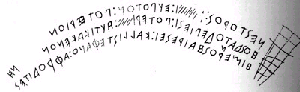
Not one but two amateur poets took a hand in making the brief dedication that adorns the cup. The first of the two offered a mock-heroic blandishment on the object itself —"I am the cup of Nestor, a joy to drink from" (164)—which is, in fact, a direct allusion to Iliad: for Nestor of Pylos owns a marvelous drinking cup so heavy with ornament that only the hero himself can heft it to the tipple. Perhaps the real owner of the cup actually bore the name of Nestor. That would be part of the joke; the other, more important, part has to do with the epic allusion, since the present wineglass is a piece of modest ceramic, making the identification humorously absurd. The second composer has responded to the learned reference of the first with two equally absurd hexameter lines of his own: "Whoever drinks from this cup, straightaway that man the desire of beautiful-crowned Aphrodite will seize" (164). If this were indeed Nestor’s Cup, the second composer jests, then we who drink from it might well be lovers of the goddess. (Right!) Some third party, remarking all this spontaneous felicity, has scratched down the three lines on the cup, thereby immortalizing them; he has even added punctuation―the vertically arranged double dots of the colon used to separate the individual words and to mark the clauses of the iteration. Ronald S. Stroud notes the "lighthearted" character of the diction (Senner, The Origins of Writing 112); he also remarks that the retrograde (right-to-left) inscription is "very competently scratched through the glaze" (112). One might examine the inscription itself to verify Stroud’s assessment. The Nestor Cup tells us not only of the rapidity with which the Greeks mastered alphabetic writing after its appearance but also suggests how inseparable that mastery was from the social milieu in which it occurred.
Consider the phenomenon of the symposium: at the beginning of Plato’s dialogue of that name, we learn that a lively drinking party constituted an event the word of which might persist for many years and provide a kernel of intense curiosity. The unnamed friend of Apollodorus hails him and asks for news about the memorable speeches on love that the dinner guests delivered during the celebration in honor of Agathon’s prize for drama. In his account, at second-hand, of the evening, Apollodorus gives the picture of an intensely social table at which men of the upper classes show off their knowledge of poetry, science, politics, and the arts; at which they indeed compete with one another in a contest of verbal skill and knowledge. The three lines of verse on the Nestor Cup in fact anticipate the richly dialectical character of the sequence of speeches in Plato’s masterpiece. One of the Pithekoussan dinner guests responds to another and completes the enunciation; a third writes it all down. So, too, at Agathon’s house, one speaker follows another, building on the prior speaker’s words, until, based on oral accounts, Apollodorus rehearses it in detail for his friend or Plato writes it all down. As do the encomiasts of the Nestor Cup, the participants in Agathon’s soirée make allusions, bold and subtle, to the heroic cycle, citing the poets and turning allusions into satires on the moment. Coincidentally, Aphrodite is a topic on both occasions. Powell, noting the unusual double lambda in the word καλλίστεφανο (beautifully crowned—just in the middle of the third line), says that it betokens "the inscriber’s sensitivity to metrical requirements" (164). In this we see a demonstration both of Havelock’s claim that the alphabet stimulates an unprecedented awareness of language and of Ong’s claim that literacy alters consciousness.
As in Jaeger’s description, the archaic symposium forecasts the intensification of intellectual life that Plato so vividly posits of its classical successor: the symposium constituted "for Greek men—through its free friendly companionship and its fine intellectual tradition—the capital of the newly conquered realm of individual liberty" (I 129). Jaeger argues that early lyric arises from the good-natured yet erudite versifying over wine and meat in the clubs. Thus "the drinking-song of Alcaeus presupposes a drinking party of his comrades, and a love song or a wedding song of Sappho presupposes the society of young girl-musicians who were her friends" (129). It is important that Jaeger mentions Sappho in this context: it reminds us that the literacy revolution of the archaic cultural flowering was not a patriarchal conspiracy and that women too participated actively in the Zeitgeist. Indeed, as Jaeger puts it, "the marvelous process by which the inner soul of man shapes itself in Aeolic lyric poetry is no less miraculous than the contemporary creation of philosophy and the constitutional state by the Greeks of Asia Minor" (128). One immediately thinks of Sappho’s allusions to and jibes at the Homeric, military ideal of beauty in her best-known lines, "To Anactoria," and of her use in that poem of a complicated “μεν… δε” structure ("not this… but that" or "whereas… and yet") such as occurs also in the logical analyses and philosophical disquisitions of the Pre-Socratics. Sappho’s "not this… but that" is in fact a "neither this, nor this, nor this… but that," and involves backlooping in a way that would not likely occur in a pre-literate, primary oral utterance. Sappho works out a kind of ironic visual punning that depends on the reader’s seeing the name of the god Ares in the word for "excellence," arête. One must infer the concept of war, and the particular allusion to Homer’s account of the hostilities at Troy, from the glancing and entirely optical allusion to the name of the god of battles. In the rise of the alphabet we witness, swiftly, the subversion of the acoustic-mimetic paideia by the literate and philosophical style that finds its paradigm in Plato’s dialogues, to which much later writers like Plutarch or the younger Pliny look back for the model of their own book-based learnedness.
II
There is a paradox in Powell’s assertion, which we are now in a position to resolve, and which has a bearing on the contemporary situation―a meaning, as we shall see, for student prose. As the rehearsal of arguments by Eric Havelock, Walter Ong, and others, shows, the effect of the alphabetic revolution was to create a new medium of thought that swiftly became divorced from the "natural" medium of spoken language and then changed thinking. We see this happening, as the rhetorical display, the toast, on the occasion of the symposium becomes an inscription incised through the glaze of the otherwise unremarkable oenochoe. Yet as Powell says:
Early Greek writing is frankly idiosyncratic in its concern to represent accurately the phonetic elements of speech. (115)
The ancient Greek alphabet was… a rigorous phonetic system. In the archaic period every Greek territory recorded regional variations of pronunciation in its inscriptions and, to a lesser degree, in its local literary tradition… In archaic Greece, a fundamental principle of writing was that the written word should faithfully reflect the way the word was spoken… [The archaic Greek writer] listened with cocked ear to the very sound of words, ever striving to record words just as he heard them. (117)
The social milieu that fosters Greek literacy is not, then, at the time of the "adapter’s" adaptation, literate; it represents, rather, a particularly highly developed instance of primary oral culture, to use Ong’s special lexicon. Initially, alphabetic writing heightened a defining trait of orality―the subject’s keen attunement to the sound of language and to the deportment, to the gestures and facial expressions, of the speaker. The bard, whose salience on the scene alphabetic writing would soon diminish, embodies traditional authority; he is the mimetic teacher whose voice the early didactic poets like Theognis borrowed. The bard, to cite Powell, makes his impression and consolidates his own reputation by "by thinking aloud for his audience, replacing their thoughts with his own" (223). As soon as I transcribe the bard’s words in an accessible manner, however, and can backloop among them, my thoughts begin to take precedence for me over his. But my words too, once I write them down, become vulnerable to a like criticism; I am not immune from this "etic" procedure. Writing does not reinforce a raw subjectivity, but rather reveals the extra-personal objective world in which careful judgment replaces both opinionated ego-assertion and the social demand that everyone conform to the received dispensation. In so doing, it recreates subjectivity in a new form. Self-assessment from an external point of view—seeing one’s own character according to objective criteria—is perhaps the first stage in social analysis and in the critique of the folklore that "everybody knows". If so, it would also be the first stage in the emergence of a new kind of subject who is independent of the mimetic pressure of the acoustic paideia.
The self-directed irony of the Nestor Cup gives evidence of that ability to see oneself clearly that Luria found conspicuously lacking in the illiterates and semi-literates whom he studied in Uzbekistan and Tajikistan between the wars, and that Ong and Havelock remark in their discussions of the transition from orality to literacy. So do the poems of Sappho, Alcaeus, Archilochus, and above all Anacreon. As intellection shifts its interest from the spoken to the written word, its context undergoes alteration: from a purely receptive crowd addressed by a uniquely knowledgeable speaker, there emerges the isometric company of learned enthusiasts whose resentment, channeled into competitive analysis and creativity, preserves and drives onward the cooperative endeavor of revealing the human condition through art, literature, science, and philosophy. The personae in Plato’s Symposium, however we might chide them for their individual flaws, add up to the type of group in question. One cannot think of Greek literacy―one cannot think of any genuine literacy―without such a communitas spiritualis or cultura animi as its context.
One reason why contemporary college students stumble and flail so badly in fronting serious reading or in responding to it in writing is that they have never enjoyed membership in that type of community; nothing in their experience has guided them, by a close mutual pressure, toward refinement or cultivation or endowed them with definite knowledge as opposed to casual lore. They have a group, to be sure. It takes various forms: circles of friendship, cohort affiliations in middle and high school, athletic comradeships (which, however, do not carry over into college although new ones might be established there); but these tend to be overwhelmed by commercially defined associations such as those involving an investment in currently popular music, television shows, and movies. Some students were or are in the marching band, or play a team sport; some went to the same high school; some follow business or education majors. All students are massively assimilated to the great electronic audience of radio, television, the Internet, the compact disc, and the multi-screen cinema located at the mall. None of this―to assert what ought to be a truism but what, in the present climate, must be forcefully reiterated―is literate in the strong sense in which I am using the term in these pages. It is, however, a powerful source of conformism across sex, class, and race among late-adolescents including those bound for college.
A big part of the conformist order among youth is verbal limitation, a confinement to slogans and ready-made "opinions", and indeed a noticeable satisfaction (the peers will not disapprove) in not knowing much beyond one’s casual likes and dislikes. An evasive "whatever" and a shrug of the shoulders is often a student’s response to the request that he consider something in its details or switch, as Luria says, from an existential to a theoretic scheme. Now it was in a context of cultura animi that Heraclitus could assert his claim that "all men should speak clearly and logically and share a body of thought in common, just as the people of a city are under the same laws." This is the obligation that each member of the drinking club places implicitly on every other; the poets undertake a similar incumbency concerning elegance and wit, and the result is a delicious fillip like the one that begins, "I am the Cup of Nestor." The joke depends exactly on the dinner guests sharing the Homeric, the incipiently literate, "body of thought" among them. Sharing it, they can also jest about it with a flippancy hardly imaginable in the sacrosanct domain of the oral/acoustic tradition. They can distance themselves from Homer. This implies, as already suggested, a budding capacity for depersonalized observation and criticism of received lore, such as we find in the ethical dicta of the Presocratics. In addition to defining the condition of articulateness required by civic life, let us remember, Heraclitus also criticized popular culture: he questioned, for example, the esthetics of the Dionysiac rites and wondered about the political acumen of the people. A thinker whose thought partook of Havelock’s "separation of the knower from the known" inherent in alphabetic writing, the Sage of Ephesus could step back from the sensorium and view it from a distance.
We have sampled elsewhere student reaction to Heraclitus’ self-explanatory prescription that "all men should speak clearly and logically," a founding insight of civilization and high culture. The typical student response is again relevant:
This quote reminds me greatly of the thoughts of American culture. We are all taught to think rationally and organized, and be able to share thoughts together without our peers. For example in school we are taught to read and write about a topic, even share these thoughts and be able to except [sic]feed back, positive or negative. I’m more of a rebel with my thoughts and I believe that all men don’t have to speak clearly. Who are we, fellow men to judge who is clear and intelligent and who is not. We should embrace everyone’s thoughts and be able to give feed back whether the person speaks how we do or not. Outlandish thoughts should be accepted too. We are all individuals and our differences are what makes us (the USA) such a great country. We don’t have to have anything in common but we can still live with one another and respect different. I think that we should all have a common ground with the laws of the land, but how would we learn anything new if everyone was the same?
Note first the absence of specific references. The paragraph likely enough represents an honest attempt to respond to Heraclitus’ single sentence, but lacking real knowledge the writer finds it difficult to focus his reaction. The phrase "American culture" (once we extract it from the confusing "thoughts of") either betokens something large and diffuse or it is a pretentious label for the writer’s own limited experience. Mention of the Declaration of Independence or the Constitution would sharpen the discussion, but this would not serve the subjective (the oral) claim that external criteria stymie personal expression. I suspect that the details of our polity simply do not impinge on the student’s awareness, not because he disdains them but because no one has ever taught him either that they exist or what they are. His jingoism and his egocentricity are one and the same. The subjective argument thus takes its root, so to speak, in the student’s very lack of literate knowledge ("cultural literacy", as E. D. Hirsch has named it) and in his non-cognizance of genuinely literary texts and important political documents.
The student’s position is, in a word, without a context. The assertion that "I’m more of a rebel with my thoughts" tells, again, of the oral person taking up his agonistic posture, as does the rhetorical question that follows it. The exordium that "we should embrace everyone’s thoughts and be able to give feedback whether the person speaks how we do or not” represents someone else―the current collective authority―speaking for the student, as the bard spoke for the community in early archaic Greece before the advent of alphabetic writing and literacy. “Feedback” (which the writer’s training has led him, in his term, “to except”) comes as a piece of technical jargon from the electronics of voice and music amplification―an appropriate “neo-oralism”, as one might say. That "we don’t have anything in common" (that we are all absolutely and incommensurably "unique") is another proposition from the existing menu of mandatory postures, and it resonates with the writer’s typical claim to non-pareil status. (He calls himself a "rebel," after all.) Yet the writer cannot by his prose differentiate himself from his peers. This is what makes us wince when he stakes his claim, putting it in the form of a dismissive question, that no one would ever "learn anything new if everyone was [sic] the same," committing the same error of interpretation as three out of four of his classmates. His awkwardness of utterance assimilates him to them, as in the wonderfully insouciant sentence that says, "we are all taught to think rationally and organized, and be able to share thoughts together without our peers." The impossible notion of sharing thoughts together without our peers is hardly unparalleled in contemporary student expression.
One additional characteristic of the paragraph needs attention. Not only does the writer not adhere to any standard (because, as we may surmise, nothing in his K-12 experience ever suggested a standard); he is subtly but aggressively indisposed to standards. That much he has learned. Two of his sentences―“we should embrace everyone’s thoughts and be able to give feed back whether the person speaks how we do or not” and “outlandish thoughts should be accepted too”―sum up the attitude. In sum, the student’s expression is without context. Pragmatically he has taken his ABCs some distance. Purely as a material technique, writing serves him, but it has not become for him a tool of analysis or the entry into a wider intellectual world than the one circumscribed by the folklore of contemporary North American secondary orality. We can guess at the origin of the attitude: he has learned writing as a tool of occasional self-expression, but he is not a reader and therefore not a student of anything, say of grammar or vocabulary, in any meaningful sense. Holders of the doctoral degree might find it difficult to believe, but a literate education, of the kind already available in the time of Plato and increasingly available in middle and later Antiquity, entails a certain capacity for humiliation and a certain willingness to consider novel theses on their own terms before reacting to them intemperately. What I know is as a point compared to what I do not know, as Emerson more or less said, summing up what I take to be the genuinely literate attitude. Just this capacity to sense one’s limitation in comparison to authority, or to an ideal, is visible in the self-irony of the Nestor Cup writers; but that it was or soon became a positive concept, an axiom of learning, is attested by a raft of ancient documents beginning with the Platonic dialogues.
It is often quite touching when Socrates acknowledges an authority, as he does even to Protagoras and to Gorgias, both of whom he roundly criticizes. In the case of Protagoras, there is probably something ironic in such praise, but even then there is probably also something sincere and humble in it. In the case of Gorgias, the kind words about him in Phaedo and other dialogues than the eponymous one suggests that no irony here undermines Socrates’ admiration. He has learned much, Plato’s master says, from Gorgias. We should not take our own condition—of academic rancor and rebuke, of petty egos in even pettier clashes over vanishing flyspecks of significance—as the legitimate model of scholarly discourse or of genteel literate behavior. On the contrary, the existing ethos among scholars in the age of the culture wars all too painfully resembles the untutored rhetorical bristling of the students who react to Heraclitus as though, in recommending reason and clarity, he were guilty of lèse majesté.
What the ancients themselves expected from a literate education we can learn from a number of sources. A particularly good source is that remarkable document of pedagogical theory, psychological insight, and anthropological acumen by a Late Antique follower of Plato, Plutarch’s essay On Listening.
While the ancients, as Ong has pointed out, never quite managed to formulate the speaking/writing dichotomy, an awareness of it is implicit in their discourse, as soon as alphabetic writing appears. Yet because of the rarity of texts, recitation remained the primary medium in Antiquity for apprehending discourse; for many people the auditory and the lectionary were not entirely separate, even though they might have been skilled in writing and habituated to reading. It should not surprise us that there is much—not only the title—in On Listening that reflects the importance of oratory in ancient intellectual life. Plutarch made his living, during the middle decades of his life, as a professional lecturer in Greece and in Italy, visiting Rome at least twice in this capacity. Even the most cursory acquaintance with his work, however, will reveal his strong orientation to the written word. Quotation from ascertainable sources is central to his style. He habitually maintained notebooks into which he entered ideas, notions, quotations, and commonplaces for later consideration or for inclusion in some formal context. On Listening began as a lecture, to be declaimed in the forum, but for publication via the copyist he gave it the form of an admonitory letter to a former pupil, Nicander, just now embarking on the higher phase of his education. In its complexity of construction, in the grammar and syntax of its sentences, On Listening clearly makes its appeal to the eye rather than to the ear. It works within a theoretic scheme and it constitutes an independent setting-forth of the requirements of intellectual receptivity. As such it separates the knowledge that it formulates from the actual presence of him with whom that knowledge has its origin. The sender dispatches his missive, his text as distinct from his speech, at once across a distance and into the future under the assumption that it is sufficient in itself as a plausible argument.
As Oswald Spengler puts it in The Decline of the West, writing symbolizes "the Far". Giambattista Vico reasons similarly in his New Science (1725) when he says that only the developed languages (his generic third stage in the tripartite evolution of language) might be identified with "epistolary", by which "men at a distance... communicate to each other the current needs of their lives" (140). Early languages, argues Vico, confined as they were to "hieroglyphic" expression, remained attached to "poetic style" and concerned themselves with "fables", whereas "rational or philosophic universals" could only appear "through the medium of prose speech" (154). So we might describe Plutarch’s real topic in Spenglerian or Viconian terms as paying attention to or learning to concentrate on something other than an immediately present interlocutor; or even as following an argument—as distinct from following a speaker—in itself, timelessly, and on its own terms. Thus does this heightened attention or concentration entail precisely those mental acts that Ong, Havelock, Powell, and Jaeger attribute to literacy rather than to orality: assessment of logical structures, which can only be accomplished by carefully recalling earlier portions of the speech in connection with the present portion; awareness of plausibility in assertions apart from the character of the speaker; and a deliberate suspension of any emotional reaction to the argument. The discipline of proper listening emerges in Plutarch’s analysis of it as not only epistemological but ethical in its aims: "Proper listening is the foundation of proper living" (50). The primary advice that Plutarch offers Nicander is thus to keep his counsel, to stay quiet, and not to express himself prematurely. Writes Plutarch:
it is noticeable that most people... practice speaking before they have got used to listening, and they think that speaking [as opposed to listening] takes study and care, but benefit will accrue from even a careless approach to listening. It may be the case that in ball games, learning to throw and learning to catch the ball are simultaneous, but in dealing with speech proper receptivity is prior to delivery, just as conception and pregnancy precede the birth of viable offspring. (29-30).
Listening belongs to "the divine leadership of reason" (29) and to "philosophy" (30). Not to be informed by "rational discourse" (29) means to remain a natural person moved by impulses and appetites rather than by "external tendencies implanted by words" (29). Only "good arguments" can chasten and tame "nature" (29). Plutarch thinks of language in remarkably modern terms, as a system related to the civic order. Through language, reason (λóγος) makes itself known. Of course, not every instance of language corresponds to an instance of reason; there is much useless palaver. Those who have not learned to contemplate meritorious speeches quietly, rehearsing the arguments to find the syllogisms and testing whether the premises are valid, run the risk of being taken in by easy talk: "if they come across anyone with a story to tell about a dinner party or a procession or a dream or a slanging match he had with someone, they listen in silence and cannot get enough" (30). Note that Plutarch makes the same criticism of idle chatter that defenders of literacy in a modern context have been making about television and so-called popular culture since the middle of the last century. Says Plutarch of those same untrained youths, "if someone attracts their attention and gives them some beneficial instruction or necessary advice... [they] become impatient and, if they can, they make a contest out of it, resist his words and try to argue him down" (30). A contemporary example of the same impetuous behavior is the common student response to Heraclitus, the one that characteristically reverts to the rhetorical ploy of asking, who is he to posit criteria? The implication is that criteria, even the grammar rules of orderly speech, always constitute the oppression of the complaining subject.
Plutarch’s contentions on these matters resonate with Sandra Stotsky’s criticisms of modern writing curricula for the secondary schools. These are the curricula which most decisively shape the concept that students have of written exposition. In Losing our Language (1999), Stotsky notes the emphasis placed on expressive or personal writing in high school English programs:
Certainly, personal writing may be useful to get students started as writers, and there are volumes of anecdotal accounts by teachers detailing their successes in using personal, or experience-based, writing to motivate beginning or reluctant writers. The value of personal writing has long been an article of faith among English teachers at all educational levels, but in my exhaustive review of research studies, I found no evidence that could contribute to the pedestal on which personal writing has been placed. As a frequent practice, it may well promote self-centered thinking and limit students’ capacity to understand abstract concepts from a more analytic or distanced perspective. (270)
Recently, Stanley Fish made a similar argument, in even more forceful terms than Stotsky’s. As for Stotsky, her invocation of "distance" links her analysis to those of Ong and Havelock, as well as to the case for what we might call non-expression as a condition of intellectual development being made by Plutarch. Expression is simply not a discipline; it is, rather, a natural propensity that requires training and as such gets badly in the way of tuition, as Plutarch shows. The pity in the predominance of the expressive model in secondary the writing curriculum is that even a little tuition soon inclines the student into "aiming at truth rather than winning an argument" (31), in Plutarch’s words. As Ong says, with reference to Luria, "it takes only a moderate degree of literacy to make a tremendous difference in thought processes" (Orality and Literacy 50).
An extended paragraph-sequence in On Listening examines in detail how envy and resentment, two strong emotions, prevent the assimilation of just advice and hinder the acquisition of objective knowledge as against untested opinions. Holding one’s tongue, one of the disciplines that Plutarch recommends to Nicander, aims at suppressing invidious reactions to persuasive arguments that irritate the natural person precisely because of their integrity and stylishness. The exchanges of purely oral people, which tend toward the egocentric and rancorous, cannot tolerate silent pauses, for to indulge in one would give the impression that the tacit party has conceded the contest to his opponent. There is no time, in oral contestation, to meditate on significations and tropes. Only with the silence that imitates the mute character of the letters does the space for a philosophical apprehension of words at last open. In a related essay, How to Study Poetry, Plutarch affirms the value of a literary curriculum to intellectual development provided that it concerns itself not only with story and image but with grammar, etymology, and what a later age would call the semantics of the poem. When teachers guide their students through the poets, Plutarch urges, they should take care to make them attend to γλώτται, "glosses" (117), or nuances. Words take on slightly different meanings or connotations in different contexts: they can have "one signification at one time, and at another time... another" and a learned connoisseur of poems will thus "observe closely this distinction and discrimination of words" (119). The student will not acquire this capacity for detecting nuances immediately; the acquisition will rest on many a layered foundation, beginning with the child’s abecedary and progressing through the adolescent’s exercises in grammar, vocabulary, and the accessible classics.
Cynthia Ozick discusses these requirements in her essay on "The Return to Aural Culture" (from which I have already quoted) when she describes a classroom anthology used in the New York City Public Schools early in the twentieth century when her grandmother attended them: "Nine tenths of this inventive book is an anthology engaging in its richness, range, and ambition" (Washburn and Thornton 81). Ozick lists some of the contents:
"Lochinvar" is here; so are the Declaration of Independence and selections from Shakespeare; so is Shelley’s "To A Skylark"; so is the whole "Star Spangled Banner." But also: "Description of a Bee Hunt," "Creation a Continuous Work," "The Sahara," "Anglo-Saxon and Norman French," "Conversation," "Progress of Civilization," "Effects of Machinery," "On the Choice of Books," "Our Indebtedness to the Greeks," "Animal Heat," "Corruptions of Language," "Jerusalem from the Mount of Olives," "On the Act of Habeas Corpus," "Individual Character," "Going up in a Balloon," and dozens of other essays. Among the writers: Dickens, Macaulay, Wordsworth, Irving, Mark Twain, Emerson, Channing, John Stuart Mill, Carlyle, De Quincey, Tennyson, Mirabeau, and so on and so on. (81)
The curriculum that at last produces the young person able to gloss demanding poems with expertise (and to achieve cadence in his own sentences) will necessarily be rich in a carefully graduated literature.
As for Plutarch’s own massive literacy, on which I have already remarked, classicist C. J. Gianakaris writes that throughout his life,
as a matter of course, [Plutarch] continued to take notes on his observations from books or life itself. The result was countless well-stocked notebooks from which to draw. Though he possessed an excellent memory, Plutarch at the same time shows few signs of relying solely upon his recollections. Instead, wherever he found the opportunity, he read and consulted books, taking down specific details or quotations which later were to appear in his works. (Plutarch 80)
As a tutor, Plutarch presumably encouraged his students to do the same. He no doubt maintained a private library in his home at Chaeronea and engaged in the borrowing and lending of books, or the commissioning of copies for friends, such as we read about, for example, in the letters of his Latin contemporary Seneca: "The book you promised me has come... It was a joy, not just a pleasure, to read it" (Letters from a Stoic 89). Every element of Plutarch’s acumen, or Seneca’s, stems from lifelong inveterate and morally dedicated reading. Such acumen did not exist prior to alphabetic writing and the literacy, rooted in prose, that the alphabet generated.
Should literacy cease to exist, a similar acumen would become impossible; consciousness would contract and the human universe, as the poet Charles Olson called it, would become less subtle and less clear.
III
When I asked my composition students in the Fall of 2002 to write down the titles of the last ten books they had read, excluding currently assigned textbooks but including items that they might have read in high school, most could not list more than three or four. One of them joked—and I took it for a positive sign, a germ of incipient irony—that no one reads textbooks anyway. Only a few literary titles featured in the response, while most of the rest I take to be journalism or popular, perhaps adolescent, fiction. Four students, none of whom could name more than four books, listed Harper Lee’s To Kill a Mockingbird. Three listed F. Scott Fitzgerald’s The Great Gatsby. Three listed John Steinbeck’s Of Mice and Men. Two listed Alice Walker’s The Color Purple. One student each listed Shakespeare’s Macbeth and his Hamilet [sic] and his Romeo and Juliet, Crane’s Red Badge of Courage, Austen’s Pride and Prejudice, Wright’s Native Son, Hemingway’s The Old Man and the Sea, Hawthorne’s Scarlet Letter, Sophocles’ Antigone, and Williams’ A Streetcar Named Desire. Other titles mentioned, usually by one student, are: My Darling/My Hamburger, The Cheese Stands Alone, Interview with the Vampire, True to the Game, Sittin’ in the Front Pew, The Elf Queen of Shannari, Frankinstein [sic], I Know Why the Cage [sic] Bird Sings, When Bad Things Happen to Good People, Chicken Soup for the College Soul, Summer Sisters, Men are from Mars and Women are from Venus, and The Things They Carried. Not only does the list fail to signify "a body of thought in common," as Heraclitus recommends, but it suggests that such reading as students do manage is desultory. While Jane Austen and Stephen Crane are respectable, it is still shocking that each represents a student’s total literary recollection. How much does Pride and Prejudice mean when one is eighteen or nineteen years old and it is the sole serious book that one has read? The list also defines, in its negative way, the lack of context that I earlier posited as characterizing the student’s response to Heraclitus when it came under scrutiny in the foregoing section. My word processor insists that there is no such entry in English as "contextless" or "contextlessness", and keeps marking my diction ominously in red, but I fear that some such coinage is required.
Fifteen years ago, in What do our 17-Year-Olds Know, Diane Ravitch and Chester E. Finn, Jr., wrote of "the poor performance of many students on simple questions of general knowledge, such as those drawn from biblical or mythological literature" (201). It seemed to Ravitch and Finn then that "movies and television", rather than literature, constituted the cultural experience that students shared. They concluded that while "American 17-year-olds are [not] stupid, that they are [not] apathetic, or... short on savvy, creativity, and energy" their cohort was nevertheless "ignorant of important things that it should know, and that it and generations to follow are at risk of being gravely handicapped by that ignorance upon entry into adulthood, citizenship, and parenthood" (201).
What kind of prose do students write whose sole reading is My Darling/My Hamburger or When Bad Things Happen to Good People—or even Hamilet? My Fall 2002 composition students, the same students who listed their meager readings, responded in writing to Plutarch’s On Listening and to one of its companion essays, On Contentment. Because Plutarch always argues his case articulately, with plenty of illustrations, the student responses necessarily acquire some minimal form on their own; in Plutarch’s essays they begin to share in body of literate thought held in common with someone. These are some of the ways in which quality reading is related causally to competent prose. Even so, incoherency remains a problem:
Plutarch argues that envy plays a big roll in listening skills. Envy that’s a strong word, it means a lot of stuff. But the definition that I would use in this case will be "hating". Envy means to hate. When you envy somebody you tend to have a disgrace for that person. When you envy somebody, everything they do looks wrong to you, or you would always tend to say I could do it better. Individuals lack to see beneficial stuff from that person, envy blocks your mind, all your eyes will see and all your mouth will comment would be negative stuff, all you would be able to do in that stage is critize [sic], interrupted that person, ask question that have nothing to do with that person. This envy issue, is really common, is just like in school there are certain classes which are beneficial to the students, but we call them boring classes and what students tend to do is act childless [sic] or if the teacher is a well-educated person and speaks in a sophisticated way, an educated level, students tend to hate that fact and that’s when envy takes over and takes over your good listening skill.
The first sentence gives an impression of competency, but does not originate with the student writer. I provided the class with a printed list of attributive phrases that they might want to use in ascribing claims, and "Plutarch argues that..." was one of them. This is not a complaint: when students possess so little in the way of literate vocabulary or grammar, they need whatever they can get. The breakdown in articulation begins with the substitution of "roll" for role, one of those cases where orthographic unfamiliarity with one of two homophonic terms creates the assumption that the known spelling covers both meanings. Or is the other meaning as unknown as its spelling? This is possibly so. The ubiquity of the term rock and roll, I would imagine, causes the spelling r-o-l-l to be the familiar one. The word "stuff," which turns up three times in the paragraph ("a lot of stuff", "beneficial stuff", and "negative stuff"), is a colloquialism and, as such, provides more evidence for my running contention that students operate in the oral mentality described by the researchers rather than in a genuinely literate mentality. The "I" in the third and the "you" in the fifth sentence establish the poles of spoken dialogue. This too tells us that the writer thinks of writing as a making visible of what one says rather than as something independent of persons. He can expose an argument only by imagining it as a tête-à-tête between the ego and an alter who is, however, not actually present. The discussion of envy and boredom in the final sequence, although marred in diction and grammar ("students tend to act childless"), shows some promise. It is almost an instance of reflection as self-criticism, except that the writer at last cannot take the analytical burden on himself but, rather, transfers it to his alter: "envy takes over your good listening skill."
Stotsky writes that "an overabundance of personal writing assignments may... reduce students’ experience with informational writing and the modes of reasoning and organization it calls forth" (Losing our Language 270). Indeed, the "paragraph" cited above is really a snippet from the middle of two-and-a-half un-paragraphed pages of similar character; it attains articulation only with it makes contact with Plutarch’s text, whereupon it invariably returns to the form of a vast run-on sentence in the first person. It is expression with a vengeance but it is not prose. Another response seems slightly better controlled, but manages to be incoherent in a like way:
In Plutarch’s essay On Listening he talks about how there is a right way and a wrong way of listening. Good listening can be interfered by loud noises such as crashing, clattering, and booming sounds. If you hear noises that distract you from listening to what is being said to you then you are listening the wrong way. Another wrong way to listen is to start listening to someone and then stop them to argue over what they are telling you.
Good listening goes along with being courteous to others in their presence. The correct way of listening doesn’t even involve another human being speaking but listening to their body language...
Luria and Ong argue that the oral person always addresses an external "sensorium", some aspect of the environment that impinges forcibly on an essentially passive consciousness. The writer’s misinterpretation—his inevitable misinterpretation—of Plutarch’s case stems from an inability to grasp that the Greek’s proper listening must derive from an inner determination: the writer can only imagine that "loud noises" from without disrupt careful attention. This absence of any intuition about the interiority of consciousness leads to the logically untenable assertion that "if you hear noises that distract you from listening… [,] then you are listening in the wrong way." The follow-up claim that "the correct way of listening doesn’t even involve another human being speaking but listening to their body language" likewise indicates an oral disposition like the one described in Luria’s work or Ong’s—more dramatically, perhaps, in Havelock’s—where bodily comportment, which subsumes the whole of the sensorium when the speaker carries a sufficient charge of charisma for his audience, conveys a mute authority stronger than any specific words. The mimetic-acoustic paideia, as Havelock notes, was heavily gymnastic and choreographic. I am not saying that the writer does not think. I only say that he thinks orally. He is, in fact, remarkably candid about his thought processes: Plutarch "talks" about attentive auditing; in order to understand Plutarch’s essay, the writer imagines it as an interlocutor who speaks. To the writer’s credit, however, is the observation that proper listening, in Plutarch’s scheme, maintains an intimate connection with the protocols of courtesy; his phrase, "being courteous to others in their presence," indeed suggests the germ of elegance, although it is closely modeled on a sentence from On Listening and might more honestly have been placed in quotation marks. Note finally the writer’s insistent references to singular subjects by the third person plural they or their. This is pandemic in contemporary student prose, but one also reads it in journalism and hears it in broadcasting and in public speaking. Does it portend any significance?
The use of they for he, she, or it belongs at the very least to the pronounced reluctance of students, in their writing as in their banter, to stick to the subject. I mean this at one level grammatically. Students might begin a sentence with a person, switch to the plural they or their in the next clause, and then refer everything to the generic second-person of their prose, that ubiquitous you. Yet the defective grammar almost certainly points to something deeper: the subject of the iteration slips and slides in the sentence because it slips and slides in the student’s thought; there is no gap between conception and articulation—the articulation reflects what takes place in the student’s mind as he tries to come to terms with a topic. Prose is topic-oriented, linear, single-minded in its focus, but oral language follows an associative rule. The arbitrary shifting among subjects and persons reflects the difficulty that students have in making predications, as we have observed elsewhere. They and you constitute members of the group that the student hopes will do his thinking for him, just as the bard does for the community in Powell’s description of Archaic society in Sixth Century B.C. Athens. Third-person singular subjects regularly geminate into third-person plural pronouns because in the world of oral people, no one ever does anything originally or spontaneously or on his own. All deeds take their pattern from collective behavior and find legitimacy only as vetted by the group, which is always present, at least to imagination. The one is many and the many are one. For example: "Being envious of a good speaker is something that a person should not let overcome their self... they should relax and listen carefully and they could learn how to speak." Here the moment of "morphing" is apparent—in the solecism "their self"—after which "a person" has geminated into the omnipresent and irrepressibly plural "they".
Another example is this one: "It doesn’t matter what that person situation he gives you advice on how to increase your listening skills." (The "he" is Plutarch.) A more skilful (a more literate) writer would note that whatever a person’s situation, Plutarch nevertheless has good advice for him. Such a sentence would predicate of the generic person a need for careful instruction in the method of listening. It is quite possible to imagine a non-expressive, a reflective, first-person version of the same competent sentence: I thought I knew how to listen, but Plutarch’s essay taught me that I hadn’t fully considered it. Observe how the student writer passes the need for edification to the imaginary alter who seems always to hover over his words. The grammatically defective construction "their self" is interesting in another way: in its possessive connotation it strongly suggests that the individual belongs to the collective; the one is always subservient to and dependent on the many. Should the one take a stand on his own, he will become too conspicuous for comfort. If this were true, it would help explain the deep reluctance of students to venture independent analysis. Not only do they find it difficult, for all the reasons previously adduced, to establish cause and effect or unfold the nuances of an implication, but they fear the distinction in so doing, since autonomous positions are, by definition, not already vetted by the majority.
Often when a student appears to have gleaned something from the reading and would report it, grammatical deficiencies and a poor vocabulary get in the way:
One of the greatest things that people misunderstand is that listening is important in any situation. Plutarch believes that people in their way cannot and will not stop certain things from really listening. Some of those things will include your own opinions and ideas that might have effect on what the speaker is trying to tell you. If the speaker contradicts to what you believe his speech will be in vain because his words will fall on a death ear. Another thing that might get in the way of good listening is when a speaker is praised by the audience to much, this praise has a negative affect on him and this will make the speaker loose the train of thought and might ruin the whole ordeal.
This writer adds that "a good listener will have to have good ability to portrait what you think of what was said... and this is done by facial expirations, bowing of head, or just approving mutters." The diction problems stem from hearing words rather than reading them. We thus get "a death ear" and "facial expirations". Those latter no doubt lead to the former. The shift to the second person in the third and fourth sentences links this sample to the others and demonstrates how consistent the pattern is. When the writer asserts that "people... cannot... stop certain things from really listening," only a charity exceeding the pedagogical will grant him a point. That he must have been thinking toward a thought, let us admit; but as "things" do not listen, the point eludes us. The failure is not simply a failure of writing, either, but, in the first place, of reading. Plain statements have eluded the student, ones no more difficult than those that Cynthia Ozick’s new-to-English grandmother must have understood when she was in the eighth grade. He has not gleaned Plutarch’s thesis that a lack of training and a susceptibility to emotion get in the way of understanding. If we scanned backward from the next sentence, we might suspect that the writer is reporting Plutarch’s claim that the naivety and prejudice of untrained people ("your opinions") diminish their capacity to grasp a discussion; the subsequent sentence suggests something similar. Ong writes of the way in which speakers cast about for the adequate phrase. That is what is happening here, as the student tries to resolve a meaning that for a variety of reasons remains beyond his ken. Writers also cast about for the proper words, and when they do it is a means of understanding, but the genuinely literate ones edit the text to elide the experimentation. Students always assert that they have edited and rewritten, but I rarely see any sign of it. When I insist on revision and supervise the effort, small changes occur, but adjusting the pronouns to the subject in one sentence, for example, does not necessarily lead to spontaneous adjustments of the same type in subsequent sentences.
The conclusion forces itself: when they arrive in college, these students do not possess the concepts that attach to literacy, among which one of the most important is the concept of consistency, without which there is neither grammar nor style. The ethos of revision, so prominent in the high school and college writing curricula, seems to me to miss the point. For individuals who have mastered grammar, who have harvested a cornucopia of vocabulary from years of reading, and who therefore also have a magazine of references, revision should be a matter of minor adjustment and polishing, not of extensive rewriting. The ethos of revision entails the postponement of real writing and probably gets in the way of good writing, insofar as good writing comes from genuinely literate people, whose defining characteristic is their inveterate quality reading.
The discontinuity in student prose reflects the discontinuity in student reading. On the back cover of the Penguin edition of Plutarch’s essays, this sentence appears: "Born at the very heart of Greece—between Athens and Apollo’s shrine at Delphi in the mid-40s of the first century AD, Plutarch combined an intense love of his locality and family with a cosmopolitan outlook that embraced the whole Roman Empire." In a student essay this becomes: "Plutarch is a Greek writer that lived in the mid 40’s of the first century AD. He was born in Greece which is between Athens and Apollo’s shrine." In conversation, the student who wrote this sentence shows no sign of mental dimness; his repartee gives evidence of a native wit. Sadly, the same student can quote Plutarch verbatim and then fail to interpret accurately what he has quoted:
Plutarch talks about how it is not good to admire people. He says this "Admiration is the opposite of contempt, and it is, of course, a sign of a more reasonable and equal nature; all the same, it too needs quite a lot of caution, and perhaps even more." This quite [sic] tells that it is ok to admire people but don’t look up to them to much because then when [they?] are teaching people mitt believe them and it is not the truth sometimes.
The attribution to Plutarch that he urges it as "not good to admire people" glosses the quotation. The quotation, of course, calls admiration "the sign of a... reasonable and equable nature" which "all the same... needs quite a lot of caution." The failure of interpretation consists in the student’s inability to detect nuance. By all means admire those who deserve it, Plutarch says, but do so with caution. One might guess that the final sentence of the paragraph assimilates the nuance except that the idea of nuance is so greatly at odds with the awkwardness of the sentence, with its lack of punctuation, its misspellings, and its run-on character. Even granting that the student has seen Plutarch’s point more or less clearly, the first and last sentences would still be mutually incompatible. The writer retains both—it might serve for a textbook case of not backlooping—and one might plausibly propose that he feels no discomfort in doing so. That it really is a reading problem one can tell from the student’s erroneous transcription of the quoted sentence, where Plutarch (or rather his translator) uses "equable" but the student puts "equal." Probably equable lacks an entry in his vocabulary, even in his recognition vocabulary, so that the eye sees it, not in its own characters, but under the guise of the familiar term, equal. The so-called look-say method of reading instruction in the primary grades might likewise be at work here. Asked to read aloud, the student proceeds haltingly and simply cannot pronounce some words. On his list of recently read books, this student put only one title, The Things They Carried, not a book at all but a short story by Tim O’Brien widely published in contemporary high school anthologies.
One exceptional student turned in a list of recent readings that suggested both personal ambition and acculturation in a milieu that must have valued literature. His schedule includes Tolstoy’s War and Peace (which on casual examination he seemed really to have read), Dostoevsky’s Notes from Underground, Poe’s The Narrative of Arthur Gordon Pym, Bradbury’s Fahrenheit 451, Melville’s Typee, Camus’s The Myth of Sysiphus, Conrad’s Heart of Darkness, Thoreau’s Walden, along with many titles by popular and contemporary authors such as John Grisham and Kim Stanley Robinson (who has written a massive Mars trilogy, which I can avow is complex, literate, and full of educated lore). How does this student do in responding to Plutarch?
The thesis of Plutarch’s On Listening is that learning how to listen effectively will improve one’s life in numerous ways. As humans, our emotions can easily control the direction of our life. Unfortunately, our emotions are often ill advisors, and so we must learn to gain control of them if we are to improve our lives.
One way for a person to control his emotions is through rational arguments. An important result of learning proper listening skills is the ability to form rational arguments. Rational arguments teach us how to analyze a situation, and maximize it’s benefits, while minimizing it’s losses. "Proper listening is the foundation of proper living," says Plutarch.
The first thing to remark is the refreshing refusal of "a person", at the beginning of the second paragraph, to geminate in a plural they. The quotation at the end of the second paragraph for its part reveals a great deal, for it is the last sentence of Plutarch’s essay. This writer—who qualifies also as a reader—has performed the considerable feat, when compared with his peers, of backlooping from the conclusion of Plutarch’s On Listening to its beginning and of seeing that the essay constitutes a whole, rather than merely a sequence of unrelated paragraphs. His first sentence condenses the many examples that Plutarch gives of how learning to listen carefully enhances other aspects of life; other students laboriously rehearse them, instance by instance, often getting the details wrong. The student later writes that "to learn how to use rational arguments, one must first learn to listen, for if one cannot listen effectively, then one cannot form a rational argument." This encapsulates Plutarch’s hermeneutics of learning: logic is an external force which cannot transform the mind until the mind allows it to enter; the prelude to transformation is owning up to one’s naivety and submitting quietly to instruction. There are a few mistakes (it’s for its and ill advisor rather than bad advisor), but again no other student grasps the point so succinctly; no other student integrates quotations from Plutarch so competently, if not quite elegantly. While not wanting to overstate the case, I nevertheless believe that one of Jaeger’s remarks on the Archaic poets has a bearing on this student’s prose. Writing of "Archilochus and poets of his type," Jaeger says that "personality, for the Greeks, gains its liberty and its consciousness of selfhood not by abandoning itself to subjective thought and feeling, but by making itself an objective thing; and, as it realizes that it is a separate world opposed to the external law, it discovers its own inner laws" (Paideia I 114).
IV
A deficit of Jaeger’s "inner laws", one directly linked to the sorry fact that young people do not read, dogs untutored students in their struggle for written articulation; lamed in the hamstrings of their literacy, they stumble and fall. Something else dogs the commentator who would write about the decline of literacy. It is truism. This is the case because the chief cause of the literacy disaster looms so obviously in any analysis and has for many decades. The iconography of mass entertainment—not exactly orality as Ong or Havelock means it, but certainly not literacy either—has seduced the Western consciousness away from the dual basis, alphabetic literacy and cultura animi, of its own achievements. One feels something close to embarrassment in saying so, in pointing to popular culture as the culprit, as if one were to recommend the "Blue Danube" waltz for its lilting melody or the Mona Lisa for her smile. One invites a depleted everybody knows that! Perhaps the way to animate once again the too familiar case is to show how belated the famous authors of it, MacLuhan in the 1960s or Postman in the 1980s or Birkerts in the 1990s, really are.
As early as 1929, in his Creative Understanding, Count Hermann Keyserling wrote of the then burgeoning movie business that its triumph stemmed from
the fact that, looking at the living motion-picture implies real and absolute relaxation. When reading the most inane of books one is compelled to think, however little; every theatrical performance forces the spectator into its three-dimensional field of forces; but the movies can be enjoyed with hardly any personal brain activity. What one experiences here resembles the process of dreaming... it renders mental activity superfluous to an unheard-of degree... The other day, a company applied to me asking my permission to make a motion picture of my Travel Diary. I should almost have liked to acquiesce from sheer curiosity. It was clear to me at once what it was all about: the plan was to make easier the comprehension of my book. (75-76).
Intellectually, North Americans in particular have now enjoyed fifty or sixty years of "absolute relaxation" in the fluid imagery of mass entertainment with its ever easier understanding. Keyserling dubs his age as an "epoch of liquidation" (77), in which the accumulated lore of centuries simply ceases to be of interest to those who might otherwise inherit it. His summary of the modern classroom sounds as though it had been written by Heather MacDonald in one of her (eminently recommendable) critiques of post-modern pedagogy for the neo-conservative City Journal. As soon as the grand détente of the mind occurs, the latest cohort is suddenly unable to rise to the scholastic measures matched by the previous generation. They are too much conditioned by the ubiquitous passivity. Then "in order to address unprepared audiences in the appropriate way, the teachers must retrench not only the demands they make upon their audience, but also the demands they wish to satisfy" (78). As swiftly as one-two-three, the unschooled mass has brought the whole educational apparatus "down to its level" (78).
Some fifty-five years before Keyserling made his observations about the dumbing-down of culture, as we now call it, the then seven-and-a-half-year-old Herbert George ("H. G.") Wells broke his leg, whereupon "for some weeks," as he says, "I found myself enthroned on the sofa in the parlour... and I could demand and have a fair chance of getting anything that came into my head, books, paper, pencils, and toys—and particularly books" (Experiment in Autobiography 53). The intellectual awakening that would lead to over a hundred published novels and non-fiction books arose directly, as Wells argues in his own cause, from the enforced leisure of that childish invalid’s couch in Atlas house, the family home. Although poverty reigned there (Wells père worked as a cricket and bowling "pro" and Wells mère as a lady’s maid), books of a kind held something of a place in the milieu. Sarah Wells, an ardent Methodist, brought in many religious tracts which at least made arguments of a kind and quoted sources, mainly the Bible. Joseph Wells read the newspapers and liked books of facts—geographies and natural histories. "I had just taken to reading," Wells writes; "I had just discovered the art of leaving my body to sit impassive in a crumpled up attitude in a chair or on a sofa, while I wandered over the hills and far away in novel company and new scenes" (53-54). It is the Spenglerian literate "Far" again. The father’s presence manifests itself noticeably in some of Wells’ recollections of that earliest conscious reading: "bound volumes of Punch, and its rival in those days, Fun, which my father renewed continually during my convalescence" (55).
A little later, the usual boyish taste appears, and Wells mentions "Fennimore Cooper and the Wild West generally" (55) as fixing him for a while in their magnetic field of fascination. His being a reader helped Wells to extract an education from the less than adequate schools that he describes in rather generous and understanding terms in his memoir, where most of the curriculum seems have consisted in book-keeping drill for the making of shop clerks. Of schoolmaster Morley, Wells guesses, "I do not think he read much" (66). His own reading habit Wells insists that he "developed at home", and he has no inkling "that Morley ever directed [his] attention to any book" (66). The pedagogue would nevertheless now and then "get excited by his morning paper and then we would have a discourse on the geography of the Northwest Frontier with an appeal to a decaying yellow map of Asia that hung on the wall, or we would follow the search for Livingstone by Stanley in Darkest Africa" (66).
When Wells was in his teens, his father suffered a fractured leg and became a cripple, his hope (far fetched, perhaps) for making a posh living as a cricketer and bowler going all awiddershins with the bone. A complicated providence enabled Sarah to keep the family from the poor barracks by going back into service. A manor house, Up Park, had been inherited by an old employer, who promptly put her in charge of the maintenance and scullery. Wells spent a good deal of time at Up Park and enjoyed, among other privileges, the freedom of a deserted attic and the use of the otherwise disused library. In the attic, Wells lucked upon "several great volumes of engravings of the Vatican paintings of Raphael and Michelangelo," and he spent many solitary hours studying "the mighty loveliness of these saints and sibyls and gods and goddesses" (106). He also dug out a Georgian telescope in brass, which he set up in his customary room. Once, his mother stole on him "in the small hours, my bedroom window wide open, inspecting the craters of the moon" (106). Of the library, Wells says:
Sir Harry Fetherstonhaugh [the deceased lord of the manor], like many of his class and time, had been a free-thinker, and the rooms downstairs abounded in bold and enlightening books. I was allowed to borrow volumes and carry them off to my room. Then or later, I cannot now recall when, I read such books as Vathek and Rasselas, I nibbled at Tom Paine, I devoured an unexpurgated Gulliver’s Travels and I found Plato’s Republic. This last was a very releasing book for my mind. I had learnt the trick of mocking at law and custom from Uncle Williams and, if anything, I had improved upon it and added caricature to quaint words, but here was something to carry me beyond mockery. Here was the amazing and heartening suggestion that the whole fabric of law, custom and worship, which seemed so invincibly established, might be cast into the melting pot and made anew. (106-107)
Plato (and all the rest of that reading, no doubt) transformed the young Bertie from a smarmy adolescent into an incipient thinker. The details of the transformation can be telling.
None other than Plutarch’s analysis of how carefully to pay attention, in his On Listening, comes forcibly to mind when Wells describes how the social and psychological acumen of Plato’s thought in The Republic, even while it inclined him toward a rationally revolutionary posture, also later enabled him quickly to see the irrational, or sub-rational, strain in the ascendant species of antinomian social and political doctrine. It might be Plato himself denouncing sophism when Wells says that "Marx offered to the cheapest and basest of human impulses the poses of a pretentious philosophy, and the active minds amidst the distressed masses fell to him very readily" (143). Plato’s dialogues, with their complex arguments and dramatically envisioned give-and-take among competing positions and divergent analyses, had inoculated Wells against second-rate dialectic.
The Wells of 1934 remembers the feeling of "tremendous significance" (140) that inhered for his youthful forerunner in the green leather-bound one-volume edition of the dialogues that he took with him day by day to read "lying on the grass slope before a little artificial ruined tower that, in the spirit of the eighteenth century, adorned the brow of the Up Park Down, overlooking Harting" (140). The edition, Wells importantly adds, contained no introductory or analytical apparatus. He had to puzzle it out on his own. Plato at fourteen prepared Wells later on for "Goethe and Carlyle, Shelley and Tennyson, Shakespeare, Dryden, Milton, Pope—or again Buddha, Mahomet and Confucius" (194). Wells chooses resonant words when he describes his year as a student in zoology and biology under Julian Huxley, who brought to his teaching and infused his students with an "urgency for coherence and consistency" and a "repugnance from haphazard assumptions and arbitrary statements," which together, Wells says, essentially distinguish "the educated from the uneducated mind" (161). This might be Havelock describing the criteria of the new literate epistemology being articulated by Socrates and Plato in Fifth Century B. C. Athens. While studying zoology and biology, however, Wells by his own admission spent a good deal more time in the art and literature than in the science libraries. Carlyle’s French Revolution and Blake’s prophetic books had battened on his imagination. If the "riddles of Blake" (161) appeared beckoningly before him at this time, so did the mysteries of the city where he lived, London. Wells spent his eighteenth, nineteenth, and twentieth years studying London like a book.
Colin Wilson, another British writer and one who has much in common with Wells, tells another, but similar, story about the indissoluble link between reading and intellectual awakening. Like Wells, Wilson was born to poverty, in depression-ridden Leicester in 1931. Wilson’s father worked, when work came available, in a boot factory, but frequently had to endure unemployment; his mother stayed at home raising three children, of whom Colin was the youngest. Wilson associates little in the way of reading with either his mother or his father, but certain uncles and aunts who lived close by were readers, and so was one of the grandfathers. In the "Autobiographical Introduction" to Religion and the Rebel (1957), his second book, Wilson writes how, "when I was eleven years old, my grandfather gave me a tattered and coverless science fiction magazine" (6). The stories pricked Wilson’s imagination, as did the repeated references to Albert Einstein:
I had never read anything like it. Compared to boys’ papers and comics, it was recondite and intellectual. And one had a feeling of far off more serious issues at stake than in stories about football games and ragging in the Lower Fourth. ("Yarroo, you rotter! I’ll tell old Quelchy!") There was talk about positrons and cyclotrons and the theory of probability. Not to mention professor Einstein.
I found Einstein’s own little volume, Relativity: the Special and General Theory, and consciously plugged away at it, skipping the mathematics and wondering what the devil he meant by "orientation." But Sir James Jeans was easier; his explanation of the Michelson-Morley experiment simplified everything. (6-7)
Jeans and Eddington’s The Mysterious Universe Wilson holds responsible for his "sudden mental awakening at the age of twelve" (7). The speculative, or cosmological, passages especially "produced a sense of mystery that was so intolerable to me that I once wrote a twenty-page letter to Sir Arthur Eddington, asking him if he could please explain to me what the universe was all about" (7). By twists and turns of bibliographical association in the local lending library, Wilson peregrinated from Jeans and Eddington to Freud, Adler, and Jung, from them to Wells’ Outline of History, from Wells to Shaw, and obsessively wherever any of these pointed him. By his mid-teens, Wilson had progressed to Nietzsche’s Zarathustra, James’ The Varieties of Religious Experience, Eliot’s poetry—Ibsen, Pirandello, Joyce, Chekov, Saltykov, Goncharov. The list quickly becomes enormous. "I remember how," Wilson writes, "I discovered the Tao Te Ching in a compilation called The Bible of the World" (17). Next came Berkeley and Hume.
For reasons economic and proto-philosophical, Wilson dropped out of high school at seventeen, worked in dead-end jobs as irritating as those that irked Wells, went in and out of national service in the Royal Air Force, and ended up the British equivalent of a beatnick in the shabby, economically sour London of the early 1950s. His syllabus on coming out of national service consisted of "Herrick, Rabelais, Boccaccio, Blake" (21) and the Baghavad Gita. In London, with the Reading Room of the British Museum at hand, not to mention the second hand book shops, Wilson devoured books voraciously and began to make the notes that would become his first book, The Outsider (1956). During part of this time, he actually lived in a waterproof sleeping bag on Hampstead Heath, spending his days in the Museum while working evenings in a Haymarket coffee bar. Through Stuart Holroyd Wilson made contact with a loose Bohemian society of poets and poseurs who convened regularly to talk, sometimes violently to argue, about literature and ideas. The sessions took place in the room of whoever had congenial lodgings, or in pubs or the coffee bar, after hours. Wilson had met Holroyd through Alfred Reynolds, who ran a philosophical movement called The Bridge, which convened more regularly and with such structure as Reynolds could impose.
In his "Memoir of the ‘Fifties", Wilson describes the atmosphere in Reynolds’ rooms, where meetings took place:
I felt instantly at home... The shelves were full of Kafka, Mann, and Hesse, although some of the volumes that interested me most were in German or Hungarian. There were books on comparative religion, and a copy of Ballou’s Bible of the World. Another case was full of record albums (all 78’s; these were the days before LPs became popular)—I noticed some Beethoven quartets and the Mahler fourth symphony (the only one I knew). (The Bi-Cameral Critic 259)
Reynolds might set the mood for discussion by playing a Bruckner symphony or a Beethoven quartet. The conversation tended to address the philosophers and poets. Wilson mentions Dostoyevsky, Nietzsche, Tolstoy, and Eliot. Although both Wilson and Holroyd eventually felt estranged from The Bridge (they found Reynolds too much a cult figure), they both learned from him, absorbing the wisdom of what Wilson calls "a cultured, metaphysical mid-European" (259). The Bohemians had no program; they also liked beer and wine. Half the time, they were drunk. One of them, Bill Hopkins, who shortly thereafter became a novelist with The Divine and the Decay, liked to make outrageous claims and exaggerated demands, once advocating the random dropping of H-bombs, more or less just to liven things up and shake people out of their complacency.
Both Wells and Wilson educated themselves largely outside the institutions, by inveterate reading and, particularly in Wilson’s case, by attaching themselves to spontaneous symposia of Bohemian ne’er-do-wells and would-be men of letters. Wells certainly knew the milieu, as he describes it in many of his novels; for example, in The Research Magnificent and in Joan and Peter. I will paraphrase rather than quote directly from Jaeger’s Paideia: the symposium was the real school of the literary revolution at the end of the Archaic period of Greek culture. It probably still was in later Antiquity, to judge not only by Plutarch’s "table talk" but by Gellius’ Attic Nights as well.
If I adduce my own memories of education, as I propose to do, it is not to suggest any comparison with Wells or Wilson, who are incomparable. My purpose will be, rather, to contrast my sense of the modern public school in the 1960s and 70s with such literate, extra-scholarly milieux as I was fortunate to encounter. Sometimes the milieu branched off from school; sometimes it had a quite separate existence. I might begin by mentioning Miss Watson, my fourth-grade teacher at Toland Way elementary school in the Los Angeles Unified School District. This would have been about 1963. Miss Watson insisted on reading like no other teacher in the school. She herded us once a week into the library and supervised our silent, individual reading, in the classroom, for forty-five minutes every day. My mother had read to me and my sister when we were younger. I remember a story about otters called A Ring of Bright Water. There were plenty of "Dr. Seuss" books and the like in the house. In the fifth grade I started to read a series of boys’ novels about two brothers, Hal and Roger Hunt, who went on adventures with their zoologist father in exotic locales: Amazon Adventure, South Seas Adventure, Volcano Adventure. Alas, the author’s name escapes me. During my year in Miss Watson’s class, my maternal uncle, David van Westen, gave me a parcel of pulp magazines from the 1930s and 40s. Some were science fiction (a handful of Galaxy magazines from the 1950s) but most were of the air-war genre, Flying Aces and G-8, the latter about a fighter-squadron leader in World War One. The covers showed lurid scenes in either case, in garish primary colors. Flying Aces had stories and articles, and I became sufficiently fascinated by the airplanes to read the articles, set in two columns, usually with an illustration on the first page of the article. I soon graduated to serious books on aviation and air warfare borrowed from the adult section of the public library, on Colorado Street in Highland Park, where we lived. Two or three books on the Battle of Britain became important to me and gave me, for the first time, a sense of the palpable reality of historical events.
In one of the science fiction magazines, possibly from a movie poster reproduced on the inside cover, I learned of a "famous" novel by H. G. Wells, The War of the Worlds, which told about an invasion of earth by Mars. My brother, sixteen years older than I (from my father’s first marriage), had in fact seen the George Pal film of the book when it came out in 1954, and his enthusiasm added to my interest. I borrowed from the public library a hardcover Dover edition called Seven Science Fiction Novels by H. G. Wells. Like Flying Aces, the presentation was in two columns, but there were no illustrations. It took me a while to figure out where The War of the Worlds began. I have the indelible but paradoxical memory of not understanding much of what I was reading but of persisting nevertheless page by page because I did occasionally grasp the story. I remember a vivid scene during a thunderstorm when the narrator is nearly crushed by the footfall of one of the gigantic, striding Martian machines; I remember the charge of the armored cruiser Thunderchild, which succeeds in dispatching a similar machine that has waded into the channel waters near the shore. I then read The First Men in the Moon and The Invisible Man, both of which seemed easier once I had put The War under my belt. By the time I went to seventh grade, I was a confirmed science fiction addict and already an inveterate reader of novels (some of them, like Twain’s and Steinbeck’s, "mainstream"), but I also liked science and I devoured vulgarizations of astronomy and physics greedily. Geography and history began to interest me. My eighth grade civics teacher, Leonard Vincent, gave me on loan Alan E. Nourse’s The Nine Planets, one of the best popular astronomies ever written. He also taught a course in major Supreme Court decisions, which we read for a semester verbatim, not in simplified form, and about which we talked and argued and wrote.
Santa Monica High School, where I attended 1969-72, boasted in those days an extraordinary teacher who managed to be hardly any part of the system at all. Gary Johnston was born in Prussia as Gerhardt von Stub in the mid-1930s, as best as those who knew him can reconstruct. He became a war orphan until an American couple from Pasadena adopted him and brought him to the United States. He taught English while studying musical composition at night at the University of Southern California. He saw himself as a serious composer in the line of German music stretching from Bach to Schoenberg. I encountered him for the first time in the summer between ninth and tenth grade, when I signed up for early sophomore classes in the summer sessions at Samohi. He offered as the subjects Western World Ideas (first summer session) and World Folk Tales and Mythology (second summer session), although I took the latter in the regular fall session. The seriousness of Johnston’s approach to the literary education of fifteen- and sixteen- and seventeen-year-olds can be assessed by his reading lists. Berkeley ("Berk") Blatz, who currently teaches English at Samohi and who took Johnston’s courses when a student there, has preserved the Western World Ideas syllabus from 1966 and 67. Here it is: Plato, Phaedo; Brossard, The Bold Saboteurs; from Sumerian tablets, The Epic of Gilgamesh; Sophocles, Oedipus the King; Richard Strauss (composer) and Hugo von Hoffmansthal (librettist), Elektra; Aeschylus, Prometheus Bound; Richard Wagner, The Ring of the Nibelungs; Friedrich Nietzsche, Also Sprach Zarathustra; Eugene O’Neill, The Iceman Cometh. Berk’s extremely literate notes, which he copied in typescript at the time and still possesses, suggest that Goethe’s Faust was also part of the reading. In World Folk Tales and Mythology, the readings ranged from Gilgamesh and Odyssey through the tragedians to Snorri Sturluson’s Edda to Wagner’s Ring and Nietzsche’s Zarathustra again. We also read, chapter by chapter, Joseph Campbell’s Hero with a Thousand Faces, referring the primary works to it for explication. A senior seminar was based on Beardsley’s college text Aesthetics, Carl Jung’s Man and His Symbols, and lots of Shakespeare, O’Neill, and Wagner. Johnston lectured a good deal on Spengler, from whom he seems in retrospect to have taken his orientation.
Johnston’s reading-lists, which became ours, consisted of much more than poems, plays, novels, and philosophical essays: serious music figured in the curriculum, too, not only the operas by Strauss and Wagner, but big chunks of the symphonic and chamber traditions as well. Listening to Strauss’ tone poem A Hero’s Life with Campbell’s framework of "the Mono-Myth" in mind is an intellectual exercise that has remained with me to this day. Preparing to audition The Ring, which we fronted in Wilhelm Furtwängler’s then just re-released version, entailed reading Wagner’s dramatic poems and discussing them so that we understood the action, gaining familiarity with the major musical "leading motives", and studying Rackham’s color illustrations. Johnston’s seriousness—he struck one as genuinely ernst—communicated itself intensely and discussion tended to be lively, whatever the course. My friend Tom Cunningham, who went on to the Massachusetts Institute of Technology for a biology degree and now practices patent law in the District of Columbia, recorded a brief impression for me:
Mr. Johnson introduced me to Carl Jung. He was reading through the collected works of Jung one summer and in conjunction with his own regimen had the class read Man and His Symbols. This work was well-chosen, as it provided a convenient framework for the discussion of many topics, including the Shadow, the Anima and the Animus, Gilgamesh and Enkidu [from The Epic of Gilgamesh], Alchemy and the Philosopher’s Stone. Man and His Symbols is illustrated, [which] expos[ed] us to various cultural and psychological images, and is formatted into sections, [which] allow[ed] us to digest the material easily. I also recollect reading Hesse’s Demian and Steppenwolf and Kafka’s The Trial and being encouraged to read other works such as Kafka’s Metamorphoses and Hesse’s Siddhartha and Die Glassperlenspiel.
I think the class was quite challenged by the material, and I, personally, felt "in over my head" sometimes. This, I suspect, was calculated. While Mr. Johnson was not a martinet, he kept us continually challenged and would validate interesting remarks made during discussion. Much like holding an uncomfortable stretch in yoga, his class stretched and increased the elasticity of our minds. This material was more challenging than most humanities classes I later took at university.
Berkeley Blatz remembers Johnston as the "Ur-Teacher" of the "Ur-Text" who represented the ethos of an "ascetic aesthete". He writes of the "sense of danger that one felt in Johnston’s classroom" and adds that "what and how we studied set us off against philistine convention and the institutional white lines demarcated in Kenneth Brown’s The Brig... Who else would have arranged to take us to the Sunset Boulevard Cinemateque for an evening of underground film or on a month-long day-by day critique of Old Testament authoritarianism?" Berk sees in Johnston, looking back on him both as teacher and colleague, a man who
found his pedagogic model [in] the Harlot, who taught Enkidu, and [in] Diotima, who instructed Socrates. Like Conrad’s Kurtz, he will be remembered for his voice and for the fact that he had something to say. He communicated a Greek vision of the value of suffering... A cultural conservative, he viewed modern literature, with Jung, as the same cake with a different frosting: Gilgamesh established the fundamental themes of love, death, and self-identity. O’Neill’s Yank is Enkidu in modern garb. A bust of Beethoven and a blackboard musical staff constituted his idea of classroom ornamentation... To Gary Johnston I owe, in large part, my vocation as English and German teacher.
I could say much the same thing. What I would add is that, in filling us with excitement, Johnston was endowing us with what Keyserling calls the "inner laws" and Plutarch the "external tendencies", so that the intellectual ferment, having seized on us, traveled home; it was where we were. With Regine Wood, Steve Devorkin, Tom Cunningham, Todd Garvin, and Evan Hess (I name the names of high school chums), separately and in different combinations, I had many committed discussions of O’Neill or Nietzsche, Beethoven or Wagner. Regine once argued with me ferociously about the "sentimentality", as she called it, of the first subject of the first movement of Jean Sibelius’ Second Symphony, which she found saccharine, and which I defended as providing the essential material for a magnificent development of folk-music fragments into a symphonic structure. When we referred our dispute to Johnston, he remained strictly neutral; he did, however, explicate the movement for us in the way a New Critic might explicate an ode by Keats. The demonstration established itself for me as a model of textual analysis. Regine and I took the cue from Johnston to see the traveling M. C. Escher exhibit at the Los Angeles County Art Museum and to visit the Dorothy Chandler Pavilion of the Music Center to hear the Los Angeles Philharmonic play Gustav Mahler. Johnston’s performance objectives are ambitious beyond most of today’s college coursework and propose serious and specific linguistic-cognitive goals for students: "On a teacher constructed test the student will identify examples of the use of figurative language (comparatives, relational degree, allusion, figure of speech), name each example, and cite a corresponding example from mythic literature." All of these pedagogical miracles took place at the zenith of "youth culture" between 1969 and 1972, when every middle class family owned at least two television sets, among high school students madly distracted by hormonal paroxysms of eros and rebellion, who were formed nevertheless by what Plutarch would have called in Johnston "the divine leadership of reason" and by the challenging example of tough primary sources that, in Cunningham’s words, stretched us the way the most severe yoga stretches the muscles.
Many of Johnston’s students went on to college. Many who did found their way to the Westwood campus of the University of California. My friends Sabina and Christian Fredrics, a brother and sister, had both passed through Johnston’s classroom. Inveterate readers (Sabina’s Christmas gift to her brother one year was a one-volume Nietzsche), they came from a house sans television. I have tried to describe the symposiastic character of our friendship in a piece for Arcturus called A Blast-Proof Bunker. One of the most spiritually transforming nights of my life took place in Sabina and Chris’ company on a New Year’s Eve atop Saddle Peak in the Santa Monica range, and it centered on a discussion of His Master’s Voice, a philosophical science fiction novel by the erudite Pole Stanislaw Lem. It also involved wine aplenty, much tasty food, and a common determination to figure out what Lem was getting at in his epistemological puzzles and moral paradoxes. However banal my paideia might be compared to the ones traversed by Wells and Wilson, I know what they are describing when they write out the itinerary of them.
The fate of Johnston’s courses and of his attempt to maintain their high standards tells us much. In a memo to the English department dated 2 November, 1973, and resubmitted in February, 1974, Johnston complains of the results stemming from the suspension of prerequisites for World Folk Tales and Mythology. "The course of study," Johnston writes, "was designed for the academically superior (college preparatory)," and students needed a grade of "B or better" in lower level English to gain admission. On the theory, one supposes, that these standards unfairly kept out students who wanted in (and many wanted in—Johnston enjoyed a deserved reputation), the administrators had dissolved the criteria. They made it easy. Says Johnston, "the course of study as designed is now too advanced for a sizeable portion of the students... the materials are too advanced... [and] students who are not succeeding because of ability problems are truant from class." He recommends reinstatement of the prerequisites and the institution of a preliminary course in the same subject to prepare students for tougher, more serious work. It appears not to have happened. Who, after all, can resist democracy?
The grim conviction sits heavily on me that teachers like Gary Johnston have vanished from the earth; a veritable Götterdämmerung separates us from them and the leaden now from evanescent then. Reading appears to have disappeared, too—a whole curriculum, as indicated by the formlessness of student attempts at prose and the difficulty they experience in deciphering serious written documents. None of the sophomores and juniors in my Rhetoric, Analysis, and Critical Thinking course had read Julius Caesar, which my father, whose formal education ended with his graduation from high school in 1929, can recite at length purely from memory. Students today by and large are weekend binge drinkers rather than symposiasts; left to write what they will, they invariably produce egocentric monologues about drunkenness and hangovers, and these have a generic quality, like the same oral story repeated endlessly even by those to whom it never happened. Yet one need not rely exclusively on wine for the symposium, for even coffee will do, as it often did for me and my bookish friends. Even so, all the proliferating coffee houses, all the corporate chains of them with a hundred and more in every city, seem to make no difference.
In Creative Understanding, Keyserling writes as follows: "the mysterium magnum of the book lies in the fact that, without containing anything but letters, it externally reassures the perpetual re-creation of a certain meaning by the particular arrangement of those letters" and "this resurrection of the meaning depends entirely on the personal exertion of the reader," such that "if the latter does not add something of himself, nothing comes to life" (81). Yet to add something, the reader needs to be practiced in his art and in possession of knowledge, and these tasks are difficult. So Keyserling arrives at his moment of enthymeme (the italics are his): "Therefore nothing can be brought to life where one makes things easy." It ends not with a bang but with a whimper.
Works Cited
Sven Birkerts. The Gutenberg Elegies: The Fate of Reading in an Electronic Age. Boston: Faber & Faber, 1994.
C. J. Gianakaris. Plutarch. Twayne Publishers, Inc.: New York, 1970.
Cyrus H. Gordon. The Ancient Near East (Third Edition, Revised). W. W. Norton & Company: New York, 1965.
Cyrus Gordon. Ugarit and Minoan Crete. W. W. Norton & Company: New York, 1968.
Eric A. Havelock. The Muse Learns to Write: Reflections on Orality and Literacy from Antiquity to the Present. Yale: New Haven and London, 1986.
Eric A. Havelock. Preface to Plato. The Belknap Press of Harvard University Press: Cambridge, 1963.
Werner Jaeger (translated by Gilbert Highet). Paideia, in three volumes. New York: Oxford University Press, 1939.
Hermann Keyserling, Count (translated by Theresa Duerr). Creative Understanding. Harper & Brothers: New York, 1929.
G. S. Kirk, J. E. Raven, and M. Schofield. The Presocratic Philosophers. Second Edition. Cambridge University Press: Cambridge, 1990.
Alexander Luria (edited by J. V. Wertsch). Language and Cognition. V. H. Vinston and Sons: Washington DC, 1981.
Alexander Luria (edited by M. Cole and S. Cole). The Making of Mind: A Personal Account of Soviet Psychology. Harvard University Press: Cambridge, 1979.
Walter J. Ong. Orality and Literacy: The Technologizing of the Word. Methuen: London and New, 1986.
Cynthia Ozick. "The Question of Our Speech: The Return to Aural Culture." In Washburn and Thornton, Dumbing Down: Essays on the Strip-Mining of American Culture. Norton: New York, 1997.
Plutarch (translated by Robin Waterfield). Essays. Penguin: New York, 1992.
Plutarch (translated by Frank Cole Babbitt). Moralia, In Fifteen Volumes, Vol. I. Harvard University Press: Cambridge, 1957.
Diane Ravitch and Chester Finn. What do our 17-Year-Olds Know: A Report on the First National Assessment of History and Literature. Harper and Row: New York, 1987.
Seneca (translated by Robin Campbell). Letters from a Stoic. Penguin: New York, 1969.
Wayne M. Senner (editor). The Origins of Writing. University of Nebraska Press: Lincoln, 1989.
Anthony Snodgrass. Archaic Greece. Berkeley: University of California Press, 1981.
Oswald Spengler (translated by C. F. Atkinson): The Decline of the West, Vol. I, Form and Actuality. Knopf: New York, 1926.
Oswald Spengler (translated by C. F. Atkinson): The Decline of the West, Vol. II, Perspectives of World History. Knopf: New York, 1926.
Sandra Stotsky. Losing our Language: How Multicultural Classroom Instruction is Undermining Our Children’s Ability to Read, Write, and Reason. Free Press: New York, 1999.
Giambatista Vico (translated by Thomas Goddard Bergin and Max Harold Frisch). The New Science of Giambatista Vico. Cornell University Press: Ithaca, 1984.
H. G. Wells. Experiment in Autobiography. Macmillan: New York, 1934.
Colin Wilson. The Bicameral Critic. Salem House: Salem, New Hampshire, 1985.
Colin Wilson. The Books in my Life. Hampton Roads: Charlottesville, Virginia, 1998.
Colin Wilson. Religion and the Rebel. Salem House: Salem, New Hampshire, 1984.
**********************************
And Choice of Sides or Pronoun
By 6:47 PM this holiday evening
Quick Chicken Shack has served
enough supper rush that
choices fresh-roasting on the grill
sizzle fewer than all the plastic photos
boasting on the overhead menu,
so the young woman at the register
rushes through her reports
of losses at the grill,
tells the truth without the royal "we"
to each of us men ordering meals
to take home to wives and children.
At her accented, rapid news
"I have no white meat, only dark"
each customer hesitates, so
to speed understanding for these slow men
workshopped a decade to avoid sexual harassment:
"I have no breasts: I just have legs and thighs."
Ralph S. Carlson
From a Safe Distance
Well, John, since it has been
a couple millennia since
you preached repentance
and your cousin came
to be baptized,
and since your head
already went on a platter
to a dancing girl,
daughter-niece to a too-earthy king
so it isn’t going to go again
to any of the princes of theology
or country preachers
or televangelists
taking their personal swings
with what they term "the sword of truth",
and since the descriptions of your work
don’t give a specific date or month,
and don’t state anything about
the meteorology or hydrology of the region
at the time your cousin met you at the river,
and since I’ve been wondering about
folks who live near rivers long enough
to split a continent, and wide enough
to carry five deep-draft freighters abreast
a hundred leagues or li or miles inland
making assumptions about
water levels in riverbeds
in a country that sometimes sees its streams
as random puddles, barely sandal-deep,
or even dry rock and dust for months on end,
and since I should seem safe
in Trinitarian immersion
following confession of faith
as a young adult,
let me risk the asking—
could you let slip just this one detail
this side of the New Jerusalem?
Really, that day, roughly speaking—
to the ankle, the knee, the waist—
just how deep was the Jordan?
Ralph S. Carlson
**********************************
Who Needs Enemies?
The Peculiar Struggle of Literary
Studies at Christian-Affiliated Colleges1
by
John R. Harris
I
For the next few pages, I am going to discuss a classic but little-known Italian novel of the late nineteenth century. I have a purpose in mind for doing so, which extends far beyond the pages of the book in question and most pertinently into the early years of the twenty-first century. I ask the reader’s patience as I develop my case. For the moment, I prefer to anticipate only one generalization: that literacy and Christianity, when both are considered in their most essential sense, have an intricate connection. The literate mind gathers problems inward to its resources, where it keenly analyzes them in pursuit of objective, responsible solutions. By the same token, the Christian moral acumen strives to evaluate options, not simply on the basis of well-established precedent, but also on that of disinterested obedience to the highest motives living in one’s heart of hearts. Indeed, this delicate moral undertaking of intense self-scrutiny will for a while be the most obvious strand of my comments about the Marchese di Roccaverdina, a novel explicitly about moral degeneration. Bear in mind, however, that the following discussion is elicited by a novel—which genre poses the climax of Western literary evolution—and that those who forget how to write or even read novels are very likely forgetting, as well, how to examine their own conscience.
Luigi Capuana has never been considered a novelist of the first magnitude. Even in Italy, his niche in place and time (Sicily of the late nineteenth century) has been largely preempted by his friend, Giovanni Verga. As for his faith, appearances (for what they’re worth) do not suggest that he was a Christian of intense commitment. Though the young Luigi was devoted to the cult of the Madonna, and though an aging Capuana saw the Church as highly useful in inculcating healthy social values, the mature novelist was well aware that he often aligned himself against the Church’s secular privilege and influence.2 Not that Capuana displays a latent vein of Protestantism: his work, frankly, exhibits no interest in exploring a more independent relationship to God. A much keener interest (or a more honest expression of whatever interest he had in "things hidden") lay behind his lifelong fascination with hypnotism, the supernatural, and what was generally called "spiritualism" at the time. Critics have convincingly explained such "studies" as an appendage of his positivism. The truth for Capuana’s "verist" avant garde was there for the eye to behold—but the keen eye could discern truths which defied the rationalism of science. Hence a need for a science of the irrational.
I suppose an ingénu might maintain that the young Luigi’s apparent successes at hypnotizing a Guinea-pig serving girl named Beppina indicate a certain charisma.3 Of infinitely greater spiritual consequence (if less empirically impressive) are his portrayals of mental illness. Zola has left us plenty of examples of how a card-carrying Naturalist might construct such case histories, from the libidinous pair of Thérèse Raquin to the fatally alcoholic couple Coupeau and Gervaise of L’Assomoir. Indeed, religious fervor was not infrequently represented by this school as an addictive drug. The obtuse Félicité of Flaubert’s Un Coeur Simple submits to a life of bestial servitude largely because of the Church’s potent opiate; and Gabriele D’Annunzio, once a protégé of Capuana’s, would reprise this dull vulnerability in La Vergine Anna. The varieties of religious experience which so intrigued William James, in short, would typically be treated by Realism and Naturalism as neurotic, if not pathological.
Here is where Luigi Capuana, that most companionable and progressive of men by all accounts, defies the odds. Il Marchese di Roccaverdina is at once much his most verist work and one of his era’s most relentless analyses of psychological degeneration. There is nothing particularly compassionate in how the Marchese’s decline is traced: on the contrary, his sad tale reads with the inexorable objectivity of a lab report. The specific catalyst of his irrationality is guilt. Alcohol is never more corrosive in Zola than is the Marchese’s hidden crime in this novel. The stages of his torment are invariably tinged with religious language, and sometimes overtly cast as confrontations with religious ritual. Yet the Marchese is no pillar of the faith; his chief ambition, rather, is to equal his autocratic forebears in their contempt of secular and sacred law alike. To view him as having been driven mad by what Keats labeled "vulgar superstition", then, would require that we give the influence of environment a mighty victory over one man’s resolution to reject what he considers childish folly. It would force us to dismiss the notion that the Marchese’s crime is objectively wrong to him—to reject that his humanity rather than his conditioning drives him crazy. Capuana, it seems to me, offers little encouragement to this position.
Let me summarize the story as I elaborate (since, unfortunately, it has never been translated into English). By the opening sentence, Antonio Schirardi, the Marchese of Roccaverdina, has already slain Rocco Criscione from ambush. The first several chapters gradually expose his motive without clearly divulging his guilt. We begin to infer his involvement, rather, from his strange behavior. His irritability at having lost an able foreman is understandable, though it seems extreme; but why his reluctance to offer testimony at the trial? Once the innocent Neli Cassacio has been convicted, the Marchese’s spirits revive. For the dignitaries at the local club, he reproduces almost ecstatically the prosecutor’s harangue about passion’s irresistible force, and his resentment of a dissenting opinion nearly erupts into violence. His spiritist legal advisor, Don Aquilante, who is commonly laughed off by everyone, claims to have seen Rocco’s ghost, and his accounts acquire a gloomy fascination for the Marchese.
As we merge these curious scenes with the evolving discovery that the Marchese married off his beloved mistress to his trusty right-hand man, imperiously stipulating that the union remain unconsummated, we see the writing on the wall. The Marchese has allowed his willfulness to place him in an impossible situation. Obsessed with the beautiful plebeian, he is equally so with not becoming love’s fool—with being a ruthless autocrat of the old school. Remarks his uncle at one point in allusion to the family legend, "I break, I don’t bend—Frangar non flectar! In ages past, the Roccaverdinas were nicknamed The Maluomini. Nobody messed around with our ancestors."4 Such pride partially explains why the Marchese does not now wish to renew his liaison with Agrippina Solmo. Yet his sudden horror of the bereaved widow is beyond the bounds of reason, and offers further evidence that something is gravely amiss within him.
No torments are more acute, however, than those imposed by two encounters with formal religion. About a quarter of the way into the novel, the Marchese steals through the empty streets on an ominously blustery night to the humble residence of the parish priest, Don Silvio. When he asks to confess himself and reveals that he is Rocco’s murderer, our suspicions turn to certainty. Of course, Don Silvio cannot repeat the disclosure, and he soon carries the revelation to his grave—much to the Marchese’s relief; for Antonio has sought absolution without true repentance, and his gambit to shift his burden of guilt does not trick Don Silvio into desecrating his office. In any case, the Marchese briefly feels the lighter for having tried (so he believes) to make peace with God. He also shores up his spirits artificially by slipping generous gifts to Neli Cassaccio’s family and, contradictorily, reading up on the new scientific explanations of being which entirely dispense with God.
Yet every peak is followed by a fearful trough. One of Antonio’s greatest scourges is a huge crucifix stored in the basement of his palazzo.5 He blunders upon the relic by chance, then revisits it obsessively (though most often in his imagination). Only at those moments, writes Capuana, when the figure of Christ "seemed to watch him with eyes veiled by a spasm of agony, and the swollen, purple lips to pronounce words without sound, would he feel himself again engulfed in the terrors he had known as a child."6 Annamaria Pagliaro has argued (in the most insightful article about this novel to date) that such moments of horror, if closely read, reveal a mind tortured by culturally inculcated superstitions rather than genuine guilt. Clearly, Capuana links the Marchese’s attacks of panic to his violation of taboos learned from childhood. The dusty, hidden crucifix, far from representing God’s judgment upon his impenitent heart, is a sort of evil eye, almost sneering at him sometimes for lacking the ruthless courage of his aristocratic progenitors.
Yet like so many archetypal symbols, the cross is paradoxical: the call to repent can co-exist (though not happily) with a child’s bugaboo and a man’s sense of betrayed birthright. Perhaps, indeed, the dizzying conflict of these meanings torments the Marchese more than any one message, for the cross is ultimately too heavy for him to bear. Bestowing it (in another act of artificial generosity) upon the local monastery, he has it literally transported from his premises.
In the novel’s second half, the blunt choice between this world and the next—in the Marchese’s case, between evading detection and enjoying true penitence—is no longer operative. For all but Antonio, the murder is receding from memory. The case has been closed, Neli Cassaccio has died in prison, and Don Aquilante sees Rocco’s specter no more. This outward stability is the most powerful textual argument against the claim that the Marchese is unhinged by his society’s religious prejudices. Pagliaro asserts that his remorse is registered "as a psychopathological manifestation rather than a crisis of an ethical or spiritual nature," and that "this psychological state is constantly nourished by the protagonist’s sense of disequilibrium with his ambiance and by increasingly negative experiences which he suffers in interacting with his society."7 Where, I wonder, is all the disequilibrium if not within the Marchese’s own psyche? His forward-looking projects put him more right with social expectations than he has ever been: many compliment his new public-spiritedness. He assumes the lead in initiating an agricultural commune intended to pool all the latest technology, he runs for and is elected to public office, and he drives his torrid passion for Agrippina from his mind by marrying the highly respectable Zósima, he meticulously renovates his palazzo during the long betrothal. If all of these gestures are futile, it isn’t because anyone in the village fails to be utterly convinced by them. Yet futile they are. The problem lies deep within the man himself. Writes Capuana, "Sad presentiments would overshadow his spirit. They would mass themselves and then pass on, like clouds dispersed in the wind, and then they would return from time to time without any reason and without any clear intent."8
Eventually, these psychic clouds become impossible to drive away. As he watches a restorative downpour which liberates all of his drought-threatened projects, the Marchese can only brood: "The sense of sadness which invaded his heart was the more keen and painful by how much less he could now find occasions and circumstances to justify him in feeling this way."9 More specific mementos of his infamy, of course, are not lacking. When Neli Cassaccio’s widow praises the Marchese for his unexpected generosity toward her, she pours hot coals upon his head; and her cursing of "the wicked people who made my innocent husband die in prison" invokes no superstitious trembling, but an all too justified sense of guilt.10 Driven by these inner demons, Antonio abandons the agricultural commune as impulsively as he inaugurated it. The first wine from its presses is bitterly acid. Tormented by the celebration’s ribald heathenry (a toast to the Devil carries the praise, "To this one he says ‘steal!’, to that one he whispers ‘murder!’"),11 the Marchese senses that all his projects henceforth are doomed.
With far greater pathos, the newlywed Zósima soon finds her redoubtable man of action falling constant prey to irrational fits of temper, insomnia, and intense depression. A climactic seizure (presumably a stroke) leaves the Marchese a gibbering idiot for whom the doctors offer no hope of improvement. When the demented invalid babbles to all bystanders the secret whose suppression has cost him everything, the morbidly proud Zósima shows her sad relic of a husband no mercy. "I cannot pardon him!" she proclaims to her mother. "It’s a disgrace, a terrible disgrace! Don’t you understand, then? He loved that woman to the point of murdering for her! As I kept telling you, I’ve never been anything to him, anything at all!"12 She washes her hands of all things bearing the Roccaverdina name, vowing never again to set eyes upon the man who has so humiliated her. To feed, bathe, and clothe this miserable hulk until, a few days later, his death agony begins is a burden assumed by none other than the dark figure of Agrippina Solmo.
Thus ends a novel which surely rivals Saltykov-Shchedrin’s Golovlyov Family for the distinction of being the gloomiest of its century. Like that breath-taking tale of religious hypocrisy brought to abject misery, however, Capuana’s story is essentially Christian in leaving room for the independent existence of conscience, if not insisting upon its presence. Pagliaro is quite right that the Marchese’s confession is bogus, that his apparent remorse is nearer to superstition, and that his decline is presented as more pathological than moral. Nevertheless, she discounts the genuinely moral basis of several of his gloomy bouts, the curse of Neli Cassaccio’s widow being but one. Consider the dark moment of truth in this internal soliloquy about two-thirds through the story: in many ways, it is the novel’s moral epicenter.
"It would please you if God didn’t exist, wouldn’t it? It would please you if the soul were not immortal! You’ve taken the life of another human being, you’ve caused an innocent man to die prison, and you were hoping to enjoy life in peace as if nothing had happened! But you’ve seen how it is: somebody within you has always kept remorse awake in the bottom of your heart, notwithstanding all that you’ve done to plug your ears and not hear his voice. And that somebody isn’t going to stop or grow weary until you have paid your debt—until you have done penance right here on earth." 13
This sleepless night of lucidity, and lesser moments of terrifying honesty, deserve some sort of acknowledgment from Pagliaro. True, such occasions quickly plunge the Marchese into literal fear of the shadows. Yet false penitence, superstition, and psychosomatic disorders do not disprove the reality of a deep spiritual malaise. Why should Capuana’s keenly clinical eye for pathologies be viewed as demonstrating his personal disbelief in spiritual reality? What else would a faithless person’s conscience look like, in fact, but a web of contradictory and hypocritical rationalizations? Were the Marchese’s fear of God grounded in a consistent and persistent recognition of guilt rather than mingled with childhood formulas and lurid obsessions, we may presume that he would have confessed openly to his crime. The nature of his fear is not so robust: hence no confession. Capuana prefers to follow the tailspin of his desperation in its own terms. That is, he portrays the tragedy without vouching for any spiritual reality. Had the author done otherwise in circumstances where no character (after the death of Don Silvio) speaks with a devout voice, he would have transformed the novel into a homily. That he has not leaned on faith yet has empirically documented the kind of psychological catastrophe which faith would have predicted hardly renders the novel "pagan".
I have the same response to the recent spurt of critical interest in Capuana’s long essay on spiritism (Spiritismo?). When such studies mention this particular novel, they invariably assume that Capuana has anticipated the Marchese’s sad case in describing the pathology of hallucination. "Without the contrapuntal action of real sensations," writes Valeria Giannetti of the Marchese, "figments of his imagination incessantly, obsessively reappear."14 Quite true, as far as it goes; but this kind of analysis doesn’t suggest why a mind suffers such malfunction, any more than Pagliaro’s environmental causality explains why the imagination should open a door which society has discreetly re-sealed. No, Don Aquilante’s ghosts never walk onto the page, much less off of it; no, the crucifix in the cellar induces no Scrooge-like vision of Christmas Future; no, the drooling stroke victim does not recover his wits just long enough to make a sincere confession. These options might represent the supernaturally assertive Christianity which some believe in, but we find them more often in stories than in life—and we find them in mediocre stories, because really good stories are indistinguishable from life.
I am fully convinced that the supernatural does exist in our daily grind. Most palpably, it exists in the right action of an inspired conscience. Another age would have written of this action assertively and vigorously: the Middle Ages would have surrounded the literate mind with stories of martyrs laying down their lives against all discernible self-interest. In the so-called age of realism, however, self-surrender is as close as authors get to self-sacrifice: Conrad’s Lord Jim or Axel Heyst. More often, we find Pavel "Little Judas" Golovlyov and the Marchese of Roccaverdina self-destructing for no empirically observable reason. Their conscience, faintly yet intolerably inspired, has consumed them. Their relentless certainty of having flaunted goodness, though resourcefully suppressed, is strong enough to turn them against themselves. This kind of thing doesn’t register as conscience on any of the scientist’s instruments. It can register only as an advanced pathology: otherwise, it must remain a stark, blunt anomaly. Yet the inscrutable happens. Capuana the positivist knows it happens: he has left us his meticulous lab notes of one baffling instance. Call this the bemusement of honest agnosticism, if you wish. I prefer to see in such high regard for the statistical margins—for that infinitesimal inexplicable whose greatest chronicler was Joseph Conrad—an earnest profession of faith.
II
And what has this digression on Italian verismo to do with the crisis of literacy in our time? Quite a lot, really. First, I would have the reader notice that even the most meticulous and erudite literary criticism practiced today—the most historically informed, the most deeply versed in related literary texts, the most unlike victim-ideology’s prevailing ethic of slipshod research and slapdash generalization—no longer has much feel for the spiritual. Lest I needlessly provoke controversy, let me explain that by "spiritual" I simply mean "endowed with an empirically indeterminate will, vibrant in a reality whose coordinates are not materially perceptible". Today’s best critics (with whose method I would compare Pagliaro’s) are direct descendants of Capuana’s positivism. They seek literary causes in other celebrated texts of the time, in authors or circles with whom their subject was in personal contact, in historical and political movements, in their subject’s upbringing or class consciousness or sexual experience. They often combine all such extrinsic factors in the belief that the more circumstantial causes they collect, the closer they approach a full understanding of the artistic phenomenon. Sometimes they do their job so convincingly that the artist under their microscope seems as though he or she could not possibly not have created this or that opus.
It is a shame that philological thoroughness should have sawed off its own limb in the academy, as has apparently happened in North America. Fine scrutiny of historical environment and cultural tendency should always have a place in the study of art. Yet the petulant campus rebellion which originally adopted deconstruction as its standard and then fragmented into dozens of politically driven sects and cults was surely stirred up in some measure by a perceived stuffiness in scholarship excessively burdened with such factual minutiae. At a moderate level (well beneath open rebellion), the protest had validity. The Western academic establishment, at its most assiduous and profound moment in the twentieth century, had already lost touch with the spirit. It did not allow room for human nature freely to choose servitude to certain abstract values.
If this was so during the "culture wars" of the seventies and eighties, it remains so now only in retrospect, for the old style of scholarship has virtually vanished in the United States. Remarking the danger of literary criticism’s suffocating on excessive factual detail has the same melancholy about it as reading epitaphs in a cemetery. We haven’t run that particular risk in what seems a very long time! In the meanwhile, not only have literature programs changed into endless "gripe" sessions about Western bourgeois capitalism, white racism, and the rest, but a good many departments have entirely disappeared. This is true especially of foreign languages: to study Italian, for instance, is virtually impossible without enrolling at one of a few flagship state universities. The dollars saved by eliminating such programs are channeled into the torrent which washes over such indispensable academic disciplines as Black Studies (already passé) and Gender Studies (going strong but troubled by further schism within). Half a century ago, these same state universities, with their vast libraries, their generous budgets for building, their ability to attract internationally acclaimed scholars through lofty salaries, and their freedom from peculiar requirements (e.g., prohibition against seeing movies) were a literature lover’s Mecca. Now their hostility to the human spirit has grown so overt that literature itself is banished from their realm unless it can demonstrate a relevance to some activist agenda of social transformation.
At this point, one would be fully licensed to throw up one’s hands in disgust, turn one’s back upon public institutions entirely, and search among the nation’s hundreds of Catholic and Christian colleges for Western tradition’s safe refuge. That series of responses has often been described over the past twenty or thirty years. Protestant fundamentalist schools, especially, have thrived during a period when higher education in general has endured a major drouth—and they have done so, as much as for any other reason, because they emphasized their adherence to traditions which the public schools have abandoned. Catholic institutions, both Roman and Anglican, have fared less well, usually because they are more concerned over being outpaced in the chase after trend than over being pried away from traditions which are rightly theirs. In them, one often observes the tragic results of mistaking the "relevance" movement’s identity—of taking its rhetoric of human crusade at face value and integrating Ethnic Studies into Liberation Theology. As Christopher Lasch has quite fairly noted, "Even when seriously advanced in opposition to sterile academic pedantry, the slogan of relevance embodied an underlying antagonism to education itself—an inability to take an interest in anything beyond immediate experience."15
For these reasons, my ensuing application of Capuana’s "lost dossier" to the circumstances in private colleges aims mostly at Protestant schools, and indeed mostly at those considered sitting well to the right of the Wesleyan tradition. Here we find precisely those schools whose enrollment and endowment have grown healthily over the past two decades while, hand in hand, their rebukes of state-sponsored secularism and eulogies of the classical heritage have waxed eloquent. Yet a very odd manipulation of the truth (probably unconscious on the part of many involved in it) is at work behind the private college’s loving embrace of Western culture. In fact, to highlight what might otherwise be a very hard sequence of shifts to follow, I have begun this essay with a Christian apologia for a work which has never been thought distinctly Christian. I wish to shock the reader mildly, that is, and the matter of my shocking disclosure is this: not just that the "campus culture" of the typical Christian college would never accept such an apologia as mine, but that a vast quantity of the West’s literary classics which might show forth brilliantly in a Christian light is utterly ignored on these campuses as a matter of routine, if not policy. These schools rarely teach Dante, let alone Vergil and Homer, unless in a literary survey. One rarely sees Thomas Mallory mentioned in their course catalogues, let alone Marie de France or Chrétien de Troyes. The cause for this is partly—but not simply—because medieval Catholicism is regarded as scarcely less pagan than classical polytheism. After all, the same institutions generally offer a wide array of courses studying nineteenth- and twentieth-century authors; and if their instructors are far more likely to deliver a conference paper on C.S. Lewis than on E.M. Forster, they are more likely still to teach Forster than Lewis in a Modern British Novel class. The process of elevation to major study, then, does not involve a passage through some kind of doctrinal inquisition. On the contrary, I would maintain (having observed the process up close for several years) that it primarily involves ascertaining the work’s immunity to inquisitional unease.16 That is, a work acceptable for the "Christian college" syllabus is either patently reverent of reformed religious practice (and there are few enough of these with real literary merit: Donne and Herbert are always immediate beneficiaries) or patently heathen in worldview (as long as it isn’t graphically erotic or effusively blasphemous).
The apologia, in short, is the stumbling block. "Be thou either hot or cold!" Entrance into Christian morality by the back door of literary subtlety—by a portrait of appalling misery like Capuana’s, for instance, where human nature itself condemns though the Bible’s written word has been ignored—is seen in such circles as "lukewarm", or equivocal. More than that, it is seen as heretical. Since the theological movement known as neo-orthodoxy (inspired by Karl Barth) began to dominate the scene after World War II, Protestantism has shown little inclination to accept that God’s voice speaks from within the human heart. Instead, insights which arise from any sort of contemplation or ratiocination are considered tainted by their close contact with man’s inner corruption. The only possible conduit to the truth must come clearly from without and, having pierced the heart like an arrow, streak back outside along the same supernatural vector. The thunderclap of external revelation—of miraculous cures, of prayerful visions, of an unearthly voice speaking imperatively in the night—is the alpha and the omega of Christian duty.
Under the circumstances, to offer as the basis of one’s faith a deliberated conclusion about the squalor of living for selfish vanity or the nonsense of living within impervious walls of mortality just won’t pass muster. True faith, far from being rational, must be incorrigibly irrational. (In this fierce hostility toward rationalism, by the way, the neo-orthodox zealot shows himself to be a genuine child of postmodernism, despite his fond gestures at the past.) All apologetics necessarily fly in the face of such passionate intransigence; for the Christian apologist, by definition, seeks to show that the human heart is inevitably at war with itself, irrationally and suicidally, unless God All Good is consciously, thoughtfully placed at the apex of that heart’s devices and desires. The acceptance of an immaterial authority as supreme is thus the triumph of lucid reason in pursuit of greater lucidity rather than the irresistible invasion of a Dionysiac rapture. In contrast, for the neo-orthodox fundamentalist (to use the most common—but in many ways least appropriate—term for this firebrand), Tertullian was entirely incorrect in maintaining that the soul is naturally Christian (Apologetic 17). It was Kierkegaard, rather (in Fear and Trembling), who had the right idea when he extolled Abraham’s willingness to slaughter his young son—an irrational commitment to voices in the night if ever there was one! Acts which directly outrage native human moral sensibility may be seen from this perspective as confirming one’s faith in God with particular devotion, since they so violate "merely human" prohibitions as to leave one poised over an insanity as catastrophic as the Marchese of Roccaverdina’s.
The curricular result of this devoted anti-rationalism is a disparagement of all reason leading toward the spirit, whether in Augustine or Aquinas or Descartes or even Kant (whose name is sometimes dropped, however, to introduce a caricature of his ideas: when the fundamentalist scholar says "Kant", he usually means "Hegel"). Rationalism may perhaps be awarded some attention as a token of what happens without the thunderclap of revelation: empirical science, positivism, literary realism, death and despair—the sort of thing Capuana’s friend Verga represents, and to which Capuana’s Marchese di Roccaverdina would be reduced if it were ever noticed hereabouts. At the same time, I must add that Barthian neo-Calvinists are not at all uncomfortable with the material progress of science. Calvin himself has often been linked to a late-Renaissance religious posture which, in contrast to Catholic ascetic traditions, favorably viewed amelioration of material circumstances. On the subject of sexual gratification in marriage, for instance, Calvin wrote, "It is tempting God to strive against the nature imparted by him, and to despise his present gifts as if they did not belong to us at all."17 Such formulations as this tend to repudiate the classical struggle of mind against body, of will against impulse, even though they may seem good common sense in their specific context. For if material pleasures are harmless—nay, beneficial—as long as indulged within the law, then what possible harm could lurk in the various toil-reducing wonders of technology?
From a certain vantage, then, Calvin’s heirs regard the modern treasure-trove of conveniences and luxuries less as the smoldering baubles of a hell-bound worldliness than as a God-given abundance whose enjoyment many pioneers of science and industry have themselves been denied because they were not "elected". In fact, it would not be grossly unfair to say that the view of reality which the Christian college advances in history and literature classes shows terrestrial existence getting better and better for those whom God has touched, while those over whom His hand has passed without pause have often served the elect as mindless slaves serve a wealthy master.
It may be protested that I am reading too much into the cultural poverty of what I have called the Christian college syllabus—that such schools have often arisen from very humble beginnings, and are only now materially able to strive for the educational excellence once displayed by the great church-affiliated schools of the northeast. I imagine this protest for the sake of argument, but in fact I cannot imagine an informed person making it. The truth is that small rural colleges, particularly throughout the southeast and the so-called Bible Belt, once had curricula of a thorough traditionalism quite impressive by today’s standards. Their clientele was largely female and often destined for the ranks of the teaching profession; so, however humble the campus library and unadorned with degrees the faculty, a conversant knowledge of Vergil or Dante or Mallory was far more likely to be passed along at that time than today. Again, those foreign language programs which have fared so poorly on state campuses of late are a good measure of the changing times. Elementary Latin might well have been available at the private rural college of 1950, French almost certainly so, and even German and Italian might have enjoyed a presence.18 Today, the colleges which have descended from such "humble origins" are offering Spanish in abundance while French hangs on by a nail. Of German, or Italian, or Russian, or Latin, there is no more visible trace than at the local community college, and for much the same reason: except for Spanish, foreign language is unmarketable. French majors cannot get jobs, and Classics majors are in even worse shape. As has already been implied, the Christian college has other bones to pick with these languages, as well. Being intricately connected to Catholicism, they are rich in a "heretical" literature which often discounts stark external revelation in favor of self-knowledge and conscientious insight. In contrast, courses in New Testament Greek are widely available. What could be a more precious learning experience than reading the Word in its original words?
Yet the greater truth falls on the side of "marketability", even here, for many of the students who study koinê Greek will proceed to a seminary and thence to a livelihood in the ministry. To be sure, the calculation is not nearly as venal as teaching Spanish to business majors so that one day they may swing deals in Buenos Aires… but neither does it deserve to be viewed as an unadulterated sacrifice of worldly ambition to spiritual values. New Testament Greek is actually not the original language of the Gospels: it was chosen by early translators only because, in the wake of Alexander’s conquests, Greek emerged as the international tongue of the eastern Mediterranean. Beside the fluid, eloquent writing of Homer, Herodotus, and Plato, koinê Greek is indeed awkward and impoverished. The King James translation of the Bible is infinitely more sublime in style (thanks somewhat to the vulgate Latin Bible).
Hence we return to a realization that this campus so often advertised to be the antithesis of the degenerate state university’s is but its mirror image. Instead of relevance, we have marketability; instead of PC censorship, we have censorship of apologetics. Neither venue hesitates to denounce the pitfalls and evils of rational thought; both go so far as to encourage periodic surges of hysteria (whether at sporting events or date-rape protest rallies or special revival events). True, the state school is more apt to offer a course in mystery movies or comic books, the Christian school to require a course in Shakespeare or Victorian novelists. The difference here, though is one of degree, with state institutions being generally less rabid than they are portrayed in the mass media and private institutions being really quite tolerant of film studies, popular culture, or anything that doesn’t constitute a beachhead for that Christian-campus bugbear, feminism.
True again, the Christian campus is more likely to demand six hours of literary survey in the detested historical-cultural format of distinct periods and canonical authors. The same ironies and exaggerations exist here as elsewhere, however. On the public side of the coin, one can readily enjoy the rare spectacle of young lecturers, fresh from writing dissertations about the bigotry inherent in historical reportage or literary canons, giving sophomores multiple choice questions on the three distinctive features of medieval literature. On private campuses, other young instructors (and a few old curmudgeons and dowagers) have not so tightly embraced "standards" that they fail to review the video collection before drawing up a syllabus. One such institution where I worked for several years bore witness to skirmishes every spring (when the second semester of World Literature was taught) over who could get his or hands on a certain rare video. The work in such contentious demand was not a dramatization of Murder in the Cathedral or Shadowlands, but rather of Samuel Becket’s Endgame! This calls attention to the further irony (since Becket was on everyone’s syllabus only because the Norton anthology had canonized him) that the decadent atheist scholars of Harvard and Yale are—along with Masterpiece Theatre—more or less dictating the menu from which Christian scholars end up choosing assignments.
In fact, the selection of texts on such Christian campuses is problematic for reasons extending far beyond the publishing industry’s hegemony over options (and even beyond the academic élite’s hegemony over the publishing industry). The fundamental problem is one of verification—of determining what is true, or true in what measure. The neo-orthodox stance is that truth is alien to human institutions and cannot be analyzed by human reason. Though this same body of believers tends to be stunningly unsuspicious of scientific affirmations and all too ready to harvest the blessings of medical, communication, and transportation technology, it quickly reverts to its Kierkegaardian irrationalism in matters of moral and aesthetic value. Both strains of thought—the empirical and the irrational—gravitate against a mature appreciation of literature and art. By an empirical standard of truth, how does one write "true fiction"? The fundamentalist constituency which so generously donates to Christian colleges is indeed likely to contain few readers of novels or short stories or plays: if this public reads at all, it reads biography, preferably of an "inspirational" sort. Within the academic pale, meanwhile, those students and professors who feel moved to write creatively are careful to hide their polished jewels from the untutored eye lest they themselves be damned and excommunicate, say, for recording a sexual encounter in "undue" detail. The safest course is also the most insipid: write praises of God’s ways and works in ample platitude and hyperbole, without acknowledging the real trials of real faith or, at most, without offering these in any detail (for detail may always seem "undue" to someone). The true believer is meant to understand that what appears cloyingly vague, effusive, and overstated to "the world" is really not so, since all true believers have in common that rapturous first-hand encounter with their creator which ignites the most stale, most jejune language into glorious fireworks.
Of course, this is simply asking too much of language—or too little. It is the abstract painter’s gambit of squeezing two or three tubes over a canvas, raking his shoe across the puddled pigments, and challenging the audience to see heaven or hell or anything intermediate in the resultant mess. In art, irrational ecstasy too ravished for words quickly intersects tasteless puerility. It is worth noting, once again, how very postmodern this predicament is. One thinks of reader-response criticism, and of the deconstructive canard that language sustains only illusions of meaning, never real meaning. Così è se vi pare! Artistically, at least (and I suspect in every other way), the neo-orthodox protest against our decadent slide into relativism differs from that very relativism at its most anemic only in insisting that no one must let on to the vacuity—that the audience must agree as a unit upon seeing heaven in a muddy mess of paint. It is the game of Anything You Want mingled preemptively with The Emperor’s New Clothes.
Certainly Scripture offers no Voice from the Clouds proclaiming precisely what constitutes art. The few scriptural references to art have little bearing upon literate composition as we know it. St. Paul has caustic words for the "profane myths repeated by old crones" (1 Timothy 4.7), but only the bluntest of minds could suppose this a pronouncement upon the art of story-telling generally. Yet there are plenty of pragmatic empiricists in the fold who will point to just such passages (and to others condemning prevarication) so as to ensure a distinctly chilly climate for imaginative energy. Thus the cycle of formal hostility toward art to tentative artistic endeavor to intimidated retreat among clichés scented with holiness grows well worn. At the center of it all remains the Bible, which has now, as a mystical triglyph from heaven’s cornice rather than a mere record of inspired words and saintly deeds, become a cult object. Any reference to Scripture is to supply the affective electrification which art must usually create through diction, structure, rhythm, and trope. In an inside-out sort of way, this, too, recalls, deconstructive practice, wherein the critic’s analysis of the text often advertises itself as superior to the literary text. If one imagines a piously intended work of any sort, then the observation of some lackluster sophomore that such-and-such a phrase echoes a passage in the Gospels, the Gospels themselves are naturally at the top of the valorative pyramid—but the scripture-scanning drone is on the middle rung, having upstaged the art work itself by connecting it to holy writ.
All such confusion (to return to the main point of selecting texts) collides in the Christian college’s classroom. Those of us who have labored in the trenches know the attendant risks—and yet again, I must emphasize that they are perfectly parallel to the risks of absurdly petulant and subjective denunciation on the politically correct campus. Most classes will let Madame Bovary pass without protest, though it is certainly one of the most scathing (and, I think, high-handed) caricatures of bourgeois existence ever penned. Upon being introduced to one of Robbe-Grillet’s sado-erotic instantanées, however, with the clear warning that this sort of thing now passes for fine art, the students of my experience would less often click their tongue over Western culture’s decline than indict the instructor for forcing their nose near the garbage can! Such self-indulgent clinging to naiveté is understandable, no doubt, and even rather poignant. Far more disturbing is the reception which classic Protestant authors of high religious fervor (and, as I have said, there are few enough of these) sometimes receive from English majors taking upper-division courses. Paradise Lost is always sure to draw at least one protest from a class of ten—a protest, I mean, against its being studied. The reason: Satan’s prominence in the work—the presence of the Devil as a main character!19 I recall at least one student who remained unimpressed by Donne’s Holy Sonnets because his amorous poetry, riddled with "lust" and "misogyny", could only lead to the conclusion in her mind that the man was an outright hypocrite. From such reasoning as this, it is the smallest of leaps to the infamous "Goya incident" on a large state campus, wherein a female instructor demanded that a print of Naked Maja be removed from her classroom because it made her feel violated.20 In fact, I have had female students to protest in class that the medieval knight Owein (whose story appears in the Welsh Mabinogion) and the speaker of Erskine Caldwell’s short story "Warm River" are both "disgusting", one for sleeping with his lady’s maid, the other for trying to seduce a girl under her father’s roof. If you know these stories, you also know that nothing of the kind happens in them. Yet my appeals to the text’s wording were futile in both cases. So vulnerable were these coeds to the fear that something tawdry might be going on under their noses that they carried the smell of corruption wherever they looked. Their "sensitivity" to ever-so-faintly erotic settings made of them at once incurably coarse readers of stylized writing and genuinely wounded victims of their fantasies.
Instructors trudge on, nevertheless, some of them quite bravely (for, in a private school, one never knows just which whining adolescents have ties to which wealthy donors or trustees). My meaning is not now, and has never been in this essay, that teachers in Christian colleges are not intelligent, dedicated servants of their faith and of literature’s sublime inspiration. I say, rather, that within their institutional parameters, they do not have the necessary latitude to make their case. Most of them know quite well that some works of art, though ostensibly pagan, are masterpieces, and that some contents of the campus literary magazine, while they may invoke Scripture endlessly, are hopeless drivel. The problem is that, having been deprived of any quasi-objective measure of verification by the high regard in which irrationalism is held around them, these educators have no keys to the human heart. Arbitrary thunderclaps and unearthly voices in the night may be believed to bypass the tortuous corridors of human inclination and calculation (though I don’t see how they could: the rawest of sense impressions are still processed by evaluative judgments); but an object which is painstakingly made to be perceived, to invite deep and lengthy perception, and thence to elicit a powerful sentiment will hardly lend itself to classification by the toss of a coin. Scholars of the secular community who scarcely know more of Christian colleges than those lurid fairy tales which they concoct and share among themselves may think that only Hawthorne, C.S. Lewis, and Frank Peretti are taught at such places. They are egregiously mistaken. On the contrary, the typical Christian college, in between sparring matches with churlish trustees who do not accept literature of any sort as wholesome, is intellectually hamstrung by its inability to pass meaningful value judgments and make them stick.
I know of one such campus where seniors are treated to a critical seminar where they read a little structuralism, a little deconstruction, a little Freudian criticism, and little feminist criticism, a little biographical criticism (whatever that is… biography, perhaps?)—a whole smorgasbord of some seven or eight "criticisms" in the course of half a semester. Apparently, the objective is to be able to put up a good show, rather like knowing which fork to use with the salad. In the subsequent weeks of this literary finale, the students write a paper using five of the isms eclectically to pry away at some notable work of fiction. I always marveled (for my exposure to this institution was protracted) that the professor at the seminar’s helm believed a full five of these critical perspectives—any random five, it would seem—to be logically reconcilable. How, for instance, would a theory like feminism or another victim ideology strike a truce with Freud, or even structuralism; for if the reasons for our behavior are either biologically hardwired into us or determined by the cultural content of some inexorable thinking process like binary opposition, how could one ever arrive at the high moral indignation needed to condemn men or Europeans or Caucasians for being what they are?
Of course, the papers which resulted were as schizoid as the pedagogy: a few pages of this, a few pages of that, and no coherence visible to the eye that might seek it. There you have the Christian campus in microcosm, its fragile ship abruptly listing toward any direction of the compass, her prow bound for no destination other than, at last, the bottom of the sea. For that matter, there you have the contemporary public campus. The play of winds is just as deadly to a craft whose rudder has been nailed fast as to one whose rudder has been cut loose. Relativism, in practice, is far less a matter of whimsical shilly-shallying than of rigid inflexibility before forces which cannot be assessed and in a struggle whose desired end is unknown. The surface tremble of whimsy arises from deep, unyielding, wholly subjective fixation. True conviction, in contrast, allows one the luxury of considerable flexibility since one has the coordinates of one’s endpoint. One can dare to study Capuana and Saltykov-Shchedrin—or even Becket and Robbe-Grillet—because one knows how to reach a morally anchored verdict about them. One can also wave aside silly objections, though they be ever so densely indexed to Scripture, for the same reason. The letter means nothing without the spirit to inform it: rather than a vehicle of authority, it becomes a deconstructionist’s mirror casting forth images of value whose direct contemplation has been indefinitely postponed.
III
A busy-body in Terence’s Heautontimoroumenos famously proclaims, Homo sum: quidquid humanum est non mihi alienum ’st—"I am a man: whatever is human is not foreign to me." The Christian should have more claim to this sentiment than others, not less, and quite without any irony attached. After all, part of man’s nature is unfortunately not to care about his neighbors. The Christian, forewarned of mankind’s fallibility and perversity, is primed to understand choices and longings which would vex or repel most observers. He is not insulated from human misery in a hermetic capsule sent for him from the higher empyrean: on the contrary, he is the world’s expert on misery—its beginning and end, its range and depth.
A human being, whether saved or damned, whether male or female or white or black, remains a human being. If this person (and I mean any person now) commits a murder—and what human being is incapable of murder under extreme circumstances?—then his internal life will be tormented by certain thoughts. If no such torment follows, then there are certain reasons why it does not; and if it does, then there is a certain very finite number of paths which it will eventually pursue. Nowadays, of course, we are all well rehearsed in treating such issues as the "science of psychology", with its arsenal of explanations drawn from early childhood, adolescence, normal biology, cerebral malfunction, and—increasingly—genetics. These explanations have in common a) that they are materially adequate as causes, whether taken individually or in a cluster; and b) that they entirely dispense with free will as a contributing cause of behavior and, indeed, leave little room for its possibility. The neo-Calvinist portrait of salvation is fully compatible with such empirical approaches to human conduct, in that it claims (or boasts, I should say) that God’s commandeering of His creatures’ will has no basis whatever in either their external or internal condition. For that reason, an approach to literature which is "Christian" strictly and solely in this manner cannot handle literature as a map of the soul, but only as a vast load of case files awaiting the psychologist’s attention. The Marchese of Roccaverdina, having remained untouched in his vanity and his subsequent madness by God’s thunderbolt, cannot pose us the study of a soul putrefying in the knowledge of its own sin, since to know sin would be to divine something of goodness. The Marchese’s sad story can only sit on the clinician’s desk until, called up for examination, it is empirically diagnosed.
Oddly enough, so antiseptic a procedure sounds very much like the verist/realist conception of story-telling from the critic’s perspective (i.e., critical positivism: don’t discuss what you can’t "image"). The high regard in which Calvinism holds empiricism reminds us that the renunciation of free will was a horrid kind of amputation which literacy worked upon itself in the years following the Renaissance, and not simply through the development of science. The European generations which discovered how to chart planetary movements and to isolate microbes also banished the human spirit from any sort of natural, innate presence in the body. That theologians continued to speak of "natural man’s" despiritualized, libidinous hulk as flesh with a fallen soul rather than mere, pure flesh is deceptive; for this fallen soul, having lost every last inkling of goodness (Calvin himself couldn’t deny it a few scintillae), became incapable of moral choice and was hence left lying beneath the threshold of freedom. It was a pale ghost of freedom which allowed those same theologians to preserve their arbitrary distinction between the damned and the elect—a rhetorical ploy, that is, to reprieve their case from the outright material fatality which would appear lucidly much later in Darwin.
So let it be concluded, yes—and let all take heed—that today’s pious student, scarcely sprinkled in literacy, recoils from Paradise Lost because he or she misreads it as an oral-style invitation to step into Satan’s shoes. But let us also remember that high literacy itself bears some responsibility for mis-teaching this student’s ancestors on the matter of shoes, cloaks, and superficial adornments. Visible details are grist for empiricism’s mill, but our overly analytical forebears should have remained less impressed with mills.
Surely the sheer power of great literature upon those who still read is in some way evidence of an invisible soul. Surely the Marchese, even after we have factored in his cultural and genetic predisposition to quick temper and vain pride, is a profoundly wretched man—not a man in need of a drug or an anger-management class, but one who has made abominable choices, and who knows that he has done so. Surely his story would have little or no effect upon us without this self-knowledge which he fights until his last trace of sanity ebbs away—surely Capuana’s having presented his inner crisis with such cool dispassion proves a masterful touch precisely because we know what a guilty conscience looks like and recoil when some hack bluntly labels it for us.21 Surely the whole literary experience of the West since Homer would have been quite impossible if all sane adult human beings (including non-Westerners) did not well know that our better nature is eternally warring with our worse.22
Such secrets are hidden only from the scientist who forgets to be a person, or from the theologian whose vanity drives him to pursue consistency beyond the limits of common sense. They lie at the heart, not just of true morality based on free choice (Christian morality, properly speaking), but also of the story-teller’s art. That is, they are as essential to narrative aesthetics as they are to a healthy conscience. Every dilettante who has ever bundled a short story off to a literary quarterly (and I myself am among those millions) can vouch that editors still look for strong characterization and plausibility of motive, however insistently their academic training may have taught them that such criteria are silly archaisms. Indeed, none of us will sit still for a movie or television show whose characters respond to love, danger, and death with clichés or non-sequiturs. These expectations are not programmed into us: they are ineradicably laced into our nature, for they are implied by whatever self-knowledge we have amassed during our years of life (and they grow in number with our years, of course: hence the appeal of today’s artistically bankrupt TV tales to "youthful" audiences). Love incurs risk and excites fear, leading sometimes to exhilaration, sometimes to despair, often to both. Death’s possible consequences upon the living are innumerable, for perhaps no two companions stand in precisely the same relationship as any other two. Yet the permanent rupture of any close tie must carry some significant consequence or other. Stories which play fast and loose with such strictures are irredeemably bad stories. No amount of intricate plotting or spectacular landscaping can conceal the poverty of a tale where people do not behave as we all know people do. The reader who shows unmistakable signs of having been programmed is he who can read a story thus flawed and brazenly maintain that it has merit (that I, Rigoberta Menchú, for instance, is a modern masterpiece because it displays the "right" political views). For the rest of us, the indispensable glue of narrative’s arabesque—the invisible gravity which holds characters in their intricate orbits—is the reality of human freedom, including the hope which shimmers around choices not yet made and the grief which clouds choices poorly made. There can be no narrative aesthetics, no truly literary stories, without this irrepressible energy of desire; yet desire itself originates altogether beyond the l’art pour l’art play which makes certain colonnades elegant and certain harmonies delightful.
Literature, as no other art, is inextricably tied to morality. The zealot who should seek to deny the very possibility of a morality based in the human heart, therefore—who requires that goodness descend upon us wholly ex machina, and who otherwise would have us wallowing in brutish squalor—cannot teach us to appreciate literary narrative. Success in the endeavor for him would be categorically precluded. One might as well expect a Ptolemean astronomer to steer a spacecraft to Mars… except that, in all things material, blind chance must never be discounted. In matters of the soul, there is no such blind chance. Freedom chains us to the recognition that it exists, and that its existence is not the ultimately inscrutable chaos which hums within the atoms of the deterministic physical universe.23
As I enter the home stretch of this ambitiously arranged and (I fear) unavoidably antagonistic essay, I cannot resist citing by way of contrast a passage which I happily blundered upon recently. Below are a few paragraphs of Jacques Maritain’s Thomistic approach to literature. (I need not add that the professor who taught the multi-approach seminar on literary criticism didn’t put this one on the menu.)
Everything belongs to it [Christian art], profane and sacred alike. It is at home on any terrain reached by industriousness and human joy. A symphony or a ballet, a film or a novel, a landscape or a still-life, the libretto of a child’s farce or of an opera… it can appear in all of this as well as in a church’s glasswork and statues.
"But," some will protest, "isn’t this Christian art just a fantasy? One can scarcely even conceive of it! Surely art is pagan from its moment of birth and tied to sin, just as man is sinful from birth." Yes, but grace heals the wounds in nature. Do not declare that a Christian art is impossible: say that it is difficult—doubly difficult, or rather difficulty squared—since being an artist is difficult and being a Christian very difficult, and since the total difficulty is not simply the sum, but the product of these two difficulties multiplied one by the other, inasmuch as two distinct states must coexist in peace. Say that the difficulty becomes agonizing when one’s entire epoch lives far from Christ, since the artist is significantly dependent upon the spirit of the times. But when has courage ever been found entirely missing on the face of the earth?
Add that wherever art has known a certain degree of sublimity and purity—among the Egyptians, the Greeks, or the Chinese—it was already Christian, Christian in hope; for all spiritual luminescence is a promise—indeed, a symbol—of the divine harmonies in the Good News.24
I will admit that livret de Guignol (which I have translated after some anguish as "the libretto of a child’s farce") comes close to being a comic book, that popular addition to the postmodern syllabus! Yet Maritain (and through him St. Thomas) plainly visualizes a hierarchy among artistic products. Here we find no anticipation of that indiscriminately inclusive, insipidly leveling impulse which so thickly imbues both public and private college programs of our own time. To be sure, Maritain at first seems poised to announce a rather Calvinist view of Christian art—a litmus testing by doctrinal confession which will either leave literature irrelevant or, at most, allow it to sing the praises of the Church (instead of the Bible: a Catholic twist to the worship of external revelation). As we have seen, when literature is submitted to such hierarchy as this, the practical course of study tends to permit everything as long as it permits anything: the standard is too alien to essential human desire for any other result. Fortunately, Maritain proceeds to clarify his position, especially in the final paragraph. The basis of establishing priorities is not merely the splendor of the artist’s faith, or even of the skill with which that faith is transferred to the art object: it is the object’s success in expressing universally human tensions which find their fullest release (eventually—perhaps beyond the text’s last word) in faith. Furthermore, whatever the importance of the artist’s personal faith in this equation, his or her skill as an artist must be considered no less important. Hence the "difficulty squared" of Christian art in the narrow sense (i.e., before the final paragraph admits pagan works): not that it must recite just the right doxa, but that it requires of the artist genuine faith and a genuine gift for manipulating materials. From this perspective, a devout Christian author of little artistic ability might rate well below an inveterate pagan of clear artistic genius.
Lest it be objected that elevating pagan works over Christian ones is a preposterous antidote to the frequent laxity of the "Christian curriculum", let me underscore Maritain’s suggestion that all great literature is Christian in that it speaks moral truth. Granted, novels of such vast appeal to fundamentalist audiences as Frank Peretti’s or the Left Behind series would fare poorly by the standard I recommend. Peretti’s apocalyptic blockbusters oversimplify the immensely complex internal struggles of people sincerely seeking goodness into Manichaean, "good guy/bad guy" battles royal with principalities of darkness—this without ever a hint of allegory (in open rejection of allegory, I would say).25 As for Tim LeHaye’s array of bestsellers, they melodramatize these same struggles into entertaining yarns which, however, afford little scope for character development. The existential agony of choosing among clearly imperfect options is forever being upstaged in such romantic tomes by the thrill of visible action: exactly the criticism which any thoughtful person would have to level at television dramas.26 None of this is to say that the authors mentioned are not exemplary Christians: it is only to confer some value on the second half of the formulation, "Christian literature", and to insist that college courses would better serve profoundly Christian ends by attending more to truly literary ones.
By the same token, scholars and teachers should not be reluctant to challenge the prestige of certain canonical works if they appear untrue to the moral facts of human nature. This may (and, I argue, should) be regarded as a fully Christian enterprise—but it should never degenerate into blackballing a novel because it attacks the clergy, treats of adultery, or otherwise rankles orthodoxy. Emma Bovary’s adulteries, for instance, are an accurate representation of a vain soul’s attempt to proclaim its freedom in an unoriginal and rather obtuse fashion, even though Flaubert was a bitter enemy of the Church and did not sketch it flatteringly in his masterpiece. What strikes me as least "morally real" about the work of Flaubert, Zola, D’Anunzio, and other authors swept up by one current or another of realism is that they find in warts, wrinkles, and dirty nails an adequate ground to repudiate all of the spirit’s aspirations. Contrast these with Jean Giono, than whom no novelist was ever more attentive to gritty detail—yet what flights of spirit he engineers from sweat, mold, and offal! Or, to remain within realist boundaries both of theme and of chronology, consider Tolstoy’s Anna Karenina. In her we plumb a reality which Emma Bovary never approaches. Though Anna’s illicit partner is in many ways a much more legitimate soulmate than her legal spouse, and though the bourgeois system of betrothal and marriage comes off looking very flawed, she should be a highly sympathetic figure to any Christian reader—and not because her sin leads to her death in some facile, summary manner, but because she longs after goodness amid a sea of self-righteous hypocrites. The greatest horror of her adultery is not that she breaks a sacred law, but that she is driven to such impiety by people who claim to act on behalf of that law. The poignancy of Tolstoy’s novel is immeasurably greater than that of Flaubert’s because Tolstoy has better assessed moral reality and integrated it into his story’s tension.
I do not imply that, should the semester’s constraints force a trim of the syllabus, Flaubert should go before Tolstoy.27 Those who avoid the hierarchy of clear judgment because they see it as a smoke screen for arbitrary censorship have misunderstood the ends of studying literature just as much as those who long to practice such censorship. The bottom of the creative heap, no doubt, does not produce matter fit for the college classroom: I do indeed favor liberating departments of literature from the analysis of comic books, cartoons, and rock lyrics. That said, we should also open up the classroom to the analysis of "second tier" literature. We should do so precisely to invite judgment, and perhaps to precipitate conflicts of judgment which will never be resolved within that classroom. The end of literature is to enjoy the pleasure of delicate judgments made without the strain of real-life deadlines and real-life consequences—to enjoy, if you will, the luxury of scanning the whole situation for coherence. Yet vases and carpets and cathedrals also harmonize diversity into pattern, and without any attendant knowledge that a life might hang upon their curves and vaults in other circumstances. Unlike these, the art of narrative is always living life with us even as we study it in luxurious suspension. Though the human choices which are its angles and arches will not produce a headline in tomorrow’s newspaper, they are the story behind the headline’s story—behind many such stories. They are the beauty of goodness: often a terrible beauty, to be sure, since they are often wrong choices, often goodness’s photographic negative. However ominous their message about our nature, though, they remain omens—signs of deep truth, archetypes behind years and years of headlines. They cry out for interpreting, and not just the purely aesthetic interpreting of how a colonnade contributes to a cupola. Ultimately, the dreadful beauty of stories, the sad patterns which confirm that life is, after all, coherent, tell us how we must live, or at least how we must not live. They are the soul’s mediation upon a week or a year or a lifetime of choices made after a certain fashion. What thoughtful person could ever seriously maintain that such an exercise is irrelevant, or even hostile, to the life of faith?
Yet this is exactly the verdict which haunts all too many Christian colleges at a time when the reading of great literature and the practice of intensely reflective analysis are all but a thing of the past. These colleges may be one of the last credible hopes for the Western literate tradition (and the reader will now understand if I include Christianity in that tradition); yet, like the rest of postmodern society, they seem prepared to turn their back upon it. To the extent that they have not, we may thank a few professors—or perhaps a great many—for going about their business as servants of taste, culture, and human nature’s faculties of fine discernment. Whether the group of these stalwarts is small or large, however, it is certainly no army, because the explicitly stated doctrinal position of its employers will not permit any overt valorization of natural human tendency. Indeed, what is known among specialists as "natural theology" is considered by most Protestant evangelicals (or by their ministers) to be little less than a surrender to demonic possession. To be sure, the phrase may nowadays include such whimsically romantic folderol as the worship of Mother Nature—the outrageous doctrine, for example, of the fatuous omphaloskeptic who would not have crocodiles hunted from shores where they devour toddlers. Nevertheless, the history of natural theology is for the most part perfectly respectable. In a historical context, we may define it as the proposition that God, far from remaining capriciously arbitrary to our groping intelligence, may be known in no small measure through the inner resources of His human creatures (who are stamped in His image) operating upon the whole of creation.
In his splendid book, Biblical Revelation and Natural Theology, James Barr cites Christian Link at one point (who is himself referring to Edward Schillebeekx in strong approval): "‘the crisis today of Protestant and Catholic theology seems to me, seen from a particular angle of view, to be the ultimate consequence of the denial of every form of "natural theology"’."28 If I conclude by citing what is already a twice-cited reflection, it is because I can find no better way to stress the dire consequences of disparaging human reason. Our literacy, our creativity, our taste, and our very faith in goodness—our comprehension of what it means to be good—are all intricately related. We can no doubt become post-literates and still survive—still enjoy material prosperity, even. Our present is the proof of that proposition: for we are already largely a post-literate culture, and we continue to wallow in costly toys as we chase extravagant pleasures. There are various dire predications afloat about our being taken over by more industrious societies which catch us napping, about our being colonized by our own robots, or about our forgetting how to read the instructions of our repair manuals. None of these frightful scenarios is implausible: rarely is any frightful scenario implausible of human beings. Certainly the centuries when literacy reached its zenith in the West did not prove any less endowed with vast carnage and civil collapse than the vision of a dumbed-down future conceived by our most alarmed prophets.
But fear is something which the human being, uniquely aware as he is of his own mortality and of specific threats to it, has always come to terms with, more or less. We should not rate our success as a human culture by how few of us die over a given span, for the figure is always 100% if the span is lengthened a bit. Rather, we must judge ourselves by how many of us take death’s full measure and live life for reasons other than to avoid or postpone the inevitable end: by how well we live for and in that which does not die, that which is as imperishable as it is invisible. This is a Christian formulation, I admit: others may propose their own, and I wish them much luck at persuading us that it is any more attractive. For those of us who accept the spiritual reality of lasting goodness, though, there can be no doubt that the death of literacy is one of the gravest threats on our horizon. When people no longer read to themselves and for themselves, how will they profitably converse with their inward voices? How will they sort objective reason from self-serving rationalization, loving commitment to a high cause from delirious participation in a massive bacchanal, resignation to a principle which draws scoffing howls from surrender to a cowardly solution which betrays friends and dependants? Is a sprinkling of water (or a dunking in a vat) sufficient service to goodness? Need we inquire no further beyond that point—should we account all our solemn moral duties, rather, washed away?
The prevalence of such thinking among professed Christians, and indeed among institutions which claim to produce intelligent Christians, is even more terrifying in its certain consequences for spiritual reality than in its probable consequences for material reality. The worthy people who yet teach great literature, and teach it with regard for its greatness, are unlikely to stem the tide of nullity sweeping over such campuses as it sweeps across every other social structure around us. The material causes for their remaining quiet are numerous and convincing. They have to pay their bills, and one can be summarily dismissed from such a place for openly questioning a point of doctrine (especially a point of such transparent irrationality that it will not withstand questioning). On the other hand, people do strange things when moved by the spirit; and a sense of common humanity will find infinitely more claim upon that spirit, even in the dawning age of post-literacy, than a defensive, somewhat vengeful mistrust of all things human.
**********************************
Fish in a Barrel
by
Ivor Davies
Mr. Davies has often contributed short stories to Praesidium, always on the subject of academe and its droll inconsistencies. He has given up seeking employment in this milieu.
It was already almost ten-thirty. If the Burger Barrel had not featured a plate-like, black-and-white clock above its counter, imperviously timing the errant habits of truckers and drifters all night, every night, Gaines would have known, anyway. The pick-up window had been deserted, and the two adolescents (whose sex was indistinguishable beneath their white paper hats and their wrinkle-free pouts) had not so much tried to shoulder each the other in his direction as they had both gazed upon him to see if he would disappear. A missed rendezvous with a client or a supplier, maybe a quick check for a daughter who’d run off with her boyfriend… that was how they had sized him up. Not an eight-thirty sigh or a nine-thirty yawn, but a ten-thirty fade behind the cash register.
But it was from the darkness back outside that he really took his bearings. A fisherman from another century and far from this continental mass might have read the passing minutes in the stars—in a constellation noiselessly submerging at the pace of an hour hand. Here, somewhere about midway between the foothills of the Rockies and the rills of Appalachia, there were no clusters of stars; an occasional bright orb, maybe, which might have been anything from a police helicopter to a late flight bound for Dallas or Atlanta to a giant planet mastering the smog to the first tremor of the Second Coming. There was no way to cross-reference its appearance with the zodiac, no parallax to gauge its descent toward the Metropolitan Trauma Center. The mists which curled off a wide river with a vowel-rich Indian name had mingled in incalculable portions with the diesel fumes of interstate truck traffic to keep this "clear" night’s ceiling low.
Yet the ceiling’s tainted ether itself told him a story. As he gripped the warm, dry bag a little tighter on the curb of the Burger Barrel’s island, Gaines was more conscious of messages soaking into his senses than of any effort to absorb them. His hearing came more alive
than his sight, which was perhaps even blunter now than his smell. He turned his face into the south wind, a gentle warm wind carrying moisture through his hair roots as well as the acrid vapors of eighteen-wheelers into his nostrils. By morning the whole state would be socked in with low clouds; by mid-morning the autumn sun would have rolled the overcast into shocks of cumulo-nimbus with blue heaven splattered between, and by afternoon a sticky feel would soil the radiant death of gold and red leaves. He was as confident of these scenes as he was of his hamburger’s bready, oily fragrance. He held them as securely as he held the white paper bag.
The interchange was complex here, even though his location was well beyond the city, on the edge or in the midst of a vaguely emerging suburb. The underpass (potentially dangerous in its lack of a sidewalk) would take him back to his motel; but before he would reach that concrete canyon whose ambling road was now as lifeless as a dry gully, he would have to cross one more grassy island and then the frontage road leading up to the interstate. Scarcely a car brushed by beyond the high guard rail. Instead, he heard an intricate symphony of diesel engines at full throttle, fully laden trailers thundering curtly onto the overpass, and empty flatbeds dead-heading in a racket of unburdened shocks and flapping straps. As he crossed the access road, a lull fell over this frontier of black chaos. He heard its invisible boundaries expanding behind the last truck as it coasted the faint downhill straightaway toward the city limits. Yet before he was well through the underpass, another diesel boomed upon his shoulders with a fury that sent a delightful shiver down his spine. They were moving fast—well over the speed limit—in thin traffic, and without harassment from the state patrol. In their lawless haste loomed the approach of midnight.
As the ground rose beyond the underpass, Gaines scaled high into the tall grass. He climbed until his motel’s rectangular sign glowed steadily on one side and the interstate lay unfurled on the other. In a faint south wind which kinked his hair, before quasars of red taillights and meteors of raw-throated headlights, he ate his burger to the last swallow.
***
For the assembled worthies of Crockett Wesleyan College—professors, students, administrators, patrons, donors, literati, conoscenti, friends of the arts—he read his most widely anthologized short story at the ten-thirty session. "Exactly twelve hours later," he mused within his reading: for some reason the thought almost made him smile, and a smile would not have appropriately accented his description of a ten-year-old boy squeezing off a rifle shot at his mother’s boyfriend. The shot would go wide (his nether mind pursued, racing ahead of the words and perhaps arguing for the smile). The slug would end up miraculously traversing half a mile of thicket to lodge in the skull of The Foxtrot Club’s owner as he emerged from his car in an empty parking lot. The bullet would be matched to the rifle, the rifle would be traced to the boyfriend, the boyfriend’s drunken quarrel with the owner would come out, and the child would be liberated from arbitrary beatings for at least twenty-five years (or until his mother took another boyfriend). It was not a story which struck Gaines as particularly Wesleyan, or particularly symbolic or literary, or even particularly Southern (whatever that meant); but the organizer of The Eighth Annual Conference on Contemporary Southern Literature had expressed a particular desire for him to read it.
Gaines sat down among the seats of honor on the plush amphitheater’s carpeted stage. Round of applause deftly accomplished, no Styrofoam coffee cups upset. And they were going to pay him a thousand bucks for a few hours of this… like shooting fish in a barrel.
A thin man in a corduroy sports coat whose tie vanished in a microscopic knot sidled awkwardly to the rostrum, as if both his feet were asleep. "I should have added," he exhaled into the microphone, "that Mr. Grizzard missed our reception last night because he was delayed in Birmingham. He told me this morning that he arrived at his motel only at about… was it ten o’clock last night?"
Gaines stared back at the corduroy shoulder bowing in his direction, then stared up into the sea of glinting lenses, gray lapels, expensive scarves… was ten o’clock a bad hour around here?
"Anyway, we’re sorry we missed his company at the reception, and… and I hope you’re all planning to attend the banquet tonight. We will be able to ply Mr. Grizzard with questions there, no doubt, and to renew our most interesting conversations with our other two speakers. I… what? Starts at seven, yes. And Shirley says not to be fashionably late! When we say seven, we mean seven… so we should probably have said six-thirty. I guess we’re not very fashionable around here… no, but really, everything will be cold if you don’t come till seven-fifteen."
The microphone began to squawk painfully. The corduroy man thumped it with his finger ineffectually (at one point wincing when his fingernail caught the stainless steel too bluntly). A young man without a tie, probably a student, finally came to his aid, but the electronic whine refused to be tamed. After about five minutes (during which the front rows began to peel away for more donuts at an accelerating rate), the resolve was taken to forge ahead without artificial amplification. "Can you all hear me?" pursued the corduroy professor with outstretched arms—an appeal heard throughout the amphitheater, and which attracted one enthusiastic nod from a middle-aged female with a World Wildlife Fund panda on her suede pullover.
The offending microphone was disconnected and lain discreetly beside Gaines’s folder, as if that were the designated position for Temporarily Inoperative Technology. Gaines fidgeted with the gadget to stay awake. The voices around him, now deprived of their engineered edge, had all the softness in the great padded room of kitchen gossip after Thanksgiving dinner (or of prayers at a death bed). The premier guest of honor embarked upon a Faulknerian account of life coaxing mudcats from the bayou while the mill owner’s son terrorized your eight children in his BMW… of life as an illiterate, a pauper, a Negro—a thin Negro—all the things that this man obviously was not, never would be, and never could be. Gaines refused to allow the fat squat figure more than the corner of his eye to flesh itself out. The voice was enough. Too damn Southern by half. He couldn’t stand anyone who played those cracker cards, especially to a "social worker" audience like this one. How much were they paying him? He had to be getting more, maybe a lot more. Professor Corduroy had said that he’d published something like sixteen novels, and he was delivering the speech (or whatever they called it—some Latin name) at the banquet tonight. Maybe they’d give seconds on dessert… or maybe no one would sit at his table, and he could eat up all the strawberry cheesecakes.
Huge round of applause, including the moderator’s generous contribution (which caught Gaines head-on in the left ear).
"We’re so grateful, Dr. Sheets… I just… that was truly marvelous. I suppose you all know that Delta Down is up for a Pulitzer. We’re just so fortunate to have Dr. Sheets with us today… and our other speakers. I should add, by the way, that Professor Hartley requested to go last. She says it helps her to…."
There was a thin protest from the other side of the rostrum.
"Oh, I don’t mean to embarrass you. I shouldn’t have said that! I was only going to say… to help her settle in. You have to feel settled in now…."
"Now that you’ve embarrassed her," mumbled Gaines.
The moderator glanced back over his corduroy shoulder in utter disarray. Gaines offered the microphone to him. "It should work now," he said.
But he received the fading attention of a bump in the night on All Hallows Eve which is found to be wind up the chimney.
"Anyway, I just wanted to add that you all mustn’t think that Tabitha Hartley was scheduled last this morning because… because she is in any way least!"
"That would be me," mumbled Gaines again, "since we know it’s not Corn Pone."
The moderator fell prey to another look of utter bewilderment, though it wandered among the feet of the front row without reaching Gaines. The man must have thought that he’d left his fly open.
Again Gaines lifted the microphone in feigned meekness. The moderator waved it down with three fingers.
"It’s okay… it doesn’t work. We’ll get by…."
"Sure it does." Gaines rose, easily shouldered the corduroy mass aside, and slipped the piece into its holder. "Just turn the damn thing on, and off you go."
He had in fact slid the switch down before recommending that the other do so, and his final sentence circled the amphitheater like a descending god.
"Just stop thumping it. The circuits are already loose from that."
At least Ms. or Dr. or Professor Hartley was nice to look at. Even her all-but-shaved head couldn’t ruin her, though it left too much of the picture to her ears, nose, and lips. Gaines peered a little closer, as close as he dared under so many stares. Was that a racist thought to have? But if he had been a racist, would he find her attractive at all? He tried to imagine her ears a tad shorter, her nose a tad thinner, her lips scarcely penciled over the teeth like a German’s. No, baldness wouldn’t have helped that face, either. Besides, he didn’t like bird-beak noses, a woman’s lips should always be full enough to pout or smirk or tremble, and as for ears… those earrings would have pulled the shortest down to the jawbone. Grow some hair and lose the earrings….
Her voice was pleasant, too, even over the microphone. He hadn’t applied himself to listening, instead exploiting the pretext to give his eyes free rein; but he became dimly aware that her story had very subtle character touches. He listened in spite of himself. There wasn’t much that happened, but he remained struck by how certain deep feelings were described with the prickly, sensual sharpness of a sneeze coming on. This woman had something that he could barely reach on his best day. A few reviews (of the very few he ever read) had called his style understated, surgically spare, and a lot of other garbage. The truth was that his scalpel and sutures just wouldn’t fit in places where Ms. Hartley was doing delicate embroidery while she hummed.
He was surprised to find himself clapping as she finished. She must have heard his flapping mitts at her elbow, for she turned briefly from her retreat to the rostrum’s other side and acknowledged him with a smile. Yes, a woman needed full lips to smile like that—and those large almond eyes held all the South, and another world or two, as well. For some reason, his hands froze in mid-air. All he could do was act like maybe he was going to smile in return.
He was still brooding over his inexpressive response as the moderator opened the floor to questions. For the most part, this sequence involved a series of long-winded, more or less political statements from middle-aged, well-dressed members of the audience which elicited equally long-winded ambles through the bayou from the Pulitzer candidate. "In the light of diversity consciousness, therefore, considering the initials of BMW and the obvious phallic value of the glistening red sports car, might we not also read a subtext of gay solidarity with the story’s other oppressed groups, namely traditional Southern women and descendants of African slaves?" The really amazing thing to Gaines was that none of the others—not undergraduate coeds in their Nikes nor the very visible dusting of deans in suits with matching tie and kerchief—gave the slightest twitch. Only a graybeard in a rumpled white coat turned noisily to lean on the other arm of his fold-out chair. "Considering the recent xenophobic events which have elicited such imperialistic reactions from our state department, therefore, is floating down the river perhaps an allusion to the boatload of refugees that recently went down when turned away by our xenophobic military?" That meditation actually drew something like an enthusiastic interruption. "You know, Carl, I thought there might have been an allusion there to Huck Finn and the long tradition of racism in Southern fiction." "Or what about Conrad’s gunboats floating down the Congo in Heart of Darkness?" "Well, why couldn’t it be all three… or four, I mean? Weren’t there four… things, you know? That you all said?"
The impending Pulitzer laureate beamed passively over the scene, content to watch the seeds of his planting sprout, spread, tangle, and mutate. Gaines stretched his left arm with what he thought was tactful slowness, baring the watch on his wrist. Irresistibly, he reared back a little in the same motion until he could see Ms. Hartley around the rostrum. The smile which flickered across her lips, sealed but full of nervous eloquence, was well worth the risk.
Already time for lunch, and not a single question had strayed his way. Like shooting fish in a barrel… even if some of the clammy creatures came belly-up without the encouragement of a half-aimed bullet.
Yet the Q&A dragged on. Suddenly Ms. Hartley was caught in its sticky web, though just briefly and politely by an admiring student who wanted to know something like how she came to be such a great writer. (The other questions—the political treatises with a tailhook launched by professional hacks and jades—had all denounced racism too passionately to be directed at someone actually of a minority race. It wouldn’t have felt right, no doubt—all that tearing one’s hair out for blacks and women when a beautiful black woman was sitting face-to-face and looking very cool, very comfortable. It would have begged the further question, "Why aren’t you doing this instead of me?" And so Ms. Hartley had been politely cordoned off from the parade, until, at the last possible moment, a late adolescent who still possessed some child-like sensitivity had realized that it was impolite to exclude her. It was all beyond funny. It was… bizarre.)
Bizarre. Gaines had been drawn into a reverie by this inverted-racist minuet of sidestepping around certain members of certain races. The moderator touched his elbow lightly.
"Mr. Grizzard? The question was… I think he’s asking if you empathize with some of your characters more than others?"
"No," insisted a faintly male voice from about two-thirds up the amphitheater’s congregation. "My question is, why don’t you empathize with any of them? You just kind of lay it out like a news story. Isn’t that kind of hard on the little boy? And the mother, too—I mean, women in her position are surely to be pitied… I mean, not pitied, but… but we should feel outrage at the men who have reduced them to their condition, like the boyfriend. And yet you have the mother come off as a… well, it’s hard to empathize with her. And then the boy, it seems like he’s guilt-ridden. Or potentially so. At the end."
Gaines folded his hands, interlaced his fingers. Was he being called upon to shoot a dead fish?
"Do you…." The moderator squirmed from the rostrum now, where he was apparently poised to break for lunch. "Do you understand the question?"
"I didn’t know there was a question."
"He… I…"
"You asked me one, and then he asked another, and then he went on and answered it."
"I did not answer it," persisted the voice, still frail but audibly piqued. Now Gaines could discern a spectacled young man with a ring in one ear. The tiny gold ring caught the room’s soft neon light somehow and became one of the face’s dominant coordinates. (Now there was a ring that would look good in Ms. Hartley’s ear.) "I want to know why you don’t sympathize more with people who are victims."
"Maybe I just empathize."
"No! No… you don’t." The little twit wasn’t going to let go.
Gaines chose his words carefully: he knew what he wanted to say, but he wasn’t used to people who needed telling such things. "So you want to know why I don’t see stuff just the way you do? Or maybe you want to know if I do. Or is it just that you want my stories to have your point of view whatever I personally happen to believe? Are you asking about the story or are you asking about me? Because either way, it seems to me that you’re just telling me about you."
"I do believe that Mr. Gaines believes in aesthetics," drawled Dr. Sheets richly at his right.
Gaines was mildly startled. He had so far succeeded in completely averting his gaze from the man who sat beside him.
"If the narrative is to be separated from the morality which it implies," continued the man of the hour, stretching implies across several extra beats of the metronome, "then I suppose we emerge with something like an antiquated l’art pour l’art criterion. And everyone knows how we Southerners love antiquated things!"
The atrocious pronunciation of the French phrase was gloriously advertised by another plantation-porch drawl, and the smile that punctuated the final words wholly erased what had already been tiny blue eyes. Now there was a set of fat lips on a white man, mused Gaines, which he could think of doing nothing to but punching.
"Ah… I’ve been advised that our lunch hour is—"
"I write things the way I’ve seen them happen," said Gaines loudly into the broad, eyeless, browless smile—into the genuinely bald (not close-cropped) crown whose sheen mimicked the fat lips. "What I haven’t seen, I don’t write. I’ve seen men beat women, and I’ve seen women hit the bottle and bring back the same men to beat their children. I’ve seen children do things to such men that haunt them the rest of their lives—the children, when they become men. I’m not going to reverse anything or turn it inside-out." He turned his face back two-thirds up the amphitheater. "Maybe you don’t want those children to feel that guilt, and maybe I don’t, either. That’s outside of the story. And it’s not outside because the story is all art and no reality. It’s outside because the story is all real, and what we want is nothing more than what we would like to be real."
He finished in absolute silence, shook his head, and sought his wristwatch again. Even the comfortably corduroy moderator, it appeared, could find no bland observation to drape over his retreat. What the hell.
And then, on the far side of the rostrum, an explosion of clapping occurred. It was detonated by a single pair of hands, but it persisted undeterred. The same inverted-racist politeness which had squeezed an empty question from the audience before now forced its members—first the lower rows who had the clearest view, then others in a ripple effect—to second Ms. Hartley’s applause. Maybe she knew that, too: maybe she was working them. Maybe, in a way, she was even getting back at them on her own behalf. As Gaines peered between the rostrum and the moderator’s floppy jacket, all he could see was her almond eyes and, occasionally over a floppy sleeve (for now the moderator was also clapping), that smile-to-die-for.
***
He looked for her that evening, having reached the banquet at the unfashionably early hour of six-thirty so as to be assured of some latitude in his table companions. Such was his scheme, at any rate. Instead, a talkative blonde female professor with two coeds in tow soon responded to his magnetism, removing from play three of his great round table’s remaining nine chairs. The professor’s conversation was pleasant enough. Its lavish apologies were even some measure of recompense for the morning’s tense moments (if not for the afternoon’s incredibly dull ones: those long hours had been devoted to scholarly paper readings by various academic participants). After a few preliminary meaningless praises ("I was so moved by your short story!"), there even came to Gaines’s ear, in hushed tones, certain shrewd insights into the day’s events. "It’s that PC crowd," the woman scowled winsomely (as Southern women do so well). "They’ve taken over evvv-rything! And you might as well not lift a finger, because the administration is scared to death of all their lawsuits. What would these girls’ parents say if they could hear that question about… well, you know. You remember, don’t you? The BMW?"
"They wouldn’t understand a word of it," shrugged Gaines. "I didn’t."
He seemed to have scored a coup with that repartee, though he didn’t understand why. All three of his fair companions (two of whom had not yet said a word) giggled merrily. It was his misfortune, however, that Dr. Blount, the Dean of Something-Or-Other, appeared at that moment with two shadows and a tail clinging and fawning about him. This stately gentleman seemed to have set his sights on sharing an evening with "that ordinary Mr. Grizzard" (as he instantly confided to everyone)—"only man up there who sounds like he comes from my planet!" That left two seats free, at ten minutes of seven, and the room was fast filling up. It probably wasn’t going to happen: Ms. Hartley would be nailed as soon as she walked into the room, before she could even look around.
In fact, the two remnant settings were never occupied. A very large woman ran her fingers across one chair’s back, was hailed from another table, and passed on by. Gaines gazed ruefully at the pair of adjoining empty spaces from time to time, as if trying to picture himself and Ms. Hartley in an intimate tête-à-tête. Once the room began to swarm with waiters, there was little hope of discovering where the flesh-and-blood Ms. Hartley had come to alight. His filet was tender, at any rate, and there were plenty of potatoes to offset the ascetic serving of snow peas (they were neither numerous nor tasty: were they harvested during the Rebel Belt’s three annual days of snow?) He was hungry for real food, and he tied in.
The Dean skillfully, affably rambled while Gaines chewed, then slipped him a question of manageable proportions as he wielded his knife and fork. "I saw that Sixty Minutes story about you. You made a fine showing! Do they really spend hours putting make-up on everyone?" (The story wasn’t about him—he only garnered three minutes of the sixty—and, no, he did little more than shave closely. But thank you.) "So you really didn’t get your first degree until you were twenty-eight?" (First degree? How many did this fellow think he had? But the question had been rhetorical: he continued chewing without haste.) "That was quite an array of jobs you had! Mechanic, trucker, security guard… I went in for dirt track racing before I was old enough to know better. Ever do that circuit?" (He’d worked in a pit crew and taken the car out a couple of times.) "In my opinion, that’s all very good training for a career in academia. We ought to know more about where our students are coming from. We also ought to know what dirt and grease under the fingernails feels like." (No answer needed here: Gaines sneaked in another mouthful. As he did so, he observed under his brows some sort of silent exchange between the blonde female professor—whom the Dean called "Marianne"—and his conversational partner, whom Marianne would only call "Dean Blount".) "I refer, of course, to male members of the faculty, Marianne!" the Dean finally added aloud. "You know the ones I mean… you and I have to live with them every day!"
"Yes, Dean Blount," assented Marianne with a curt sweetness that bordered on sweet curtness.
And then the Dean continued. Gaines managed another mouthful, and another. It was all pretty good stuff flowing through the oratorical spigot now: real life, real people, real experience… outreach to the community (read "aggressive recruiting"), non-traditional students (read "older undergrads"), the wave of the future (read "a great opportunity to make money"). Thanks to the Sixty Minutes story, Gaines was fully conversant in the idiom. Though they hadn’t spent much time rebuilding his rough mug (they had almost seemed disappointed that he had shaved so closely), they had indeed wasted hours of his time chattering at him about the "phenomenon" of "returning" students (read "old" again) just to prime him into uttering two minutes and fifty seconds of "usable footage" (read "claptrap that supported their point of view"). The other ten seconds, of course, had him loafing around his trailer home—most of the time framed against a diesel semi that wasn’t even his. He recalled wondering if he were being auditioned for a remake of The Rockford Files.
In the report, he had been one of five older students churning up the wave of the future; but he had also been much the most lengthily featured, thanks to his unusual interest in literature. (The camera even zoomed in briefly on the cover of The Catawba Quarterly wherein one of his stories had been published.) Yes, in a way the Dean was right; it had been his twelve minutes of glory—the other interviewees had been his supporting cast.
"You’ve become so well known, in fact," began the Dean with an awkward rise in pitch which should have been merely a rise in volume. He must have had a good ear for such things; for he caught himself immediately, coughed into his napkin, and turned to signal for more coffee at a trolley which had not even reached their table. Gaines instinctively shot a glance at Professor Marianne. His look ignited some sort of conspiratorial mirth which she could only conceal by ironically henpecking her two students.
"Girls, you’re not going to become addicted to caffeine at your age, are you? Dean Blount, you’re corrupting our young ladies!"
Now the Dean was utterly routed. He actually babbled behind his manicured mustache. "I… well, I… please, Miss Marianne! I’m only indulging my own bad habit! Must I be responsible for our graduating seniors, too? Have we taught them no independence of spirit?"
It was a deft babble: the spout of verbiage quickly set his persuasive gyroscope upright again. Gaines toasted the man with his iced tea in a gesture which was detected by none but himself.
"Anyway," hurrumphed the Dean (a waiter, unaware that he had ever been beckoned, now refilling his coffee cup deferentially), "you could do us a very valuable favor here. We’ve just launched a recruitment drive specifically targeting the non-traditional student. Some people say we’re behind the curve—that distance learning is the key to the future. Computers, you know. Have everybody sit at home and take their degree online. How would you like that, Marianne? Instead of making lesson plans, you answer e-mail all day long!"
"Please, Dean Blount! We mustn’t give the young people a jaundiced view of their professional future."
"Well, no. Maybe not. But in all seriousness, Mr. Grizzard, I believe that most people still enjoy the campus experience once they get here. You should know that better than anyone. That teacher you spoke about on Sixty Minutes… the one who wrote poetry, who encouraged you to write…."
"Menard." Gaines turned to the trolley with his empty glass. Anson Menard didn’t write poetry, he took life’s full measure every day and refused to buff the rough edges off of what he saw… but why bother with the distinction?
"Yes. Well, that’s the sort of testimony that needs to be heard if we are to draw people back to the campus. That’s something they can’t get over a screen, especially the ones who are older—um, more experienced, and want to engage life at a level where they can actually live it."
"And that’s what I do… engage life at a level… all that?"
The Dean burst into a broad smile whose laugh was stillborn—or almost. One short, loud, hearty note of laughter: the rest suffocated in his throat, as if he had sniffed a trace of insult.
"Funny, isn’t it?" broke in Marianne fluidly. "I mean, about your name and… and Professor Menard’s. Grizzard and Menard. French, I expect?"
"I copied mine from his," said Gaines flatly. He turned back to the Dean. "When you said ‘valuable favor’, did you have in mind…."
He paused and reared back, aware that he was about to muddy up the patina of genteel manners which had been spread across the table, not quite sure if he cared enough to labor after circumlocutions. Why not let the ex-dirt track racer feel a little of the old grit under his nails?
At that instant, he saw Ms. Hartley for the first time since taking his seat. People were milling about, probably in preparation for enthroning Dr. Sheets at the head of the room where he would impart his deep-fried philosophy to one and all. Ms. Hartley’s trim figure, from the waist up, appeared in the rift between passing bodies. Her smile, her brilliant front teeth, shed a serene glow as her lowered lids seemed to gaze into a crystal glass.
Gaines looked back at the Dean, who had offered not a word more, had scarcely even moved. "You saw that stupid TV show. You know where I live and how I live."
If the Dean had sensed an insult in the air, he was apparently satisfied that this crude display of honesty was its full excuse, its point of origin. "Considering the high stakes—and, of course, a sudden celebrity which has made you highly visible in this area… well, the College would naturally want to show its appreciation."
Blonde Marianne was playing about in her empty plate. In contrast, her two callow undergraduate charges seemed captivated by the exchange. The wide eyes glistened in their lineless faces. For some reason, Gaines thought of the two attendants at the Burger Barrel.
The chair at his right hand (the two vacant places stood to his immediate right) wobbled dangerously. He thought some passer-by had stumbled. Then, with an ease no doubt born of slouching around bachelor apartments and dormitories, his inquisitor of the morning session—the kid in glasses with the gold earring—slid down beside him.
"Eliot, please! Um, Dean Blount—"
"Hey, Paul!"
"How are you doing tonight, sir? Ladies. Hello, Marianne. Phil, Russell… uh, Mr. Grizzard, this is Eliot Postlewhite of our graduate program in English. Please excuse his zeal. He’s been pestering me all evening to come over and talk to you…."
"Yes, I have."
"And as it looks as though Dr. Sheets’s encomium will begin pretty soon, I thought I’d bring Eliot on over here…."
"To ask you some questions, Mr. Grizzard. How do you pronounce that, by the way? Everyone has been saying it like mansard, but in your neck of the woods, I believe, it is sometimes pronounced to rhyme with gizzard or lizard."
"May we sit down… or may I sit down, since Eliot has already…."
"Sit down, Paul, sit down. Mr. Grizzard and I—Mr. Griz-zard—were just talking about the Adult Education Program."
"Maybe you can enroll in that one someday," Gaines remarked into the gel-enforced spikes of hair which momentarily rotated into his face as the young man groped after an unclaimed iced tea.
One of Dr. Marianne’s girls overheard his utterance and spat some half-masticated projectile onto the tablecloth. Marianne occupied herself with saving her protégée from an early death by asphyxiation. The newly arrived Paul glanced at his own young hanger-on altogether too furtively for the circumstances. The Dean smoothed his mustache to keep from gaping, and his Rosencranz and two Guildensterns inaugurated a discussion on where to submit their vouchers for the dinner.
"Mr. Griz-zard, I’ll come to the point," said the gold earring, "since I was cut short this morning by what appeared to be a very sudden exit for lunch." He paused to glare through his tiny specs around the table, as if everyone were listening or anyone could have divined his allusion to conspiracy. "My thesis is on the subject of metamorphosis in Southern fiction as an attempt to deconstruct patriarchal norms—transgendering, moving across racial lines through ‘passing’, miscegenation laws…."
"Yeah, that kind of thing," mumbled Gaines as the girl on his other side coughed lustily.
"… and so I naturally found your theme of shifting guilt to be of great interest, as if the boy who shot the club owner had left his own skin and come back again—"
"Shifting guilt? He doesn’t shift any guilt." Gaines was aware that he was discussing his story in a literary vein for the first time that day. He had vowed from the start to avoid the snare, but the student’s assertion was unbearable. "Don’t you know the difference between guilt and blame?"
"Maybe I’ll learn it in the Adult Education Program. I’m guessing that blame, in your view, would be like facing the rigors of the law for doing something you don’t consider wrong—say, pilfering someone else’s good idea—while guilt would be the pangs of conscience."
"I guess blame and shame are close enough that we don’t want to waste your time on the difference."
"No, but shame, too, plays into my question." The young man paused again and frowned over his wire rims until the coughing abated. Gaines was again struck by how few lines the pale, plump forehead could muster. There was a kind of madness, or intoxication, or at least profound discomfort in being surrounded by so much youth in such adult trappings. The boy lifted his voice. "You know what I found out on the Internet when doing research on you, Mr. Griz-zard? You seem to share a lot of biographical details with a certain Wilfred Galley, as well as a striking similarity in name. Walter Grizzard… Wilfred Galley?"
Gaines sipped lengthily from his tea. The table had quieted now, and all eyes (he sensed from the immobile heads in his peripheral vision) were turned on the two of them. In fact, the hush was spreading to nearby tables.
"Not only are the two of you endowed with similar names, from the same part of the state, and of about the same age, but the story you read this morning is also very similar in some respects to one Mr. Galley published a year ago in The Carolina Review. The central incident of the boy accidentally shooting the wrong man is more of a vignette in that story, I admit. Maybe that’s why you thought you could lift it and work it over. The Review’s editor wrote me that the Galley story was initially withdrawn, so maybe you thought it wouldn’t appear in print and create problems for you. No doubt, you know Mr. Galley pretty well… a childhood friend, maybe. That would explain your stealing his name, more or less, along with his work. But really, Mr. Griz-zard, don’t you have any shame? Do you even have any guilt?"
Gaines took a quick survey of the faces around him: the utterly blank Marianne, the equivocal Dean Blount (who had started to interrupt numerous times, but always held out for another revelation), the altogether too-unsurprised Paul (chair of the English Department—he was the one who had insisted that Gaines read that particular story)… over a sea of weaving heads, he even saw Ms. Hartley, her alarmed doe’s eyes not catching his but aware that something in the great room was amiss.
"Well?" said Gaines, planting his fists on the tablecloth and facing his immediate group directly. "Anyone figured out the mystery? Remember what I said about my name and Anson Menard’s—wasn’t anyone listening?"
"It’s your penname," said the girl to his left, her voice husky from having almost choked. "You’re Wilfred Galley, and Walter Grizzard is your penname."
"Pretty close. Actually, they’re both pennames, along with a couple of others. All beginning with the same initials, which belong to my real name—which any grad student researching his thesis can read down in hell as soon as he arrives."
"Come now, Mr. Grizzard…."
"Mr. Grizzard, I didn’t mean to…"
The twit got the accent right this time. Gaines reared back and laughed so loudly that even Ms. Hartley, on the far side of the room, located him. He gave the young man a slap on the back which literally sent his glasses to the edge of his nose.
"Just a little redneck humor, ladies and gentlemen. That’s how people talk in my neck of the woods. You see, some of my acquaintances are so redneck that the last thing I wanted was for them to know I write stories for… for educated people. That was before the TV thing, of course. Being famous on TV, that’s another matter. Now people know me in my various names and forms that I never met in my life. But how could I have known that would happen?"
"And the reporters called you ‘Grizzard’," leapt in Marianne, "because…."
"Because that’s the name on most of my stories that got accepted. That’s my lucky name."
"And you didn’t want them getting your real name… or what?" pursued the Dean. "I still don’t…."
"Neither do I. You’d think they would have done a little more research, but it never came up."
Someone was pinging a glass to draw the assembly’s attention, and the lights were being dimmed. In the gathering dusk Gaines drew a heavy sigh, so slowly that no one could have heard it in the bustle. The young man beside him also showed faint signs of relief, or collapse. His pudgy torso, too large for a well-worn blazer (whose collar visibly reared up behind the neck even in the penumbra), leaned sulkily forward. Gaines could smell some sickly sweet aroma rising off the healthy hulk, perhaps from the hair gel. And this was to be his table companion until Sheets’s speech ended or the help threatened to go home, whichever came first….
As he watched the chubby arms nestling in upon the tablecloth and heard the college’s president begin to introduce the great man, Gaines could only think of Ms. Hartley, sitting beside someone else in the shadows. He suddenly lunged across the place setting beside him, seized the unclaimed cheesecake from his neighbor’s exploring fingers, and planted the plate noisily in front of himself.
***
A mild autumn thunderstorm rolled through that night, and the air cleared and cooled. The next morning—a crisp Saturday morning, marked around campus by an eerie vacancy—there were puddles of water at the edge of the sidewalks, fresh piles of wet brown leaves chased from their branches, and a new prominence of the clean blue sky in abruptly bare treetops. Several jays squawked around empty benches and along deserted walkways, but the more articulate rhapsodes of summer had already taken wing. Of the very few human figures which scuffed dutifully along the meander of signs lettered "Southern Lit Conference", all bore their hands thrust in pockets or under the armpits of sweaters, and all expelled a faint frost as they hurried along.
Gaines was perched on the edge of a fold-out table (where a male functionary had already muttered that he must not perch), feeding himself Danish and coffee. The two broad doors to the amphitheater were thrown wide open, revealing a vast void but for three women conversing thickly on the front row. Gaines’s stare, however, was fixed out the plate glass window opening on porch, steps, and shrubbery. The sunlight boring through the steam of his coffee forced a constant wince upon his face.
When he saw Ms. Hartley ascend the concrete steps alone, clutching a satchel to her chest, his pained grimace instantly grew more focused. He downed the remnants of his roll in a gulp, swallowed hard, looked about frantically for a napkin, mopped up his chin and fingers, and resumed his casually illegal pose, coffee in hand, just in time to be pleasantly surprised by her entrance.
"No readings today!" he greeted merrily (aware that they had not even been formally introduced yet: the mumbles of that corduroy moderator yesterday hardly counted). "At least, not until we can get at least five people to show up. So that’s more free food for us… and at noon, we’re out of here! If they want to pay me for that, all the better. Fish in a barrel."
He was aware that he needed to shut up. He concentrated on staying riveted to the table rather than springing to attention and hovering over her as she peaked into the amphitheater.
"Of course," he thought to add, "I’ll be very upset if I don’t get to hear you read another of your stories."
For a horrible moment, he was sure that she was going to proceed into the auditorium. But her step in that direction proved to be more of a final concession to propriety (perhaps even a check that the coast was clear), and she instead turned smartly on her slender hips back toward him. She deposited her satchel on the table at his side, keeping her fingertips poised upon the leather and her eyes occupied, it seemed, with some invisible document inside.
"You know why they’re all late, don’t you?"
Such a rich voice: a voice to die for. And then her eyes rose to him, those almond eyes big enough to hold two continents.
"Sheets has let it slip that he wants to endow a chair here, or something," she continued. "Seems that he and the president were quite taken with each other last night. You know, don’t you, that Sheets has been fighting cancer for years?"
"No, I… what’s a chair? I mean…."
Now she laughed. Gaines found himself all but wilting under this unexpected assault of so many irresistible charms at once.
"Let’s just say that Sheets is a very lonely man, and a very wealthy man, and wants to be fondly remembered somewhere. This has been a really big occasion for him… one of those epiphanies that come along from time to time. Or that’s how it sounds. Seems as though no one around here had any idea he was ready to open his… his heart. Coffee any good?"
"Oh, it’s…."
"Don’t get me wrong," she piped from a few feet away now, bending over the electric coffee dispenser. "I think it’s wonderful that the man wants to do something like that. But the whole brain trust here is just topsy-turvy over the sudden… opportunity."
There was nothing ostentatiously Ebonic about the way she said opportunity. It was just black—deep, lilting, inimitable (Gaines knew) to a thin tongue like his. Another charm whose intoxication he tried to fight.
"So… are you saying there’s not going to be any session at all today?" A galaxy of possibilities—of opportunities—all at once battered against his eyelids in the sunlight.
"Oh, no, I didn’t mean to say that," she answered rather listlessly, perching her own hip (as she pulled out her plaid skirt’s wrinkles with the coffee-free hand) ever so much less insolently on the refreshment table. Their extended feet were now mere inches apart. "Life will go on… the show will go on. I just meant that there was a lot of late turning-in last night, and some of the big wigs now have better things to do this morning than listen to us read our stories. But the others will trickle in. That’s how these conferences always work. Been that way since I was a grad student. The extroverts show up on Thursday evenings and hob-knob with the celebrity guests, the untenured and the jobless pour in on Fridays to beef up their vitae with paper readings, and on Saturday the politically ambitious hang around to elect each other to their steering committees. We got one of those today, you know. A plenipotentiary meeting at noon, right after the closing ceremonies. A few students will escape, but there will be more people for that, probably, than for our readings. X nominates Y, Y nominates X, and everyone else gets to vote for Y and X."
"Do we have to hang around? For that?"
"Mm… it would be rude if we didn’t," she said thoughtfully, gazing now at the auditorium door. "Besides, whoever’s taking us to the airport will probably stay for that."
Gaines noticed that she hadn’t hesitated to use the word "rude" upon his ignorant alternative. It delighted him. She was taking him under her wing: they were co-conspirators, she the experienced one and he the novice.
"I don’t mean to lecture you," she looked back around, suddenly sensing the intimate trespass.
"No, I appreciate it."
"It’s just… well, it’s obvious that most of this is new to you," she smiled, bending his way slightly over her Styrofoam cup.
"Sure is."
"How do you like it?"
"Easiest way I ever found to make a buck."
"I said how do you like it, not how profitable do you find it."
"This coffee’s not really very good, is it?"
For twenty-four hours, Gaines had thought of little but being able to have this conversation with this woman, the two of them unmolested by the prevailing idiocy around them. Now, for some reason, he had grown extremely uncomfortable. He walked around Ms. Hartley (just slightly around, almost grazing her wrist with his sleeve) to a trash can and jettisoned his cup with a flick of the finger.
"Come on, now," she encouraged, leaning toward his ear. "You can’t tell me that was much fun yesterday morning—and I heard about what happened at the banquet. That would certainly have ruined my day."
"By that, you mean being singled out as the token local white-trash redneck made good when someone slipped a pen between his hairy fingers? No, I guess I don’t enjoy that part of it very much. You seem to be pretty well informed… did that little rumble-in-the-jungle last night really make it into the campus headlines along with the Sheets legacy?"
"Marianne McCrory and I went to grad school together. Anyway, I’m sorry you had that experience. Sounds like it was the same little twerp who came after you in the opening session, so at least you know it’s nothing more than one childish individual trying to impress his graduate advisor."
"Oh, is that all is was?"
"That’s all it was."
"Maybe. The truth is, I’ve played that part a lot since that TV story aired—I mean, I’ve been playing a lot of rope-a-dope with bright people since being pushed into the limelight. This is my third conference… or fifth, if you count speaking gigs at high schools. One of them even wanted me to conduct a workshop. I told them I didn’t have any idea what they were talking about, but they said, ‘Come anyway, we’ll help you,’ and… well, that one paid especially well. It ought to have, as much as I hated it. I mean… look, I like writing, of course…"
"Of course!" she urged him on, seeing that he was about to give up the struggle.
"Of course I do. I’ve always written things down, ever since I was a kid on the farm. I wrote my own books, and drew pictures. I made treasure maps and secret pacts, and… and ever since I went back to college—especially after I met Anson Menard, who made me feel that I wasn’t out of my mind—I’ve been able to place a story or a poem in some tiny little mag or rag here and there pretty steadily. For about three years now. But the money, the… the conference circuit… that began with the TV show. Now I’m a poster boy for everyone who wants to… well, you’ve seen it. And when they want me to show them how it’s done…. ‘Look, boys and girls, if this redneck hairy ape can write a poem, then so can you. Let’s listen to him tell how he learned to move a pen across paper!’"
"It’s not that bad, is it?"
Gaines sighed heavily in exasperation—at himself. (Too late, he reflected that his coffee breath probably stank.) "No, it’s not. It’s not bad at all. A lot of times it’s just a pat on the back. What’s wrong with that? How can I object to the occasional slap in the face when I get so many pats on the back? The important thing for me now is to… to make this work for me. The afterglow of Sixty Minutes has already lasted longer than I ever would have guessed. If I seem like it’s bad for me, it’s just that… I don’t feel that I have much time. I have to learn how to do this well enough, or funny enough, or something, that I still get paid to do it after I’m no longer primetime’s famous Trailer Park Poet. But I sure as hell can’t make myself talk the way they do at these things."
"It’s an acquired skill."
"Hmm. Not one I want to acquire." Shouldn’t have said that—for it was as obvious that these things were her element as that they were not his. Gaines bit his lips hard and swallowed, hoping to repress the coffee’s linger, and showed some teeth. "Hey, now, maybe if I… maybe if I adopted the Sheets style for my upcoming commercial…. ‘Come to Crack-it Wess-lun College. Ah nevah git mah du-grees no place else!’ That’ll pull ’em in from their boxcars and whiskey stills. Not that they’ll have any tuition money… I wonder if the Dean’s thought this one through?"
"They’ll get government-funded Pell Grants," she murmured distractedly; and then, "Did you say ‘commercial’?"
"The Dean… Dean Blount—there are several deans at these places, aren’t there?—he wants me to stand in front of a camera and fulfill my mission in life. Cider jug in one hand, sheepskin in the other. And he’s paying me… that is, they’re paying me, they who built these august halls!"
Though Gaines tried to sound urbanely sarcastic as he trailed into a whisper, he hated himself for trying. The strain of making pleasant conversation on this subject had grown too great for his honesty, his self-respect (as he had known it would from the start). He drew closer to the unblinking face (how much more beautiful it looked without those sledgehammer earrings, as if she had just sprung from bed, splashed in the basin, and tugged on a pullover) than he had yet been, yet there was hostility creeping into his voice.
"I know how all this sounds to you—like I’m cashing in on what I should like. I should like doing this, not be worried about making a profit at it. Thing is, I’ve got no grants, whatever they are, and I can’t live on air. I like to write—sure, we’ve agreed on that—and the only creative writing I get to do behind the wheel of a truck is figuring out how to make twelve hours look like ten in the log. It’s not what I like, Ms…. Tabitha… it’s what I don’t like. I don’t have time enough to worry about what I like, I’m too busy trying to get out of what I don’t like. For that matter, I don’t much like being Southern, either. But if it will help me climb out, I’ll be as Southern as fried chicken. If they want some rube with straw in his hair to stand in front of the camera, then hey, just tell me what to roll in and for how long. That’s… none of that is me, okay? I don’t like it. But what the hell, at least I have time enough to think to myself, ‘I don’t like this.’ Maybe if I make enough money, maybe if I work this right, I can have enough time and enough money someday that I can do something I purely like. Maybe when I get back to Birmingham, I’ll get me a… you know, an agent. Depends on how much they cost."
He kept looking all around her—anywhere but straight in her eyes—while he spoke. As he finished and leveled off a slightly defiant stare, Gaines was surprised to find Ms. Hartley’s face bent toward her coffee cup, her lips compressed to a slit. The square shoulders (for she, too, seemed stunningly young to him) gave a sudden heave in the turtleneck, and she lifted her gaze again, her open lips now freshly moist.
"It’s not my place to judge you, Walter. Please don’t make me your judge. These doors that I got through… I’m not even sure I’d help you through them, even if I could. I just don’t want you slipping through some other door and then finding you can’t get back out."
"Oh, I always find a way back out…."
"Then you’re not really in. Because once you’re in, you can’t get back out. I really like where you are. I really like the way you write, and how you stand up for yourself, and…."
"I… I wouldn’t be fit to write an address label for one of your new books. I was sitting there yesterday thinking to myself, ‘This is really… this woman writes beautiful stuff.’"
Her lids fluttered, but for the most part she talked her way right around the compliment (or around the feeling behind it, too much feeling now that people were passing by them in ones and twos).
"I haven’t actually written a book yet, a novel. I was completely stalled when… hi there, how are you this morning?"
Gaines ground his teeth. He couldn’t very well pull her to one side—not with both of them on the docket this morning, and the session’s beginning already tardy. But he was uplifted, at the same time, to see that she was determined to reach a stopping point with him, even if it meant delaying the session further.
"I was going no place, Walter. Just a girl with a couple of degrees teaching English at a community college. I didn’t have the time or money to finish my Ph.D. work… and then I started… yeah, okay! We’re coming in jussst a minute!"
As she sweet-talked the corduroy moderator (wearing the same coat after donning a suit last night), she also steered Gaines into the sunny stream of the window, for the donut table had suddenly grown popular. He winced what must have been a grotesque smile into the brilliance: that faint pressure on his elbow was the first time she had touched him. Her breath smelled of coffee as she hushed it to a murmur, but he didn’t mind the aroma at all.
"Then I started writing all these stories about being black, and female. Or female and black… but the ones where black came first did the best. An author put me onto it when I was attending one of these conferences. Not this organization, but… who can remember all the organizations? Anyway, I hated it at first, but it was working for me. Like you said: I’d found something that I could make work for me. As I’ve gotten… well, better known… the tenure-track appointment in the writing program at Sarah Thomas U, all that… I could start to tone down some of the stuff. When most of the story is about feeling, they can’t tear you down because this happened or that didn’t happened. Because it’s all private, you know? It’s all in the heart. But first they have to know that you’re on board with them, that you’re the kind of person they want you to be—"
"But that’s just what I’ve been talking about!" interrupted Gaines excitedly.
"I know! I… I know. And that’s just what I’ve been warning you about."
"Listen to these two talking shop over here!" boomed blonde Marianne a few feet from his ear, where Gaines turned to find his dinner table’s feminine threesome reassembled and brandishing sweet rolls. "Come on, you two, you’re not allowed to have your own writing conference till this one is over!"
"See you after," she said over her shoulder, more with her lips than in a remnant of their conversational whisper. Even so, Gaines somehow detected that it was a statement, not a question.
***
He had two stories left in his folder, the one he wanted to read and the one he knew would be more appropriate for the Eighth Annual Conference on Contemporary Southern Literature. He had rehearsed the latter Friday night in his motel room; but on Saturday morning, after his encounter with Ms. Hartley in the lobby, he read the former. The only concession he made to his sense of propriety was to stammer a clumsy preface into the microphone (still working) as he reshuffled his papers.
"In the interest of time… since we’re running late… I’ve decided to read another story… a shorter story… than the one on your program… not on your program."
Just as he was finally getting himself settled down, the moderator called over to him that they had plenty of time, since Dr. Sheets would not be attending. Gaines froze for an instant, not so much irritated as perplexed. The group before him now was somehow not only smaller than yesterday’s, but more familiar, even though he actually recognized only a handful. He sensed that they were prepared to listen to just about anything he might offer, whether because he had defended himself nobly on a couple of occasions or had become a "character" or was simply part of a golden-cold autumn morning which had "farewell" written all over it. If only he could say that to them, say it in just that way—how suffering and suspicion and rivalry and loss sometimes make you a part of those who have hurt you, whom you have hurt, as receptions and banquets never could—then he would have produced a complex yet pure sentiment vaguely reminiscent of Anson Jones.
But he couldn’t, and it wasn’t worth trying. So he simply said that part of being a Southerner was to hate being a Southerner, and to hate that sometimes it was useful to be a Southerner—in politics, in poetry, in matters of the heart. So he was going to read this shorter short story (he said) about hating the occasional usefulness of being a creature grown famous for his useless dreams.
Afterward, in his chair, Gaines struggled hard to concentrate every particle of his consciousness on Tabitha and her reading. Yet he could not mute a strange tingling that stayed with him, a nervousness that he had not felt on any other occasion over the past two days, even when beset by hostile questions. He clapped extra hard while Tabitha sat down (on the far side of the mike again: the moderator seemed determined to seat her beside himself) as if to conceal some sort of defection.
Then the final sand began to race through the hour glass. The plenipotentiary meeting ended within minutes of starting, as Tabitha had promised. In its brevity, nevertheless, it sufficiently bored the faithful few who had remained that they mostly vanished within seconds of the final gavel… or maybe the glorious noon was merely calling them forth. Gaines strolled a bit wearily out upon the theater’s front steps, slipping off his jacket in what had become a clement, gilding shower of warm sunlight. He had supposed Tabitha to be at his side back on the stage, had realized that she had been nailed by the last three conferees in the building (Marianne and her two nurslings again), had shifted his feet and smiled with inane politeness for five minutes, and had eventually decided that he didn’t want to "hover". It would have been easier to wait out here even in the wind and rain. The day’s transformation was such a surprise, however, that he could only drape his coat over his shoulder by a finger and gape. A kind of dull, distant roar was in the air which he sought, open-mouthed, to identify. A fresh breeze beyond the building? But the remaining leaves were suddenly few and far between, and their gold and red flecks above curbs and sidewalks were as congealed as the strokes of an impressionist oil painting. Traffic on the Interstate, perhaps, just beyond the campus and ten-or-so modest residential blocks? But this sound had completely stabilized, like the leaves waiting to fall: it contained no ebb and flow. He decided it was the absence of things—of breeze, of traffic, of bird chatter and human banter. It was the presence of an almost interstellar silence imposed by the great blue ceiling upon the absence of terrestrial clutter.
"Mr. Grizzard, it’s been a pleasure."
The moderator (what in hell was his name?), now strangely serene, was sticking a palm toward his shirt buttons. Gaines grabbed the hand and held on to its warm shake. The sparkle in this man’s eye hinted that there might be much more to him than a corduroy coat—that he might dress frugally in order to send three or four children through school with full lunch pails; but Gaines realized that he would never find out more as he watched the figure stride vigorously, neck craned back into the firmament, down toward the main parking lot. Reflexively, he waved the white envelope (slipped neatly into his hand after the shake) after the figure in a farewell, or perhaps a valediction over the whole odd weekend.
"Goodbye, Mr. Grizzard! It was so nice to be able to meet you! Please come back to visit us. Thank you for a must stimulating evening last night. Maybe at our next meeting, some of us will find a path around your various sobriquets which doesn’t lead through Hades."
Within a few seconds, the blonde Marianne had led Gaines through the gamut of charm, from formal courtesy to friendly cajolery to humorous irony. As Gaines bowed to the two speechless girls over Marianne’s slender hand (having deftly transferred the envelope into his shirt pocket), he felt vaguely that he owed them all an apology—even the vanished moderator. Perhaps especially him. Was it a trick of the sunshine, or did liberation from the lecture hall endow all these people with a new humanity?
"That was a really beautiful story!" crooned Tabitha almost at his ear. For once, Gaines did not feel startled. It seemed, rather, only natural that she should appear beside him at that instant.
"I read it for you," he returned, not even startled at himself this time, at his handsome lie; not even startled to discover that it was not a lie. "And then, too," he recoiled toward safety, "maybe the main reason I wasn’t going to read it was Sheets—I mean, because I wanted so much to shove all that Southern mystique in his face, and then last night I decided… what would be the use?"
"Walter, I don’t think that story was primarily a shove in anyone’s face. They need to move their face, if it was. But not Sheets. I think you’ve got him wrong. I happen to know that he’s very impressed with you. Give him a chance, won’t you? I think he’s going to write to you, and you might give some thought to writing first. He could be really good for you."
"Good for my budding career, you mean? Open some doors for me?"
"Why do you say it like that?"
"I don’t know. I… don’t mind me."
"I’m trying to mind you the way I’d mind the store, to use Southern diction."
She gave him her warm smile again (large, perfect front teeth beneath a lavishly arching upper lip), and Gaines almost faked his best down-home drawl for her once more. The silent music of gold in the blue dome framing them—framing not just him and her, but the two of them against all humanity—cried out for peace, for reconciliation. But he put up a weak fight on principle: this peace was too much a curious intoxication of the moment.
"Anson Menard," he droned, "taught me everything I know. He gave me my start. I’m not ashamed to be grateful. I’ll be grateful to him all my life. But it’s one thing to be grateful to a man for showing you how to let the words come out—it’s another to thank someone for showing you how to pull certain words back in so they don’t offend, how to dress certain others up so they get you through the door…."
"We’re only talking about introductions here! He has no intention of messing with your style."
"But just to be near him, Tabitha, messes with my style. It starts me thinking. I mean—you know, calculating. I don’t want to calculate."
"But you don’t mind standing in front of the camera with a cider jug in your hand."
The reproof was a bit stiff. Gaines caught her eyes fluttering as she delivered it, and he remembered sensing earlier that the risks she ran in challenging him this way were a sure sign of attraction.
"But I can always wash my hand off," he said gently. "How do I wash the calculating out of my mind?"
"Clean hands, huh?"
She continued to look away sadly. The suspicion all at once dawned on Gaines that she was submitting her own work, perhaps her own life, to the judgments which he passed upon Sheets.
"There are no black hands and no white ones, Walter, just gray ones. Every time you reach out to pull someone out of the ditch, you get a bit muddy. The only way you keep clean is to shoot free of everybody." And she turned her huge eyes upon him in a huge appeal. "Isn’t that true?"
"I… I don’t know."
A voice (another amazingly young voice) called from the sidewalk just beyond the hedge. "I’ve got your bags in the car, Ms. Hartley. We’d better get going if your flight leaves at two."
"Be right there!" She latched onto his free elbow (his left hand still held a coat dangling over his shoulder) and they clopped down the steps to the sidewalk. "I don’t want to tell you this in front of our driver there. In fact, I probably shouldn’t tell you at all. But maybe you ought to hear what I just heard, just so you’ll know what you’re up against. What we’re all up against, all of us who want to keep reasonably clean hands."
Gaines was about to insert something flippantly void like "fire away" or "lay it on me"—but Tabitha’s breathless haste scarcely left him time to open his mouth.
"Do you have any idea why you were asked to come here? No, it wasn’t even because of Sixty Minutes. See, you think you’ve seen it all from inside your truck cab or on the job framing houses, but that’s just garden-variety cynicism. There’s a sickness on these campuses, because people live in their minds here. And the twisted things people do in their minds—in their vanity, Walter—are way beyond what they do for their body. You got asked to this conference…."
Gaines watched her labor mightily as they turned a leaf-littered corner toward the parking lot, heading into chilly shadows that suddenly sent a shudder through them both.
"Paul Reuss’s golden-haired boy, that grad student who thought he had all the goods on you… he told Reuss that he’d dug up all this poop on some Grizzard fellow who was plagiarizing. Marianne told me all about it just now—she thought you’d never leave in there by the stage! She found out because one of those lady-scholar apprentices of hers has a boyfriend who’s doing grad work along with our super-sleuth—and of course grad students tell each other everything. It’s good to know that some things never change!"
"It’s just a penname!" Gaines couldn’t keep from blurting out (for the detail had rankled him all night). "That’s the obvious explanation—even one of those chit girls figured it out at the table. On the spot, so to speak."
"Yeah, Marianne was really pleased that… how did it happen, again? She said one of her girls got straight to the truth last night. The main reason she stopped me was to gloat a little. And as for the reason it never occurred to either of the boys—or to Reuss—that you were using a penname, my guess is that they just couldn’t imagine publishing something and not taking full credit for it. Stealing something, okay… but why would anyone write something and hide it under another name? It’s part of their culture, once they get into the system. One of many parts of the culture that you don’t understand, Walter." Here she got back—or got him back—to the issue. Gaines watched her Adam’s apple dip as she cleared her throat. "But the real point is that you were set up from the start. It was Reuss’s idea to get you to the conference so that the kid could accuse you in front of the movers and shakers. Think of the publicity! Another great career born! And Dr. Paul Reuss, whose management of the graduate program is apparently under severe scrutiny, would have a nice feather in his cap."
She laughed with a cynicism not her own, a painfully shallow laugh which bent a wrinkle across her forehead. Gaines hung back ever so briefly, indetectably to her. The revelation was no great blow: the department chair had made him suspicious from the start by insisting that he read one certain story in the opening session, and the man’s acute glances at the dinner table last night were still fresh in Gaines’s mind. What troubled him infinitely more was why Tabitha should think he ought to know all this. What did it all really matter? Was there any way in which her nasty gossip could still be squeezed under the label of hurting him to help him?
"The king is dead, long live the king," he murmured as they crunched onto the parking lot’s gravel.
"I… what?" She looked keenly at him, as if relieved that he had broken the silence but uncertain of his feelings.
"The Trailer Park Poet would be unmasked as a phony… then a new Boy Wonder of the Backwoods could step into his shoes."
"Oh. Well, something like that, I suppose. But do you see now how dirty it gets in these places?"
There was a catch in her voice, flat and thin, retreating from the last words rather than raising their volume in an honest question. She sounded like a lying child who has never lied before, whose ring of conviction has been absorbed by a looming sob. Gaines could hardly bear to look at her in that instant, and she turned away as soon as he did. Her lips were drawn now, not smiling, and left her teeth raggedly exposed as if they were chattering from the chill.
"We’re ready now, Ms. Hartley."
Gaines reached for the passenger-side front door. "You’d better get inside and bundle up. There’s a little breeze picking up."
"But… I thought we’d just sit in back."
Then he remembered something she’d said earlier, and realized that she had envisioned a much longer conversation. Certainly not one like this at the end of their first meeting.
"I’ve got to stay for the shoot, Tabitha."
"The shoot?"
"That’s what the Dean calls it. You know, my commercial. They’re setting it up for Wednesday. I have to hang around until then. Anyway, I… I drove up. In my clunker of a car."
"I… they said you were delayed in Birmingham."
"I was. By the traffic. There was an accident just about where I got on the Interstate. Two eighteen-wheelers. One of them probably fell asleep."
"How awful," she said into the cold breeze that neither of them could find in the dead leaves, but that both were sure had arisen. "How awful."
As the kid in the driver’s seat fooled with his keys and as Tabitha directed a horrified stare at his feet, Gaines tried to size it all up. She had humiliated him, betrayed to him that he received an invitation here only so that his mangy scalp might hang from some snotty scholar’s belt. Yet at the same time, it had all started—and gotten instantly out of hand—when he’d unloaded on Sheets; and after what they’d said to each other in the lobby this morning, she could only have thought that his charges were aimed in her direction, too. So maybe she’d counter-punched—in vanity, what she herself called the special commodity of these places. But then, maybe she had cut him down so that he wouldn’t end up too tall to see her. Maybe she had been defending herself less to herself than to him… and had given him a cheap shot without thinking it through, without even knowing it was coming.
"Here." He draped his loose coat around her shoulders impulsively. "That pullover isn’t doing you much good."
He had completed the move almost before she saw it coming, his left thumb grazing her cheek as it descended. Now his two fists were almost touching. For some reason, they strained at the jacket’s lapels as though he intended to stitch her up inside an improvised bag for safekeeping. She must have recognized in the maneuver something more than it was—perhaps something he himself had yet to recognize; for she looked up in amazement, her lips parted but speechless. Gaines discovered that, if he could "shoot" her picture and put it in his pocket, this would be the frame, and the shot: the perfect chin against his camel hair coat flaring out toward the now compact ears (starred only by tiny earrings) whose greatest proportion was their rounded top, the broad forehead with a fine carpet of jet-black hair… he took his mental photograph.
"I can’t go off in your coat!"
When she laughed, Gaines felt a burst of warm air upon his chest, upon his open neck. Tabitha slid adroitly, gently, from the embrace of the jacket’s lining. Her hand remained clinging to his wrist.
"Take care of yourself," she murmured with a squeeze.
"Sure. Uh… now that winter’s coming on, you need to let that hair grow out."
"I’ll bet you’ve been dying to tell me that."
"Been saving it up."
"Well, I promise not to get it cut before I see you again."
She suddenly slipped away into the car seat like a mermaid receding into the waves. The engine started. When Gaines could not rouse himself to swing the door to, she pulled it shut. He had the feeling that, once brought back from the edge of the precipice, she wanted to run down the safe slope at a joyous sprint. And, after all, what else could they say for now?
Yet she instantly lowered her window. "I’ll call you this weekend. Will you be back from your shoot by then? In Birmingham?"
"Yeah," he smiled back, taking half a step away as he heard the gear shift clank into reverse. "Or I can call you."
"I’m on sabbatical right now. In and out. I’ll call you!"
"Hey, wait! My number…."
"It’s okay!" she cried from the retreating car. "How many Walter Grizzards could there be in that town?"
The car had already wheeled her out of his direct line of vision, come to a stop, and shifted gears again before Gaines had fully assessed the error. His name! She seemed to have so much campus gossip at her fingertips that he must have assumed… but then, no one on this campus actually knew his real name. He threw his jacket down and broke into a run, veering across the lot so that he would overtake the car on the passenger side. It was still halted at the exit as she came into his view… but she had ground up her window.
"My name!" he shouted. "My real name is…."
The window came down again, just as the car turned right and started down the street. "Bye, Walter!"
"Winslow! Win-slow Gaines!"
He was going to repeat it when he saw her almond eyes widen and her front teeth flash.
"One day at a time!" she called back. In the moment he required to process her musical but already faint cheer into meaningful words, the car had sped through an intersection. She was gone.
Gaines exhaled heavily. That name of his, that stupid name… the one his father had given him (so the story went) just five years before dying overworked and in debt thanks to the chicken farm he’d been suckered into buying… the name that stupidly embalmed the poor man’s stupid optimism. Gaines grabbed a pecan tree at his side and smacked his forehead on the rough bark.
He still had the brochure, and that had her college on it; and maybe someone there would know how to reach her, even though she’d said that, for some reason, she would not be reachable.
He thought about these and a lot of other things in the days before his "shoot". Three full days: enough to get in his clunker and drive somewhere where he could think. Somewhere west of the Mississippi, west of changing leaves, west of the past. Somewhere so dry and bare and sky-flat that the only traces of human intrusion were long freights of hopper cars carrying ore and an endless but hair-thin stream of tractor-trailers in search of cities.
back to top Praesidium Archive
The Center for Literate Values