Home Page of
The Center for Literate Values
Itaque te duco quo omnibus qui fortunam fugiunt confugiendum est, ad liberalia studia.
~ "Therefore I take you where all must retreat who flee chance--the liberal arts."
Seneca (Ad Helviam Matrem de Consolatione 17.3)
| Praesidium Archive | Favorite Websites | Favorite Books | Favorite Music and Films | |
| The Blog of Virtues | Make a Contribution | Search This Site | Contact Us |
We have neither the technology nor the desire to record your visit and pass along your address to irksome e-hucksters. We would be delighted to have your response to the site (send to ), but under no circumstances would we share your "contact information" with a third party.
The Center for Literate Values (formerly The Center for Moral Reason) is not one of the following:
|
a) a clearing house for instructional materials intended to teach elementary pupils their abc's, b) a lobby group to advance English over other languages or to serve any particular political cause, c) a society of tutors dedicated to coaching semi-literate adults in reading.
|
 |
We are a non-profit, charitable organization of scholars and concerned citizens (most members of our board hold a Ph.D. and have taught or are teaching at the college level) who share a grave concern over the collapse of Western culture. Many of us have done research which has carried us across the paths of legendary scholars like Albert Lord, Eric Havelock, Walter Ong, John Miles Foley, and Aleksandr Luria. Others of us (or sometimes the same ones) have seen with our own eyes the decline of analytical finesse and expressiveness in our composition classes over the past two or three decades. All of us have converged upon a few basic realizations, whether persuaded of them by theory or driven to them by hard experience.
These realizations might be subsumed under one baleful insight: that the West has entered a post-literate stage. This does not mean that people no longer read. It means, rather, that reading has become ancillary to electronic technology, and that the quality of literature is largely dictated by that technology. Tabloids and biographies about movie stars have elbowed serious writing off the charts over the past three decades. What literary fiction remains is highly imitative of electronic narrative: that is, it displays shallow characters, formulaic dialogue, and plots where physical action trumps psychological depth. When our students and children do any writing of their own, they misspell ("lite" for "light"), they spout stale clichés ("you were there for me"), they support their views with peer-group prejudice rather than objectively valid reasons ("people should never judge people's sex lives"), and they lurch impulsively from one point to another rather than building a logical chain ("it makes me mad that some people..."). In fact, the constant intrusion of "I" and "me" into this writing is specific and convincing evidence that our children can no longer sort personal mood (or even downright moodiness) from arguments which reach out to other intelligences and lead them to common ground.


Post-literacy is not overtaking us like an invasion. Its progress is almost imperceptibly slow, leaving us ever more bored with our heritage and ever more excited by novelty. If restless non-literate Third World populations do at last sweep away the ruins of our culture, it will be because we ourselves abandoned the work of maintenance to chase "progress".
The great scholars mentioned above (Havelock, Ong, et al.) have remarked that denizens of oral-traditional cultures display precisely these same habits of thought. Whether in Homeric Greece or the Serengeti, they tell stories where characters act rather than reflect--and they all tell the same stories, speak the same slang, and orient their behavior to the same proverbs and prejudices. They do not think for themselves, as we would say. (Achilles is forced to do a bit of this when he withdraws from battle to save face, but all he can find beyond the communal context is chaos.) Now, responsibility to the group isn't a bad thing: but members of oral-traditional cultures do not acknowledge an abstract debt to the tribe (let alone a mystical allegiance to humanity) so much as they do what the neighbors are doing. Their obedience is not guided by principle, but conditioned by habit. In this regard, they are already somewhat hampered in moral endeavor: that is, they do not freely choose their acts but merely conform to an ageless paradigm, which may include stoning hapless strangers as well as dying on the front line for their brothers. They have often been called child-like, no doubt with Victorian condescension sometimes. Yet they do tend to show a child's discomfort with the onerous freedom to arbitrate dilemmas not narrowly fitted to a certain pattern and not consignable to a chief or elder.
Literacy, by giving us such moral freedom, has made us both better and worse. It has made us capable of being good or bad. When we learned to write as a civilization (at least in the West, where alphabetic spelling put literate skills within everyone's grasp), we became much more private. We knew what we had read--which could differ widely for every individual--rather than what we had all heard in the plaza. We stared at our own thoughts on paper and revised them rather than releasing them glibly into thin air. We developed an inner life whose lonely depths could be more than a match for the buzzing activity around us. We grew to be creatures who could stand up before the whole tribe and say, "My heart tells me that stoning this stranger is wrong." Unfortunately, we also grew more apt to engineer our rival's stoning in Iago-like fashion, keeping our own counsel and nursing along our own soul's decay. The moral history of human creation is less one of peaks and troughs than one of a "progress" whose harvest of mature good souls is vitiated by highly evolved weeds.
|
|
Yet we at The Center for Literate Values believe that humanity's solemn obligation is to pursue this ambiguous progress. A generation of very good and very bad people is significantly closer to achieving the metaphysical ends of human life than a generation of lukewarm, protected, underdeveloped, "child-like" people. Literacy is confessional, from a spiritual standpoint. The person who does not know his own heart may be less guilty for the wrong he does--but our duty to a transcending goodness begins in studying our motives minutely, honestly, and humbly. As we lose writing, we lose the very ability to confess, to know who we are and what we do. Our reading may guide us to tonight's ball game or may permit us to escape to a planet populated by talking camels. It is no longer prodding us to dissect psychology, however--our own and others'--since reading and writing are no longer practiced with slow, meticulous care and in silent, intense privacy. |

Besides, as our children's minds are trained by pulsing screens, they are really not veering back into oral tradition at all (a truth entirely lost on the young Marshall McLuhan and many others since). The traditional tribesman is firmly oriented to a body of myth, lore, ritual, and proverb, much of which has a moral component. Our children, in contrast, have no orientation to anything but the latest fads, which are becoming outdated at exponentially increasing rates. Their devotion is to change. They hunger insatiably for something new. That hunger drives our economy today, and may soon drive us along with our economy into a cultural meltdown. Yet politicians and professional educators continue to place more screens in the classroom and insist upon more digitalization of the marketplace. None of them seems willing to incur the career risks involved in telling us to our face that we have a cancer which needs to be treated aggressively and immediately.
If you are reading these words, you almost certainly have Internet access. It is not our policy, obviously, to disdain the Net's worldwide forum. On the contrary, an organization of our limited resources would have no hope of reaching a large audience without the Net. Are we cutting a deal with the devil? It need not be so: the best movies and TV shows were once based on good books or created by very literate writers. Just as writing supported oral tradition for a millennium in northwest Europe (the Middle Ages), so electronic media, used correctly, can nurture the literate values of fine analysis, patience, objectivity, and creation of mature consensus. At present, our primary endeavor is to bring to the world a quarterly, Praesidium: A Journal of Literate and Literary Analysis. We believe that you will find the essays, stories, and poetry contained herein to be of a profound and readable caliber not known, perhaps, since Blackwood's Magazine (the first literary journal ever) shut down its operation thirty years ago. Later on, we hope to publish and distribute useful books for those who share our concerns.
Yet no one can deny--and we at The Center feel compelled to underscore--that technological progress has indeed reached a stage where it constantly and subtly undermines literacy. Members of the academy sometimes bristle reflexively at what they perceive as rank conservatism in our undertaking. To be fair, we do aspire to conserve such humane elements of the Western inheritance as open inquiry, creativity, freely embraced moral duty, and the pursuit and maintenance of a clear conscience. Our literary and artistic past and our traditions of faith in an eternal being whose moral imperatives are humanly comprehensible and humanly liberating rank at the very top of what The Center strives to sustain. Yet because of this very mission, we are also dismayed by mainstream society's dedication to creature comforts, shallow amusements, pointless speed and convenience, and ostentatious acquisition--the sort of laissez-faire progressivism on the Right which so irritates the progressive utopians of the Left. We are not, then--please note--politically partisan in any recognized sense. We believe that progress must be defined neither in terms of mechanized sophistication nor in terms of efficiently manipulated masses--that the individual human being, possessed of a unique and irreplaceable soul, must instead be the reference of all forward movement. We wish to conserve what is right and good, and we wish to change what is not so.
The photographic art throughout our site tends to stress this critical theme of growing conflict between technological achievement and fulfilled human potential. Honni soit qui mal y pense!


John R. Harris, Ph.D. (President)
Thomas F. Bertonneau, Ph.D. (Secretary)
Helen R. Andretta, Ph.D.; York College-CUNY
Ralph S. Carlson, Ph.D.; Azusa Pacific University
Kelly Ann Hampton
Michael H. Lythgoe, Lt. Col. USAF (Rtd.)
*
Donations are now fully tax-deductible.
Simply use the PayPal button below; or else send your check, endorsed to The Center for Literate Values, to 2707 Patriot Drive, Tyler, TX 75701-6604.

FREE BOOK OFFERS AND Thumbnail REVIEWS
In the absence of any book-length publications produced by our own charitable enterprise, we sometimes offer books which other publishers have donated to us. All books are offered free of charge. As a charitable, non-profit organization, we are not in the business of marketing products. Simply inform us of your desire to have a certain book or books, and we'll see that you get the item if it remains in stock. We ask only that you consider the costs of packaging and shipping: usually about $2.00 for one book, and another dollar for subsequent books. If you wish to remit any amount to us as a donation, it will be deeply appreciated. Forwarding of books, however, is NOT contingent upon a donation.
Similarly, we have endeavored to supply the general public with a list of books and classic films which deserve special attention. If enough of these are purchased from Amazon through our site in a given month, we receive some remuneration therefrom. There is absolutely no additional cost to you in such transactions, and the small profits they glean are applied--down to the last penny--to The Center's essential operations.
Classic Books, Music,
We can direct you to a host of books, music CDs, and movies which appeal to those who value the past and who believe that the future should be addressed rationally and humanely. Our categories include literary criticism, fiction and poetry, religion, and cultural commentary. Furthermore, we have a keen interest in promoting the great books of the Western tradition in their original languages: French, German, Greek, Latin, Italian, and Spanish. Click here for more.
We have also compiled a list of our favorite classical music CDs and not-so-contemporary films (mostly on DVD) for the casual listener or viewer who simply seeks a pleasant experience. Click here.
|
|
Index of Donated Titles
A Body Without Breath How Right and Left Have Both Stifled Moral Reason Within the Christian Faith John Harris There is no other book on the market which more cogently chides the Christian Right for its idolatry of the Bible in refusing to accept the moral essence of God's goodness OR more vigorously denounces the New Liberalism for giving up on spiritual reality. No courting of any favors here--just plain truth! Return to Chivalry How Contemporary Men Can Recover the Dignity of Living for a Higher Purpose Peter Singleton Dr. Peter Singleton argues that the sexual revolution has deprived males of manly virtue and females of gentlemen. Time to aim higher! Why Boys Shoot Culturally Conservative Scholars Review Our Crisis in Masculinity with Minimal Statistics and a Classically Christian Sense of Human Nature Helen Andretta, Gianna DiRoberti, et al. Four literature scholars (who are not tenured professors and have no PC eggshells to tread) conclude that the "boys and violence" issue really reflects our ignoble lifestyle and admits of no quick fix. |

|
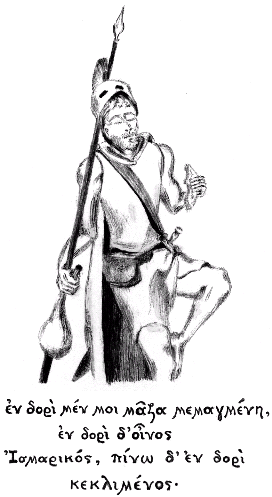
"The spear that earns my bread and wine is also my couch": the hoplite mercenary in this sketch models Archilochus's vaunt. Such self-sufficiency was also once the ideal of the free, individualist American: a profoundly classical ideal which assumed the sufficiency of reason and moral will to found the good life. Imagine such a being among us now, resisting the insistence of the New Right that he clutter his daily routine with expensive acquisitions and high-tech gismos, rejecting the pieties of the New Left pressuring him into identity with mass movements and bondage to carnal needs. He would be a rare bird, indeed! |
Interested in "blogs" on current events? The Blog of Virtues advertises a disclaimer in its tongue-in-cheek name: opinions are those only of The Center's President. Yet the non-partisan insights offered into our dumbed-down "post-culture" are quite sincere. Click here. For more about us--who we are as individuals and as an organization, where we've been, what we hope to accomplish, what we actually look like--click here. Our financial records are an open book. For a full disclosure of recent operating expenses and donations, as well as full instructions about how to make a tax-exempt donation, click here. For links to compatible Web sites, click here. Questions or comments about us? Send e-mail to |