A Journal of Literate and Literary Analysis
2.2 (Spring 2002)
A quarterly publication of The Center for Moral Reason
Board of Directors:
John R. Harris, Ph.D. (President)
Thomas F. Bertonneau, Ph.D. (Secretary)
Helen R. Andretta, Ph.D.; York College-CUNY
Ralph S. Carlson, Ph.D.; Azusa Pacific University
Kelly Ann Hampton
Michael H. Lythgoe, Lt. Col. USAF (Rtd.)
The previous issue of Praesidium (Winter 2002) and other issues in our Archive may be viewed by clicking here.
CONTENTS
© All contents of this journal (including cartoon as well as poems, articles, fictional works, and short pieces by staff) are copyrighted by The Center for Moral Reason of Tyler, Texas (2002), and may not be cited at length or reproduced without The Center's express permission.
Spring revives America’s favorite pastime… now, what was that again?
*
The Intimate Message of Foreign Language:
One Small Curricular Step Toward Restoring Reason
John R. Harris
Learning a foreign language is still possible at most colleges and high schools—and, if not coupled with a hostility to literacy, it promises great benefits.
*
Staff
This time we retrieve French novelist and essayist Jules Romains from forty years of dust.
*
Bimbos in Limbo: Will the Real Bobo Please Stand Up?
Gianna DiRoberti
David Brooks’s new book is charming, intelligent, witty… and morally evasive. Just like a "Bobo" (Bohemian Bourgeois).
*
William James Visits Yosemite in 1898
and
Itinerary and Chronology of William James’s
Allan Shields
Professor Shields recovers the details of the celebrated Bostonian’s ramble in the Far West—a jaunt which is now bittersweet to read about through our veil of lost innocence and squandered wealth.
*
Joseph Soldati
A short poem on a classical subject.
*
Staff
Stoic exponent Lucius Annaeus Seneca knew full well that people are not capable of perfection.
*
Our escapes into nature bring us up against ourselves.
*
J. S. Moseby
This whimsical short story may be more prose poem.
*
Author and editor discuss magic realism, post-modernism, literary theory, grad school… and a host of other things.
*
Ivor Davies
If you’re a professor up for tenure, take an antacid before reading this short story!
*
Staff
Our Current Events Stew has a familiar taste.
*
What do you call someone who is ingenuous?
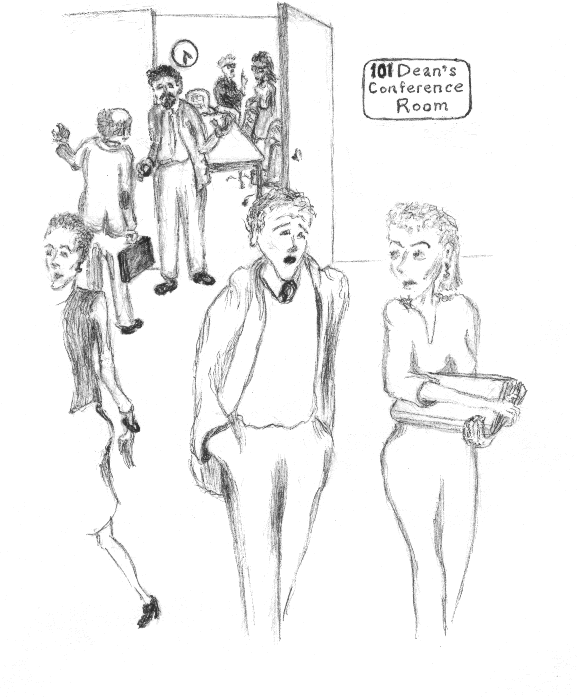
"They keep saying that without tenure, the faculty would be afraid to express an opinion. I’ve been kissing up to tenured faculty for so long, I can’t remember having an opinion!"
A Few Words from the Editor
As in little things, so in big things. When I volunteered to manage my seven-year-old’s Little League team (under some duress: it was implied that without my help, the team would disband), I had not the remotest idea that I was in for an object lesson in human nature. First of all was the draft—a business as sordid as any pork-politicking or fall-guy selection that ever went on behind closed congressional doors. The managers who have seen all the children play ball from the cradle immediately snap up the most talented and experienced, while any newcomer (yours truly, in this instance) is appointed, quite without his knowledge or consent, to be the season’s punching bag. Yet a deficit of experience is not always insurmountable at the age of seven, and I briefly had confidence that our "bums" (a malign spirit whispered "Dodgers" in my ear when I was asked to choose a name) could be drilled into shape. That was before I realized that a good half of the parents considered their mission accomplished once they had photographed their child in his new uniform. Practice? "Why, of course he’ll be there… as long as we don’t have a party or bowling league or choir rehearsal—and, you know, he spends every other weekend with my ex."
If baseball is the national pastime, then Little League—with all of its unethical boundary-drawing, skin-deep family-friendliness, evasion of firm commitment, allergy to drill, and transferred lust to win—must be a national allegory. And a human allegory, too; for, to be fair, much of this was going on when I was seven, a tally of years ago better left to the imagination. (Hint: we used wooden bats.) Believe me, however, when I say that the conduct of parents is different now. Some sign up their little tyke for two or three sports at once, just to make sure that he doesn’t get cheated. They seem to devote not an instant to reflecting that his inability to practice with each team regularly is a betrayal to other children who may wish to improve. They buy him state-of-the-art gear for every role, so that on rare occasions when he actually shows up for a game, he is accoutered like a superstar—until, that is, his pricey toys are hopelessly mislaid over house, van, and field. They find a scapegoat for each of the child’s setbacks during the game: the umpire made a lousy call, the ball took a bad hop, the manager hasn’t supplied adequate direction, the opposing player is on steroids. Yet all is quickly forgiven and forgotten when the fat lady sings. After all, Tommy had fun. He failed to perform at the most elementary level, but he liked wearing his uniform and he got to play tag with Billy in the dugout.
In a decade or so, Tommy will attend college. His parents will fork out the money, not just for tuition and lodging, but probably for a car and a "cool" wardrobe. Undeterred by a full course load, he will sign up for glee club, use his student card for season football tickets, join the Alpha Omega fraternity, film a campy sci-fi flick with his buddies, and discover an interest in rock-climbing. His professors will rack their highly trained brains to make his course work fun, and those who finally assign him a C will receive a very long stare from the Dean. On his way to becoming a virtuoso-dilettante, willing to dabble in anything for five minutes and informed enough about nothing to author more than five lines, he will drop a great deal of money from his porous pockets. At the end of it all, he will be eminently qualified to adorn the upper floors of an office building where potential investors are made to feel that they are "among their own".
So play ball! With this issue of Praesidium, we again invite you to ponder the lost depth of a culture which tunes in to watch people eat loathsome invertebrates, act insufferably rude to other people, and hurl chairs across a stage upon hearing the results of a paternity test. My own essay about foreign language instruction is perhaps a bit pedantic; I am especially grateful, therefore, to Gianna DiRoberti for livening things up with a most stimulating—even polemical—piece about the "bohemian bourgeois", and to Allan Shields for resurrecting landscapes of a hundred years ago. What an irony, by the way, that the age of high literacy was also the golden age of walking! The "book worms" of the old school were often master ambulists: Wordsworth thought nothing of hiking twenty miles to post a letter. Now, with all our "free time" from the "boredom" of clerical labor, our bodies are growing as flabby as our brains.
No recent issue of this journal, furthermore, has been more generously endowed with creative work. Mr. Moseby’s short story strikes me as something more on the order of a prose poem, and rewards the effort which it takes to work through properly; but, if you disagree, surely the ensuing exchange between the two of us will be more to your taste! In any case, the second story, "Straight Shaft" (which reached me just before deadline), is as "realist" and linear as it is delightfully acid. I’ve read nothing else that comes close to satirizing a departmental meeting with the ruthless candor which Mr. Davies displays here.
Then we have our poet-contributors, whose reliable Muse is a needed reminder to me personally that contemplation and mystery have not entirely abandoned us. When I saw that Professor Carlson had sent me a little piece about coaches, of all things, I couldn’t resist!
~J.H.
*******************************************
The Intimate Message of Foreign Language: One Small Curricular Step Toward Restoring Reason
by
John R. Harris
Πολυμαθία νόον ου διδάσκει.
Knowing many things does not
produce an educated mind.
Heracleitus
The subject of primary and secondary public education was recently a very hot issue in these parts—though not, I fear, at the proper level. The enormous tax increase sought by our school district was earmarked (as well as I could ever make out—details were not forthcoming) for major building projects; and, like good middle Americans, my fellow citizens fell to arguing mostly about whether our children "deserve" to have tedium held at bay daily in surroundings somewhere between the Mall of America and Disneyworld. The general opinion was that no amount of convenience and luxury (at the expense of property-owners, of course) was too good for "our nation’s future leaders". Pundits who keep saying that American character rejected big government and the welfare state after Jimmy Carter should get out of DC once in a while. Madison lies a-moldering in his grave. So for the Protestant work ethic; and as for the Western valorization of endurance, self-discipline, and inner strength… Sparta, thy ghost has been laid, and thy very foundations carted off to make golden arches.
If we could have concentrated this debate upon what actually happens in the classroom, we would, I believe, have taken a major collective step toward arresting the vast ruination of our young minds and the sickening degradation of our culture. We would at least have been shooting on the same range, if not at the same target. Another missed opportunity... and who knows when the next may come? In preparation for that distant day (may it be much nearer in your own community), I share the contents of a letter which I addressed to our local rag. It was never published in that venue, by the way, and I can’t really argue with the editor. Considering that the biggest bone of contention was an eight-million-dollar swimming complex, I can hardly maintain that the thoughts expressed below were in the fore of my neighbors’ minds.
"Dear Editor," I wrote:
"Though much has been said lately about the importance of schools to our children’s future, little attention has been paid to the content of their classes. I wish to state briefly my concerns about the ‘silver bullet’ of contemporary education: computers.
"Computerized searches are anti-hierarchical whenever values cannot be quantified (as in morality). They strew limitless information over the table without ranking any of it for beauty, truth, or goodness: a smorgasbord of fare to flatter every whim.
"Computerized studies are anti-deliberative. They keep the eye (and ear, increasingly) always occupied, and at a click they bring up a flashy new screen. To sit in still silence and think a question through is not a skill anyone ever learned from Microsoft.
"Computerized communications are anti-social and prone to misuse. No amount of ‘interaction’ substitutes for the presence of other human beings, and the dependency of such interaction on protocols is an open invitation to cheats and crooks. No program is hack-proof. Every time you log on to the Net, you are trusting in methods of verification whose exploiting is a nice livelihood for criminals who cannot be caught.
"Computerized expression is counter-creative. All the talk about creative freedom is based on the correct perception that computers destroy hierarchies of ethics and taste—but that doesn’t mean there’s no ‘first’ and ‘last’. Marketing is all about the morally repugnant and creatively degraded competition to seduce bystanders. The Net’s big winners are the best seducers. Even off-line expression—say, a mouse-controlled ‘paintbrush’—gives a pitiful approximation of the shades and textures found in real paint; and the project almost always begins with a pre-packaged image (like a photograph).
"Finally (and most importantly), computerized life is anti-spiritual. By that I mean that computers deprive reality of its depth precisely by destroying hierarchy, deliberation, social bonds, and creativity. A trip to the art museum becomes ‘virtual’, a climb up Everest is packaged on a CD or Website, and a moral question like abortion produces an opinion survey and some ‘bulletin boards’. I call this drowning at the shallow end of the pool.
"Add to all this that many of our society’s leaders have staked their reputations or fortunes on luring us into this ‘web’, and you have a crisis far greater than Islamic fundamentalism. (By the way, Al Qaeda has massively exploited the West’s digitalization.) So you’re concerned about education? Go see if our schools are using computers to supplement literate, humane learning or, rather, to fill large parts of every child’s day with fireworks displays."
The letter ended here. I should most certainly have stressed the parenthetic point in the final paragraph had I wished to sound a utilitarian note over a moral one (viz. "Computers may not leave us worse people, but they may well leave us all dead"). If identification documents were not checked by computer, flights not booked and cleared and virtually flown by computer, power plants and water treatment plants not operated by computer, financial business from sales of stock to bank loans to credit card purchases not transacted by computer, and intimate friendships and confidences not cultivated by computer, opportunities for catastrophic sabotage and undetectable infiltration would not so abound in our society. (Yes, I know, we’re all being pushed to accept a "foolproof" electronic identity card of some kind. Incredible. Then the fake Mr. Jones will no longer need to shave his thumbprint with a razor: he will only need to hack into the FBI’s database.) Already as I sit writing, a purely natural disaster—a mid-winter ice storm, say—is capable of visiting calamity upon vast areas thanks to our electrified way of life. Our wood-burning ancestors didn’t stay as toasty as we do, but neither would they have frozen or starved because a blizzard brought down a bunch of tree limbs. In the near future, our very doors and windows will open by computer command (as our garage ports already do by hand-held remote-control stick). We shall have invested so heavily in this single technology that its compromise for any reason will leave us fully at the mercy of raw nature and malevolent aggressor.
Even though the rest of this paper is not dedicated to stressing the practical dangers of wired living, we should never forget that its proliferation has thoroughly tarnished the motives of our age’s leaders. With or without cause, Democrats have always accused Republicans of pandering to big business throughout my lifetime. The computer revolution, however, has soiled everyone’s fingers, at least potentially. Its profiteers and piggy-back riders include dot-com fly-by-nights as well as oil magnates, radical propagandists as well as Madison Avenue publishers, incendiary crackpots as well as straight-laced establishmentarians. When the local school board or a national representative, therefore, recommends that we teach our kids from screens, their or his or her political affiliation or age or race or gender or socio-economic profile cannot be relied upon to supply any kind of filter which might help us to snare traces of self-interest. All are tainted. The stock trader owns shares of Microsoft, the small businesswoman has a lucrative Website, the councilman’s son-in-law sells computer systems, the college freshman grew up on video games. You have a far better chance of finding a critic of the automobile, whose toxic emissions are disputed only as to degree and whose lethal abuses have left human gaps around us at the rate of a major war.
Neil Postman’s recent work, Technopoly, is as splendidly insightful as his now almost legendary denunciation of TV culture, Amusing Ourselves to Death. Postman recognizes that we cannot backpedal to a pre-electronic age of Jeffersonian letter-writing and Addisonian pamphleteering. Computers are here to stay, and in some ways we all welcome them. The labors of Praesidium would be impossible for so few people so poorly funded if the word processor and the Internet didn’t lend a thousand mechanized hands. The trick is to keep these hands from unlocking their cage: to restrain this Briareus from picking our pockets, stealing our lunch, redecorating our living rooms, playing with our babies—taking over every aspect of our lives, in short. Postman ends up advising that we acknowledge "technopoly" to be, not just a specific range of household and marketplace conveniences, but an entire philosophy, complete with its own epistemology (what we know about reality) and its own ethics (what we should do about what we know). Since this digital philosophy is miserably impoverished, we should actively combat its toxic effects by teaching other ways of assessing reality and its obligations upon us. Along with a historical overview of technology and of the arts, Postman counsels a course in comparative religion. No particular religion would be allowed to dominate the student’s attention; rather, the course would cultivate the religious sensitivity to truths not fully visible, not remotely quantifiable, and not amenable to popular vote despite their hold upon our basic humanity.
This is a daring proposal, and, of course, has little chance of finding its way into either public or private education. Public schools will reject what they see as incipient narrow-mindedness, despite Postman’s emphatic insistence that sacred texts from the Bhagavad-Gita to the Koran to the Communist Manifesto (you read that right) should be included.2 Private institutions, in turn, will reject what they see as a dangerously demoralizing broad-mindedness (Islamic schools more vehemently than Christian, by the way, and Marxist academics more vehemently than anyone). In the real world, at the very least, one would hope to observe a smattering of the great ethical philosophers introduced someday into the last years of high school. They have long been banished from most college campuses, as we all know, but not because adolescent minds cannot grapple with them at some level beyond the merely superficial. (On the contrary: Plato, Aristotle, and the other "dead white guys" would make only too much sense to inquiring young minds, which must be "protected" from them for subsequent programming with addle-pated ideology.) A few brave, thoughtful, and competent administrators could redeem our young minds from the nauseating nullity of their cultural surroundings by offering them such intellectual bread of life. Here the problem seems to be less political than practical. Neither bravery nor thoughtfulness nor even basic competence is in abundant supply at the top of our educational hierarchy.
There is one well-established discipline, however, which is by nature humane, social, analytical, dependent upon hierarchy, insistent upon clear and distinct truths, indebted to tradition, dedicated to correct self-expression, and—in short—pregnant with all the values our children sadly lack and our avant-garde theorists vigorously persecute. It is the discipline of learning a foreign language. Consider the virtues of submitting to such a regimen. You have to talk to other people, or at least attend their recorded communications very closely and respond in point-by-point fashion. It isn’t enough to have your own "thing" which you’re going to do in your own way: indeed, it runs entirely contrary to the exercise. You are not even allowed to say things like "thing" without, at a minimum, becoming aware that you are using a highly ineffective idiom. Hence the analysis, the hierarchy, and the clear truths which follow from such an intense degree of human interaction. When your mind is narrowly focused on what others are saying, you scrutinize each piece of the puzzle—not just individual words, but the inflections and prefixes and suffixes of those words—to arrive at the most accurate perception possible. In this analytic exercise, your mind is concurrently leaping back from the minutiae to view the emerging landscape. Which of two homonyms confers a clearer sense upon the emerging sentence? Which of two orthographically identical verb forms better suits its action and time frame? This synthetic counter-motion to the analysis of small parts is a hierarchy-building operation. It creates priorities of greater and lesser likelihood. (And let’s be honest: when not translating in a professional setting, we often shoot in the dark. Our quick measurements of likelihood in these circumstances may go so far as to include what we know of the author’s character and tastes.) Obviously, any solid affirmation we can clutch in such clouds of witness is a great help. The French tirer can mean "to shoot" as well as "to pull", and it almost certainly does if we find fusil—"a rifle"—in the same sentence. Words mean things when we anguish through these quests after another human being’s intent. They may not mean anything at all when we later sit at the feet of some critical-theory guru; but in French class, tirer means "pull" or "shoot" or one of a few other things—not "sail" or "simmer" or "make love".
I remember a passage in Tobin Siebers’ excellent Morals and Stories which reflects upon the analytic-synthetic tug-of-war involved in the discovery of meaning. I plainly recall, in fact, that when Siebers summarizes the research of linguists Schank and Abelson on the importance of verbal clusters and social environment in conferring sense, I thought immediately of translation from another language. "Both literary and ethical notions of character," Siebers concludes, "rely on a dense social context that is responsible for their applications and that is influenced in turn by those applications."3 The chapter in which this remark appears is titled, "The Case Against Linguistic Ethics". Siebers takes aim in these pages at such contemporary torture of words (usually called "play") as one sees in deconstruction and reader-response criticism. I find him right on target. As a matter of fact, in dealing with defunct languages, we sometimes have nothing but inference from context to suggest a word’s meaning to us; and in reading such formulaic texts as the Homeric epics, we may well choose to make little of a specific word’s known meaning if it creates dissonance in its setting. ("Swift-footed Achilles" would be an irritating phrase to encounter while the hero sits in his tent if we truly dissected each bit and piece to the skeleton.) The intensity of analysis practiced by literary critics upon single words often seems to have gone haywire, leaving its complementary synthetic "checks and balances" far behind the way an overheated machine might lock in a certain gear. The crowning irony is that many theories which the simplest translation exercise would prove ridiculous have been concocted in Europe, where every educated person is a polyglot. But then, perhaps that’s why they had to emigrate to the New World to attract a following: nobody back home took them seriously! Certainly mainstream French scholars, whose letters have long been guarded with Cerberus-like ferocity by the Académie Française, would not take kindly to the notion of "playing" with words until they yield ideological bias. A French colleague once assured me that she viewed Derrida very much as a bad boy reacting against the academic successes of Lévi-Strauss and structuralism.
Would that we were capable over here of telling a genius from a prankster! But we are not, at least in linguistic theory, and our clumsiness with foreign language must be part of the reason. Because the discipline of learning another language, while firmly established in our schools, is now just a shadow of what it might be or what it once was in the United States, we are easy prey for charlatans selling the propaganda that every expression conceals propaganda. As a society, we already denigrate those other virtues which I listed as implicit in acquiring a second language: high regard for tradition and dedication to expressing oneself clearly. We Americans have always trusted that newer is better and complained that time-honored formality is suffocating. We call ourselves rugged individualists —which creates a contradiction, of course, with our contempt for precise self-expression. Perhaps we view the painful labor involved in crossing all our t’s as oppressive to our free-wheeling spirit. If so, then our individualism isn’t very rugged, or else our ruggedness is doomed to become crudity incapable of individual finesse. We latch onto the phrase, or even the entire sentiment, currently in general circulation, and then we self-indulgently try to cover our tracks by saying that we value the common man’s honesty over the scholar’s stuffy jargon. (On the morning of my writing these words, I was forced to sit through a video tape chronicling the ascendancy of a certain religious denomination. I found myself wincing at each of the narrator’s pregnant pauses in anticipation of a "warm fuzzy" shibboleth: "God shows his will through… people. His ultimate purpose is… love." Flann O’Brian, blessed be his memory, would have found ample matter here for his series, "The Catechism of the Cliché".)
The truth is that accurate self-expression depends mightily upon conventions. People must be able to index your formulations to a set of generally received and acknowledged meanings before they can determine in what sense and degree you are challenging the received or the acknowledged. When we abandon such accuracy, we enter the unwholesome realm of the inarticulate mob, part of which is ruled secretly by sophists who speak only to pluck the desired nerve, the rest of which belongs to the frightful chaos of pre-rational whimsy, passion, and stupor. The new sophists who reached our college literature programs from France and Germany were deluded, no doubt, only in thinking that the adulation they harvested was a proper verdict upon their merits. (Sophists are always so deceived: a liar may be bright enough not to believe himself, but he is never honest enough to refuse himself the praise of his believers.) English and History departments fell like dominoes before the trend. Young people, many of them exceptionally intelligent, swallowed whole the toxic notion that every notion wants you to swallow something toxic. How could that have happened—why had they no confidence in the ability of rational discussion to ferret out illogic and falsehood? Because their own culture had already betrayed them in a way they never suspected: because, that is, they had not been educated to analyze and synthesize and re-analyze, to work toward coherence however they could (including by appeal to common sense), to establish priorities of resemblance to the real, and to have recourse to convention in all these endeavors. They could not express themselves, and so they were willing to believe that their unexpressed frustration grew from the manipulative expressions of others which had somehow cut them off, somehow stilled their tongues. They had never learned how to think.
The cause of this intellectual debacle is manifold. The appearance of the television and the disappearance of neighborhoods where people walked about and spoke to one another probably had far more to do with it than the recession of foreign language study from the curriculum at all levels. Yes, we still have such study. Time was, however, when young adolescents studied Latin and Greek and French or German in many schools, and had access at least to Latin courses in virtually every school, public or private. High school graduates of three generations ago were often better thinkers than Ph.D. candidates are today: they plainly wrote better English, at any rate. Ask your grandparents (or, better yet, a great-grandparent if you can find one) where they learned to handle sentences so well and they are likely to answer, "Latin class." Subject-verb agreement and subordination, especially, are linguistic concepts with which English-speakers bent over the Latin grindstone become very familiar. Now that such apprenticeship has virtually vanished, we need only click on CNN to hear senior newscasters and successful lawyers-turned-politician mauling the King’s English in their profound ignorance of these very concepts. Even worse, their reasoning reveals deficiencies corresponding to their grammar. They have no sense of proportion: they quickly lose the main point, or else have never identified it among a debris of loosely relevant detail.
I repeat that the causes of such intellectual degeneration are many. If learning a second language, however, could merely slow the bleeding of what increasingly looks like a mortal wound, why not apply the poultice? Instead, colleges are actually abandoning the foreign language requirement among their core courses with alarming insouciance. Some campuses have the audacity (or the stupidity) to volunteer "computer literacy" as a replacement. Gertrude Himmelfarb, ruefully reflecting upon this trend, explains, "The presumption is that any method has its own justification, has to be tolerated on its own terms and judged by its own rules".4 Just so. The administrative brain trust is so far from understanding the interconnectedness of disciplines (and, in this case, the very special connections of foreign-language learning) that it advances computer studies because of their difference from everything else! These architects do not answer the question, "How does Field A relate to Fields B, C, and D?" Rather, they defiantly fling out the rhetorical question, "Why not Field Q—what genuine relation has anything to anything else, after all?"
And indeed, computer-speak encourages none of that intellectual stimulation which I catalogued in the learning of another language. The occasion is not social; those who stress that we are receiving instantaneous messages from people all over the world have blinded themselves to the machine’s ineradicable drawback: its obstructive mediation. "Worldwide earth-linking internet"? We’re actually crouched in reverence before a screen whose flickers claim to come from Russia or Kenya, but might just as well hail from the next room or be a "glitch". As for analysis, computers may greatly assist statistical studies by providing instant graphics or projecting trends quickly into the future, but they cannot question the quality of the data. Hence we have the vexatiously "unanalytical analysis" of opinion surveys or of next year’s weather. Too many people are falling on their knees before the electronic oracle’s print-out, and too few are aware that "facts" need to be evaluated very closely before they are fed into mathematical formulas. For the computer knows no true or false: its definitively yes-no, on-off digital nature takes you left or right without ruling upon the soundness of your choice. If we pursue this absence of truth a little farther, we find that it becomes an absence of hierarchy. A stint on the computer is a lateral navigation among various options: any command will open a door. The level of satisfaction your journey raises in you after a long series of opened doors, however, is an entirely subjective response to a medium indifferent to vertical thinking. Tradition, of course, is the computer industry’s primal adversary. Though computer programmers must observe certain protocols, the level at which the typical college student is expected to become "literate" on the machine hides the binary coding and the HTML. The celestial term "user-friendly" might indeed be defined as relying minimally on any fixed body of knowledge. What "self" this sad student has left to express, having been liberated from analysis and the past to lurch around in a menu, is quite beyond my ability to imagine.
I have just recapitulated the letter to the editor with which I opened this essay. What an irony! The digitalization which is carrying us away from the Western tradition of humane letters and literate analysis is prying its way into the curriculum behind the wedge of foreign language! Foreign it surely is, but language it will never be. One hears occasionally that mathematics is also a language, and not without justice. The "laws" which govern numerical relationships are the most impressive example in our human world of universal truth not dependent upon empirical phenomena and yet as "objective" as anything we know. What these laws gain in truth value, however, they lose in finesse. They require no negotiation, no qualitative sensitivity, no soul-searching struggle toward consensus. In that regard, they are only half human. "Computer fluency" takes the worst of both worlds. It borrows from mathematics a disdain of tradition and a worship of rigid numerical "fact", marries these to rhetoric’s lame pretense of sociability (which is truly a following-leading immersion in mass whimsy), and gives birth to a barbarous pseudo-objectivity of pseudo-feeling.5 This is precisely the sort of influence which we most need foreign language programs to combat.
I cannot "prove" that curricula with stringent foreign language requirements make better thinkers—not in the sense intended by the stuffed shirts who always require proof. They seek a statistical vindication for everything they do; and, not surprisingly, they are leery of the humanities and all other fields not readily susceptible to quantification. I can only promise them that the world would have fewer of their kind if it had more foreign language instructors. I know this because it is a thoughtful observation based upon long experience. I have spent most of my life in and around schools in some capacity. At the moment, I am tracking my young son’s progress through grade school with great interest. I find that the settings which produce eloquent, imaginatively agile, profoundly discerning graduates are those which offer more foreign language. Naturally, if an institution does not measure success in eloquence, imaginative agility, or profound discernment, but only in ability to attract the attention of the region’s accounting firms and machine shops, the advantage I cite will seem negligible. The never-known is never missed: no swine ever wept for a pearl.
Yet one experience in my own considerable stock of anecdotal evidence has nagged at me steadily as I have prepared these comments. It directs us back to college—in fact, graduate school—rather than keeping us focused upon our local school district, and to that extent it constitutes a digression. Yet I pursue it here, not only in the spirit of honesty, but also because I believe that, however irrelevant graduate study may be to grade school in other ways, in this one there are meaningful correlations.
I received my doctorate in Comparative Literature. The "comparatist" on most campuses which have such a program is required to be fairly competent in at least three languages. If my theory about the intellectual rigor of studying other tongues is valid, then surely here, if anywhere in the humanities, we should find scholars being produced who have no patience with theoretical mush and irrational victimology. We find nothing of the sort, however. On the contrary, Comparative Literature was the landing craft which outlandish critical theories of conspiracy, privilege, and propaganda used to make their beachhead on many campuses around the country. This would seem a most embarrassing circumstance for my argument.
The more I ponder it, the more the Comparative Literature phenomenon strikes me as the exception that proves the rule. It is complex, and requires careful dissection. First of all, every such program of which I have any knowledge accepts English as one of the languages qualifying one to participate. This means that our "polyglot" graduate student may in all probability turn out to be a) a British or American national strong in one other tongue and passable in a third, or b) a foreign national who happens to speak good English as well as a third language usually related to his or her mother tongue (e.g., Spanish and Portuguese, German and Danish). Now, since the gurus of theory were almost all northern Europeans early on, our graduate student, if British or American, may well have learned another language precisely to plunge into the delights of the sacred tantrum tantra; or, if European, may have come to America precisely to discuss the banished prophet unharassed—and perhaps to sit at the Great One’s feet. Even students who were not fully converted to a faith in verbal conspiracies upon entering grad school would be instantly and permanently immersed in anti-propaganda propaganda. Their reading lists would contain practically nothing else: just trendy theoretical works and a few non-canonical (i.e., miserably written) primary texts showing the "play" of exploitation and oppression in "narrative". To put it bluntly, the connection of Comparative Literature with foreign language was often no more subtle than getting to read folderol in its original form.
I have frequently tried to imagine how a faculty of comparatists would go about evaluating such a candidate’s competence to proceed to the dissertation. What would a competency exam look like when given over texts which overtly—even militantly—declare that all efforts to establish hierarchies of competence are an oppressor’s power play? To say the least, a dedicated footsoldier of the movement would be under great pressure to grade charitably. So what if this student doesn’t know that tirer means "to shoot" when coupled with fusil? Why should any decent person expect another decent person to be versed in the wicked male idiom of detonation and murder? Better to fail the ones who get the sentence right: their heads may be sitting straight, but their hearts are horribly skewed!
I exaggerate, of course (or so I fervently hope). I may add in all candor, however, that the best thinkers in the program I entered were invariably those who did not fit the categories I have just described. They were not self-styled victims of oppression in search of a soapbox who happened to be bilingual. Many of them did not choose English as one of their three languages of specialization. Others specialized in the ancient or medieval phase of a certain language and culture rather than insisting that all should be contemporary (and, as anyone knows who has ever tried it, studying medieval French or German is like learning a language almost entirely distinct from modern French or German). I will not say that I found these people politically out of step with the theorists. Most of them lived on the borders of nihilism, at least superficially: after all, this was graduate school! Yet with a little persistence, one could always bring them to a depth of conversation about literature where the theoretical jargon simply blew away like chaff, leaving behind long-deliberated opinions and a genuine humility before the evidence’s vast diversity. They were not above secretly sniggering at the pompous critical jargon which their less weighty peers clung to as a shipwreck hugs his driftwood.
Then there were the Hispanists, the Spanish majors who spoke fluid English and tacked on a bit of Portuguese. I must say immediately that I intend no disparagement of Spanish literature, either of the Old or New World, in what follows. I came to Spanish rather late myself and am completely self-taught (with a lot of help from Latin and Italian). Nevertheless, I have already discovered a great many jewels which I highly prize, from Antonio Azorín to Rómulo Gallegos. I will admit that Spanish literature confronts the classical temperament with certain challenges not met in other romance languages. Spain was so well insulated from the rest of Europe that she preserved her serious ruminations in a Latin Catholicism longer than other nations (including Ireland), allowing mostly popular legend and picaresque narrative to leak into the vernacular.6 Yet there are quite enough Spanish classics to keep the most voracious reader busy, even if they do not root as deeply in the late Middle Ages and Renaissance as do the canons of France and Italy.
That said, I may proceed to certain geographical and cultural realities which bestow upon Spanish a unique position as a foreign language in North America. These realities will carry us right back to our original discussion of foreign-language learning in our grade schools and high schools, so they are worth stressing. Spanish is actually the mother tongue of many North Americans—and I do not mean simply Mexicans. It is the only language other than English which Americans find on most of their government’s publications (much to the chagrin of many). It is the language, therefore, of a culture in highly visible rivalry with traditional Anglo-Saxon customs; and since Anglo-Saxon culture is so deeply infused into our institutions, Spanish is a language of the underprivileged. Bilingual Hispanics who entered Comparative Literature programs thus already bore a much more substantial baggage of victimization when they walked through the ivory gate than did classmates who merely felt out-of-joint with life and were looking for somebody to blame. Furthermore, the massive corpus of Spanish literature generated by Central and South America over the past century is replete with Marxist sentiments dramatizing the struggle of oppressed against oppressor. How could it be otherwise? This part of the world has seen more years of real oppression by an alien culture than anywhere else. (I am not excluding Africa: the European exploitation of the African interior began relatively late and lasted relatively briefly. Besides, Europeans never settled in Africa and merged racially with Africans to any degree approaching what we find in the Americas.)
In short, with the Hispanists you often got real victims with a genuine literature of victim-chronicles. There’s nothing anti-intellectual about recognizing this, either (though there is something quite unintellectual, I believe, about founding an entire Manichaean philosophy of good guys/bad guys upon it). One may hone one’s reasoning skills just as sharply by reading and analyzing Karl Marx as by paying homage to Dante or Shakespeare; and if you add Gabriel Garcia-Márquez to the equipment, you can bring a sparkle to your blade. My reservation about Spanish as the major power in today’s foreign language departments, I emphasize, has nothing to do with the progressivist tendencies of modern Spanish literature. It has to do with speaking. The special reality of Spanish to us in North America is a spoken reality, not a read or written one. Many of our hispanophone neighbors are no more literate in Spanish than in English: printing government documents in both languages doesn’t help them much unless they find a friend who can read. Nor is this true simply of the poorer classes which tend to slip into the United States in desperate search of work; even the comparatively affluent Argentinians and Chileans are finding that their populace, though widely educated, chooses not to read.
Spanish-American culture is vaguely but significantly opposed to literacy. I have already grazed the reasons why this should be so. The original Spanish who subjugated the New World did not themselves have a vernacular literature as liberal, expressive, and meditative as the rest of Europe. What literature in Spanish existed, furthermore, was no more passed along to native converts and collaborators than was the Summa Theologica. Transplanted Spaniards themselves were too busy with the work of administering colonies to cultivate literary taste. Hence today’s Hispano-Aztecan Mexican or Hispano-Mayan Guatemalan or Hispano-Carib-African Dominican has no centuries-old tradition of literature upon which to draw, even if we may assume that he knows how to read, nor are the endemic customs which survived Spanish colonization remotely relevant to life in the TV-and-Computer Age. These people have few roots reaching back either to oppressor or oppressed. They have been dumped into the twenty-first century almost as if they had been transported through several previous centuries in a dark knapsack.
Now, at last, we confront a major issue. Spanish departments are clearly going to endure at our universities, and Spanish classes will clearly continue at our local grade schools. The ideology of victims-and-villains which reigns in the academy will secure the place of Spanish in the former venue, and the blunt reality that immigrants from the south are permanently settled among us will secure its place in the latter. The last stand of foreign language promises to be a good one. In fact, it may just turn the tide of the battle.
Unless, that is, you insist upon the healthy survival of literature as a condition of victory. Spanish may not be able to deliver this prize. Since the ivory tower has been so heavily politicized, I fear that even graduate programs in Spanish may become steadily mired in contemporary fiction which is little more than the transcript of those soap operas so extremely popular south of the border (even more than here). Such works are centrifugal in every way: they orbit no nucleus of common values or traditions, their style chases after the ever-changing slickness of the movies, and the patois in which they are written is itself almost indecipherable in other quarters of the Hispanic world. Certainly our schoolteachers seldom inspire a love of literature. Administrators and parents alike lean upon them to produce adolescents who can chatter away like some fudbol sportscaster—this so that Johnny and Susie may have the inside track when it comes to getting a job among a bilingual public. Our primary and secondary schools have the ethic of instant utility forced down their throat in this age of "accountability" (I cannot resist the quotes, as a defender of the humanities); and our "higher" educators (no explanation of quotes needed, I trust) choose to live out their Juarista fantasies rather than to help us all rediscover what unites us as human beings.
Allow me to explain why this emphasis upon speaking, and upon a popular literature more attuned to electronic performances than artistic composition, undermines the thought-provoking qualities of foreign language study. The speech of ordinary people in ordinary situations (called "demotic" from the Greek demos) is far less rigid than the formal language of "serious literature", if one may still use that phrase of any creative writing in the world. In Spanish culture, at any rate—especially Spanish-American—it has little meaning. Writing is judged on how closely it approaches informal speech, just as plot is judged on how closely it replicates the microscopic melodramas of unheroic multitudes. There are many casualties of such popularization. For instance, the tense which is designated conditional in Italian and French, constructed from the present infinitive, and employed under specific circumstances has collapsed into the imperfect subjunctive in Spanish.7 I have found repeatedly that even college-level instructors cannot define for me the circumstances in which one form should be chosen over the other: they only remark that the infinitive-based subjunctive (once the conditional tense) predominates in the New World, while the other structure (the imperfect subjunctive in Italian and French) is Old World, old-fashioned, and practically obsolete.8 Demotic usage simply lost sight of the distinction, and its indifference soon became law (i.e., abolished the existing law) since Spanish has no watchdog like the Académie Française to guard its standards.
This "tyranny of the street" is even more apparent if one examines vocabulary. The common people frequently don’t understand big or rare words. As a result, they either discard them or press them into service as synonyms for words with only approximately the same meaning. A few issues ago, we wrote in Praesidium of how the Spanish verb cavilar rather brutally comes to mean "think", leaving a gap around the subtle act of caviling which can only be filled by supplying descriptive phrases ad libitum. Demotic language lacks rigor and precision. Any student of Greek who has read Plato and then attempted the New Testament knows the frustrations of rule-bending and oversimplifying for the earnest translator. If you are an educated American who has lived at least forty years, of course, you must be painfully aware of this leveling phenomenon already from observing how quickly a sloppy coinage, once popularized, finds its way into the dictionary. The man who wins the lottery is "fortuitous", we hear it said, and an idiot does not "bungle" but "bumbles" like a bee.
To be sure, diminished rigor is still better than no rigor at all. Yet the laxity of demotic language has more serious consequences. A language can get along nicely without a conditional tense, and the meanings of words are never rock-solid; but the most morally salutary quality of language study—its invitation to think things through—may actually be opposed by the ethic of casual conversation. When people talk casually, they spend far less energy on thinking than on keeping the verbal ball in lively motion. They grab at idioms instead of pondering the mot juste. The teaching of conversational technique—which, I repeat, dominates foreign language pedagogy today—depends heavily upon burning into the student’s memory a bunch of tired phrases, trite sentiments, and dead metaphors. It is a preparation in how not to think, in how to jabber seamlessly and volubly. You know what people sound like on a given day at a given street corner:
"Hey, Bob. How’s it going, man?"
"Okay, I guess. No complaints. How’s Jane?"
"She’s back up again, she’ll survive."
"So she’s cool with your new job?"
"Hey, man—totally. She wants that new pad, know what I mean?"
How could anyone not know what these vocalized hand signals mean? That is, how could anyone think that they mean much of anything? It is into such challenging situations as these that we prepare our students to plunge on a faraway street corner.9
The objection may be raised that idioms are traditional, and hence uphold that respect for the past and for hierarchy which I recommended earlier. Not so. The idiom is precisely the lingo of the idiotês—the regular Joe, the average bloke. In today’s parlance, idioms last (I would guess) about five or ten years: less all the time. Our electronic technology causes them to be churned out at breakneck speed—and we all know better than to ascribe any regard for tradition to that source! In fact, The perceptive reader may already have reflected that to draw closer to street talk in today’s circumstances is to draw closer to TV, the movies, and the Internet. If I am correct that the skills involved in acquiring a foreign language are in some important way opposed to those involved in "computer literacy", then dedicating a foreign language program to bus-stop blabber is sleeping with the enemy. With the flux of "in" phrases, naturally, comes a parallel flux of topics and ideas. Rock stars pass into and out of popularity, movies explode on the scene and then vanish, and even the most critical events now have a shelf life of mere months. (How many people were interested in President Clinton’s impeachment even for a few weeks? How many people on the streets of New York mention the World Trade Towers today if they do not happen to pass by the yet littered chasm?)
In a truly, functionally oral society, language is anchored firmly, not by the idiom, but by the proverb. It has been plausibly maintained that oral-traditional peoples do not search their souls as do their literate counterparts. "By separating the knower from the known…" writes Father Ong, "writing makes possible increasingly articulate introspectivity, opening the psyche as never before not only to the external objective world quite distinct from itself but also to the interior self against whom the objective world is set."10 A counter-argument might be made, however (and I very much doubt that Ong would disagree with its terms), that the pre-literate person is not wholly deprived of self-expression—he simply "seeks" himself in the broader community rather than in his intimate thoughts and feelings. Proverbs are indeed a measure of such self-expression. A speaker puts before his audience a timeless proverbial truth, implying that it is relevant to a specific situation being considered. The audience’s members then ruminate over the suggestion, fitting specific details into the universal panorama. One of them may respond with another proverb, which may either confirm the first or hint at an adjustment. These people are most certainly in some sense "speaking their mind". Their exchange is punctuated by respectful and meditative silences. (One sees the like, for instance, in Chinua Achebe’s Things Fall Apart.) They are not riding the crest of trend to sustain themselves in incessant prattle. Though Ong, Havelock, and others have been quite right to distinguish their activity from its literary equivalent by depth of analysis and force of individual assertion, they are in their way infinitely more analytical—and, yes, even more individualistic—than the tourist armed with a host of "guidebook phrases" learned in French or Spanish 202.
Lest I seem to be bullying Spanish, I must add the final point about demotic language’s degradation that, in every particular venue around the world, it is growing more and more anglicized—and especially more americanized. Eventually, I suppose we will end up with one bland American cheese of slang. The assault, as one would expect, comes primarily in the form of technological terms. Words for "telephone", "microwave", "minivan"… a glance across my desk assures me that the French for "toner cartridge (according to Xerox’s box) is cartouche de toner. Antoine de Saint-Exupéry refused to learn English when he took refuge in this country during the Nazi occupation, worried lest the gradual American conquest of his culture proceed through his own writing! What would he think of télévision and the rest? Reading with great pleasure the Venezuelan novel Doña Bárbara the other day, I ran across the word Güinchester for a Winchester rifle. As an enthusiastic student of other languages who does not, however, make any effort to sustain the conversational fluency of the soap operas and gossip magazines, I can only imagine how many such barbarisms have been machine-drilled into reverend tongues around the world. And with this techno-speak come more conventional Anglo-American idioms. Irish has a colorful and intriguing phrase for "give an account" or "describe": cur síos (literally, "put down"). Move the image in the opposite direction and you get cur suas, as in "put up [with], endure"—an image very familiar to us, as well it should be.11 It is ours. You won’t find it in any Gaelic text of more than a few decades old.
When things are viewed from this perspective, one has to conclude that all foreign languages—but perhaps especially Spanish, with its relatively thin layer of literary tradition in the New World and its immense weight of popular pressure—would very much benefit from being taught more from plays, poems, stories, and novels and less from the language lab. Those exponents of ethnic preservation in the Hispanic community should realize that delivering Spanish instruction to a slaughterhouse of electronic chatterboxes will sooner or later strip the language of most of its character. What people like the Irish and the Welsh hope to achieve in Europe by foisting their ancestral tongue with similar jingoism upon uncouth teenyboppers is beyond me to say. National unity, perhaps… but what they will in fact achieve is the ultimate colonization of their heritage, not just by the English, but by all the tasteless ephemera of postmodernism’s posthumanism.
Here, then, is my most urgent recommendation for availing ourselves of foreign language instruction’s happy survival among compu-kid games and PC history books, among business departments and nursing programs. Teach the literature. Relegate speaking to a secondary status: don’t avoid it, but don’t stress it. First and foremost, teach the rules of grammar and cultivate a richness of diction. Do so as quickly as possible, in preparation for the marvelous day when children (or young adults) can pick up a short story by Dario or Maupassant or Deledda and read it in its original form. The blessings of literacy include a richness of internal life and an acute analytical ability; those of orality include a richness of communal life and a wonderfully synthetic sense of transcending purpose. The electronic habit of living, I am fully convinced, cultivates the psyche from neither of these directions, nor does it have anything substantial to offer in their place. It is the first step upon the path to becoming a robot. Computers can already talk to us with about the level
of sophistication that we find in the typical language lab: "Would you like to write a letter… may I make some suggestions?" (Of course, the suggestions themselves will be dictated by a suffocating uniformity.) If, instead, we surround the nurturing of verbal skills with thoughtful, humane, intricately crafted literature, our language programs, rather than "programming" kids to ask directions in German or Russian, will bestow upon them the best gifts of oral and literate culture at the same time. Rather than preparing them to think like robots, we shall be preparing them to think and live without robots.
My own experience has been that language labs are of doubtful efficacy even in the narrow endeavor of learning how to speak among natives. If one could pass within a few days from the lab’s headphones to the streets of Paris or Madrid or Cairo, the strategy might make sense. In fact, if I were a coordinator of events, I would never use a speech-and-listening intensive program except in just such a context: that is, when I could arrange for students to hear and speak the relevant language several hours a day immediately before they take a school-sponsored trip to another part of the world. But this is seldom the procedure. Instead, the student routinely devotes a couple of hours a week throughout the semester to listening in on taped conversations, repeating certain passages as directed, and taking aural comprehension tests. These tedious hours would be better spent reading, writing, and learning grammar. Whatever facility may be acquired in making conversation vanishes over summer break, if not the Christmas holidays. One must hear and speak a language almost daily if one has no other means of preserving a mastery of it. Of course, one must read it scarcely less often to maintain the same level of mastery, and most students will no more take a French novel home over vacation than they will track down a French speaker to address; but the point is that they could do the former with relative ease—and throughout their lives—whereas the latter would eventually prove impossible (always barring marriage with a French national). Read a language every other day, and you will be able to bring your speaking skills up to speed with little pain whenever the need may arise. Basic grammatical principles will be firmly fixed in your mind, and your vocabulary will grow by the month. Immerse yourself in speaking, however, and all your painful learning will fly away within weeks of your leaving lab and classmates behind. Even if you should find a conversing-partner within your life’s stabilized boundaries, what are the chances that brief chats about job and family will keep in repair (let alone improve) your knowledge of the language’s complexities?
There is a species of teacher, I know well, who will not appreciate my suggestions. In fact, I am bound to say that one of the reasons speaking and listening are so strongly endorsed by teachers of foreign language is the ease of lesson-planning and paper-grading involved in that strategy. Administrators, in their characteristic ignorance, are impressed by such chirping extroverts, who often speak their special tongue with the beauty of a cardinal calling for a mate at springtime. But if these same teachers don’t read anything except the textbook dialogues assigned to their students, they have little to their credit beyond their warbling mellifluidity—and they can scarcely impart that to their classes!
Until we face up to the liabilities of such methods, we shall be getting far less out of our language programs than we ought to. I can well recall the first college-level interview I ever endured after earning my doctorate—for a joint Latin-French position, with emphasis on the former. Now, even with secondary emphasis, the French duties concerned were arguably beyond my competence, given that developing conversational abilities in the students was a stated objective and that my delivery in French was halting. (My English isn’t much closer to the torrential: I have a nasty habit in all languages of pausing to think over what I’m about to say.) I could have accepted my rejection, therefore, if it had been couched in those terms; but what I heard instead has left me disturbed for two decades. I sounded "too much like a book", read the verdict—not halting, but too formal in style and too florid in diction. What strange reasons for denying one access to impressionable young minds! If I had possessed a cab driver’s command of French, on the other hand, I suppose I would have been ideal.
Where will this orientation take us, if not (I repeat) down a cloaca maxima where everybody speaks in the same hybrid slang of the same television-and-poll filtered ideas? Why not speak like a book to one’s students? What’s so frightening about a live person with a better-than-average vocabulary and an uncommon respect for subjunctives? Indeed, isn’t it precisely those languages most ravaged by popular short-cuts and misconceptions (I repeat) which should most heartily welcome a few "bookish" referees?
I shall close with two scarcely more recent memories. I found myself in Dublin during the summer of 1986 to attend a three-week course in Celtic Studies. At the first week’s end, all of us students (there were only about forty of us) were invited to some sort of nightclub/eatery where only Gaelic was spoken. I almost didn’t make it past the door. A rather assertive young scoundrel kept yammering something at me which I finally understood to be a question about how many were on my ticket. As if touched by an electric cow prod, I piped in sudden recognition, "Mí fhéin" ("Myself"), the only Gaelic I managed all night. (One of the instructors kindly translated my dinner order for me.) The whole outing, beyond being a bit humiliating, struck me as thoroughly ridiculous. Why would people do this sort of thing—just to give England and her language a political thumb in the eye? If these Dubliners had political differences with England, would such differences not profit from being addressed directly; or if they merely wanted to cultivate their ancestral tongue, could they not do so with less ostentation and more method? What was the exact nature of the good being served when one uttered, "Tasty grub," or, "I like that song," in Irish? What good is served, for that matter, by the new rash of Gaelic short stories about teenagers running away from home or priests arranging trysts with hookers? In our miserably ignoble world, is our squalor somehow sanitized when expressed in the Irish? Wouldn’t we do better to use language in our recovery of right reason than to translate our lunacy into every language on earth?
Then I remember a scene involving Proinsias MacCana, author of many fine books, scholar of international repute, and gentleman of the old school. He had just finished his daily lecture on the medieval Fled Bricrend, a new edition of which he was preparing at the time. I had made the trip across a quarter of the planet largely to hear him on the subject of Irish myth and legend. He had attended the soirée at the nightclub, of course: in a way, he was our host. I can’t vouch for the quality of his modern Irish, but I should be very surprised if it were deficient to any other’s except in abundance of slang and "colorful" mispronunciation. This particular scene, however, occurred right outside the classroom which we were all in the process of vacating. As I followed the others out, I noticed that he had stopped to converse with another student—in fluid French. Having just parsed a great many difficult Middle Irish verbs in impeccable English, he could respond when plucked by the arm in yet a third language without breaking stride. To be sure, what I inadvertently overheard of his response sounded a bit bookish: no ça va bien or je m’en fiche. But then, I feel fairly confident that he must have been talking about books, not taxis or soccer or draft beer.
The full experience of another language does not confine you within that language: it carries over, rather, into how you speak your mother tongue and treat a stranger and grapple with a moral dilemma. Likewise, another language is experienced most fully when not severed in artificial "concentration" from issues of universal value. Our creature concerns will take care of themselves; if I had been ejected from the nightclub, I would have dined just as well from the corner supermarket. Education isn’t about how to stay alive, but about what one lives for.
1 Technopoly: The Surrender of Culture to Technology (New York: Vintage, 1993). Amusing Ourselves was published in 1986.
2 Ibid., 198.
3 Tobin Siebers, Morals and Stories (New York and Oxford: Columbia UP, 1992), 34.
4 Gertrude Himmelfarb, The New History and the Old: Critical Essays and Reappraisals (Cambridge, MA, and London: Harvard UP, 1987), 34.
5 I use the word "rhetoric" quite deliberately. It is worth noting that, as the star of foreign language has declined on college campuses, that of rhetoric has shot to the zenith. Freshman English is indeed titled "Rhetoric and Composition" in many course catalogues, and the students in such classes are often issued a "rhetoric" to accompany their more conventional grammar handbook. The shift in focus is understandable, perhaps inevitable. With the exile of objective truth, tradition, and hierarchy from the ivory tower, relativism has carried the day by default—and rhetoric is relativism applied to verbal expression, the science of manipulating an audience purely by style. This situation, too is pregnant with irony. The revolutionaries who subverted the stodgy Western faith in universal ideals now teach out of a bag of tricks purloined from hucksters, shysters, and demagogues: the bourgeoisie’s inveterate enemy is instructing our children in how to sell used cars. Gianna DiRoberti’s review of David Brooks’s Bobos in Paradise: The New Upper Class and How They Got There (Simon and Schuster: New York 2000) appears later in this issue; and whatever one makes of that book, it clearly announces that our progressive ideologues have become highly successful salesmen.
6 For instance, note that the vast majority of learned ecclesiastics cited (albeit ironically) in Letters 5-10 of Pascal’s Provinciales are Spanish. The foundation of the Society of Jesus had concentrated Spanish intellectuals upon the culture of Church Latin more than ever.
7 As a matter of fact, the conditional form began life in Latin as an imperfect subjunctive: what the romance languages view as an imperfect subjunctive was pluperfect in Latin, a tense not preserved anywhere in that mood among European tongues today. Both subjunctives—in fact, all four Latin subjunctive tenses—could be involved in Cicero’s conditional sentences. By the Renaissance, apparently, one was favored in those circumstances just for its statistical frequency there. All such struggles have been entirely forgotten in modern Spanish, which has no logical rules for distinguishing between occasions to use hablara and hablase. We cannot say, therefore, that Spanish has remained uniquely true to Latin. We can only conclude that evolution ironically came full circle—with extinction waiting where the loop was closed, however, rather than revitalization.
8 If I may, from my paltry bit of experience, propose an example in confirmation: Rómulo Gallegos wrote Doña Bárbara in 1929. Having just finished the novel (I refer to it elsewhere in this essay), I can vouch for the frequent, even regular occurrence of the "Old World" imperfect subjunctive featuring an s. I am currently reading Antonio Skármata’s Ardiente Paciencia, published in 1986. The "New World" subjunctive using r has entirely taken over. The only occurrence of the European form I have noticed comes when a dour widow stiffly directs to Pablo Neruda a request that he dissuade his young protégé from assailing her daughter’s virginity. Skármata is clearly unsympathetic with this character: in her mouth, the old-fashioned subjunctive partakes of wills, obituaries, and letters of intent to sue. Both novelists, by the way, are highly educated South Americans (Venezuelan and Chilean). The difference lies in fifty short years of electronic entertain-ment and the suppression of "élitist" usage.
9 To the extent that Jacques Derrida’s rave against "logocentricism" in Of Grammatology has any coherence at all, it is patently contradicted by the observations I have just advanced. Far from being at their most "essential" in the spoken word, people are far less themselves when forced to respond quickly in a slick wash of slang and clichés. There is no conspiracy afoot against the written word, and never was. That writing involves more reflection than speaking is transparent, and that more reflection favors richer, more honest self-expression is surely no less so.
10 Walter J. Ong, Orality and Literacy: The Technologizing of the Word (London and New York: Routledge, 1989), 105. Ong refers to Eric Havelock’s Preface to Plato in the matter deleted from this citation.
11 Cf. these uses of cur suas at about the turn of the century in Fr. Peter O’Leary’s Gaelic-language autobiography, Mo Scéal Féin (1915): "… until that strike came that was put up [i.e., mounted] against the great afflictions"; also, "every man understood how to put up [i.e., interpret] the cry." Clearly, there is nothing very English here.
*******************************************
It’s Been Said Before
"I’ve just been speaking to you rather lengthily about painting, to the point that I may seem to see in its adventure the central subject of this letter.
"I repeat to you that the recent history of painting is full of significance in my view. The analysis to which it lends itself is valid in many other cases. The term ‘conspiracy’, which I have perhaps abused, is not inappropriate here. We are clearly in the presence of an intersection of deleterious tendencies. What it possesses of the non-deliberate does not attenuate the resulting bad effects.
"Other sectors of the art world would lend themselves to very similar considerations. Sculpture, for instance, has been struck by the same ill: an overgrown corkscrew is entitled Andromeda’s Dream and flatters itself that it perpetuates a kind of art which has descended straight from Phidias to Rodin. The causes of this degeneration are the same as for painting: the artist’s desire to shock at all costs; the intimidated public’s resignation; the pretentious verbiage of a critical establishment anxious, above all, to appear ‘on the right page’ by verifying such issues of counterfeit currency—an enterprise with which it has associated itself for too long to be able to pull away now.
"One arrives, thus, at a very grave state of affairs.
"Such a situation cannot continue indefinitely. The spring-releases of shock are eventually worn out. In practicing the rule, ‘always push things farther’, one sooner or later reaches, however much one may resist it, a border beyond which is utter void. After having offered to the admiration of the masses a rectangle of white canvas with a stain in the middle and an overgrown corkscrew, you can take very few more steps in the same direction.
"Furthermore, this paradoxical situation concerning art is contemporaneous with a rapid, even prodigious development of industrial technique whose origins lie in science. At the same time as a painter ‘on the right page’ is wondering if he should put one red and three blue splotches in the middle of his blank canvas, an engineer is drafting a plan for a new calculating machine; another is working to perfect the controls, already maddeningly complex, of an airplane; a third is researching a way to install telephone automation between two large cities while inconveniencing customers as little as possible. Each of these labors is of the utmost intricacy. They are rendered practicable only by accumulations of knowledge and experience: a capital of technique which would make the uninitiated tremble.
"I’m very much afraid that, sooner or later, the technician of electronics or of aeronautic design may perceive a contrast that has grown scandalous. He could well end up saying to himself, ‘When, a century and a half ago, society urged one of my predecessors, practicing what they called then a "mechanical art", to bow before a masterpiece of David or Ingres or Delacroix, he might have been personally indifferent, but he found it entirely natural to pay homage to the complex of acquired science and invention with which he was presented….’
"Now that’s all over. This same man will say one fine day, ‘The technique which I apply has not ceased to grow more complex and profound. No more can you ask me to respect and admire something which I consider the game of a spoiled child.’"
Jules Romains, 1966
Lettre Ouverte Contre une Vaste Conspiration
*******************************************
Bimbos in Limbo:
Will the Real Bobo Please Stand Up?
by
Gianna DiRoberti
Ms. DiRoberti has often contributed to Praesidium from her bunker of erudite reflection among the cultural ruins of outer Dallas. Her Ph.D. in Comparative Literature, she insists, has inspired her to make her children musical.
David Brooks certainly seems to be a very pleasant fellow, in addition to being bright and well informed. His assertiveness is chastened by just a hint of shyness, and his glasses and coy smile bestow upon him the faintly nerdy good looks which are likely to attract intelligent people. Many of us feel as though we know him well after his Friday-nightly appearances on Jim Lehrer’s News Hour. (He holds up the conservative polarity against Mark Shields, a position previously occupied by David Gergen and Paul Gigot, who have gone on to better things while Shields remains a fixture. Eloquent conservatives are hard to come by and quickly enlisted in higher causes.) A book written by this gentle, thoughtful man, therefore, on the subject of the Bohemian Bourgeois—or Bobos, as they have been christened—seems to hold the promise of a good read. It must surely be well researched, tastefully executed, seasoned with humor, and above all weighted with a cultural conservative’s classical insights into the flighty nature of this frivolous group.
Bobos in Paradise delivers on all of those expectations—except the last.* Three out of four isn’t bad. Heaven knows, you will look far and wide nowadays before finding a book which is researched or tasteful or humorous, let alone all three. So I could recommend Brooks’s book for its successes; and as a reviewer, I do. But as a commentator in my own right (one who hasn’t one scintilla of Brooks’s brilliance, yet who is perhaps for that reason not blinded by her own halo), I choose to devote most of this essay to the one great failure I find in Bobos: its lack of gravity, of "rootedness" in timeless truths. In retrospect, I shouldn’t have been so unpleasantly surprised. The hyperbolic blurbs on the back cover are a tip-off. Christopher Buckley, P.J. O’Rourke, Tom Wolfe… not exactly wellsprings of gravitas. Darlings of the East Coast intellectual élite, these worthies are either too young to have witnessed our culture’s four-decade dance around the drain (Buckley) or too heavy with wine and laurels to walk straight down the foul line. And if you approach the book in a "party" mood, you will indeed enjoy its merry meander. But that, as I say, is not my purpose.
My discomfort began with the first chapter, "The Rise of the Educated Class", though it was little more than a subconscious nagging at that point. Brooks’s style is immediately seductive, and I thought that perhaps my fidgeting was a perverse reaction. Maybe I had picked up the book with such a hunger to see the Bobo phenomenon dissected that almost fifty pages on the history on the New York social scene made me impatient. But no, my response was not mere impatience—or my impatience was not merely with a meticulous manner bordering on digression. What should have been a digression, I realized on the chapter’s last page, was being advanced as a pedigree in all seriousness. "The WASP Establishment," concludes Brooks, "fell pretty easily in the 1960s. It surrendered almost without a shot. But the meritocratic Bobo class is rich with the spirit of self-criticism. It is flexible and amorphous enough to co-opt that which it does not already command" (53). Flexible and self-critical, the overbearing ideologues who have destroyed the academy—the thousand-buck-an-hour social activists who have turned "lawyer" into a swear word? Brooks is already sidling toward this extravagantly generous conclusion in the early pages about the Ivy League set growing brighter as tradition and privilege lost their hold upon college admissions offices. There is much more later in the same vein.
But take the beginning proposition that Bobos, first and foremost, are intellectually sharper than their predecessors at the top of the socio-economic ladder. This just isn’t so. While snobbery has surely kept good minds out of Ivy League colleges in the past, its
demise there was no simple yielding of the scepter to scholastic credentials. In the sixties and ensuing decades, high SATs were only one way of getting into Harvard or Yale, and they soon became the less reliable way. Besides the leveling effect of various quota systems, respected colleges were also suffering from a moral collapse in the professoriate. Even the first-rate minds which managed admittance to the halls of ivy through an ever denser clutter of racial screening were sitting through ever duller classes. Teachers asked to be called Bob and Susan, they consulted you about what you wanted to read, and they contracted with you for your grade. Certainly in the humanities, this period must rate as the Ivy League’s dark age. The students who sullenly crossed the stage for their diploma during these years entered life with far more claptrap in their heads than they could have imagined as high school seniors; and of basic historical facts (if surveys are at all reliable), they possessed fewer than ordinary high school freshmen of a generation or two earlier. Perhaps their quantitative skills were impressive—perhaps the engineering and architecture majors were wonders. Yet I have never observed this group to be very much given to any of the affectations which Brooks describes in his subsequent chapters. The only college-educated people in Vermont who don’t drink Latte and consistently vote Republican are probably engineers.
Is Brooks entirely wrong, then, about the brilliance of these young Turks? The answer, I think, did not strike me without much reflection and long after I had completed the book, since Brooks himself does nothing to elicit it and much to obscure it. For instance, Chapter Two, "Consumption", proceeds directly to how Bobos stock their houses and dress their persons with articles as costly and artificial in actuality as they are weather-beaten and natural in appearance. Reversing Marx’s famous observation, writes Brooks, "the Bobos take everything that is profane and make it sacred" (102). This is perhaps the most enjoyable chapter for those who delight in seeing hypocrisy unmasked. Brooks has a clear genius for filtering ridiculous inconsistencies from the lives of these young, wealthy, and oh-so-sensitive proselytes of the New Age. "When we need lettuce, we will choose only from among those flimsy cognoscenti lettuces that taste so bad on sandwiches. The beauty of such a strategy is that it allows us to be egalitarian and pretentious at the same time" (97). To me, at least, Brooks’s discussion reveals that Bobos are the bourgeoisie-hating children of the haute bourgeoisie. They buy peasant and dress down to thumb their noses at their snooty forebears; but they do so in the ostentatious, even exhibitionist manner so typical of their forebears, and the whole show ends up costing a small fortune.
These are my words, however. In fact, you will notice in the last citation that Brooks includes himself, if somewhat ironically, among the very class he is cajoling. The inclusions become more frequent and less ironic as the book progresses. They are partly responsible for what comes across as an odd sympathy with the Bobo charade, as if this contemporary version of pompous pretense had its heart in a better place than earlier versions. We were told before that Bobos are brighter than their predecessors; now we see that they are kinder and gentler. Could it be that Brooks’s book is indeed organized around an effort to win us over to the Bobo lifestyle? Certainly Chapter Three, "Business Life", would have been more appropriate right after Chapter One if Brooks intended to finish building a case for superior Bobo intelligence. For, sure enough, it turns out that Bobos are neither engineers nor (for the most part) literary scholars. They are business and communications majors—and maybe art majors, but only if their course work focused on computer-assisted design. They are the types he observes in Burlington, Vermont, home of ice cream legends Ben and Jerry. Hippies lecture on the stock market in cafés. Distinguished liberal politicians run bed-and-breakfast houses in retirement. Younger idealists make a handsome living selling organic vegetables or Shaker furniture. Folk art festivals are in constant session.
And what strikes me about all this only now—what never occurred to me as I muddled through Brooks’s labyrinth of irony and admiration—is that all this activity is marketing, and all of these people are marketers. Why patronize a B&B rather than a motel? Why buy organic vegetables over mass-produced varieties? Why a Shaker rocking chair instead of something on clearance at Big Al’s? We all need sleep, sustenance, and shelter, yes; but you can get a good sleep in a motel, no evidence shows that organic foods are healthier (some of it suggests the contrary), and a chair does its job if it doesn’t fall apart beneath your weight. The Bobo alternatives in these matters are all more expensive—tremendously more expensive. Yet they manage to generate a whopping profit. How? By marketing. These are children of the "information age" (translate, "age of incessant hyperbole"). They sell, not objects, but visions. You think you are living closer to nature, peace, virtue, truth, and God when you sleep in a restored cabin, eat what the rabbits left, and feel your chair arm’s splinters clawing at your sweater. You feel that way because you have bought the Bobo worldview, the recycled (but not fortified) utopianism of the sixties. To be fair, some of the Bobos have sold you the vision, and some have only sold you its accessories after your "consciousness" has been "opened". No wonder they cluster in these lucrative villages! Where vultures circle, there you find a corpse.
I don’t know that this genius for marketing makes Bobos any smarter than Beats or Hippies: it certainly doesn’t make them any more honest, especially since they are most emphatic about having rejected the philosophy of P.T. Barnum. Brooks begins to look more and more like these computer nerds from whom he distances himself less and less. By Chapter Four, "Intellectual Life", his smugness is at its most indigestible. Here I found marketing mentioned for the first time—that’s right: in a chapter devoted to writers and academics! Quite a smooth sell, making your readers believe that the word-doctors are the culture’s new salesmen while the number-crunchers in Adidas shoes are leaving their money to Greenpeace. Not that Brooks criticizes the new professor or journalist for scoring points on talk shows or amassing huge honoraria on the lecture circuit. Referring to the fifties intelligentsia as if he actually had some recollection of its quirks, he laments, "the self-importance of those thinkers was often hard to take. In cutting themselves off from political insiders, intellectuals cut themselves off from the reality of what was going on…. Today all that is as dead as the dinosaurs. Now intellectuals tend to minimize or deny the gap between themselves and everyone else, not defend it. The central feature of the information age is that it reconciles the tangible with the intangible. It has taken products of the mind and turned them into products of the marketplace" (147). So he finally gets it—but only in the sideshow which we might call (and which the editor of Praesidium has called) the education-entertainment industry. Even there, he doesn’t really get it. A loquacious Stanley Fish is supposed to be a vast improvement upon a pontifical Lionel Trilling. How? By making extravagant claims which cater to the adolescent impatience of his students and the pugnacious bigotry of his colleagues? Was Trilling’s insistence upon studying the literary text first and last, then, and extremist strategy in comparison with this new "reconciliation"? Or are bright young Bobos like Brooks just a little too deeply imbued with Attention Deficit Disorder to sit still for a discussion of disinterested literary aesthetics?
One of the things that keeps getting marketed in the Bobo paradise, I notice (present tense, because this is another inspiration which the book only delayed), is what has been called insipidly for thirty years "self-image". The Bobo isn’t just marketing snake oil as an all-natural cure for arthritis: he is packaging himself to and for himself. He is no mere marketer—or if he is, then he has revolutionized that lowly enterprise, redefining markets to be humane, progressive, and user-friendly. He is a prophet or guru or shaman who just happens to make a hefty income because his blessed activity is widely sought after and gratefully compensated. He’s a savior who just can’t fight off the generous gifts of the lepers he has healed.
There’s much of this mentality in both of the next two chapters, "Pleasure" and "Spiritual Life". The book’s order again tends to beguile rather than reveal, though Brooks appears amiably skeptical of lofty Bobo motives from time to time. If you went to another planet and did a study of Little Green Men, you might well begin with their social structures and routine occupations, then work inward to their mating habits and their worship of the Big Green Being. Brooks continues to market such an illusion of objectivity as he undertakes (perhaps in spite of himself) a major apologetic behind it. Most of us have a pretty good notion of the Bobo’s sexual mores: after all, they dominate the entertainment media. Sex is a favorite recreation before marriage, but thereafter it is severely bridled to keep the family together (and to avoid AIDS). Extramarital affairs must be rather few, extremely discreet, and above all strictly hygienic. Far preferable is the revitalizing of sex within marriage at moments of lull by means of everything from natural aphrodisiacs to stamina-building calisthenics to guru-guided classes and videos. There is quite enough grave obsession with the quality of orgasm among this silly bunch ("Doctor, I’m worried that I’m not achieving maximum pleasure!") that Brooks might have dedicated the whole of Chapter Five to it. Instead, what he has to say about sex is mostly addressed to sadomasochistic practices, as if these were standard issue among Bobos. (I really doubt that, though I’ve done no survey.) Why the lurch to the extreme? Because, I think, Brooks wants to give the lie to dour traditional conservatives like William Bennett and Robert Bork who see our culture in an advanced state of moral degeneracy. "But if you look around upscale America, it’s not all chaos and amoralism, even among the sexual avant-gardists…. What they are doing is weird and may be disgusting, but it has its own set of disciplines. And when you get to the educated-class mainstream, it’s hard to find signs of rampant hedonism or outright decadence. Smoking is down. Drinking is down. Divorce rates are down" (196-197). Not only do the sex-tech set and the leather brigade drink lots of tomato juice and bike regularly; they are also highly disciplined in their special hobbies. Brooks presents them almost as Zen masters.
Bright, informed, altruistic, sensitive, dynamic, witty… and now Spartan, even in their pleasure! What admirable people these are (and what a super-salesman Brooks turns out to be in his own right). If even the most extreme forms of hedonistic self-degradation are almost ennobling as practiced by a Bobo, then we must have a remarkable specimen of humanity before us. Of course, it’s all nonsense. Moral depravity is almost never chaotic. The sailor who goes on a binge during three days of leave may descend into chaos, but he is not depraved for this very reason. The depraved person has turned civilized custom and natural reason ritually inside-out, and often follows rigorous rules in metamorphosing from a human into an animal. The ritual is what makes him lower than an animal—what puts him at the low end of humanity. To attempt to elevate such characters into the dawn of a new Moral Majority is not just slaying the straw man of "disorder" on their behalf: it is using a sophistical perversity to scuff up the boundary lines of basic decency. Brooks never makes me more nervous than on these few pages.
There are other pleasures, too, of course—and they are not only more sane, but must rank among the funniest close-ups in the book. Brooks’s trek through the REI emporium in Seattle, where Microsofties buy "boots, rugged khaki pants, and carabiners [to wear] around their belts with cell phones hanging down" (211), is comic pleasure of the purest sort. Yet it occurs to me (again after much reflection) that he missed the point of the journey in exploiting its satirical potential. It is the point which could have arched backward to the sexual obsessions of his subjects and unified a great deal of stray detail. He prefers to emphasize the "serious pleasure" which the well-drilled S&M moonlighter and the well-read orgasm-connoisseur have in common with the flawlessly equipped spelunker or rock-climber. Discipline again: the foundation of moral probity. The point, however, is not in the practice, but in the pose. These people are all acting out the lead role in one robust drama or tender romance after another. Their discipline is that of the impersonator who can imitate the smallest mannerisms of his subject after a little intense study. They must be the best, the brightest, the wealthiest, the most generous, the most competitive, the most compassionate, the most exalted, the most humble, the most heroic, the most sainted. And they haven’t quite time to fit it all in on their digital calendar, so they just do the important bit: the scene where they accept the award, denounce the establishment, rescue the baby, gaze from Everest’s peak. Even in their sex lives, where the only audience is their own neurons, they must be constantly milking out one notch more of ecstasy from bodies taxed to the limit.
This isn’t "serious pleasure". Brooks does well to fling an oxymoron at it, but ill to do no more. That’s all he ever does throughout the book: toss out oxymorons, one after another, as if the impressive pile of them at the end amounts to some kind of explanation. The explanation is that Bobo surface is consistently being belied by Bobo motivation. Bobos are shallow people who have to be first and best and most, the pampered darlings of the most affluent society the world has ever known. And Brooks’s book, which began vaguely as a critical analysis, soon peters out in more flattery.
Consider the final chapter before the summation: "Spiritual Life". Brooks again begins with a caricature which disarms us. As he sits meditating in rustic Montana, where "the only things merging into one are my fingers into a block of frozen flesh" (219), he wins a few more laughs. But by now I am familiar with this strategy. I know that its appearance of earthy realism, instead of being a welcome antidote to pompous Bobo fantasy, will end up denigrating itself somehow as it reviews the Bobo alternative, and then—in the greatest mystery of all, a true Montana epiphany—become one with its subject. And I, the bemused reader who thought herself an amused onlooker, will find a bottle of high-sierra snake oil in my hand.
Brooks is still playing his "wry social critic" part when he writes the following. "Bobos tend to feel a little surge of moral satisfaction if they can drop their church or synagogue into a dinner party conversation. It shows that they are not just self-absorbed narcissists but members of a moral community" (244). It shows nothing of the kind: but no keen analysis will ensue here, for Brooks’s reconstruction is already taking shape. Never mind his fancy footwork—the show gives the game away. These people really are consumed little narcissists because they have to stage their repertoire’s "altruistic routine" before the rest of the dinner party. Their self-sacrifice has to be seen and admired by an audience. This, by definition, is the conduct of a narcissist. Someone who was truly disturbed about the possibility of growing unhealthily caught up in his own petty world would erase his presence from all struggles in the other direction. His charity would be secretive. The right hand would not know what the left hand was doing. The kind of people Brooks has described are not charitable in any meaningful sense, for they already have their reward. They have a self-glorifying part to play at the dinner party.
The book’s dissonance reaches its crescendo, appropriately, in its summary chapter, "Politics and Beyond". What was the merest tickle of logical discrepancy or unfinished argument in the beginning chapters is a torturing of the truth in these final pages which occurs almost in every sentence. By now, Brooks is steadily identifying himself as a Bobo: the first-persons far outnumber the third-persons. Bobos are represented as a kind of golden mean between the social libertarians of the sixties and the economic libertarians of the eighties. They have learned that free love has to be accompanied with condoms and counselors, deregulation with clear federal guidelines and the right to sue. "They triangulate. They reconcile. They know they have to appeal to diverse groups. They seek a Third Way beyond the old categories of left and right" (256: the chapter’s second page, hence the third person). Can President Clinton be far away? No, indeed: he strides out of the next paragraph as the ideal Bobo leader, warning Don’t Ask, Don’t Tell. "If ever there was a slogan that captures the Third Way efforts to find a peaceful middle ground, that was it" (257).
The trouble is that such sloganeering philosophy, being quintessentially shallow, runs into dishonesty just beneath its appealing surface. This particular slogan, floated during the brouhaha about homosexuals in the military, satisfied neither side. It was a lobotomy applied by Band-Aid. So for Mr. Clinton’s other coups. They invariably left both sides disgruntled, for their sleek surface was more suggestive of slime than silver. Conservative legislators were conceded just enough that they could return to their constituencies proving they had fought the good fight; liberal legislators seldom found the clear victory on principle which they craved, only a specific instance of shifting reference points. To the extent that this squishy medium is the one in which long-term representatives of either variety tend to thrive, it was of course expressive of a consensus—but let’s not confuse the survival of career politicians with the emergence of a new etiquette. Voters on both sides were being fooled. Either Social Security will go bankrupt, or it won’t: either American intervention in Bosnia helped the situation, or it didn’t. Most average citizens still have utterly no idea what to say on these questions or on a host of others prominent during the Clinton years. The legacy of that period seems to be that the masses will continue to be fooled. Bobos of both parties will continue to use their vast financial resources, their throttle-hold upon the communications media, and their acquired charm to sell the rest of the public their own narcissistic paradise, their theme park where everything is as you want it to be because you don’t lean on the props and you don’t look back. "Whether you are liberal or conservative, Bobo politicians adopt your rhetoric and your policy suggestions while somehow sucking all the radicalism out of them. They sometimes tilt to the left and sometimes to the right. They never rise up for a fight. They just go along their merry way, blurring, reconciling, merging, and being happy" (260). Will Mr. Brooks please explain to me the difference between this portrait and that of the wholly unprincipled manipulator?
Or how about the lunatic? Narcissism is, after all, a mental disorder. I recently allowed myself the pleasure of watching for the twentieth time Humphrey Bogart’s rendition of Captain Queeg in The Caine Mutiny (from Herman Wouk’s novel). Queeg is a paranoid; and paranoia, it seems to me, is the flip-side of narcissism—a defensive isolation of the self in a fantasy world rather than an aggressive exportation of the self’s fantasies into the real world. Hence the two are the same in some sense, while seeming opposites, and I offer Queeg’s case in that light. He’s so consumed with bawling out a sailor for having an untidy uniform that he forgets the course his ship is steering and cuts a cable. He is so afraid of a bombardment during a landing operation that he rushes ahead of the craft he is to escort, pretends to have fulfilled the letter of his orders, and hightails it to safety. He turns the whole crew into criminal suspects because a bowl of strawberries goes missing. Finally, he buries his head in the letter of his orders (again) rather than navigate a typhoon professionally, nearly causing the ship to capsize and precipitating the mutiny of good officers. Through it all, he could be said to "triangulate". His fantasies about being the perfect captain running the perfect ship are on one side, sloppy or menacing realities are on the other, and his practical course is one of constant subterfuge—of creative or literal interpretation, as the occasion warrants. The cutting of the cable never happened: the equipment was faulty. The desertion of the landing party was a tough, unpopular decision illustrating the loneliness of command. The strawberry caper was supposed to be "fun", or maybe a disciplinary exercise. The terrified stupor during the storm was devotion to orders.
An ordinary liar lies in specific circumstances for specific reasons. When lying is not profitable, he may generally be relied upon to tell the truth. A pathological liar has no grasp of specifics to start with, since he lives in a fantasy land. His lies therefore appear bewilderingly unmotivated to sane people and crop up at the most bizarre moments in the most bizarre forms. Truly, both the paranoid and the narcissist create this harrowing gamut of unpredictability around them. "They sometimes tilt to the left and sometimes to the right. They never rise up for a fight. They just go along their merry way, blurring, reconciling, merging, and being happy." Is this supposed to endear them to us? Should it not warn us, rather, that they are loose cannons?
Paradise. Brooks never really picks up on that word as he concludes, and perhaps he need not have. After all, he has shown that Bobos are dedicated to a constant dramatization of life wherein they always play all the heroic parts. If that isn’t paradise, it’s only because Adam and Eve were subordinate to God, whereas the Bobo writes and directs all the scripts as well as stars in them. My little boy loves to play these games, too. Sometimes we play police, sometimes cowboys, sometimes housebuilders or firemen or astronauts… but he always gets to be the hero. If he feels that he was somehow cheated of that position, he cries. I expect that and understand it, but I’m also trying to ease him out of it as he grows older. The fact is that, one day, he will no longer be a child.
No good parent ever seems to have toilet-trained the Bobo’s ego. Same old shows, and the same people must always be the stars. The rest of us are just supposed to hand over our votes, our tax dollars, our personal commitments, and our moral duties so that they can write a script where they saved the ship instead of cutting the cable, where they climbed Everest instead of wasting a lot of jet fuel, where they saved the planet from pollution instead of putting ten thousand people out of work, where they helped children and old people instead of bankrolling a new class of sinecured and lavishly perked bureaucrats, where they became more honest and fulfilled instead of cheating on their spouses, where they found new peace and touched God instead of tuning out the static of a normal human conscience. Deal-cutters, peace-makers, consensus-builders… these people? I guess that depends on which side of the cutting edge you happen to be.
Sorry, Mr. Brooks. I like your style, but your content is suspect. It seems to be all style. And perhaps, in a way, that is your book’s greatest success—as an illustration, I mean, rather than an analysis. It is Exhibit A for the Boboist mentality: an attempted definition of Bobos by a bright and charming person who eventually admits to being a Bobo, who implies that Boboism rubs away all boundaries, and who vindicates the erosion as a high moral achievement. Who tells us, in short, "You can’t define them, by definition—but they’re all right, and I’m one of them." And the whole undertaking, I might add, is very handsomely remunerated. Don’t you wish you could be one?
To be honest (for the final words of an essay are the conventional place to get blunt), I don’t even like the word "Bobo". I think of a clown or a dog or something lovable, or maybe the salty Jean Gabin character in an ancient black-and-white called, I believe, Moonglow. I certainly don’t think of rich twits with paper-thin glasses and lap-top computers who intend to donate a few thousands to the "green" candidate after jetting back from their vacation in Nepal. These same twits were called Yuppies ten years ago. Now they are supposed to be something different because their politics have supposedly grown compassionate and their lifestyles understated. To argue the difference, if nothing else, opens up more occasions for the Yuppie/Bobo élite media types to grind out more copy, chatter more at more dinner parties, publish more books, and win more awards. How could the world possibly stand still for ten years—or ten days—with people like this depending on its changes for their upward mobility? And so they make the world dance. There’s always something new under the sun, if they can get you to squint the right way. Just a matter of packaging, of marketing.
But to me, the Bobos will always be the same old bimbos. I know the word "bimbo" has also acquired certain élite-populist connotations lately (in the "language of the people", I mean, as the élite see it: dropping the "g" off of "-ing" was an élite-populism back in the sixties). During the reign of Mr. Brooks’s arch-Bobo president, the word was often connected with "eruptions". There are plenty of historical personages bearing the surname "Bimbo", I suppose (I know of an admiral and a musician), whose infamy and ineptitude could fuel a convincing etymology. But to me, bimbo points straight back to Italian, where it means a child—or, better yet, a "kid". The Yuppies were or are bimbi, and so are the Bobos. They’re all a bunch of little punks playing king of the mountain and tough guy on the block. In the past twenty years, we have changed as a society, but our frozen-in-time adolescents have remained the same. Most importantly, the Internet happened to us. Some of us got very rich very fast with very little capital or substance behind us thanks to that most seductive of all marketing tools. Many of the Yuppie class got so obscenely rich, apparently, that their consciences started to bother them, so they started redistributing some of the candy on 51st Street that their gang bullied out of 52nd Street. Or some of them—the Bill Gateses—simply hacked into central dispatching, had the candy delivery truck make a drop at their back door, charged it all to Donald Trump’s credit card, and bribed every gang on the West Side with Milky Ways. Yuppies were always creative, even when they were novi homines back in ancient Rome.
But over the ages, a bimbo remains a bimbo deep down. He needs an audience, he steals the hero’s part, he leads his troops into the fray, he melts into the onlookers when someone breaks a window, he knows how hot the sun is and how to make rocket fuel… oh, and that Mercedes belongs to his Uncle Eddie. If you have kids, you know how it goes.
* All citations in this essay are drawn from David R. Brooks, Bobos in Paradise: The New Upper Class and How They Got There (Simon and Schuster: New York 2000). I shall cite parenthetically.
*******************************************
William James Visits Yosemite in 1898
by
Allan Shields
Allan Shields, Professor Emeritus of Philosophy at San Diego State University, has appeared as a violinist-violist in symphony, chamber, and solo performances. As if this were not evidence enough of his refusal to "specialize", he continues in retirement to entertain Praesidium’s readers with unusual historical studies of southwestern wilderness areas, their patrons, and their politics.
William James had wanted to travel to California and the west coast for many years, but had not hit on a plan to free himself from his Harvard University and family obligations until January 14, 1897, when he wrote to Professor George H. Howison in the Department of Philosophy, University of California, in Berkeley. James proposed that he deliver a series of lectures for teachers he had already in preparation, in exchange for a stipend sufficient to pay for his expenses round-trip from Boston. After some exchanges of correspondence with Howison about details (July 2, 1897; April 5, 1897), James made final plans to leave Cambridge, Massachusetts, on or about August 1, 1898.
It is important to note that James’s health suffered serious degradation just prior to his departure for California. Because details of the incidents leading to his heart problem are fully reported in the literature, it is unnecessary to repeat them here. From the family home in Chocorua, New Hampshire, near Madison and Silver Lake, James went to a favorite mountain haunt in the Adirondacks, New York: Keene Valley. He meant to spend some time resting from the academic year’s trials. Hiking alone, after a sleepless night, he ascended Mt. Marcy (elev. 5344’) not far from Lake Placid, returning to Keene Valley where he joined a party of young people (30 years younger than he). The very next day, he again ascended Mt. Marcy with the group of young friends, then went up and down two other prominences, all in one day. The result of this excessively strenuous stentorian hiking left him with a heart valvular weakness, a chronically painful angina, and a troubling realization that, at 56 years, he now must pace himself carefully. (Some confusion in the literature exists about his Mt. Marcy exploits, because in 1899, he repeated the climb, despite the continuing risks to himself, and the 1899 trip is confused with that in 1898.)
James was an "outdoorsman", as one would be called in the 19th century, but far from a mountaineer or climber. In fact, by his own frequent admission, he suffered from a real, incapacitating fear of being on heights, despite repeated efforts to recondition himself to them. Acrophobia (fear of being at a great height, such as in an airplane) is a commonly debilitating emotional state. James never tried to hide the fact, despite his great annoyance with the fear and its affect on him. His acrophobia did influence choices for his coming trip through Yosemite.
How did James come to his strong desire to experience Yosemite? In 1898, the entire world was aware of the California lures--gold, excitement, Paul Bunyan forests, the Sierra Nevada range. Several close relations, faculty colleagues, and students doubtless urged him to see California in general and Yosemite in particular. His wife, Alice Howe Gibbens James, was a resident of California when she was growing up in Santa Clara, and her mother was familiar with Santa Barbara and other parts of California. When Alice’s mother was widowed, she and her three daughters eventually landed in Boston to live. Prof. Josiah Royce of Harvard, a member of the Department of Philosophy and a close neighbor of James, was born and raised in Grass Valley, California, and taught English Literature for a time at the University of California prior to being "called" to Harvard. Charles Bakewell, a former philosophy student of James, seems to have had a strong influence on James’s decision to make the extensive trip across the continent to see Yosemite and California. These were some of the influences which determined James to become "more familiar with his native land".
There is also a veiled possibility that James was given two missions by President Charles W. Eliot of Harvard to accomplish during his trip. One mission was to form a liaison between President David Starr Jordan, of Stanford University, and Harvard. The other was to visit with Phebe Apperson Hearst, whose wealth would have held keen interest for President Eliot regarding Harvard’s endowment funds. These two (speculative) possibilities, if real, were not made public, and James’s correspondence gives only broad hints of the missions. It is factual that James became well connected with Stanford and David Starr Jordan, to the point where James returned to Stanford to lecture (and teach) in 1906 in time to enjoy the earthquake. It is also true that James had a long audience with Phebe Apperson Hearst on September 4, 1898, near the period when she donated a fortune for the development of the University of California campus, and for some buildings, notably, the Hearst Mining Building, the Greek Theater, and the Hearst Gymnasium.
To James’s obvious annoyance (in his letters), his hosts, George Howison and David Starr Jordan especially, made sure James was given every opportunity to appear socially, in addition to his scheduled and unscheduled lectures.
The evidence in his letters from July 29 to September 16, 1898, makes it clear that James and Bakewell made their ambitious and strenuous trip around Yosemite before James delivered any lectures at the university. At least one important account has the order reversed, showing James giving his series of lectures before he goes to Yosemite: this is in error. All of his lectures were delivered following his trip into Yosemite. On August 25, he returned to Berkeley, and on August 26, he delivered one of his more influential lectures to the Philosophical Union at the University of California: "Philosophical Conceptions and Practical Results", later published in Pragmatism as "What Pragmatism Means".
***
On August 13, at five o’clock in the afternoon, James and Charles Bakewell arrive at the Wawona Hotel after a scenic and exciting stage ride from Raymond, along the foothill route to Cold Spring, up Chowchilla Mountain and over the pass near the shoulder of Signal Peak (and Devil’s Peak), then down the grade along Big Creek, emerging from the forest into the meadow (now the golf course) to the hotel grounds. (As with other sketches of James’s route to follow, I am giving the most likely details, for James fails to provide them. Yosemite, like any vast region, is likely to leave new visitors groping for names of places, plants, trees, and even people, as well as for a precise sense of distances.)
The next day, August 14, at the Wawona Hotel, they hike the eight miles to the Mariposa Grove of Sequoias, returning on the hotel stage, which appeared propitiously. James’s letter to his wife, Alice, says in part,
Yesterday among the big trees was another unique and delightful experience. They lie on the hill side a couple of thousand feet above the hotel, eight miles off—Bakewell and I sauntered thither after bkfst. Through the noble, refined, and park-like forest, the slope being gentle, the spaces wide and the ground free of underbrush and covered mainly with an aromatic "bear-clover" that smells like hamamelis, and keeps the vistas green. The magnificent pines and cedars have their bare boughs and parts of their sides clad with a dry but intensely green moss that adds color to the scene. At last we came upon a couple of the cinnamon-red and velvety-looking shafts of the monsters, and then some three miles of walking through the whole 600-odd. They are beauties—entirely different from what the descriptions and pictures had led me to represent—something enormous in breadth namely—for their magnificent straightness and height, their refinement of surface-texture, the deep green vitality of their wholly undecaying tops and the tactile values (as Berenson would say) suggested by their true rotundity, make them beautiful in the extreme, with no impression but that of magnificent strength and symmetry. (410)
On August 15, the two men are up and ready for a mountain hike. From James’s description, it appears that they walked back across the meadow, retracing their stage ride route up Big Creek (for four miles) to acclimate themselves further to the elevation and to forest hiking. James says this (letter to Alice, August 13) concerning their arrival in Yosemite:
This is the close of a day of which every minute has been delightful. The dust, of which we had heard such terrifying stories, proved quite insignificant, and rather nutritious and health-giving than otherwise. The temperature had dropped from 114 yesterday to 102 this P.M. (92 at 6 A.M.—98 at 12), and owing to the extreme dryness and evaporation, for we reached a height of 6000 feet by five o’clock, was really not a bit uncomfortable, and the scenery the whole way, every foot of the 44 miles was entirely novel and picturesque in the complete sense of the term. I wouldn’t have missed it for anything, even were there no Yo Semite ahead. For the last dozen miles we have got into a cooler region—a regular park, the well-graded road winding around the sides of smooth hills on which grow well spaced apart, so that the whole thing is park-like, the noblest timber I ever saw, great shafts of absolute straightness, from 4 to 8 feet in diameter & and from 200 to 300 feet high—pines with massive green heads—a noble and inspiring sight. (409-410)
In a letter composed August 15 at 8 P.M., not quoted here, James writes about their four mile hike up Big Creek.
At 7 A.M., August 16, they leave Wawona by stage, traveling to Yosemite Valley, arriving at noon. The Valley is shrouded in a thick, smoky haze, creating a view they both find totally unappealing. The atmospheric affect on them is one of uninspiring desolation—dry and dusty, with no water in the celebrated falls. They decide at once to leave the Valley as soon as possible—to get out of the choking smokiness of forest fires. On August 16 and 17, they stay in the famous Sentinel Hotel. An August 17th letter to Susan Goldmark summarizes the trip to date, adding,
I saw grand scenery on the Canadian Pacific, spent two strange days on a sun-baked ranch in the northern part of the state [in Siskiyou County], enjoyed immensely the bay of San Francisco—the most metaphysically impres-sive thing I’ve seen being the sea-lions in a state of nature on the rocks off the cliff house [Cliff House] whose ardent and tremendous life makes me feel somehow how accidental the human type is among all the other types of God’s creatures—and on the 26th, I am to be back in S.F. to perpetrate those awful lectures. (413)
On August 17, James and Bakewell take a two-and-one-half hour horseback ride to Vernal Fall and back, a wise move to prepare them for their extensive mule-back and horseback five-day trip to begin on August 18. James summarizes in a letter to Alice, August 17 (noon):
We had a fine drive of 24 miles from Wawona yesterday forenoon, though the woods were on fire for a portion of the way and the stage returning had a hard time getting in, as I just learn. The descent into the Valley is sublime enough, and beautiful in its faint smoke-opalescent ghostly lineaments. But when we got down the smoke hid every distant point, all the water falls were extinct, everything heavy with dust, and the sheer precipices on every hand, suggesting nothing to the mind but death, gave one a grievous disappointment. The whole fun is in the journey hither. This a.m. it is cooler (only 90 degrees) and we have had a very pleasant horseback ride of 2-1/2 hours to Vernal Falls which supply the river that runs through the valley and are the only fall not entirely "turned-off" by the drouth. [sic: James lumps Vernal and Nevada Falls together—a common mistake with new park visitors.] We have decided to quit the unremunerative place, and ascend tomorrow up one of the trails on mule-back for a camping excursion of five days to Mount Conness in the High Sierras, with a guide [John Sax]. It is said to be very beautiful scenery, and I hope we shall get away from all this smoke. We shall "sleep" (?) on the bare ground beneath the stars and return to glacier point above the middle of this Valley in time to be back at "Frisco" by Friday the 26th. (419)
They leave Yosemite Valley on August 18th "without regrets" for their five-day trip to Tuolumne Meadows. John Sax arranges for them to have one mule apiece with one mule for packing gear, some of which they had to buy just for the trip. Not until August 23rd does James write a letter to Alice sketching their adventure, day by day. Unfortunately, insufficient details are give to be sure of the route taken to Tenaya Lake on the first day out. (James calls it "Tenago Lake".) His estimate of eighteen miles, "…3 hours on foot, 5 on muleback", fits two routes. It is a possibility that the party ascended by way of what was then called Soda Springs Trail, now May Lake Trail, with a junction to Tenaya Lake Trail. The steep, formidable, notorious Zig-Zags out of the Valley above Mirror Lake suggest that the two tenderfeet probably opted for the alternative route up to Nevada Fall, Little Yosemite, lower Cloud’s Rest Trail and then the Forsythe Trail over Forsythe Pass down to Tenaya Lake—a more gradual trip, but still challenging for this first day out.
We went 18 miles the first day to a certain Lake Tenago—3 hours on foot & 5 on muleback. We slept as warm as toast, but my heart palpitated so during the night from the altitude (8300 feet) [actually, 8141.] that we decided to give up Mount Conness, which is over 12,000, and keep lower. (After that first night I had no trouble.) (415)
James’s account of their five-day trip is uncharacteristically laconic.
The second day we lunched at a ‘soda spring’ near ‘Tuolumne Meadows,’ and in the afternoon rode over a wonderful pass to another little nameless lake—in all 24 miles, in the saddle, having swapped my mule for a horse which we got from the proprietor of the whole outfit whom we found camping with his family at Lake Tenago. (415)
The second day’s "24 mile ride" to Soda Spring in Tuolumne Meadows and their ride to Tioga Pass to Tioga Lake, then returning to Tenaya Lake (he says it is nameless, and it probably was in 1898), is an ambitious continuation of their adventure in the high country.
"3rd day, only eight miles to a pasture ground in the woods under Cloud’s Rest mountain, where we stayed loafing and reading" (415). On the third day, they travel up the Sunrise-Forsythe trail to a camping spot near Cloud’s Rest on the Cloud’s Rest trail which runs along the back of the mountain above the Forsythe Trail. On the fourth day, Bakewell and Sax, leaving James below the summit, ascend to the spectacular summit of Cloud’s Rest. James’ acrophobia prevents his joining the two men, to his obvious chagrin and annoyance. "4th day, up Cloud’s Rest (I funking the last few feet of the summit by reason of my ridiculous fear on heights), in the morning, loafing the rest of the day" (415).
By the fifth day, James is ready to admit the nobility and grandeur of the landscapes he has been absorbing---from the comfort of the Wawona Hotel. In a peroration on the grand and noble scenes, James wrote,
5th day hither by the rim of the Valley, Nevada falls & Glacier point, 12 miles riding, 10 walking, and 10 staging. The whole thing very grand and simple. Seen from afar, from the lofty viewpoints, these Sierras form an awful wilderness of desolation of whitish granite mounds and peaks and precipices. But the ghastly gray surface is laced all over by thin lines of green following its crevices, declivities and hollows, and inside these lines, when you get at them, there is every sort of soft sylvan beauty, and through them innumerable lines of travel are made possible from one part of the scene to another. Immense pines, lakelets, brooks, springs, meadows, rock-ledges, all sorts of beauties, a perfect feast for the artist at every turn. And almost everywhere the strange nobility that comes from smooth and simple lines, majestic size of elements, and vacant space between them. At every turn a kodak or water-colour subject, so that one could cry almost at not being an artist, and I do cry for not having "storage" for it all in the way of visual memory, only abstract ideas of what it was—so different from all that you find in the white mountains or the Adirondacks, where an artist can hardly find a subject. Some of the granite mountains and precipices by which we passed were perfectly stupendous for their energy of character. The good that this trip is doing me is of a queer sort—it makes me see the world in such simple lines—the endless physical courage and energy of the common man, at the basis of it, guided in certain channels of leading minds. All history simplifies itself. (415-416)
On August 26, James is back in Berkeley, delivering his major lecture of the trip to the Philosophical Union at the university, "Philosophical Conceptions and Practical Results". His California trip is not over. Between August 27 and September 16, he spends time with George H. Howison and the Joseph LeContes, visits San Francisco again and also Santa Cruz, works on his lectures for teachers in the Hotel Del Monte in Monterey. He becomes well acquainted with President David Starr Jordan and visits at length with Phebe Apperson Hearst, though the outcomes of both contacts are left unreported in this correspondence. (The Itinerary and Chronology gives a few additional details of his final days in California.) One important outcome is that in 1906, he lectures at Stanford University for part of a term when he experiences the San Francisco earthquake: he reports his reactions and those of his fellow residents in Stanford and San Francisco in his famous essay, "On Some Mental Effects of the Earthquake", contained in Memories and Studies (1917).
He leaves for Boston on September 16 on the Denver and Rio Grande Railroad, with a stopover in Salt Lake City, where he had originally planned to deliver a lecture, but (without explanation) did not do so.
A distillation of his California trip of 1898 is contained in a letter to his close friend, Rosina Hubley Emmet, from the Hotel Del Monte, Monterey, September 9, 1898.
I have seen your native state… (How your mother must sometimes long for it again!) Of California and its greatness the ½ can never be told. I have been on a ranch in the white bare dryness of Siskiyou County and reaped wheat with a swathe of 18 feet wide drawn by a procession of 26 mules. I’ve been to Yosemite, and camped for five days in the high Sierras; I’ve lectured at the universities of the state, and seen the youths and maidens lounge together at Stanford in cloisters whose architecture is purer and more lovely than aught that Italy can show. (431)
Itinerary and Chronology of William James’s California Trip (August 1898)
compiled by
Allan Shields
July 24 James writes a letter to George H. Howison, Professor of Philosophy, University of California, Berkeley, proposing to give a series of lectures to defray the cost of his planned trip to the west coast.
July 29 Windsor Hotel/Montreal Having left Cambridge earlier than he had planned on July 27th or 28th, James takes the Canadian Pacific train at 2PM to cross Canada in a day and a half.
August 3 Banff Springs Hotel/ Banff North West Territory James greatly enjoys his train journey and his brief stay in Banff, leaving August 4.
August 5 Ranier Grand Hotel/ Seattle, Washington From August 5th to August 10th, James travels to Portland, Oregon, where he spends a day; then to his wife Alice’s uncle, Christopher Webb, in Siskiyou County, California, for two days.
August 10 Occidental Hotel/ San Francisco, California In Berkeley, James visits Alice’s uncle, George W. Webb, rides the SF Bay ferry across to Berkeley in a thick fog (normal for August). In Berkeley, meets Prof. Howison, Prof. Joseph LeConte, and Charles Bakewell—who travels to Yosemite with James. They decide to leave immediately, after talking with the Strattons, who "are just back from Yosemite," with favorable reports about conditions.
August 12 Bakewell and James travel by train to Raymond, California.
August 13 The Wawona Hotel/ Wawona, Mariposa County, California James and Bakewell arrive in Yosemite at 5:00PM by stage.
August 14 Wawona Hotel James and Bakewell walk up to the Big Trees (8.5 miles), taking the stage back to the hotel.
August 15 The Wawona Hotel/8 PM James reports a four-mile walking trip he and Bakewell took through a "heavily wooded area up a ridge." Probably west up near the pass at summit near Signal Peak.
August 16 Both men leave on the stage at 7:00 AM for Yosemite Valley, arriving at noon.
August 17 Sentinel Hotel/Yosemite Valley, CA James writes to the sister of his close friend, Pauline Goldmark, telling Susan Goldmark about his trip to date.
August 17 Sentinel Hotel 12:00 Noon Letter to James’ wife, Alice Howe Gibbens James, where he reports that he and Bakewell took a 2-1/2 hour horseback ride to Vernal Fall and back, no doubt, as with their hikes, preparatory exercise to their coming high country trip.
August 18 James and Bakewell leave Yosemite Valley "without regrets" (because of the extremely heavy smoky conditions), having chartered four mules and a Yosemite guide, John Sax, for a five-day trip to Tuolumne Meadows area. Between August 18 and 22, James writes no descriptive letters, reserving details for letters starting August 23.
The five-day trip to Tuolumne Meadows area (adumbrated from his letter of August 23 to his wife, Alice)
August 18 (1st day) Leaves Yosemite Valley, most likely by way of Nevada Fall, Little Yosemite, Forsythe Trail, over Forsythe Pass to Lake Tenaya. By day’s end, they arrive at Tenaya Lake to camp. James calls the distance "18 miles". James’s angina and palpitations of the heart affect him the first night, and so they cancel their plan to ascend 12,556’ Mt. Conness.
August 19 (2nd day) Lunch at "soda spring" (sic) near Tuolumne Meadows, then in afternoon, a ride to Tioga Pass (James doesn’t use the name) to Tioga Lake (James calls the lake unnamed). Twenty-four miles on mules. James traded his mule for a horse at Tenaya Lake.
August 20 (3rd day) They start back up the Sunrise trail to a "pasture ground in the woods" under Cloud’s Rest mountain where they camp for the night.
August 21 (4th day) Bakewell and Sax ascend the summit of Cloud’s Rest without James, who suffers from acrophobia. The day is spent loafing in the "woods" (an easterner’s term for a forest).
August 22 (5th day) They return to Glacier Point, where a stage takes them to The Wawona Hotel in the afternoon, arriving from "Glacier point on the Rim of the Yosemite Valley, 12 miles riding, 10 walking, and 10 staging" (415).
August 24 Wawona Hotel
August 25 Return to Raymond, California, for train to Berkeley.
August 26 To Berkeley. Lecture to the Philos-ophical Union at UCB, "Philosophical Con-ceptions and Practical Results".
August 27 James buys a hat in San Francisco.
August 28 2731 Bancroft Way/Berkeley, CA Three letters, including one to Alice from Howison’s, 10:00 AM. Letter to his son, "Cherubini", has a sad, charming story about a "Cayote".
August 29 Berkeley
August 30 Discussion session with the Philos-ophical Union at UCB.
August 31 Dines with UCB President Kellogg.
September 1 Berkeley Visits Deaf and Dumb School in Berkeley.
September 2 Berkeley Harvard Club meeting, including Pres. David Starr Jordan.
September 3 Berkeley Visits a course on Hegel at UCB.
September 4 Meets Phebe Apperson Hearst (Sunday). Gives lecture at Stanford University.
September 5 Belmont School, CA Belmont School Head drives James around Stanford campus and delivers him to the university.
September 6 Hotel Del Monte, Monterey, CA Two letters, one to David Starr Jordan, President of Stanford. James begins revision work on his lectures for teachers to be delivered at UCB. Writes in detail about Stanford University; hopes to send his sons there eventually. Meets with Edwin Diller Starbuck and attends one of his lectures. Starbuck gives James extensive notes on religious experiences James later uses in his Gifford Lectures and his book, The Varieties of Religious Experience.
September 8 Del Monte Hotel (sic) Note to Alice.
September 9 Del Monte (sic) Letter to Rosina Hubley Emmet, detailing in summary form his trip to California.
September 10 Hotel Del Monte Letter to Alice; last night in Monterey.
September 11 Drives to Redwood Grove near Santa Cruz. Between September 12 and 15, James completes his lecture series, "Talks to Teachers On Psychology", published in the book, Talks to Teachers on Psychology, by March 1899.
September 12 Begins 4 days of lectures in Oakland. Spends evening of September 14 with the LeContes.
September 15 Completes lectures. James buys return ticket on the Denver and Rio Grande Railroad. Plans to make brief visit in SLC.
September 16 Starts trip home to Cambridge, MA.
September 24 Cambridge Letter to Howison.
*******************************************
by
Joseph Soldati
Before Agave recognized among the human parts
heaped haphazardly upon the litter her son,
Pentheus, whom she had maimed and dismembered
in the green glens of Citheron, she proudly
held up the mangled head, believing
it a golden lion’s, the mane matted with blood.
expecting the exultation of laurels,
a victory dance and lavish feast,
she thirsted for the celebratory wine.
All this before the veil of her passion
was lifted from her eyes so that, finally
no longer possessed, she could see to trace
the boy’s lips with the tips of her fingers.
Then she took up both his severed hands
and cradled them inside her own,
as she had done countless times when he was young,
lightly, as if she were holding butterflies
wanting to flee.
Joseph A. Soldati is Professor Emeritus of English at Western Oregon University. A widely published poet, he has lately co-edited a bilingual anthology entitled, Oh Poetry! O Poesía! Poems of Oregon and Peru. He now lives in Portland, Oregon (though he has just returned from Italy at this writing).
back to top
*******************************************
Who Shall ’Scape Whipping?
The Center for Moral Reason is heavily invested in the belief that goodness is not an arbitrary thunder-clap whose decrees are located in some one or two or half-dozen strategic historical moments committed to vellum by anointed ones, but that it roots, rather, in every human heart. In fact, such a thing as "moral reason" would be impossible under any other circum-stances, for the human mind would then be incapable of sorting better from worse alternatives. At most, we might sort permissible from impermissible alternatives with sacred document in hand, the way a postal employee sorts packages weighing under a pound and over a pound. This is an objective calculation rather than a rational judgment.
Many of our well-wishers urged us not to venture into these alkaline waters, but merely to dedicate our journal to literature and literary criticism. The destruction of the World Trade Center has surely vindicated our choice, however: the present scene needs an honest, open discussion of what makes upright bipeds human beings, not another jargon-ridden forum for assistant professors in quest of tenure to place their articles. Literary creation is most certainly a vital wellspring of our humanity—but also, to all appearances, a dangerously congested one now, along with the source of our moral inspiration. To view both conduits of sentiment as related currents of a great river makes far more sense than wallowing in the stagnant pool of critical theory while looking on as morality drowns in another fetid backwater. Could it be that discussions of art actually need discussions of ethics, and vice versa?
Anyway, we ran across this passage in Seneca’s second essay on anger (De Ira) and were astonished by its overt admission—or, rather, by its eloquent insistence—on the essential corruption of human nature. According to our culture’s outspoken "revelationists", the ancients, caught in sin’s gloomy night, are supposed to have had no such awareness.
If we wish to be fair judges of all things, let us first persuade ourselves of this: that none of us is without fault. From here, indeed, arises the greatest volume of indignation. "I’m guilty of nothing!" people cry, and, "I didn’t do anything!" What you mean is that you admit nothing. We grow indignant when chastised by some admonition or forcible restraint, though at the very same time we err by adding arrogance and stubbornness to our wrong-doing. Who is this man who professes himself to be innocent according to all the laws? Let this stand as so—yet how narrow an innocence it is to be good by the law! How much broader the rule of duty applies than the rule of formal justice! How many things are exacted by piety, humanity, liberality, fairness, and fidelity which lie entirely beyond the public record! But we cannot defend ourselves even under that extremely cramped definition of innocence. Some things we have actually done, some pondered, some hoped for, some connived at; of a few we are innocent only because our venture failed. Considering these matters, let us be more level-headed with transgressors, more open-minded with our accusers. (De Ira 2.28.1-4)
It must be added at once that Seneca is quite inconsistent (a weakness not unknown to theologians and ethicists of every feather). The Stoic doctrine which he inherited from the Greeks maintained that the wise man could indeed perfect himself. The eventual thrust of Seneca’s several essays on anger is that we can eradicate angry responses from our lives and live in perpetual serenity—what one might call a Buddhist approach. Such sentiments can be more than merely naive: they can fall backward into the moral equivocations of quietism. A person who refuses to undertake an arduous opposition to institutional evils for the sake of preserving his tranquillity, well knowing that resistance will probably be vain, turns away from victims who need his support; yet Seneca seems to license just such a retreat in places (e.g., De Ira 3.7). In short, the argument that people are imperfectible is a bit shocking to find in the mouth of a Stoic as he points us toward human perfection.
That said, we are surely justified in stressing that Seneca rejects human perfection. His contradicting himself to proclaim the abiding impurities within us simply demonstrates that any reflective person can see the same limits. In other words, though all rhetorical and ideological gravity was pulling Seneca away from this argument, his basic humanity—his moral reason—brought him back to it. He could not resist declaring so clear a truth.
So let us agree that what’s going on in the world right now is not, properly stated, a slugging match between the Bible and the Torah and the Koran—between the differing revelations of different prophets, that is. People know in their hearts that they are incapable of perfect goodness: they always have. The great war for people’s hearts, rather, is between those who openly confess this truth and those who refuse to admit it. Holy books are enlightening only to the former kind of heart. The latter rides and flails the book like a poor winded colt on an expedition to insanity: Don Quixote with real bullets and real blood.
*******************************************
R.S. Carlson: Three Poems
Ralph Carlson teaches writing at Azusa Pacific University, and is a faithful contributor to Praesidium. "Seams" first appeared in Hudson Valley Echoes (1993).
Aaay Coach
Over the final French fries,
conversation drifts from how this year’s teams
ranked in soccer finals and basketball
to prospects in football, baseball and track
next season, and then to the jokes
Coach A always recycled to inflame Coach B,
and how Coach C
so often filleted an ego
with one stiletto remarks….
He listens,
crumples his napkin,
then buses his tray.
Between the cafeteria and his office,
the heat competes with the shade
of occasional trees.
Names swirl from grade school,
junior high, high school, college,
and summer camps.
Among so many mentors
for softball, baseball, football,
basketball, hockey, swimming…
why—salaried or volunteer—
so few faces
surfacing with names?
Did they demand less for a sport
than all the others?
No.
They worked people hard for their growth,—
just without abuse—Gentilman,
Johnson, Lingren, Stelios.
Medusa Bay
Stone beach moors morning without fog.
Six gulls scold and dodge for tatters of
rock bass the night tide left a
stride beyond the shush of daylight’s waves.
Basalt eggs rattle under foot.
I lift one trim to my grip.
I hurl it seaward.
The first wave blocks the toss.
I pass into the tangle of timber
long since fixed by flood tides.
One cedar stump snakes roots twenty feet
above the other skeleton wood.
I stroke the bone-sheen of a slant fir,
here burnished enamel, there frayed velour.
Climbing to its high end, I jump.
It does not flinch.
Another log clamps the low end into gravel.
In turn, my fir, at mid-trunk, pins another pair
of cedars laid out mother-and-child.
I shuffle down. I hop to another log.
I set my shoulders to the fir and heave.
I brace my feet.
I tug. I swing.
I move nothing.
Landward, a trail end cuts through the clay bank.
Pink stump faces there admit
someone came with power
to cut lengths for burning.
Coved between logs and gravel,
I find a stick to whittle at some fireside,
and one small basalt teardrop
that spins enough to skip across the surf back.
Sun and wind burn all
who presume to move
what storm alone
sets in place.
Seams
Our customary landscapes we
expect to show us just our routines.
Leave it to the archaeologist
to plan when and where to dig below
the surface we walk or dance or sleep on.
But chance insists it has a bone to pick
with any life gone smug for long.
One time it is someone digging peat,
another time, someone digging coal,
or a whole crew excavating below
the foundation of some late-century building
to ground a newer, more massive glass-eyed
hive, or someone making museum pieces out of more of Herculaneum,
or someone cross-country skiing along
ice faces pared by an overnight
dry wind, and suddenly, the body,
the skeleton is there.
A few beads,
perhaps, sometimes a dagger, a ceremonial
garment code the find. Once in a while,
the leather tatters of stomach admit of a last
meal before cataclysm—intended
or otherwise—left the remains pressed
for time. Commonly sited without language,
the bones offer only the syllables
of wear, the seams of breaks healed, often
awry, always sealed with surplus calcium.
The chewer of sinew wore teeth to the gum.
The swordsman, the spearman, bred muscle to bone
superbly, the cartilage rooting deep collars,
the more active joints clearly enlarged.
The horseman bowed his femurs. The clubfoot
begged, hard put to thicken his ribs.
The pelvis that bore most men and most
children curves most open under
the millennia, and the infants,
in sacrificial jars below the hearths,
no longer buried, but classed, named, and numbered
by what seams of soil chance cut open,
huddle still, messages for the gods.
*******************************************
Seeing Space
by
J.S. Moseby
Mr. Moseby claims to have submitted this story years ago, causing us cold sweats lest we may have published it already. He insists otherwise, and we defer to his memory.
He broke under the cloud suddenly, breaking upon a field of green. At this hour of the morning, at these altitudes, it was not unusual for the gray spray to separate without warning, without thinning. It still worried the edges of the green in gray rags and smudges. It rolled in the green waves’ furrows, defining the green into rugged waves, a too-rough-for-landing meadow that could only be something not-meadow in its still green billows. The wet smoke slid farther, curled lower, and green treetops stood roundly unveiled. A solid forest without light enough for shadow, but enough morning for green.…
Sunlight exploded silently, silverly, pelting his eyes, rolling the wet gray smoke into the past. He breathed deep in the warm clear air. His spine shuddered in the warmth. One more sheet of cloud, its wet rasp at his ears a detonation, its smudge a smoke. Then the washed light was fixed, and its shafts ran through his spine and ribs to play across the earth, to shoot as straight as his sight. The trees were next to blow away, flocks of low green cloud that vanished in one solid bank. A smooth-to-land green squared and circled. The brown, rounded delta of a ball-park infield lodged unmoved, immovable, at the far end of the down. He craned his neck slightly, and came parallel to an invisible foul-line, an axis extended by his eye-line from the handsome brown angle. He allowed his head to drop, his height to sag, breaking into long-homerun zones of trajectory, perhaps playful, perhaps remembering. The brown delta suddenly sprawled huge, huge in movement, sprinting for home. An erect cage fell and sealed it in the past.
And suddenly, field-of-broken-glass glitter made his toes curl, just below. A wire T where a green eye blinked yellow wheeled just below, a net which had just missed his knees. Plate glass magnified the morning warmth, windows and windshields everywhere, cracking open the fibrous heat and releasing it at thousands of steep sharp angles. Spinning shafts became sharp edges. No place to land: a landing of noisy death. Park, playground, and city... he had slipped too low. He had not read the playful delta, had read it upside down. The city had slung the trees into the mist like bait, and he had followed them down.
Now his heart fluttered in power lines, glass, and fumes. An oily dampness waxed his nose and lungs, a moist stench which did not vaporize, but clung and beaded and drooled. His arms were sluggish. He lost speed, and struggled for altitude, struggling against the city’s drug. He seemed to stand still, almost put to sleep in flight. Two close brick facades rolled over him, almost into him, slowly, yet he almost failed to beat his arms and miss them. Without height, he could only steer between. An alley was a sad place to die, down among the rats. He would not look down, but counted the bricks, slowly, one by one. The writing of gray mortar between the bricks, up and down the alley, was almost slow enough to read. A broken window might have been a spider’s web that watched: straight cracks radiated across its pain, but the center was a vacant hole boring into a warehouse attic. The hole was most dangerous. He almost fell through. Not even an alley rat could live within that attic. He had smelled a century’s dust.
The buildings exploded, sending him free. Carried on the impact, he fell into the morning, perhaps climbing, perhaps not. The huge blue was chaotic, without reference. Somewhere in its bath spun the sun’s white vortex billowing out warmth, but the empty blue was infinitely broader. He climbed, fell, and hung still.
Railroad tracks laced distantly through the shafts, the warm round empty wickered blue: they teed and exed against his eye until he could not stop following them. He closed his eyes, then looked again and fixed "up" and "down". Trains had passed through here to the edge of the world, perhaps. Only a toy engine sat beneath his heel now, black shadow on a shadowless landing plain, a plain of innumerable landing icebergs where the first rail would crack his skull like eggshell. He placed his toes squarely over the engine’s shadow, and saw emerging from it the tiny shadow of his writhing arms.
Scrub hills beyond the tracks. A warm updraft caught him, shouldering his chest and climbing with him. Scars of suburban drives beneath low trees, rare and young trees along fresh scars. Shingled squares the size of dice, gray dice rolled gamely among the trees, arranged on green gameboards: squares to mark prizes or lost turns in a game... red and white pieces crawling along the roads after a roll. He had fallen far, far up into the morning.
But something was not right in him. The waxy fumes sat in his lungs, and the webbed hole in the window still bored between his eyes, its century of dust caught in the oily wax. He soared and coasted, looking for a place of landing: not landing-meadow green or a landing track for continent-shakers—not a place to run to a halt or be ground underfoot, but a place to fall, an island.
A distant brown island shouldered the huge blue. He craned his neck and veered, coasting on the warm wave, unable to beat, his arms draped over broad rolling shoulders. The brown promontory heaved around and grew, a shore to be made, a pillow to be thumped, a sleep to be slept. A place, perhaps, to die.
He lost altitude, and the island grew. Obstacles grew out of it, a few gray squares, more often strangely ungrayed cubes, unshingled angles, tan scaffolds in brown sand. Their game grew large. An unroofed platform fell flat before him, and its warm dry plywood rose into his nostrils. His arms dropped, his feet dropped, and he would have stood in another moment; but a yellow arm, jointed and clawed, reared in a black wreath of stench just then, yellow beyond all yellows of the earth, playing in the stench, clawing the sand.
He fell off awkwardly, shoulder over shoulder, still moving forward, but a huge blue at his feet now and now, an unlandable huge blue that sung disaster. With a kick, he drove it straight from his eyes and arched to hold it behind his neck. Both knees buckled. The land drove into his forehead, and drove into his ribs when his knees unlaced and straightened. Sanded and crumpled, he was rolled on the bed of land, half one role, over on his spine, where the huge blue smothered him now from infinite distance. It could not be breathed: his earth-bound lungs abhorred it.
***
She had watched him falling as she hosed down the straw that incubated grass seed in their spanking new, utterly barren lawn. Her free hand rose to her eyes, and her lips, swollen with the sun’s heat, parted speechlessly. She ran half the driveway before releasing the hose. Water pythoned sluggishly down the smooth concrete, far behind her steps, a silver snake that had shed a plastic skin.
No sooner had she reached his side than she took a step back. Much more ponderously, she retraced the step, knelt at his side, and stretched a hand toward his face; but before she could touch him, she stood up again, awkwardly. She stood and gazed. The hoarse growl of pulley, piston, and tread just down the block, where the yellow arm reared and dipped behind a new house’s skeleton, attracted her stare. Her eyelashes twitched, squinting to find a fellow citizen—whether suburban colonist or hired drudge—in the movement... but the only visible movements were inhuman, accompanied by no armed-and-legged figure. A sigh left her hands hanging limply at her sides in the much-too-large unbuttoned male shirt which she wore over something pink. The heel of her tennis shoe edged closer to the fallen head as she studied a horizon of scaffolds, gibbets, and crosses. Something about her grew very still.
She found his head bobbing at her waist, bent silently over his crumpled wings. His hair curled at her fingertips, like a little boy’s. "You... can you fix them?" she asked.
Together, they carried the wings up the driveway and back behind the house, the wet straw clinging feebly to their footsteps. She bolted across the hose and turned a spigot, collected a portable telephone, and held a French door open with two fingertips that projected beyond the phone. The wing occupied all of her other arm up to the armpit.
"They still haven’t called," she murmured. "Don’t you hate it when... all day long... in fact, I really should have been called yesterday. It’s only basic politeness. And a church group, too! I don’t think my name is even on their list. It’s not as though we’re brand new here. We moved from the other side of town, but we had joined almost a year ago. When I speak, it’s as though no one hears. I can do things, you know. I did the layout for my college yearbook. We’ve been here barely a month. You must be terribly tired. I can’t believe you’re not hurt. And you must be hungry. And thirsty."
She sat him at the round table just beyond the kitchen counter, where a broad bay window’s muntins began to throw lattices of shadow across his back. It was midday, perhaps a few minutes past. Soon it would be full-fledged afternoon, shadows lean and dry outside, shadows black and leaden in the den—the room where night struck first, the room whose lamp came on first in the late afternoon, when the kids came home and turned the TV on to chase the boredom from an instant of haphazard scavenging for crunchy things in wrappers, then left it on to conceal their mysterious disappearances.
She watched a huge old tree, marked for imminent execution, just up the hill from their property line, or looked right through it as if its day had already come and gone. Two thin bars of the bay window lay perfectly straight upon her, one across her chest between the throat and the slight swells of the pink undershirt, one across her forehead.
"What will I do with you?" she said.
Then she served him from the refrigerator, surrounding him with opened tupperware dishes, anxious to see what he would eat. Before she had thought of a plate or utensils, he was eating melon from one dish with a kind of prong produced from somewhere, as if from nowhere, his shoulders bowed yet strangely full of something unbowed. He had laid his long wings in his lap, so that the chair would not fully approach the table. She continued to stand, leaning faintly against the counter, less for support than in an attitude of clinging and hiding—hiding not from him, to whom she had conspiratorially half-turned, but from the den, or something in the depths of the house.
"You can eat all of that, and the squash. The kids won’t touch it, and Jason... well, I end up eating leftovers for lunch. Just as well. Lunch is my best meal. I’m usually scurrying around too much to eat at supper. They’ll want a pizza tonight, and tomorrow is church night. They’ll serve spaghetti and fruit cocktail. Out of a can. The Domino boy couldn’t find us the first time we ordered. We’re still the only lived-in house on the block. It gets lonely, sometimes. It gets so quiet about this time, at noon. The construction crews knock off work. They must bring lunchboxes. Or maybe they go somewhere... but where would they go? There’s nowhere close. But they must go somewhere. I see them leave, sometimes. I watch them all leave. Then I come in the house and turn on the news, or a soap. I just have to hear voices... it gets so lonely. I didn’t expect it to be this way. I... that’s very strange to me, now, that I didn’t expect it to be this way. I mean, what else did I expect? New neighborhood, new houses—how could I think there would be people around? I suppose I thought that would be new, too. In the old neighborhood, it was the same way. Everyone went off. I’d stand in the front of the TV sometimes, wondering if I would turn it on. It was like wondering if you would kill or spare something that you could kill with the touch of a button. The sofa was right where it is now, and the long-back chair. Funny, isn’t it? New house, new den, new kitchen, but the furniture ends up in the same old place. The house was old as soon as the furniture was moved in."
The kitchen phone, nestled compactly on the wall between the pantry and a corner, startled her from thought. Its shrill song and rich red color borrowed something from a tropical bird within a dense forest canopy, at arm’s length but wholly unexpected. She flinched, then pressed the small of her back against the counter and gripped the linoleum edge tightly with both hands, determined. The muscles of her jaw twitched, and her eyes grew wide. In the middle of the fifth squealing flutter, the bird retreated back into its alien paradise.
Her shoulders dropped, and she mildly blushed. Her eyes could not cross the border of his table space. "I suppose I should have... but I just didn’t want to. Sometimes I don’t—sometimes I even turn the machine off... but the one at Jason’s desk probably caught it. It cuts in after five. Sometimes I just want to be left in peace, as funny as that sounds—I mean, it’s not as though I’m ever left in anything else. But it was so very quiet just now. I was enjoying just standing here and talking to you—"
The phone pealed again. She lurched at it this time, snatching the receiver in the middle of its first warble. The hopefully raised edges of her opened, breathless mouth gradually sank as she listened. "No, it’s not... that’s alright."
"Stupid me!" she said, her hand lingering on the replaced receiver. "What did I just tell you! And I thought they had finally remembered me.…"
Holding both wings folded under an arm, he had wandered into the den. She studied him in amazement, her hand still poised on the phone. He had immediately found the one dead corner of the room, the one angle where she had not yet contrived to set a chair or desk or even something framed on the wall. The necessarily circular structure which the TV had exacted from the furniture constantly worked against the room’s design, but she had managed to conceal the tension elsewhere. In fact, only now, as she watched him standing not two feet from the freshly painted sheetrock, the freshly puttied and painted nail holes, was she fully aware that she had lost to the corner, or that she had even been fighting it. He seemed to see or sense something in or within or behind it: the fresh paint’s obscured aroma, the putty’s original texture, the hidden nails, the hidden studs and wires, the hidden black space sandwiched in between the walls. He seemed almost to know what tree had stood where before the house’s concrete slab had glacially razed all, and how long the house itself would stand, and what would stand some century or other upon its eroded concrete shale.
"There’s something missing, isn’t there?" she stated simply, not questioningly, as if to herself, looking over his shoulder at the sheer blankness. "I thought of hanging one or two pictures there... but I never drove in the hangers, because I knew the pictures wouldn’t work and that I’d be left with nail holes. It’s funny how the whole house seems to revolve around this one point... and there’s nothing here, and nothing you can put here."
A look of inspired image-making, as if she had discerned a new shape in an old cloud, smoothed her brow. "I have it—I know where I can put you! It’s like a room that spun off on its own. The builder admitted to us that he frankly had no idea what to do with the space, but thought it was too much space just to leave in the attic. He called it a bonus room. It’s a crazy little room—and not so little, but long and thin, with one window over the driveway. You have to go through our bedroom to get to it. You think it will be a closet, and then you open the door, and... I thought the boys might want it for their dartboard and computer, but Jason didn’t want them tracking through our bedroom. He talked about using it for his rowing machine, but it never left the garage, as things turned out. He doesn’t use it any more, so there it sits. He might as well sell it. I ended up putting some of my... some of my old things... albums, sketches... my old cameras... I used to think I would study to make art films... you know, not documentaries exactly, but using the camera to show how an artist sees the world. Well, nobody ever understood what I had in mind, and there was no major that came close to helping me along at that tiny college. And, of course, I was told there was no market for the kind of thing I had in mind, as if they knew what I had in mind. Jason, his parents, my parents... if they told me once, they told me a thousand times: ‘There’s no market for that kind of thing’.…"
As she spoke, she led him up a stairway and down a hallway, never looking back. There was still a new-house scent of varnish, finish, enamel, sawdust, and glue loitering richly in the shadows, and she seemed to relish the adventure of bathing in it yet again as she traversed those special places where no light fell from any window. Her head was bowed pensively while she walked, as it would have under the spray of a gentle mist. The carpet’s neb was bristly and unscuffed, bearing no trace of any footprint. A minute crust of splinters might still be seen where the banisters met the stair rail and where hinge plates bore into doors and door frames. Imperfect work left perfectly inviolate. These places of the house were still inhuman, still free of various male territorial markings, from fast-food aromas to sole-marks on the molding to play-dirt and car-grease finger smudges in wide radius around door handles. It was all a kind of pristine jungle, and it vanished when she entered her bedroom.
Not that the bedroom was creased and dented with habitation. A huge king-sized bed, huge enough for several bodies or for hiding the motions of two bodies from each other, claimed an entire wall, and a dresser and almost-empty bookcase did little to balance the effect. Perhaps the shock lay in the austerity, the perverse purity, of a room which could not help but be lived in—whose enormous bed threw back the jungle like a gleaming skyscraper. On these walls, too, she had hung no pictures. She seemed surprised by that discovery, or perhaps she was frozen by the picture of herself framed in the sleeping television’s window; for she had successfully avoided the wide mirror over the dresser—and this sudden bloated distortion of her face, as of some evil empress’s who had gourmandized her subjects’ souls, was a shocking contradiction of what she would have seen over the other shoulder. The contrast was too great to ignore.
"We have three TV’s," she murmured, her stare riveted on the slanderous reflection, fearfully seeking grains of ugly truth. "The boys have an old one in the gameroom. I don’t know what people watch TV for. What a lot of junk... but it’s voices. It helps you pass the time sometimes. I turn this one on when I make up the bed... sometimes. There are lots of talk-shows in the mornings. They talk about... all kinds of things. Cooking... romance... fashion, celebrities, people in the news... all kinds of lives. I wonder if any of it’s ever true? If it is... I wonder why none of it’s ever true for me? I wonder sometimes if there might be a lot of others like me. Then, in that case, it wouldn’t be true. But there aren’t a lot of others like me. I suppose there might be, but how would you ever know? The whole thing about us is that you would never know we’re there. But there can’t be—not in this subdivision. Every wife on that long street that’s finished works during the day. There’s a retiree on the corner across from us, but even she stays gone all day, shopping and things. It was the same in our old neighborhood. All the women worked. Except me. But Jason says I don’t have to, and why should I sit at a desk all day, or stand at a counter, or something just as boring? What’s the point of that? It’s not that I’m the frustrated American housewife, or anything like that... there’s nothing anyone’s keeping me from that I want." For the first time, she looked him squarely between the eyes. "It’s not that."
***
The ease with which he escaped detection all week long surpassed even her own very optimistic hopes. The boys, of course, had been forbidden to intrude upon their parents’ bedroom without permission, and Jason had never bothered to claim the secret space for his own; but the boys were quick enough to violate any prohibition which contradicted their whim, and Jason naturally considered every splinter of this house-he-was-paying-for as his special domain.
The truth was that the house was lived in only by herself. The others did not stay there. They slept there, showered there, and sometimes fed there, at least for breakfast—at least on those rare occasions when they did not cut and slash through the kitchen in haste (weekdays) or sleep all morning (Saturdays and churchless Sundays), but actually sat in the breakfast nook. At other times, their schedules were congested not only by school and office, but by soccer, pot-luck suppers at church, movies, golf, church volley ball night, slumber parties, office parties, camp-outs, cook-outs, and out-of-town trips (to the home office in the neighboring state for Jason, to soccer tournaments and church youth rallies for the boys). Sometimes, perhaps twice a year, the church would sponsor retreats designed for its hyper-overtimed, speeding-in-the-fast-lane congregation to "reset their priorities" (at the cost of $500 a person). In these excursions, she, too, might participate.
Otherwise, she was the house’s and the house was hers. Her husband’s legally bought and being-paid-for property was a thing unknown to everyone but herself. Never before had she thought of the situation in quite this way. Now, in her anxiety to hide him, she realized to what extent she was a woman possessed of a house. Herself and the house... and, well after dark, three bathed, sleeping bodies which she might readily have bound and gagged, painted red, or sold into slavery.
The one close call only reiterated to her that there could be no close call. Jason had absent-mindedly wandered into the bonus room while searching for an old guitar which he intended to donate to the church auction (having forgotten that he had donated it last year). She had been changing into her nightgown at the time: the catastrophic, incredible event had happened right before her eyes. Her mouth had dropped open speechlessly. Even had the TV not been blaring, no peep would have reached his ears. He had left the improbable door untouched literally since the first week of their move. Surely he had detected some clue, had suspected something amiss. When he walked back out with a puzzled face that finally, once his eyes strayed to her through thin air, verbalized a question about the guitar, her continued speechlessness only struck him as shared befuddlement over the mystery he had created. He had left the room muttering, and she had stupidly called after him, "You didn’t turn off the light," her voice suddenly, traitorously freed by the luminous white line under the closed door. "I’ll do it," she had added, unnecessarily: he was already on the stairs.
When she had peeked in, her mouth hanging open and drawing her large eyes even wider, her private guest lay calmly under his two wings. His own two black eyes were as huge and obvious as anything in the room. Their image lingered in her mind long after she had flipped the switch and shut the door.
The morning after her scare—Friday morning, the last day when they would be alone—he appeared outside as she sowed grass seed and watered. She was not surprised when he began to climb straight up the brickwork (interlaced with vinyl for economy’s sake) of the side wall, over the carport and past the window of his room, all the way to the roof. She stopped her work to admire his steady, confident ascent... but she was not surprised. He sunned himself lengthily, luxuriously, upon the ridge of the roof under the late-morning sky, until at last she went back to hoeing and sowing. Only when a huge, silently circling shadow passed beneath her eyes like a curved sword-blade did she lose her understanding and start to panic. He must have lowered himself from eaves to window and extracted his wings, all in those few moments since her gaze had returned to earth, all without a sound.
She had not expected this. Slow recovery, venturing out into the sun, even stretching rested muscles—for that she had been waiting patiently, just as she waited for the green things at her fingertips to shoot and sprout. But this... he was going. He was virtually gone already. Where was he?—she might not even find in time his "v" against the sun.
And then the circles straightened into pendulum-strokes, and the shadow-strokes slowed to nothing, to full halt, leaving him inexplicably stationary just two feet in front of her like a fallen feather whose quill had stuck upright. So he was not gone yet... but he would go soon. So soon... he was already fit to fly. More than any power which she had been able to observe in the shadow, his standing appearance now convinced her that all was whole and limber again. His expression seemed to say, not "How grand I am!"—for the arrogance of any "I" could not have produced such transport—but seemed to say perhaps, "How grand my circles are! How grandly my palm passes along my shadow!" He was fully fit to go. Though he folded his wings under an arm and disappeared back into the house, she knew that she would be seeing him no more.
For her privacy would soon be disrupted, and soon was. Jason came home early, the boys somehow escaped from school early, and the empty house was instantly haunted by slamming doors with no one around them and blaring televisions with no one in front of them. The new dirt bike which the boys were supposed to share while writing snakes across cleared lots and construction refuse was busy at all points of the compass, it seemed. Jason himself had been known to commandeer it for a jayhawk through the gravel piles and sand dunes heaped beside howitzer-like concrete-mixers. Her eyes could not find it through any window, but its angry-insect buzzing drilled at her ears. She thought of the bonus room, and of why he had returned there when he might have looped his circles outward into gentle arcs bound for a quiet horizon. She was sure that it had been done for her: she was sure that he did not intend for her to see him leave. He had wanted her to know that it was time, but not wanted her to watch. And she decided that no one had ever done anything so kind for her.
He had left on Saturday. He must have. The weather continued fine, and they had all gone to the mall that afternoon, then to a Chinese restaurant and a movie that evening, Jason holding her hand from time to time as he did in public places, the boys wearing her ragged for permission to buy things and things and more things. (Jason insisted that these were her verdicts to hand down, confident that his private lectures on frugality had born fruit: at many such moments his hand would disappear from hers.) It had been a perfect day to fly away.
So certain was she of the departure that she almost walked straight into the bonus room that night as Jason, fully dressed, snored on their bed under the television’s blanket of sirens and screams... almost, but finally not. It was for herself that she allowed the knob to slip through her fingers: it was in acceptance of his incredible act of kindness. This way, she would not have to know, not for months or even years. Of course, she would know all along, and she did know at that instant, and she had known all day... but there was no need to throw open doors and turn on lights. On the contrary, there was a need not to see too much. If she was to withstand the sight of all the things he had taught her to see, things to which all the others were blind—spaces that shouldn’t have been there, things marked for execution, moldy cracks prepared to grow through and through the tyranny of the present—if she was to feel the daily, hourly rumble of the planet on its axis, then she must be granted her own kind of blindness. There must be shadows which might be wings and rooms which might hide friends.
On Sunday, after church, they scarcely had time to race home and change their clothes for the annual picnic at the large park downtown. The women of her Sunday-school class were supposed to have made a salad and desert, and Jason was honking for her in the van as she delicately balanced her covered dishes while shuffling in half-tied sneakers. At the social, she ended up gorging on her own salad, both because no one else had touched it (even her own boys—and her husband—flinched at anything green on their plates) and because eating excused her from having to speak. She listened, instead (with a munching half like nodding and occasional vague nods which might have been thought munching), to the other women of her class and age revile or praise their boss, celebrate their eldest’s scholastic achievements, and ridicule their husband’s choice of vacation sites. Of bosses she had none, and she shuddered at the disgraceful notion of publicly deriding Jason. As for the boys... why was she not more proud of them? Why was she not proud of them at all? She followed the older one with her eyes as he slinked suspiciously behind several parked cars and joined two buddies lounging against a chain-link backstop, their young mouths seldom smiling, and then only with a cynical wryness when their heads dipped close together.
What did they want, these boys, these men—these women? Why did they never want what they had yet always want more of the same kind of thing—another TV, a new house, a better-paying job, a dirt bike to wrestle noisily after an hour of fighting traffic? How could they miss it? How could they not see that what they missed was something missing?
Somehow, just by sitting still, she had lost not only all her menfolk, but also the women of her group. Her plate was empty at last, and the girls had clustered secretly around the opened doors of a bright new maroon van. She peeked to see if she was being peeked at, but could detect no clue that she had been deliberately left out. She was not even noticed: they were not even aware of her existence.
She tried to feel surly, but could not. As she deposited her empty paper plate in a trash can by the backstop where her son had recently skulked, it was irresistible to eavesdrop on the children playing ball—not her children or any of their convoy’s, but children of the city streets who had no other yard but this one. The boy at bat was particularly upset. The dark-haired, dark-eyed, dark-skinned girl who was pitching could not throw hard enough to suit him. She herself called out. She asked the boy herself in a voice whose loudness slightly shocked her, her fingers interlacing the chain-link barrier, why it wasn’t easier for him to hit slow pitches.
He looked back unsurprised, as if he had expected her to speak out. "Bad practice, lady," he cried in an accent like none she had ever heard. Above the shouldered bat, he showed her another dark set of eyes, but these flashing and lively, as if they were catching the reflection of his white teeth. "Got to throw hard, make it hard for me. Only way to get good!"
"Let me throw some," she said. The front side of the backstop cupped and wheeled over her, and the dirt and grass became magnetized lines of meaning, waves of force. She felt giddy. She might have been falling if her body did not feel so wonderfully light and balanced.
Her first throw disgusted him, a lob that sailed three feet above his head. "Harder, lady! You fraid you gonna hit me! Throw it past me! Throw like you mean it!"
She heaved and pitched her whole shoulder into the next throw, sending the ball straight and low for the backstop. Miraculously, the boy’s blurring bat tore it from its smooth atmospheric tunnel when it seemed already past him. The clean crack of the wood made the career girls look guiltily around the van door, she noticed in that split second.…
But most of her attention pursued the ball. She searched the clear blue afternoon unsuccessfully for what seemed a full minute, then found the shrunken moon, the black shooting-star, adrift in its own greenless, lineless field of play. As she broke into a shout of delight, she was aware that the boy was giving the same shout near her side.
*******************************************
Postscript to "Seeing Space":
An Interview with the Author
Having written back and forth with Mr. Moseby via e-mail, I decided to dress up our correspondence as I have down before in these pages: i.e., to present it as a live exchange. We trimmed and taped a little, but always with a view to preserving an air of spontaneity. The result seems very fluid to me, and the author claims to prefer it to his story (wherein he goes much too far). Hope you enjoy. J.H.
Harris: I was recently directed by a celebrated academic whose views on things I trust and honor (there are no longer a lot of those, I may say) to read Raymond Tallis’s Defence of Realism. She was right: the book was very perceptive and rewarding. Yet I also found myself in disagreement with some of Tallis’s assertions, and even taken aback by a few. He contends that all the current arguments against realism as tired, unconvincing, and "old hat" make enormous presumptions at a theoretical level. At a practical level, they lead to insufferably bad writing—to stories that can’t or won’t do even the simplest thing we expect of a story, and whose authors, after each atrocity, proceed to lean back and enjoy several rounds of applause from academic critics. So my first question to you would be, do you have some axe to grind with standard realism—is that why you have to render it "magical"?
Moseby: What your readers don’t see is that we’ve been writing back and forth about Tallis for several days now. I certainly plan to read the book as soon as possible. But the best answer to your question is perhaps a "yes and no". No, of course I have nothing against realistic technique in the broader sense. I think most of us nowadays are a little reluctant to wade through the long descriptions of furniture in a Dickens or Balzac novel, and maybe that doesn’t speak well for our powers of concentration. But when somebody like a Becket or a Robbe-Grillet just absolutely murders the reader with pointless minutiae in order to parody nineteenth-century realism, that, of course, is boring-times-ten, and for me the tedium is not relieved by knowing that the author is chuckling urbanely on the sidelines. In fact, that’s what makes the experience intolerable—knowing that it is all staged and has no point. At least in Dickens or Balzac, you understand than within all the details are nestled some important clues. To write thirty pages in that same vein and have no purpose behind it all… where’s the humor in that? On the occasions in grad school when I had to read those postmodern tomes, I finally just jumped up and shouted (in my lonely student’s garret), "We get it! We get it!" and flipped ahead about a quarter of the book. How would the teacher ever know—what was she going to do, test us on the contents? Test Question: For how many pages does the pseudo-realist tedium of minute description extend as Robbe-Grillet studies the book on the table? I think not!
Harris: And what about the "yes" in your diplomatic answer? In what sense are you genuinely anti-realist?
Moseby: Here I have to say that I disagree with Tallis, at least as you report him. Realism is not dead by a long shot. In the academy, it seems to me to be more alive than ever. Maybe in Tallis’s day (his book was published in the mid-eighties, wasn’t it?) that wasn’t so true. But my memory of those times, when I was still plodding through grad school, is that a lot of groups were in fact writing in a grimly realistic style—almost naturalism. All of the ideological camps were churning out that stuff—and it was so horribly suffocating! Black writers had to write about the "black experience", female writers had to write about the "woman’s experience"… there seemed to be a masterplot somewhere detailing all the incidents of oppression and injustice that you had to tick off in the course of your diatribe, which really had far less plot than sermon. As a Southern white male, I was expected to write about the detestable prejudice and disgusting backwardness of Southern white males. Your protagonist, on his way home from the catfish farm in his rusty pickup, was supposed to happen upon a teenaged black girl tripping home from school, offer her a lift, park the car deep in the woods, rape and sodomize his victim, drop her off with a smile, then park the car in the front yard and beat his wife. How many stories have I read like that?
Harris: So your objection to realism is basically that it’s used as an instrument of propaganda?
Moseby: It happens to be so, yes. Look at that outrageous thing, I, Rigoberta Menchu! It was only canonized in the academy in the first place because it was pure political propaganda. Then when the scandal broke about all the lies it contains, all the intellectuals indignantly cleared their throats and said, "Of course it’s not true—it’s fiction!" But even then, they betrayed their bad faith by what they said next. They didn’t maintain that art need have no direct bearing upon the real world: they argued, instead, that the book was truer than life because it collapsed a lot of real experiences into one.
Harris: I suppose realism is indeed naturally suited to propaganda—in a way that fantasy is not, at any rate. Zola certainly championed his share of social causes, as had Dickens before him.
Moseby: Yes—or look at the African novelists you’ve mentioned in Praesidium in the past. Ngugi wa Thiongo is an activist if there ever was one. When Ben Okri writes about the same issues—poverty, corruption, revolution—he doesn’t do so with any less conviction, but with infinitely more imagination. Ngugi’s bad guys practically wear labels. In Okri, the struggle is spiritual rather than political, and the forces are eternal and embedded in human nature rather than located squarely at one end or the other of the political spectrum.
Harris: I would like to return later to the allegorical potential of the "unrealist" style (for lack of a better general term), for that subject is of great interest to me. Realism, at any rate, is as poorly suited for allegory as it is ideal for propaganda. At most, it stereotypes all the players so that the story may seem like a thousand newspaper reports you’ve read over the past year—and I think we have to draw a distinction between allegory and a statistically "average" crime’s clinical reporting. A stereotype doesn’t necessarily amount to an archetype. Zola, Verga, and the other naturalists actually aspired to the spare, analytical "purity" of journalistic writing. But just to nail down one point… you disagree, then, with Tallis about the academy’s having booted out realism to make room for deconstructed novels?
Moseby: Yes, I have to. It goes against everything I’ve seen in the trenches as a "nobody" author trying to place stuff in academic journals, for the most part. Now, it may well be true that there are two contradictory academic cultures here. It wouldn’t be the first time. The darlings of the high-power theorists are grinding out thousand-page novels about the impossibility of writing a novel, while the short-story people in Creative Writing programs are having to get down low and dirty to have any chance at success.
Harris: That’s a contradiction which runs very far and very deep. The utter relativism of all the post-structuralists has always made a very strange bedfellow with fascist speech codes, militant PC, and all the stormtroopers of campus feminism… and yet, their love affair has been the most nearly monogamous thing about the postmodern academy. The theorists, in other words, clear the way with their haze of toxic gas, so that no truth of any absolute, enduring sort is left standing; then the tanks of the new fascists come rumbling through on their way to the next target on the agenda.
Moseby: I think I like your blitzkrieg metaphor better than the matrimonial one—somehow it captures the spirit of the actual experience! But you know, in a way both parts of the assault are the same, both the theoretical haze and the barking realist propaganda. They are lies, different approaches to lying. The one blurs everything until the truth seems to evaporate, the other hits you in the gut so hard that you think the missile must surely be real. Two different kinds of manipulation, as far as I’m concerned. And as a "magic realist", if I really must categorize myself somewhere, I don’t regard myself as running away from the real any more than I regard the "Southern white rapist" thing as staring reality in the face. It seems to me that the truth of our world has a large dose of the dream-like, if not the nightmarish. How can you talk about contemporary reality and ignore its unreal or surreal quality?
Harris: Tallis devotes several pages to disparaging that very sentiment—but I don’t find him very convincing at that point. He observes that there have been plagues and famines and dreadful wars before now—all of the things, that is, which are supposed to have plunged us into a nightmare, and then some. But surely that’s not the point. It’s not the objective fact of misery’s lasting presence among us human beings that should be emphasized here, but the absence of a framework for processing misery. Our religious and cultural conventions have been scattered to the winds. Our lives seem to change in some major fashion, thanks to technology, about once a decade now, and the pace is accelerating. After World War II we had cars, then more roads and the interstate system, then television, then multichannel TV equipped for video recording, then personal computers, then the Internet, then… who knows what’s next? And all of these things have affected how we relate to others and how, indeed, we confer with ourselves—or if we do so—in a significant way. The freshmen who enter a typical college classroom today not only don’t know who John Brown was, they don’t know who John Lennon was. Even in their dumbed-down world of heavy-rap-pop, the people who represent some earlier stage of that debased culture are of no interest whatever to them. And anyone like me who finds their complete oblivion to the past to be alarming is boring and like, dumb, you know? This all has to be a bad dream! Many’s the day that I say that to myself. I can’t imagine one of Boccaccio’s refugees from a plague-ridden Florence, surrounded by horrid forms of death and torn without ceremony from his loved ones, being half so disoriented as any thoughtful person of approximately our years who stands back to look at all this.
Moseby: You’ve just made very much the sort of defense that I would have put up, if I had the eloquence. It is because I want to tell it like it is that I feel very drawn to this dreamy quality of writing. We are living through some kind of strange dream, and it isn’t at all clear that we’re going to wake up from it.
Harris: I don’t mean to ambush you, and I am no doubt ambushing my own train of thought, too, with this question… but if the ultimate justification for "surrealism" (I am starting to hate that word almost as much as "awesome") is precisely that it is true to reality, then where does that leave allegory?
Moseby: So who said allegory wasn’t real? But, you know, the interest in allegory is yours, not mine. I don’t know that I have ever written anything allegorical, or that I would want to. Dreams and myths often look a lot like allegories for some reason, and yet they are not. As soon as all the pieces of a myth fit perfectly into a puzzle, it’s no longer a myth. Something must always be left over, something important. And as for dreams, I think the reason most people are inclined to laugh at Freudian interpretations of them isn’t because Freud wasn’t a very clever man, but just because the very attempt at interpretation eviscerates the dream. Yet you always want to make the attempt, and you always interpret partially. Getting something nailed down is as important, maybe, as having something left over. In fact, I don’t suppose there could be any sense of the left over—the ineffable—if you didn’t first have a fairly secure sense of stable meaning at the center.
Harris: Very well. But what does the allure of the ineffable have to do with postmodern reality, in particular? Isn’t the sort of aesthetic experience you describe a timeless one rather than a footnote to life in McCulture among Netwits?
Moseby: I see that you are determined to ambush me! I would need to ponder that question a long, long time. And I will say up front, honestly and without hesitation, that the notion of timeless art floating more or less free of its cultural conditions is attractive to me. I would like to believe that I might write one or two things like that in my lifetime. So maybe the appeal of magic realism is that it’s a throwback to the Homeric age, or a transcendence of all ages to a land which we visit in our dreams. Maybe the only point I’m really trying to make is that you don’t have to be an escapist to seek that land—that there are entries to it in office buildings and telephone booths as well as in hallucinations and on mountaintops.
Harris: Which is all I wanted to say in defense of allegory. That is, something can be both very mundane and, figuratively, a piece on the game board of eternity. It seems to me that people must believe that proposition for moral reasons, even if they don’t find it aesthetically pleasing. The beggar you pass by is made in the image of God.
Moseby: Fair enough. And if you put it that way, myth and dream are even more hallowed, perhaps, since mystery is essential to them as it is not to allegory. Allegories strike me as too cut-and-dried.
Harris: I suppose I was using the word too loosely. I brought it up because your contrast between stereotype and archetype suggested it. Realist works can be extremely—even suffocatingly—cut-and-dried, it seems to me, in their use of stereotypes. If their subjects weren’t so "serious", their style would often have the humor of caricature. The allegory chooses to tap this humor and direct it upward, from the comedy of manners to the divine comedy of an incorrigible human nature always chasing the same old vanities. The realist work (just to stress the point) not only refuses to go upward, but won’t even allow manners to appear comic. They are a disease, rather, that needs a cure. The progressive author dares us to crack a smile—this is terrible, and we have to do something about it! That’s what I find tiresome and imaginatively oppressive. In a sermon it would be acceptable, maybe commendable—and periods when realism thrives see great sermons written. But the work of art deserves more space: its experience requires greater latitude.
I’ve been struck more than once during our exchange, if I can make a slight shift, by a tantalizing irony in your answers which you probably didn’t intend. Although I’m convinced that you are no ally of the antinomian types whom Tallis deplores, a lot of what you say has a kind of postmodern resonance. Your regard for mystery and the ineffable, your sense of things slipping away from structure into the wide-open universe… I’m not saying that you belong among the Vandals—you know I don’t mean that! They believe that there really is no mystery, that the sense of something essential left uncaptured by words is an utter illusion. In that way, you are their very opposite. Therein lies the irony. Your writing has so many of the qualities which go in the direction of postmodernism—but then you continue far into an untrekked space, whereas the postmodernist proceeds to walk in circles or, perhaps (more mercifully for us readers), just to sit down and shrug. You show that the absence of incarnate, fully fleshed meaning in this life does not necessarily say that no meaning exists.
Moseby: I show all that? How flattering! I am not really hostile to everything in deconstruction, you know… at least, I don’t think I am, on rare occasions when I seem to understand some of it. Who can disagree with the proposition you just stated, that the real, full truth is more than we can ever express? Those of our generation perhaps feel this better than their immediate forefathers, given all the obvious changes that have occurred in the world and keep occurring ever faster. But I certainly don’t say that there is no truth at the end of the rainbow. The way to overcome the postmoderns, I think, is to take back the few sensitive insights they have which were kidnapped from the more meditative days of the Western tradition, and to build around those. It bothers me when I go to some gathering—say, a regional of the Conference on Christianity and Literature, of which I’ve taken in a few—and get this feeling that the participants think themselves required to take the diametrically opposite position. I don’t mean to attack that organization or to suggest that all of its members hold these views… but many times I’ve heard papers insisting that, yes, there’s truth and, yes, it’s black and white. Just check biblical revelation. That sort of approach just leads back to the didacticism of Rigoberta Menchu and the PC crowd.
Harris: We could talk all day on that subject, and it would be a worthy discussion; but we have only so much space here, and I want to use your short story as a case study for some of these points. In fact, let me play a bit of devil’s advocate with you, and we’ll see where the binary opposition takes us! What if I said to you that "Seeing Space" is very exploitative? It creates expectations in the typical reader and then thwarts them, which could be called something of a cheap thrill. (This line of questioning, by the way, will betray that I’ve recently been reading "reception aesthetics" for a project. For the most part, these naughty boys think that thwarting expectation is very ingenious—in the tradition of Viktor Shchklovsky.) A man flies in on the morning breeze and finds a brooding housewife: has to be something sexual going on there! He even camps out in the closet off her bedroom. Yet there are no very convincing signs of sexual fulfillment, or even of attraction. Nobody else sees the flier, so you can’t create any sort of window upon social issues—such as one gets, for instance, in Garcia-Márquez’s "Very Old Man With Enormous Wings". We can’t even turn to the flier himself for some kind of clue, because the point of view abruptly shifts to the housewife after the first section and never shifts back. A malign spirit might say that all you’re trying to do here is to wave one cue after another without any intention of delivering upon their promises.
Moseby: We seem to have shifted in this exchange from ambush to frontal assault! Maybe it’s just not a very good story.
Harris: I like it. Anyway, we postmoderns don’t say things like that!
Moseby: No, we say, "This is a rotten story, I really love it!" It’s actually amazing, though, how many avant-garde academics become very schoolmarmish when judging a creative writing contest or refereeing a literary journal. The same people who won tenure arguing that narrative structure is cultural brainwashing send you back these little notes announcing that your plot is weak.
Well, for one thing, the story has indeed been criticized for its shift in viewpoint. A good friend of mine read it and came up with precisely that comment. But, you see, I couldn’t really stick with one or the other—the flier or the housewife. To stay with the winged visitor would hold the story aloof from the social issues involved in it—and I beg to differ if you think there are no such issues. I may have failed to communicate them, but they concern the fearful isolation of certain sensitive people who live right in the midst of our leisurely, prosperous culture. The absence of a social life in the housewife’s existence is a social issue. Then again, if I had concentrated on her and made the flier somehow a dream or figment of her imagination, then she would have come off as just another suburban neurotic. I want the flier to be very real in some sense—though I don’t know in exactly what sense. I want him to be as real as she is, and I want readers to feel that both are very close to them, not weirdos or fantasies.
Harris: So you never had any conscious intention of building up an expectation there and then undermining it?
Moseby: Not in the matter of point of view, no. I struggled and struggled to be more orderly there, with limited success, probably. Now, in the matter of sexual involvement, I admit that I had constantly in mind that readers would expect something to be going on between these two, and perhaps I had a little malicious satisfaction knowing that I wasn’t going to fulfill that expectation. I mentioned Freud earlier in talking about dreams, but of course the general Freudian position is that everything, sleeping or waking, is about sex—even family structure. And as I said then, this shuts the mystery out of life, or at least squeezes it all into sex with a nauseating kind of romantic naiveté. We sometimes turn to sex when life seems to have no meaning and we feel we need an escape; but what we’re really seeking then is meaning, not sex.
Harris: And is that called love—sex not for its own sake, but to find essential meaning?
Moseby: If so, then the future for love doesn’t look good. You will eventually figure out that you’re just chasing an echo through the relationship, and pass on—fly away, maybe! But there is no hint, as you say, that the visitor’s flying away follows some kind of orgasmic fulfillment. I prefer to think of him platonically, as some kind of ideal in the woman’s head, in her soul. The house, you know, is often a metaphor for the human exterior, and its rooms for the hidden elements of the psyche. He’s up there in her attic, her unused room turned into a closet for abandoned talents.
Harris: Yes, I recall thinking that myself. And I didn’t mean a moment ago to imply that love is always sex loaded with delusion, though that is a favorite association of romantics. Deconstruction is really just a sub-species of romanticism, and it might not have flown as far as it did (if I may be excused a pun) without the sexual revolution to fuel so many young people with frustration. How else could so many have concluded so cynically that meaning is just a ghost in a hall of mirrors? Had they studied their Aquinas—or just read Dante with attention—they would have known that the ultimate sense of things cannot be fully visible.
Moseby: And maybe that’s why I wanted to create the sexual anticipation and then leave it standing: I mean, because we do tend to think nowadays with Freud that attraction is essentially erotic, whereas the truth is that eros often draws upon attractions which it can’t define and tries to satisfy them through sex. That’s part of the reason so many young coeds end up having flings with their professors, I think. They have fallen in love with knowledge, with spirit—with God, maybe—and, being young and foolish, they think they have fallen in love with the mouthpiece.
Harris: Who is unwilling to disabuse them in most instances, of course. Was Garcia-Márquez another of your red herrings, by the way? Since you’ve admitted to one such falsely raised expectation, and since I know you admire "The Very Old Man With Enormous Wings", were you somehow raising its specter only to send it back to the grave?
Moseby: What a grim way of putting it! Yes, I think that short story probably had much to do with my writing this inferior bit of confusion—but not as a direct response. There’s no intertextual exchange going on. I often have what you might call "levitation" dreams, where I’m floating far above a place in some kind of out-of-body experience. Who knows? Maybe I could have designed those "extraterrestrial" runways in Peru! But the main thing is the idea of floating above it all: that’s a very powerful image to me, or to anyone, I should think. It’s the very incarnation of having perspective, of freeing oneself from prejudice and petty-mindedness to see things as they are. And yes, that image is in "Very Old Man"—but Garcia-Márquez, frankly, doesn’t make much of it as an invitation to the spiritual. That’s the whole point of that short story, in my opinion. Here’s an absolutely stunning event that defies all we think we know of the world, that cries out for a radical overhaul of our vision… and the villagers are so mired in bigotry and vanity that they forget the basic fact of the marvel in squabbling over how to absorb it.
Harris: That’s what I meant earlier by contrasting the story’s social dimension with yours.
Moseby: All right, yes. Garcia-Márquez’s story is about the impossibility of accommodating something truly spiritual in existing social structures, which only serve special interests; mine is about the near impossibility of squeezing bits of socialized existence into a truly spiritual vision. The same basic point, perhaps, viewed from opposite directions.
Harris: One thing I have to ask you, since I’ve devoted much of my life to studying the classics. The woman’s husband is named Jason, and they have two sons. Given a situation which has obviously produced a certain amount of marital tension, does the choice of the name "Jason" not aim somewhere in the vicinity of Euripides; and, if so, why? Are you implying that there’s something Medea-like about the woman?
Moseby: I should type in a few laughs just to show how glad I am that you thought to ask that. You might have added that Jason owns a rowing machine, which he has put in dry dock for the foreseeable future; and I guess the man with wings could be a dragon-drawn chariot, in a way—except that he’s really nothing of the sort. That’s the worst part of writing in this magical or dream-like vein. You really want to include something, and you’re aware that it’s vaguely mythic. Yet if anyone should ask you why the mythic trace is there, you can’t say. You just don’t know. This leaves you wide open to charges of being a sloppy writer—charges that people like Professor Tallis would level at me, I gather. And maybe he would be right! As I’ve said, when you’re trying to write out a kind of vision or dream, you don’t want to plan it out too well or be able to explain it coherently. Because that’s not how dreams are: they’re vague, mysterious, haunting. Now, where you cross the line from visionary writing to just plain lousy writing is anybody’s guess. I certainly don’t want to be in a position of praising my work just because it’s sloppy and incoherent. I would like to think that there’s a reason for the mythic suggestion—maybe you could help me there. I’m just saying that I haven’t figured out what that reason is, and that I’m not terribly bothered that I haven’t.
Harris: I’d rather not start myself rambling about how the myth of the Argonauts and Colchis might be relevant to your intention… except, maybe, to say this. Sometimes in art, a gesture is made from one object toward another as if to suggest similarity or kinship, and then two things may happen. One, obviously, is that the audience may find convincing similarities, and that operation always receives emphasis; but the other operation is contrastive, and can be even more rewarding. In your story, for instance, say we juxtapose the housewife and Medea: both talented women (the wife’s artistic abilities are a modern version of Medea’s magical link to strange powers), both somewhat in exile and isolated, both considered by general society to be pretty happily fixed in life. Those are not insignificant likenesses, and there are soon enough of them that the differences between the two women also become interesting. I prefer, then, to underscore the vaguely optimistic ending to your story over trying to find some hint of looming tragedy because of the Medea connection. Our housewife is Medea’s better sister. She could well have flown into a rage—not necessarily like Susan Smith or Andrea Yates, but maybe just to the extent of demanding a divorce or setting the dirt bike and the lawn mower on fire. There are enough Medeas among us today that we know how that story goes. Yet she chooses another option, and it is frankly a much more mysterious option than the one commemorated in myth. What exactly does she choose, after all? What does it mean to play with a bunch of urchins in a public park?
Moseby: Are you seriously asking me? I could say something to prop up my end of the exchange here, but I honestly just don’t know. I guess I wanted to imply that the way out of suffocating on success and comfort is to stray across a boundary or two—to play with a few children not your own, at a game you scarcely know, in a place where people are watching. There is life, you see… and then there’s what we live each day. And to break away from the latter back into the former, you perhaps have to show a courage which sometimes seems to border on madness.
Harris: Forgive me just one more taunt—but are you another enemy of bourgeois decorum? Do you want us to buy the world a Coke?
Moseby: No, I don’t think I’d care for a Coke, thanks. But maybe I might want to pick up an empty Coke bottle and build a toothpick schooner inside of it. I would prefer a metaphor of creation to one of consumption. I think we should create more, and I do think that bourgeois decorum keeps us from doing that. Now, I differ from—what did you call them, the Vandals?—I do differ from our academic culture in thinking that doing something contrary to reigning bourgeois taste is not automatically in and of itself a creative act. What could be less creative than letting your adversary’s tastes define tastelessness and working to checkmate every move he makes? In fact, we should always remember that a mainstream, a mass of people who are watching, is absolutely necessary to civilized existence, and probably to uncivilized existence. I don’t suppose the way a bunch of Neanderthals chose a sacrificial victim from their fair-haired children was very different from the way a restless electorate chooses a public figure to vilify. Groups of people need consensus to survive. I only urge that we also recognize the limits of consensus. It lets us survive, but it doesn’t let us breathe. We must always be dealing it a few salutary kicks even as we patch up its leaks. It sheathes our communities—it defines our culture—and yet subservience to consensus opinion is not the mark of a cultivated person.
Harris: Did you write somewhere back there that you were not eloquent? Anyway, let me pursue one last point of trendiness: feminism. Female authors have often told me that they feel constrained to pursue the "oppression" theme if they are to have any chance at being published, at least in "serious" journals. The poor forgotten housewife thing seems a bit overdone by now (and, again, I am playing devil’s advocate rather than browbeating your particular story). Did you decide to write from the woman’s point of view in order to improve the story’s chances of material success, or to explore what you still perceive as a vibrant issue, or what—perhaps just for the challenge of writing from the other sex’s perspective? We’ve published a couple of pieces by a female author who likes to challenge herself by taking the male perspective.
Moseby: I won’t say that I wasn’t aware of an expectation that I be sympathetic toward the housewife, or even that I didn’t perceive her "exile in suburbia" as almost trite. Maybe that’s another case—or maybe that’s the most legitimate case—where I was creating an expectation only to topple it over. Didn’t I topple it over? I mean, based on the standard pabulum, what did you expect? A rejuvenating affair between the housewife and the flier? An elopement dotted with exotic burglaries and high-speed chases? The woman’s "coming out" as a lesbian? What I tried to do, instead, was answer all her unclear longing with equally unclear possibilities—because, in my view, that’s the only real kind of answer we ever get. Any of us. This woman happens to be a young housewife, and I must have created her because that situation does heighten loneliness. But she is also shy, talented, thoughtful, sensitive, artistic—she’s any number of things that men can be as well as women and which also tend to isolate one in this world. I suppose that’s my answer to feminism. Yes, I would say, I know women have a hard time, especially certain women; but so do certain men, and in neither case is it primarily because they are women or men. Life is like that. It’s hard on anyone who is special in any way. What a bummer! But then, would you rather be one of the herd, happily chewing your cud in that dull happiness which is the only sort you can know?
Harris: Thus spake Zarathustra! Thanks for a spirited exchange. Please keep sending those stories, and don’t pay too much attention to my initial responses. Part of me, too, is often on the wing somewhere, and the part that remains roosting lays no golden eggs.
*******************************************
Straight Shaft
by
Ivor Davies
Readers of Praesidium may recall Mr. Davies’ "Go Tell the Lacedemonians" (Fall 2000). Here is another of his most unflattering—and wickedly delightful—peeks at Academe.
"I thought I left… I thought I asked not to be disturbed."
Though Professor Staples had timed his delivery and gauged his pitch carefully so that the objection would fail to overtake Deanna’s retreating figure (a formidably broad-shouldered figure), he still couldn’t quite bring himself to insert the word "orders" in its proper place. He sucked his lower lip in chagrin. Better not to have attempted the part at all than to pull it off so badly. He hadn’t even managed to sound surly, whether because he was so grateful for the reprieve or because he feared that Deanna might perceive the tone even without its words. A resentful Deanna could ruin his whole day, and she took umbrage at such minor things… not that the day wasn’t already three-quarters ruined.
"I’ll… this should only take a moment," he shrugged at Mitford’s nervously seated figure, as if to say, You see what I must contend with. In the meantime (for the matter might just take half an hour), maybe Mitford would have to leave for a class.
But as he reached for the door, Deanna almost thrust it smack into his face. "He’s got the wrong catalogue," she burst out, not even batting an eyelash to find him looming six inches in front of her. "That suddenly occurred to me, so I asked. He’s got last year’s catalogue. I knew I put that in—I could remember typing the copy."
"Oh. So.. do I need… is he still…"
"Gone. Gone on his merry way." Deanna peeked around him at Mitford’s head, which appeared to be shaking philosophically, back and forth, at the paperback novels on his bookcase’s top shelf. "Would you… like me to tell anyone else who comes by that you’re in conference?"
"In…" Professor Staples very nearly forgot himself. "Yes, of course, tell them I’m in conference. Not to be disturbed. Yes… but not the Dean!"
Deanna, however, was already gone. There was no way around this. Time to take the bull by the horns. Get it all out in the open.
"This… there’s something we have to get out in the open, Maitland," he announced, straightening his belt and facing half-away from his visitor. He paused for a reply, as if one were called for—or as if, maybe, Mitford might just confess everything to him at once without further solicitation. What a messy business! "What a messy business this is! These tenure reviews… they seldom go smoothly these days. I don’t know. It’s as if you were asking to marry their daughter, or…."
The marriage. Already adrift in chattiness, Professor Staples seized upon the word as if someone else had injected it into the conversation—as if Mitford himself had raised the subject. He scowled, glanced over his shoulder, and opened his mouth to decry the outrage, then caught his breath and double-checked the register. A bit too righteously indignant, maybe. After all, it wasn’t his objection. He was only representing the concerns of other members of the department.
"Mind you, Maitland, I’m only representing to you here the concerns of other members of the department. This… this… this marriage of yours… I mean, the fact that you’re married… it has some of the English faculty up in arms—considering your area of specialization, I mean. It just doesn’t seem… quite honest. There’s a distinct resistance in the department to recommending someone for tenure who has… who has… who hasn’t been completely candid with us."
Mitford’s ingenuous puzzlement was no help at all. He only looked up from the chair as if he had just heard of his mother’s death in a plane crash.
"Oh, come on, man, don’t deny it! For God’s sake, you were seen together! Katya saw you and your wife over Christmas break—at the… at the mall, I believe, or some… well, anyway, there you were, the two of you. And you looked very… very connubial, from what I understand. She seems to have told Julius, and the two of them, or… well, I don’t know who all got involved at that point, but they seem to have found evidence… well, do you deny it?"
"Deny…"
"Being married—to a wife! That is, not being…."
Professor Staples sighed heavily and turned away again. For the first time since inviting Mitford into his office, he, too, took a seat, flinging himself with a faint air of disgust into his amply padded swivel chair. His neck rolled heavily back against the cushion under the impact. He absent-mindedly bent forward and smoothed the back of his head, ever aware that the shocks richly collected there (to compensate for their sparseness elsewhere) had a tendency to flair out in unkempt tails.
"Please understand, Maitland, no one’s trying to pry. It has always been our position from the start—the official position of this university, the principled position of the English faculty, my own passionately heartfelt conviction—that… that… you know. That a man’s private life is his or her own business. A man or woman’s private life… and public life, too. That’s their own business, too. I mean, not in the same way—it’s everyone’s business then, and everyone’s business is to see that, in public, the right of alternative lifestyles to be practiced in private—or in public—should be guaranteed to everyone. Because the private is public now. There is no more pressing issue in our time than insuring that all people have their full right to privacy publicly guaranteed."
Would he never loosen this man’s tongue? He had class in twenty minutes.
"But, you see… that’s why your case is so delicate. I mean… this is going to be damned awkward!"
Professor Staples leaned forward (with a tortured shriek from the swivel chair) so that the gap between his own outstretched hands and Mitford’s nervously twitching fingers might have been measured by the width of the desk’s blotter. He was going to be frank. Put all his cards on the table. There was no other way.
"Look here, Maitland, I’m putting my cards on the table. Katya is especially aroused by all this. She’s on the Committee of Gay and Lesbian Studies with you, of course, and she seems to think… well, that you’ve betrayed her, betrayed them—betrayed your… your constituency. I mean, it’s like a liberal nominee for the Supreme Court being revealed to have had ties with the KKK, or something, don’t you think?"
"Because I’m married?"
"Well, yes… no. Because… because for five years, you never gave us any hint that you were married."
"Because I was a closet straight with a wife and two kids in another state."
Professor Staples felt himself beginning to grow irritated at this pose of naiveté seasoned with irony. The two hands which held his "cards" on the blotter would have crumpled even the ace of trumps at that instant.
"The key word there being closet. You lied to us—you lied to us all—even if you didn’t come right out and say so in so many words. We all believed… damn it, Professor Mitford, there’s a grant application pending for the new Gay and Lesbian Center, as you well know! The English Department stands to garner some of that money, and we could certainly use the space."
"But I haven’t—"
"Oh, haven’t you, boy!" Professor Staples tossed his head back but could only manage the ghost of a laugh. That was satisfactory, though—even effective. "Don’t you know how this will be received around campus? You’ll be treated as a Benedict Arnold, a… a… an opportunist who cynically feigned his gender identity for reasons of… of professional advance-ment. They’ll have your head on a platter—the Gay and Lesbian Caucus, I mean. The Vice President will have my head on a platter."
That sobering reflection plunged Professor Staples into a slightly more meditative mood. With another huge sigh, he allowed his hands to fall vacantly.
"It’s all I can do right now to keep the lid on Katya… and I’ve only done that by promising…." No, he didn’t want to reveal just exactly what he had promised. "Um, by promising that I would put the whole thing to a vote before the tenured and tenure-track members of the department. But… it doesn’t look good for you. If there’s anything you want me to put before them all in your behalf…." Suddenly he felt almost paternal. Would he really speak for Mitford? He would certainly make the man’s point of view known: he was very fair-minded that way. "I’m known as a pretty fair-minded department chair, I think, Maitland. I’m not trying to ride you out of town on a rail. But for God’s sake… what ever possessed you to pretend to be gay?"
Mitford’s youthful face, with its faintly Grecian eyes, so dark beneath their sculpted brow, fluttered as if before the mildest of slaps, or perhaps a strong breeze. (Grecian… Mitford? For Meitiphoroumos, or something? Were the eyes part of the problem, the… mystique?)
"First of all, I do not acknowledge that I have ever pretended any such thing."
"But you surely knew that people… that it was widely rumored…"
"Maybe so, maybe not, Clark. Why should I concern myself with rumors?"
"One should always concern oneself with rumors in this business," exhaled Professor Staples without a trace of irony. "They are the only facts we have to go on."
"Okay… and I will go so far as to admit that I knew the rumors were helping my cause. Helping it a great deal—okay. Yes, I suppose I had that thought. But as for my concealing my family to feed the rumor mill—anyone who says that is a liar. You have to realize… I… Clarice and I…."
Professor Staples settled back, trying to mute his chair’s squeal. This, surely, was the long-awaited confession.
"It was so hard, especially with the two kids. It had been hard enough in grad school. But then, back in grad school, we’d always held on to the illusion of the Ph.D., of job security and good pay. Then those two long moves within three years! And after the second appointment dried up on me, Clarice wanted the kids to be back near her parents, and she knew she would have a job waiting, a pretty good one. Don’t you see? It would have been insane of me to drag them all up here when I was hired."
"But you said nothing about them during your interview," Professor Staples could not resist interjecting.
"Nobody asked! And then, you know, that was the year when Satan Agonistes had just appeared—it took the publishers forever to get it out. I didn’t know you were hiring me for that! I mean, I knew it wasn’t hurting my chances that a reputed house had just brought out my book… but I didn’t know that any of you had read it yet, let alone that I was being hired as something like a literary gay-rights advocate. Had any of you read it?"
Professor Staples deflected the question, actually executing a faint wave-motion, as if to clear the air, with his hand. "Tell me about Satan Agonistes. You certainly won’t sit here and maintain that you didn’t know you were writing a masterpiece of gay criticism as you composed it. You did write the book yourself, didn’t you?"
Now it was Mitford’s turn to refuse an answer—or to make one non-verbally with a magnificently contemptuous scowl of his Grecian brows. The scowl faded into a wince soon enough, and he ran a hand over his smooth chin. "It’s kind of a long story. Do you have a class coming up?"
"Oh—don’t worry about that. It’s the seminar." In the back of his mind somewhere, Professor Staples rehearsed a speech to the class of half a dozen keen seniors about being detained by a departmental crisis. Student evaluations were looming, and he was a bit touchy about the "professor began class promptly at scheduled hour" question; but the seniors would fully understand that the survival of the institution had been on the line in this instance. (That couldn’t help but raise his marks on other parts of the evaluation.)
"I knew about halfway through grad school that I needed… you know, an angle. I knew that I needed to be something besides just another Miltonist. It was deadly enough to be a Miltonist at all, if you know what I mean. The resident specialist who taught our Paradise Lost class said she hated Milton’s male chauvinism a little more every time she read him… I believe she said, ‘Every time I have to read him.’"
"Mm."
"Anyway, that planted the seeds of an idea in me. I had invested too much in the old Puritan, first as an undergraduate and now as a grad, to take up an entirely new specialization myself. But it had never occurred to me that I didn’t really have to like my special author—that I could, indeed, hate his guts. Or be seen to hate his guts, you know. Never before then. But then I started thinking about it. And at about the same time, something else happened."
Professor Staples had wanted more than once to peek at the clock, but he was finding this confession altogether too riveting to divide his attention. Such tales of clever professional maneuvering fascinated him as a good mystery might a lonely spinster.
"Go on," he encouraged, vaguely feeling that he was holding up one end of a conspiratorial dialogue in Dial "M" for "Murder".
"To be honest, it began as a lark, Clark—I mean, you know, as a kind of a game, Clark. A dumb grad student’s game. My best friend and I were trying to figure out how to get some publications on our record before we were pushed out of the nest with nothing but a Phud in our tail feathers. We were kind of scared… I sure didn’t want to go back home and sell insurance, and besides, Clarice and my parents didn’t get along. When you get scared, I guess you get kind of giddy, kind of air-headed. So we got this idea. We were a little drunk at the time, as I recall. Elliot started working over one of his better papers into complete theoretical gobbledygook. We laughed and laughed the whole time, and more with each overhaul. The less we could understand it, the more it sounded like the stuff we’d been assigned to read. I don’t know that he ever actually got it in a journal, but he read it at the MLA in Chicago, a version of it. That, you know, was much later… but it all started that night. Sometime in the middle of the exercise, we started thinking what I could do with one of my papers. That was a tougher nut to crack, because all of my stuff was always actually about something: a certain work, a certain passage. I wasn’t as deep into theory as Elliot was. And that’s… well, that’s when it happened. I got this half-drunk idea that Milton’s Satan was really an expression of gay counter-energy coming out against an oppressive father, and… and maybe he was, too! I mean, one thing fell into place right after another. It was like some kind of machine that I had been playing with, and suddenly it just took off and ran, and… ran and ran and ran, so fast that I couldn’t safely jump off at any point. First an article, then that book offer from Penn and the book… though, of course, once I’d seen the galley proofs, the whole thing seemed to disappear from my life. As I’ve already said. I went back to being an itinerant composition teacher, and the book, quite frankly, passed right out of my mind as I tried to keep my life together."
"Which you did quite well, thanks to the book."
"Eventually yes—but that was my career I kept together, not my life. Or haven’t you been listening? The whole point of this little inquisition is that my wife and kids don’t live with me. I only brought Clarice up here over Christmas—and it was after Christmas, by the way: I’ve always been with the children for the big holidays—because I thought I might just get tenured this spring, and I wanted her to look around for a house. I thought that this would finally be it, the move that we could risk making together. The last move. If that damn…"
Mitford’s jaws worked fiercely over a few choice expletives which he decided to swallow rather than spit out. No doubt, they were aimed at the sharp-eyed, long-nosed Katya. Professor Staples felt a faint pang of regret that they would not be auditioned in his presence.
"Just for the record, I never said that I was gay."
"Oh, come on, Maitland! Your own version of events has gone way beyond this kind of caviling. You allowed it to be generally assumed—indeed, I may say universally assumed. You allowed everyone—"
"Allowed? And what should I have done, Clark? Realistically, what? Should I have protested to Katya in the lounge, ‘I divine by that remark that you may assume me to be gay. That isn’t so.’ Should I have borrowed a bull horn from the Pep Squad and shouted from Curtis Hall as classes changed at noon, ‘If there is a universal assumption that I am gay, it is false! The general assumption is also false!’ Should I have taken out an ad in the Marauder? A letter to the editor, perhaps? Was it my responsibility to be able to see what was going through people’s minds, or was it my responsibility to act upon this rare gift of mind-reading? Say I had protested, had announced publicly that I was ‘hetero’. What would have been the response to my protest? Wouldn’t people have wondered why I thought it was so urgent to set the record straight? Don’t you think some of them would have thought I was lying to avoid the stigma of being gay—and don’t you think they would have hooted me down for not standing up to the stigmatists? Or if they believed me, wouldn’t they still have questioned why I thought it so vitally important to tell the whole world? Wouldn’t they have said that my anxiety to free myself of… of a wrongful conception about my sexuality implied that I viewed gays as something unclean, something horrible? I would have been crucified, crucified no matter what I did!"
***
This was the argument which Professor Staples carried with him late that afternoon to the meeting of the department’s tenured and tenure-track members. He carried it tidily, even respectfully, folded down the middle (as it were) and handled only at the edges. Upon request (or upon cue: there was no very convincing request), he squared his fair-minded shoulders, cleared his fair-minded throat, and produced the argument’s highlights as he might have lifted a document from a file. Mitford had never professed gayness; Mitford’s family did not participate in his original move for economic reasons; Mitford was unaware that his subsequent academic reputation would essentially be built upon Satan Agonistes; and due to all of the foregoing, Mitford found himself in a most awkward position where any attempt at clarification would only have drawn more opprobrium upon him.
"Don’t you think he should be here saying this himself?" volunteered Mercedes when the ensuing silence began to rustle and ooze. Professor Staples had always found Mercedes’ dark eyes immensely more appealing than Mitford’s (no man could pretend to be gay after to sitting elbow-to-elbow with her at a long faculty meeting, he had once joked with his drinking buddy from Psychology); but her observation was nonetheless unwelcome. Fair-minded was one thing, but he didn’t want this situation getting out of hand. (After all, he had promised Katya an execution once the trial’s formalities were done.)
"He… declined to attend. I perceived him to be… sincerely sorry for all the embarrassment he has caused, and… and I think he just wanted to leave the deliberations up to us. I promised him that I would make his case as… as fair-mindedly as I could."
"Kick his ass out of here," concluded Katya, looking up from her watch as if she had patiently allowed her remark time to cook through and through. "Are we done now?"
"What I don’t get about all this cock-and-bull crap," whined Julius in no response to anything in particular, "is this stuff about keeping the wife away from us until… until what? Until he has tenure? He makes college-teaching sound like itinerant fruit-picking. What kind of respect for the profession is that? My God, why don’t these young professors just wear knapsacks on their backs? It all makes me feel like I’m some kind of plantation-owner, or something. You know, Mercedes, what’s that word? Patrón? And after all I did to settle him in—it really irritates me, Clark. We don’t deserve to be treated that way."
"Kick his ass out of here," suggested Katya.
Professor Staples, however, had a nagging sense that some unspecified—but not negligible—length of discussion was demanded by common decency, or perhaps by the parliamentary rules of fairness. For that reason, he found Katya’s reiterated advice unhelpful. He rummaged through his notes (actually, they were notes for a class lecture, but that was nobody’s business), hoping against hope for some more decorous turn in their deliberations. After all, they were about to immolate one of their own; and even though the chosen victim richly deserved slaughter, they were not barbarians (Katya excepted), and all of them knew that their own neck could one day make it to the block from any of a thousand different directions.
These musings could not have been confined to Professor Staples alone, for he finally perceived (with what relief!) that Katherine was racing through her freshly scribed minutes with a lifted finger—actually poring over something sotto voce—as if trying to create an opening for herself in the discussion. As it happened, there was a very large opening available.
"Katherine?" he encouraged.
"Um… Number Four, left with no alternative… further alienate… um, sorry. Yes. Um, just wondering… I mean, not just wondering. This is more on the order of an observation."
It was impossible to look at Katherine and not see Katya, especially now that the latter rested her cheek on her right shoulder, next to Katherine’s chair. Professor Staples could not but marvel at the sudden interest on Katya’s face, even though this intrusion was causing a brief stay of execution. Her brows lifted and continued to waver intricately, as if she were following the lilts of a Schumann piano sonata.
"My point is just this, Clark," pursued Katherine. "Professor Mitford is a member of the English Department. If word of this mess should leak out, it isn’t he alone… him alone… who will be judged…"
"He," rasped Julius into his briefcase.
"Him!" growled Katya.
"You mean… you mean to say," babbled Professor Staples, "we will all be judged for what he has done."
"Precisely!" cheered Katherine behind red cheeks. "We… he… well, look, if we could somehow forgive him just among ourselves and let bygones be bygones, that would be one thing. But this is a tenure decision. It will affect the whole campus. And we will be seen as condoning his views, or… or what will be seen as his views, even if they’re not. I don’t think we can afford to be associated with ideas like that."
Katya was nodding as though a proposal had just been made to storm the Bastille. Into her strangely boisterous silence intruded the mellifluous peep of Mercedes again.
"But what are the chances that it will get out?"
"A hundred percent," grunted Katya. "It’s a done deal."
"That what will get out!" shouted Julius. "That he has a wife? For Christ’s sakes…"
"No, that he’s been faking being gay to rachet his friggin ass up the career ladder!" clarified Katya, abruptly leaning forward on both fists and peering down the table.
"Oh, God…"
"Oh, God, yourself, Julius! When did you ever care about anyone’s rights but your own!"
"You… you’re all missing the point," stammered Julius with an appealing sweep of his arms around the table, struggling after a note of bonhommie. "This is about collegiality! You just don’t treat your colleagues the way this man has treated us. We’re supposed to be a… well, we’re supposed to work together. We have to trust each other. How can you trust a man who has this whole secret life that he keeps from you because he thinks you plan to give him the axe at the first opportunity?"
"What if he made… some sort of public apology?" offered Mercedes.
Katya roared with laughter—or perhaps only roared. "It’s way, way beyond that! He could go around the whole campus for all I care and kiss every—"
"But what did he do, after all?" persisted Mercedes unwisely. "He just created some wrong impressions that… that may end up… that are bound to end up offending some people. It wasn’t done on purpose. And I disagree, Katherine, that we can just ignore his intent and look at this as… as some public relations redball for the department."
Katherine’s mouth had opened, but she must have heard Katya’s elbow plunk on the table beside her.
"This is a credibility question, sweetie. We don’t let people off just because they didn’t think things through. Everything we’re trying to do here is about raised consciousness. You don’t let an industrialist off just because he’s too stupid to know that the toxic waste he dumps could kill people. In our department, especially, people are supposed to know better. They’re supposed to think before they shoot their mouths off. What if I invited you over to my place for a cookout, and I said, ‘Oh, by the way, Mercedes, everybody else is having burgers, but I could get some tacos just for you, if you like.’"
Professor Staples was oddly surprised at himself for letting Mercedes be pinned against the ropes and drubbed in this fashion; he was surprised, especially, at the ease and remove with which he watched. It began to dawn on him that Mercedes would be needing his benign patronage more than ever after this meeting if she was herself to win tenure one day. (The other untenured member at the table, Katherine, would be ramroded down their throats by her protectrice: only Julius would vote against her, since Julius always voted against Katya on principle… and then there was Everson, utterly quiet this afternoon. How would Everson vote?)
Professor Staples grew so preoccupied anticipating the miseries of a possible confrontation between Katya and Everson over Katherine’s tenure that he miraculously floated free of the present skirmish. He shot a distant glance down Everson’s way (the bizarre fellow always sat at the far end of the table from him, slumped back in his chair, and scowled through whatever proceedings were on the agenda). To think that all today’s agony—it was already almost five o’clock—could be but a flash in the pan beside the gathering storm! When exactly would Katherine come up for tenure?
Katherine’s restrained voice, as if answering some call generated by his reflections, was repeating Professor Staples’s name.
"Clark!"
"Hm? I’m sorry, what did you say?"
"Um… just a point of order. We’re having such a… a wide-ranging discussion of the issues here today, and I’m wondering if there’s even really any reason for it. What weight would our collective decision carry with the administration? It’s really more their decision than ours, isn’t it? And as far as our decision goes, that’s really your decision, isn’t it?"
A kind of shiver (invisible, he hoped) shot down Professor Staples’s semi-recumbent spine. This was a tricky matter, potentially a land mine. He glanced at Katherine suspiciously. He couldn’t have misread her, could he—was she capable of laying such a snare for him?
"Take it from me," interrupted Katya usefully, "the administration is automatically against any and all tenure applications that don’t come from Nobel laureates—and there are none of those in the School of the Humanities. They only tenure someone if they think the department in question will raise a big stink if they refuse, or if they think they’ll draw bad press from off campus. In this case, the bad press will come if they do tenure. As I say, it’s a done deal… and very perceptive of Katherine to point out that we’re all wasting our time here."
Professor Staples was immensely relieved that he would not have to declare before witnesses the administration’s aversion to tenure (a stance which it formally denied with some vigor). He even allowed himself the luxury of mildly contradicting Katya, since he knew that even the chairs would not believe him.
"The administration… has its own criteria. I can’t speak for them. As for myself…." Yes, there remained himself. He wasn’t about to go out on a limb for the likes of Mitford—but neither did he want to appear a toy in the hands of his department. "In a matter of this… controversial character, I… I never move without consulting the whole department. Since all of us would have to work with the candidate… if he were tenured, I mean… I think that following the collective wish of the department would only be…"
"Fair-minded." Everson had finally spoken.
"Okay," sighed Katya, "so let’s take our vote and get out of here. Who’s in favor of keeping this son of a bitch?"
"Wait… but…."
Mercedes again. As if aware that she had at last waded in over her head, she shrank back, looking up and down the table for any sign of support.
"But what?"
"But… don’t you think… shouldn’t we have a secret ballot? Isn’t that parliamentary procedure?"
Professor Staples drew a breath to respond upon what was clearly his cue, but he bore Katya no grudge for leaping in ahead of him.
"Sure, and waste another ten minutes. What’s the big secret here? Katherine and I are a no, Julius is a no…"
"Am I?"
"Collegiality, Julius… remember?"
If there was one thing Julius hated more than agreeing with Katya, it was being openly detected in inconsistency. Though every sentence he ever uttered was rife with implicit contradictions, it was an affair of honor with him to commit no patent, deliberate act of illogic.
"Okay, then. And Clark is the chair, so he votes only in ties…."
This was going rather too far. "I… I believe in a matter of this importance, I might be allowed a vote in any case," Professor Staples protested.
"Well, alright. So you’re voting yes, is that what you’re saying?"
"No, I… excuse me, something’s caught in my throat. No, I… I’m voting… no, of course. It’s… what a sad business!"
"Yes, isn’t it? I think that makes a majority."
"And I think we should all get to vote, if that doesn’t delay your busy schedule." One could never tell if Everson’s long, crumpled slit of a mouth were smiling or wincing, perhaps because his voice always lent itself to the same ambiguity.
"Oh, Professor Niles! I assumed we had lulled you to sleep."
"I tried, but it was impossible… unless this is just another of those nightmares I’ve been having about being stuck here for the rest of my career."
Everson was the closest thing in the Humanities to a Nobel laureate: a mediocre creative writer who had once appeared on Donahue after interviewing a serial killer for one of his novels (thus acquiring such instant celebrity that the administration considered him essential to the institution). He was not exactly, not specifically an intransigent opponent (like Julius) of Katya’s every project. If he could somehow have voted against everything and its alternative, he would have done so. His philosophical commitment to all forms of disagreement had nothing personal in it.
"We’re waiting," coaxed Katya. "Just what kind of delay to my busy schedule did you have in mind?"
"Beauty before the beast," smiled or winced Everson, extending a palm toward Mercedes.
It was a stunning maneuver. All the way from his end of the table, Professor Staples could see Mercedes catch her breath above a huge, panicked widening of her black eyes. Again she searched around the table for support, and inevitably her stare darted to him. Gone was Professor Staples’s spectative enjoyment of this second, infinitely more understated execution. He was shocked, rather, that the enmity against Mercedes was so persistent and widespread, probably beyond anything that he could combat as departmental chair (not that she would need to know as much—not right away). Was it only because she had seemed to take Mitford’s side? Was it, perhaps, that she would come up for tenure about the same time as Katherine, and Katya wanted to ensure which one prevailed (aware, naturally, that the administration would never approve two candidates in one year)? And why, then, was Everson playing into Katya’s hand? Or was he just sadistically savoring the erotic prospect of the dark-eyed songbird fluttering hopelessly about her cage?
As he studied her, quite unable to assist, Professor Staples observed a remarkable transformation descending upon Mercedes’ features. She grew mysteriously still and composed: her magnificent eyes lowered upon the table as if in a kind of meditative trance. She must at once have perceived that her whole career was on the line—that this was her big test, to see if she would vote her conscience or go with the flow of power… so to what shattering insight could she be yielding at present? Perhaps she had misperceived Everson as an ally before, or had not perceived the extent of his renegadism; perhaps she had mistaken Julius’s courtly solicitude (he had done his best to "settle in" Mercedes, too) as genuine friendship. Whatever epiphany she was having, it gave her a sudden, faintly eerie tranquillity.
"I abstain," she said.
"On what grounds?" bullied Katya.
"On the grounds that I am untenured. An untenured professor should not vote on a tenure determination."
"That’s not carved in marble. We can waive that rule as a department if we wish—for the sake of solidarity." Katya infused no acid into those final words, more intent, undoubtedly, upon carrying forward her ruse and forcing her quarry into the open.
"It is carved in marble, too. It’s in the Faculty Handbook."
Katya actually turned to Professor Staples—the ultimate gambit.
"Is it in the Handbook, Clark?"
"I… I’ve no idea. I only called this meeting to include everyone relevant… relevant to the issue. I wasn’t thinking of a vote…."
"It doesn’t matter if Professor Staples thinks it’s in the Handbook. It doesn’t even matter if it is in the Handbook. If it isn’t, it should be. I am taking a stand upon parliamentary procedure and basic equity. As a matter of principle, I cannot vote on this matter as an untenured faculty member."
Professor Staples braced himself for another outburst from Katya. There was none. Instead, she gazed silently upon Mercedes for a full ten seconds, seeming for once unaware of Katherine’s presence between them. Katherine fingered her minutes as if wanting to add something, but refrained from leaning forward into the laser stare whose passing beam had already singed her cheeks red.
"Well played," murmured Katya at last, with—of all things—a smile spreading across her face. "Very well played!"
To reassert himself in some sort of supervisory capacity, Professor Staples cleared his throat and hailed the far end of the table.
"And you, Everson… um, how do you vote?"
Perhaps Everson was deliberately humiliating Professor Staples with his inattention, or perhaps the novelist in him found the drama at the table’s side utterly absorbing. Professor Staples (having checked furtively to see if others might be interpreting the treatment as mockery), cleared his throat more vocally.
"Everson? Everson!"
"What is it, Clark?"
"Your… your vote. How do you vote?"
The intimate of death-row inmates rolled his head back grandly, as if measuring the narrow walls of his own prison.
"Kick his ass out of here."
***
The rest of the semester passed in relative peace (which was to say that there were virtually no departmental meetings). Professor Staples duly made his recommendation against tenuring Mitford—without, of course, unduly emphasizing reasons which might not yet have become general knowledge around campus. (Discretion is always cynicism’s formal attire: Katya’s "one hundred percent" assurance of campus-wide dissemination was proof enough that various irate factions were not touching match to keg only because it would have seemed overkill at present.) "The Department of English unanimously concurred," wrote Professor Staples in fine fettle, "that certain elements of Professor Mitford’s conduct have been persistently calculated to achieve self-advancement, and that his attitude does not bode well for the collegial atmosphere which reigns in that department."
A candidate was usually informed that he had been denied tenure by a direct communication from the Office of the Vice President of Academic Affairs. Professor Staples therefore thought little more about the matter: it was, as Katya had declared, a done deal. He understood further (and indeed was once given to understand by the Dean) that Mitford would be offered a severance package rather than permitted the usual year to decamp. Political hot potatoes were best removed from the kitchen quickly, even at the cost of a broken window. Mitford appeared to take his disgrace in stride—no snubbed greetings, no pouting along the corridors—and the world turned smoothly. The trees along the campus’s meandering boulevards thickened their stock of rich leafage and nesting plumage, and the coeds began to sport those peculiar blouses which they knotted smartly beneath their blossoming breasts (with lots of belly-button showing below). It was Professor Staples’s favorite time of year. He was disturbed by absolutely nothing, in fact, other than an unaccountable reticence concerning his request to fill Mitford’s position. Final Exams were impending. It was already extremely late to inaugurate a search. When Katya nagged him about the matter, he could only second her anxiety. (Though, for that matter, this heel-dragging might have its compensations: Katya had already booked a six-week research junket to London over the summer, and Professor Staples was quite willing to address the labor of hand-picking a new colleague all by himself.)
Thus the Chair of the Department of English suffered no minor shock when, during Final Exam week, he happened by Mitford’s office and observed him unpacking boxes of books. The corridor was virtually empty, since students and professors alike came to campus now only for the examinations; or if the latter chose to retreat into their offices and grade papers, they made sure to bar the door behind them and subdue the lights. Mitford’s wide-open doorway was hence instantly out of place. Furthermore, the notes of jollity which leaked from it were positively facetious, considering whose door it was. Taking disgrace in stride was one thing: drinking a bumper of wine on the scaffold in this manner showed an almost overt disrespect for order, for the system. Professor Staples vacillated between feigning indifference and inserting his frown through the bright aperture. The sound of Mercedes’ voice made up his mind for him—and what a merry sound it was! If nothing else, perhaps he could still save her from the block (or sustain her in the illusion, at least, that he could do so).
"Clark! Hey, come in, come in! Buy you a Coke? We’re having a little house-warming party."
Mercedes’ greeting was more subdued: "Hi, Clark." Yet she held her ground, neither scampering off nor even hanging her head nor… she had a lovely smile, but Professor Staples decided that he didn’t at all care for it in the present context.
"A… house-warming party, did you say?"
"Yes, well… I had begun moving out in a serious way just after Spring Break, but then I had a spot of good news. I would have told you about it if you’d dropped by. Anyway, I just let the boxes I’d already packed sit where they were. Now—just yesterday afternoon, to be exact—I got what you might call the definitive okay. You’ll be hearing about it from the Dean or the VP or someone very soon. Probably tomorrow."
Professor Staples was at a loss for words (which induced him to undertake the construction of a great many possible arguments). "I’m… did you say… what does the Dean have to do with… I saw him only an hour ago, and he certainly didn’t…."
Actually, the Dean did: the preoccupied, almost curt nature of that brief interview had left Professor Staples in a mildly foul mood. In his discomfort, he sought some kind of sign from Mercedes, who continued smiling in the oddest manner. Was she mocking him—him, her best, her only hope of salvation?
"Mercedes, would you mind getting Dr. Staples a Sprite while I clue him in? I believe that’s your preferred cold caffeine delivery system? Sorry I can’t make it something stronger, but… well, you know what the Faculty Handbook says!"
"The Faculty…."
Professor Staples eyed Mercedes rather severely as she slipped past him on her errand. As he followed her retreating figure (her bare brown shoulders had the perfection of polished bronze in her saffron summer dress), the door eased shut before his eyes, and Mitford remained leaning upon it with arms crossed.
"I’ve been granted tenure," he whispered.
"Are you out of your—"
"No, no, no! Hear me out! It’s really very funny the way things work! In fact, it was kind of like Satan Agonistes all over again. I was pretty low at first. I went home one Friday evening—you know, not home, but to the cold bachelor’s apartment where I reside—and got pretty well smashed. I guess that’s when I do my best thinking. Like Rabelais. Anyway, I got this great idea. What if I really were gay, or—no, let me finish! It’s really neat, I promise you! What if I had really thought I was gay all these years? What if I had been conflicted—about my sexual identity, you know? What if I had left my wife and two kids to take this job and find my true self… and what if, after five years, I decided that I needed to be a father, whatever my sexuality? What if I had decided, after much anguish and with great personal sacrifice, to bring my family up here to live with me? What if my wife had pleaded with me to be the kids’ father again, and what if, out of a sense of duty, I just couldn’t refuse? You know what a family-friendly trend we’re all into right now. Deadbeat dads are out: stand-up guys are in."
"Maitland, what a… I can’t believe you’re saying this to me. What a… what a load of crap!"
"And here’s the best part, Clark!" Mitford lurched from the door, unlaced his arms, and had a finger literally in Professor Staples’s face. "What if the English Department sought to punish me for my noble sacrifice in order to advertise its political correctness? What if the resident butch harridan, whose hostility to me was apparent from the start and whose nasty notes and memos I have in a file at home—in my cold bachelor’s apartment, you know—what if she decided to lobby for my dismissal by exploiting the sentiments of the gay community? What if she didn’t want me clogging the way for her young protegée who’s due up for tenure shortly after me?"
"What if she saw you in… in close contact with your—what are you calling her now, your estranged wife?"
"Or what if she says she saw me? What if she says all kinds of things about me—so what? What if she has to repeat those statements in public, in a court of law? In front of a jury? What if a jury of ordinary citizens gets to hear her and decide if they believe her or not, if they like her or not? Think the parents of our freshmen are going to take well to Katya, Clark?"
"And me? What about me?"
"What about you?"
"What if I say what you told me in my office? What if I produce the minutes from a departmental meeting wherein you state that you are not gay and never intended to come across as gay?"
Mitford fell back pensively and shook his head at his half-empty, half-full bookcases.
"Mm. That was unwise, Clark. Reading all those lies into the minutes, I mean."
Professor Staples was growing agitated. "What do you mean lies, you goddam—"
With astonishing alacrity, Mitford’s finger was in his face again.
"You didn’t let me into that meeting, did you? A request was actually made for my presence—"
"By Mercedes."
"Yes, by Mercedes! She stands a damn good chance, by the way, of being made the next department chair, untenured and all, if this doesn’t shake out well for you."
The assertion was so outlandish that Professor Staples could not even manage a jeer, a scoff. It was so outlandish that he had to stop and ponder the possibility of its being true.
"Ah, now you’re beginning to get it, Clark. Lawsuit! Courts, attorneys… a lawsuit! After that drunken debauch in my cold bachelor’s apartment, the very next day, I began scribbling notes. And the following Monday, I made an appointment with an attorney. Sexual discrimination. Manipulating the gay community in the worst way—making stereo-types out of us and then crucifying me because I wasn’t quite sure of myself—because, finally, I opted not for heterosexuality, but for fatherhood. You think gays don’t want to be parents, too? Or maybe you just think that they—that we—are unfit to be parents!"
For a moment, Professor Staples had to struggle to remember where he was. The office around him swam sickeningly. With its warring smells of dust and industrial carpet cleaner, its opposing strains of packing and unpacking, its contradictory testimony of timeless literary classics and rock-star posters, it seemed to pass his whole life in dizzying review—his own years of hit and miss, of grad school and teaching assistantships and one-year appointments crowned by… by this, his ultimate success. And now he was to be embroiled in a sexual harassment scandal, his only corroborating witness the most strident female ever to burn a bra. Sexual harassment. It was one of those rare issues—perhaps the single issue these days—whose taint could override tenure—his tenure—and destroy a career. His career. And the drama would be played out, not behind closed doors on campus where his established credibility might bail him out, but in public, before the howling of interest groups and the braying of the press. Except that it would never be played out: the administration would never risk exposing its good name in such a circus.
Where would he go? What would he do?
Professor Staples’s expression must have pos-sessed an eloquence of its own; for Mitford suddenly appeared genuinely compassionate, as if recognizing that his point had been driven fully home.
"Cheer up, Clark. Nobody reads the damn minutes. And as long as you’re willing to say that you may have misspoken, I’m willing to say that it was my own decision not to come to the meeting and plead my case. Who would even bring the minutes up, except for Katya? And maybe she won’t even know in time to raise a stink. My attorney received a formal letter from the Vice President’s Office late yesterday afternoon, so they’ve only just bitten the bullet. My guess is that they may try to sit on it all a while longer… until the summer."
Of course. Until Katya’s jaunt to London!
"I’m not even supposed to be telling you right now—the letter’s strictly confidential. But I wanted us to have this little talk. This could be the start of a new era around here, you know. For me, for you. For Mercedes. That makes three. Then there’s Julius—he’s ours by default. Everson doesn’t belong to anyone, by definition, so he doesn’t count."
"A wild card."
"No, a wild card trumps. Everson’s an extra card. He doesn’t count."
"And Katherine is untenured…"
"And likely to remain so, if she doesn’t see that Katya has become a liability to her. I think maybe she’s smart enough to see that. Do you think she’s smart enough, Clark?"
"It could certainly be pointed out to her. In any case… Maity… it’s not really a question of smarts. Katherine’s great failing is her…"
"Misguided loyalty. Yes. I agree with you there. But I’ll tell you a little secret: she’s entirely heterosexual."
"Oh, Maitland! Everyone knows that—except Katya!"
And the two of them laughed so robustly that the peal must easily have been heard up and down the outside corridor. No doubt, Mercedes took it as a sign of good tidings; for she pecked discreetly at the door and re-admitted herself, Sprite in hand. Professor Staples seized the tin and drank deeply, as if it were indeed a bubbly beaker full of the warm South.
"But loyalties, you know," he waved with an intoxicated exaggeration (yet groping for subtleties which would fly over Mercedes’ warm brown hair), "loyalties can be… redefined. Re-explained. A person may be made to see that… that to preserve a certain loyalty might be a kind of disloyalty."
"I’ll leave that in your capable hands."
Professor Staples took another sip, much slower and deliberate, from the cool tin cylinder, the exhalation from his nostrils sending up almost invisible, instantly vanishing wreaths of vapor.
"And then there was one," he murmured.
*******************************************
Watch on the Wry
As the United States fights for "the American way of life" against enemies of hot dogs and heavy metal (and enjoys its new excuse to avoid fighting for Western culture against the American way of life), certain developments have been entirely predictable. Our forces have scattered several murderous gangs of renegade adolescents who ought to be learning a trade in reform school; Saddam Hussein pumps money and exhortation (if there’s any difference) to the PLO and Hamas whenever the anti-terrorism initiative shows signs of veering toward his neighborhood; the Israeli leadership cannot seem to realize that its red buttons are being pushed from Baghdad—or at least cannot thwart the maneuver by refusing to leap to Code Red; and the more "popular" leaders of the Arab world continue to shake their fists at the U.S. on local television while assuring our envoys behind closed doors that they are political realists, and… keep that foreign aid coming, please. Mr. Bush said that this would all take a long time. Let us hope that parts of it do not take too long. Saddam is within a few years of having a nuclear weapon, and he has his own brand of neo-Islamic millennialism: Après moi le déluge.
It would be a laughable understatement to say that the Palestinian question is extremely complex. One hears in some quarters that there never really was any "settlement" in Palestine before the newly formed Jewish state made the region habitable. One hears, too (after very close listening), that the Israelis are unwilling simply to build a clone of the Berlin Wall around their borders because Palestinian Arabs form a significant portion of their unskilled labor force. (One source claims that as many as 50,000 Palestinians enter Israel illegally every day to engage in gainful employment there.) How much of this is true? What is our chance, as fairly well-educated Americans in ordinary circumstances, of ever finding out? Why is it so immensely difficult for those whose job is investigating current events to report the minutiae of any situation? The United States’ role in the Middle East may very likely determine the next half-century’s stability; and that role, in turn, will be largely determined by the perceptions which American voters carry to the polls. Yet when we turn on the evening news, regardless of what channel we visit, we see the same images of shooting, screaming, and weeping choreographed in the same "he said/she said" alternations whose tempo is marked by the same grave "on the ground" gumshoe-with-mike (at least, they all look the same after a while). "Today, another attack… the Israeli foreign minister… but Yasser Arafat… the peace process… but this seems unlikely to happen soon." That’s a wrap. Yes, but what was in the wrapper? Are the Big Three and CNN utterly immune to curiosity? Must we always be waiting on PBS Frontline to tackle a subject?
Ultimately, such international crises may awaken us to the miserable ineptitude of our professional information-gatherers. The carnage will have been almost worthwhile if it leads us to start demanding more research and better verification… but that seems unlikely to happen soon.
Meanwhile, on the home front, the unremitting sniper fire of absurdity continues to wear away the outposts of common sense. New legislation permits overweight people to deduct from their taxable income certain expenses incurred at the gym and the druggist’s. The War on Fat has begun in earnest. (Actually, very few, if any, will be able to claim the deduction, for said expenses must themselves be terrifically bloated in proportion to one’s income: a legislator’s version of cosmetic surgery just to show the folks back home that he cares.) None of us in these corridors of powerlessness has heard any public discussion of the maneuver’s philosophical implications. Clearly, the theory that fat is beautiful has toppled over; but the theory that obesity is almost entirely a genetic condition is an unrecognized casualty of this new assault. Consider: if the overweight are being officially encouraged to diet and exercise, then these strategies must have been deemed officially effective… but in that case, the condition of being overweight cannot be fully genetic. After all, one can will oneself to eat less and to work out. Don’t rush off and blab the news your local representative, however. If officialdom ever catches on that it is actually endorsing a belief in free will, all will be undone, and your aerobics instructor might have to start charging realistic rates again.
So now that we know what the overweight are up to, what about that other fifty percent of American society—the people who will reveal to you every mole of their well-oiled, "muscle-toned" bodies if you give them a patch of sand and a six-pack? Spring Break seems to have occurred sometime again this spring (although we all know that the event is really genetically conditioned and not indexed to administrative fiat). The CBS news magazine 48 Hours aired a study of the all-American phenomenon in mid-April which was frankly quite informative. (Maybe the Middle East would be better covered if Islam were not so strict about booze.) As all of us would expect who know them, our college-enrolled youth are far too patriotic to be dissuaded by terrorists from observing this annual pilgrimage. Thanks to the hard work of the reporters involved, we can in this instance reach several specific and well-documented conclusions about the state of the generation which is about to be unleashed upon important white-collar positions. 1) Consumption of alcohol remains as popular as ever; 2) promiscuous sex remains as popular as ever; and 3) complete moral incoherence has grown more popular than ever. Points 1 and 2 lend themselves further to demonstrating the massive failure of PC conditioning on the campus—always assuming, of course, that PC programmers are disturbed by Point 3. But then, the source of political correctness’s failure is precisely that it is a kind of behavioral conditioning. It has sought from the start to make young people more sensitive, polite, and reflective by decreeing patterns of speech and punishing deviance with "repeat after me" inculcation. In fact, by teaching young people that morality is entirely a matter of mimicking the right code at the right time and place, PC must bear some measure of responsibility for these nauseating spectacles at the resorts of Florida (where drunken boy-men hurl themselves off of balconies to their death and frenzied girl-women bare their breasts in overloaded Jeeps). In a very interesting sidelight, one reporter tracked down several former coeds who, it seems, were originally interviewed on a segment of 48 Hours filmed a decade ago. They were gathered together—"reunited", as the reporter insisted—to view some the ancient footage. (If the American viewer loves one thing more than straight voyeurism, it’s eavesdropping on a voyeur.) Of course, our girls were chagrined—but by their hair-do’s and out-of-date expletives, not by their semi-permanent attachment to beer cans and their hustling nameless young lads for a "lay". Explained one of the Bacchae Revisited, now an up-and-coming soccer mom, "I was nineteen then, now I’m thirty. I wouldn’t do now what I did then, but I’m glad I did it then." "No regrets?" "Oh, no—no way!" Wolf whistle on campus, file a complaint: wolf whistle on the beach, drop your bikini top. Nineteen-year-olds have a right to be hung-over, thirty-year-olds have a right to skip work when Brittany is teething. Nella chiesa coi santi, ed in taverna coi ghiottoni, as Dante opined long before even the first 48 Hours segment: in church with the saints, in the bar with boozers.
Ain’t college education wonderful?
Lest we end in stupro this thumbnail review of the American Way, we offer one small but glistering nugget from the land of Fool’s Gold. NBC has been grinding out Law and Order’s lately faster than New York City can grind out lurid crimes; and the series, for the most part, shows less need of cloning than of permanent retirement to the rerun channels. The Sunday night version, however (subtitled Criminal Intent), features—brace yourself—psychological depth and a highly intellectual detective! Is it possible that the reign of Forrest Gump over American pop-culture is on a downward turn? One must not make too much of such developments, of course. How long can a couple of good writers save any cop drama from the inevitable decline into Oprah-like infatuation with the main characters’ private lives and the sadistic-lite substitution of serial cannibals for workaday criminals? Still, the survival, however brief, of such talent in this milieu is news in itself, as is the show’s apparent early success. Could it be that, in our children’s time, disgruntled couch-potatoes will be sited scouring the Internet for a genuine psychological novel? Might the day be looming when brilliant people are no longer seen as dull and Spring Break experiments in lobotomy no longer cool? From tiny fissures grow mighty clefts.
*******************************************
Dr. Palaver, Word Therapist
De omnibus pauca, de nullo omnia
Dear Doctor,
What does that bit of Latin mean beneath the title of your column? Is it gleaned from some kind of medieval coat-of-arms?
Clueless Ingenue
Dear Vanishing Breed,
As far as I know, there is no medieval pedigree attached to our legend, "A little about everything, everything about nothing." It is, rather, simply an attempt to be strictly honest. We have yet to find ourselves speechless on any subject—or to consider what we have said to be the last word. A charitable person might call that modesty: a more perspicacious person might call it trouble-making.
The condition of knowing oneself to be an ingenue, by the way (if I may allow the famed spigot to flow a little), is inconsistent with being "clueless", as I understand that colorful coinage. That is, to be aware that one is in need of instruction is to have a very important clue about how to get on in life. Most of the people I see who "haven’t a clue" are fully unaware of their severe limitations, and hence condemned to keep walking the same treadmill of ignorance, tastelessness, and tedium.
Finally, please note that you confess yourself to be female when you use "ingenue"; the masculine form would have to be "ingenu", even though MS Word always throws a red line under that word (as it just presumed to do to me). The feminine form has achieved vastly more circulation, first because the conventions of eighteenth- and nineteenth-century theater tended to represent only young females as ingenuous (i.e., naïve—a word whose masculine form, "naïf", is also ignored in English), and second because the broader social environment of those times more or less forced young women into such naiveté. Hence their caricature in second-rate plays and musicals! When Voltaire wrote a wry little fable entitled L’Ingénu as a kind of dress rehearsal for Candide, the protagonist was a "savage" from the New World. The assumption was that no young European male could possibly be so innocent unless, like Candide, his attic was almost empty.
Forgive the digression: I infer nothing about your sex. I’m merely exploiting an opportunity to say my piece about a word which is often misspelled.
Dear Doctor,
the word "bacterium"—or at least that somebody among the vast herd of technicians and producers listening to the talking heads would recognize that "bacteria" is not a singular form, and would make a note to correct its misuse. Why does this never happen? Do college students have to score below a certain level on the SAT’s verbal section to get into journalism?
Not Afflicted with Double Vision
Dear Hawkeye,
The meltdown of Greek and Latin singulars into their plurals seems to be a natural consequence of our cultural entropy. It has proceeded for some time, and every sign indicates that (like all other manifesta-tions of this vast decay) it is accelerating. Television is now a "media" (as opposed to "medium"), and a wondrous event or talented young sports figure is a "phenomena" (as opposed to "phenomenon"). I’m almost certain that we have written of such cases before in this column, so I mustn’t belabor the point. What I find more irritating, frankly, is the learned defense of slovenliness on grounds that it represents healthy linguistic evolution. That our young people are ill-instructed is hardly their fault; but that their elders—that we—should go courting their favor by applauding the patent abuses of gross ignorance as cutting-edge events is sophistical and downright unprincipled. I recently read with great distaste the exhortation of a man of letters that we discard "datum" as a singular form and preserve "data" to serve in both capacities, this in a leading magazine of opinion and analysis—a conservative one, at that (okay, it was the much-decayed National Review). What if I contract with you to collect data for my business, you submit a single finding with your bill, I sue you for breach of contract, and you argue that data can now be singular in our new dumbed-down universe? Only an immoralist could be happy at this impending prospect of chicanery-gone-wild.
To evolve is to change in response to variables in the environment: it is to recognize new colors while perhaps forgetting old ones, to develop subtlety of vision while perhaps losing subtlety of smell. I would have to agree that preserving the former sense of things while acquiring a new sense of things is often contradictory, and hence that language is bound to jettison certain words and nuances even as it takes on others. Such a process is not what we observe here. The old subtlety is being replaced by no new subtlety: it is subtlety of all kinds, precisely, which we are losing. And yes, the process here is also natural, just as atrophy is one instrument of biological evolution. Where the atrophy ensuing upon lazy neglect is all the change taking place, however, you end up with a race of dodos who fall easy prey to the first new predator borne by a piece of driftwood.
With all the recent concern about bacteriological warfare, one would think that somebody in the newsroom would take thirty seconds and look up
back to top The Center for Literate Values Archive Directory