P R A E S I D I U M
A Journal of Literate and Literary Analysis
6.1-2 (Winter/Spring 2006)
A quarterly publication of The Center for Literate Values
Board of Directors:
John R. Harris, Ph.D. (Executive Director)
Thomas F. Bertonneau, Ph.D. (Secretary)
Helen R. Andretta, Ph.D.; York College-CUNY
Ralph S. Carlson, Ph.D.; Azusa Pacific University
Kelly Ann Hampton
Michael H. Lythgoe, Lt. Col. USAF (Retd.)
"The Center’s immediate focus is on publishing, publicizing, and distributing books, pamphlets, and other printed material which furthers the revival of the Western tradition and, specifically, of tasteful literary art and morally responsible analysis. In keeping with its broad purpose, the Center is especially dedicated to representing an intellectually rich faith in the God of goodness and mercy to the academic community, and, equally and concurrently, exposing the community of believers to imaginative, challenging works of art. Our commitment to subtle artistic works of high caliber and substantial content is as firm as our commitment to well-reasoned apologetics and polemics: we seek to serve the cause of truth, not to propagandize." The Center for Literate Values, Objectives, sec. 2
View the previous issue of Praesidium (Fall 2005).
ISSN 1553-5436
© All contents of this journal (including poems, articles, fictional works, and short pieces by staff) are copyrighted by The Center for Literate Values of Tyler, Texas (2006), and may not be cited at length or reproduced without The Center's express permission.
*
Science fiction is the unintended but prominent theme of this edition, along with other more or less dire prophecies.
“I, Martian”: The Autoscopy of a Science Fiction Addict
Thomas F. Bertonneau
Professor Bertonneau explains that a paideia of science fiction prepares one for approaching creatively the challenges of terrestrial existence—a preparation sadly lacking among today’s young people.
The Narcissus Narcosis: A Platonic Dialogue on the Plight of Culture in Contemporary Society
John R. Harris
This send-up of Platonic style, wherein the shopping mall has replaced the agora, offers some far-from-frivolous solutions to our far-from-laughable problems.
Traditionalist Themes in Science Fiction and Fantasy
and
Science Fiction, Pop-Culture, and the World-Historical Crisis
Mark Wegierski
In two related pieces, Mr. Wegierski chronicles the role of science fiction in our popular culture over the past half-century and also wonders if this quintessentially “escapist” genre might not reveal something about our future, sometimes quite unconsciously.
Some Highly Impolitic Thoughts on Cultural Decay, Peasantry, and the Mexican Diaspora
Peter Singleton
Dr. Singleton dares to write what is declared in few other venues: that the real threat of Mexican immigration concerns class rather than race and pre-culture rather than alternative culture.
J. S. Moseby
This brief short story reminds us that whoever receives a child receives God.
Friedland, from Confessions of the Creature
Gary Inbinder
In an all-to-brief excerpt from a stunning historical novel (whose underpinning of fantasy is here invisible), we see Napoleon’s troops press the Russians into a frantic retreat.
*****
A Few Words from the Editor
I recently posed a group of college freshmen the question, “How might our society promptly and reasonably begin to reduce its ruinous dependency upon oil?” To my very great frustration, I found the group almost incapable of working beyond quite another question—that of how the price of gas at the pump might be wrested downward from the greedy clutches of self-interested industrialists and financiers. Most of these newly anointed voters could not see in life-by-petroleum any more consequential cost than that satisfied by the contents of their wallets. The conceptual failure here is itself part of the hidden cost, of course. That is, as we commit ourselves ever more rabidly to the post-literate life of speed and ease—a life wherein reading has become a chore and thought a violation of the right to be steadily amused—we must anticipate that our ability to grapple with generalities and abstractions will wither away. People, we must never forget, are almost infinitely malleable, particularly the young. If you have been reared in a trash dump, then you well know the various games offered by trash dumps, the various secrets, the various vistas: you become a connoisseur of trash dumps. There is no fact of human nature more daunting to the Platonist than this: i.e., that if human beings nurse deep within them a spark of the divine, they are also capable of feeding the infant flame litter rather than incense, and of growing rather fond of the resultant stench.
In blunt terms, this is lack of culture. Literacy, not spoken lore, is the means by which Western culture has been transmitted since (approximately) the time of Plato. The decline of literacy is therefore the death of culture and the birth, not of a new “manual orality” incited by clicks of the mouse or the remote channel stick, but of dull barbarism. I wanted to explore some of the situation’s ironies—and perhaps suggest a few ways of skirting the abyss—through my own salute to Platonic style, somewhat tongue-in-cheek but also deeply serious. My strange little contemporary dialogue, “The Narcissus Narcosis” (with its echo of Marshall McLuhan), was the result. Peter Singleton tackled some of the issues presently of great concern in this context more directly than I should have had the nerve to do. Indeed, his piece animated me to accelerate the present combined Winter/Spring edition, because I believe his remarks need to be read instantly. If ever there were an influence which an expiring literate culture did not need in its mortal struggle against intellectual torpor, it would surely be saturation in manual laborers wholly unfamiliar with the book, uninterested in correct expression, and hungry for the SUV and the wide-screen TV.
Whether or not we manage to preserve a few shreds of our moribund culture from Fast Food Alley and the speaking comic books which have become the movie industry, no sober optimist can suppose that our children’s children will not face a ravaged cultural landscape. Will that future be prowled by pitiless robots—or will human beings themselves have grown unrecognizable within a few decades? Remarkably, Tom Bertonneau and Mark Wegierski converged upon the subject of science fiction from two very different points of departure and quite without knowledge that the other was composing such a work for this issue. Dr. Bertonneau’s piece is nostalgic, for the most part, though he finishes in an inspiring indignation with those dull, earthbound hacks who may always be relied upon to keep any journey to the stars from achieving escape velocity. Mr. Wegierski’s inventory of the genre in film and literature is more occupied with how professedly idle visions of the future often extend certain political assumptions to their logical (and usually outlandish) conclusion. Together, these two works are not only wonderfully complementary: they also resonate with the issue’s broader question of just where our fishtailing culture will or can go from here.
I had thought, briefly, that I was in possession of three excellent fictional pieces for the first time in our journal’s history. One of the works was withdrawn, however, when its author apprehended that certain caustic portrayals of life on the university campus might prove career-damaging. The Brave New World of science fiction, apparently, is already on our doorstep. Look through that peephole before you burst forth to greet the day. ~J.H.
***************************
“I, Martian”: The Autoscopy of a Science Fiction Addict
by
Thomas F. Bertonneau
Dr. Thomas Bertonneau, a director on The Center’s board, is a faithful contributor to Praesidium. He currently teaches in the English Department at SUNY-Oswego The following essay intimates the origins of an enthusiasm which would produce his new book, The Gospel According to Sci-Fi (Grand Rapids: Brazos Press, 2006), co-authored by Kim Paffenroth. The book is now on sale at Amazon.com.
[When I was ten years old in 1941, my] Uncle Frank presented me with a volume called The Marvels and Mysteries of Science… full of photographs of stars, waterfalls, and other interesting objects. One morning, lying in bed, I read the chapter on the planets, and learned Professor [Percival] Lowell ’s theory that Mars might be inhabited by a race who dig canals as straight as Roman roads. This seemed another one of those remarkable pieces of information that I should have been told at the age of five, and had for some reason been withheld from me. I began to read everything on astronomy I could find in the local library. – Colin Wilson, Voyage to a Beginning (1966)
It was 1961, and I was on a lecture tour of America – one of the exhausting series of daylong seminars and one-night stands that killed Dylan Thomas… In Ohio , I bought the Modern Library Giant of Science Fiction Stories, edited by Healy and McComas…. It had been many years – at least fourteen – since I had last read a science fiction story…. Now, suddenly, the taste came back; at the same time, I experienced an insight that struck me as revelatory. It seemed to me, quite simply, that science fiction was perhaps the most important form of literary creation that man had ever discovered. – Colin Wilson, Science Fiction as Existentialism (1978)
I
My romance with the supposedly popular – that is to say, vulgar – genre known as science fiction is altogether intertwined with my acquisition of literacy and self-awareness. So much indeed is this the case that I cannot write of all those magazines and books (printed on the cheapest and most perishable paper possible and with lurid cover-illustrations) without writing also of myself, of my infantile and adolescent milieux, and of the friends and relatives and acquaintances who impinged on me because they, too, had been lifted up from suburban insipidity into the higher sphere of planetary narrative. I write “supposedly popular” because, while science fiction used to have wide currency as a literary genre, it no longer does. Bookstores still have shelves dedicated to science fiction, so-called; but the books on those shelves correspond to a different genre from the one that entranced, informed, and edified me.
Like music, science fiction has occasionally delivered me from melancholy and dissipation, as it did, weirdly, in the dog days of my first foray into undergraduate matriculation at UCLA in the early 1970s. I shall come to that. Seeing, handling, smelling a vintage science fiction paperback from the mid-1960s, its pages crumbling into a fine powder of allergens, typically does to me what the Madeleine dipped in tea did to Marcel Proust or what the “blue note” does to the jazzman. It “sends me.” My romance with science fiction is likewise altogether intertwined with the intellectual struggles (many of them self-struggles) in which – again in childhood and adolescence – I have found myself involved and (as it were) “under arms.” What is a value? Is the mundane world all that there is or do human beings justly aspire beyond it? We phrase these questions latterly but we experience them before we can phrase them. We experience them in inarticulate frustrations and in inchoate certainties. Because I grew up entirely without religion, science fiction became for me, no doubt, a substitute faith, but by no means an unworthy one. Like any adherent of a faith, I defended mine; I defended its incoherency, its wildness, its Gnostic exoticism and exclusivity. I defended it to supercilious female English teachers in junior high school and in high school; I defended it to scoffing relatives who, incidentally, would have regarded any reading as both suspicious and unhealthy.
If it were so, the germ had taken hold and would not let go. Afflicted an examiner would have found me and afflicted I remain. The astute examiner would have pointed out that my espousal of science fiction, undoubtedly indicative of a neurosis, had also rendered me parochial in my taste, resistant to the earthbound genres, and more than a bit nerdish in my preoccupation. On the other hand, I was certainly no more restricted in my mental orientation than my motorcycle- or surfboard-riding peers (supposing peers to be the right word) at Malibu Park Junior High School or Santa Monica High School , or than the Brady Bunch- and boy-obsessed girls of the seventh and eighth grades in the former locale. When I review my Spartan yearbooks from 1966, 67, and 68, I see a raft of hormonally distorted faces, each one in its own way registering the serial humiliation of being thirteen, fourteen, or fifteen years old. Only a few blessed exceptions look anything like happy. At least, in imaginative stories, I could rise above the dreary plane of the post-infantile erotic agony with its invidious indignity of what, in junior high school, goes under the name of “popularity.”
As for the meaning of science fiction, redemption from the insipidity of quotidian existence strikes me as a good place to begin. It provides the theme in Colin Wilson’s serious autobiographical discussions of science fiction in the frank Voyage to a Beginning (1966) or in the feisty “Autobiographical Introduction” to his study of Religion and the Rebel (1957). Among the figures that Wilson takes for analysis in Religion and the Rebel are Jacob Boehme, Søren Kierkegaard, Oswald Spengler, Rainer Maria Rilke, Arnold Toynbee, and D. H. Lawrence. No one could justly accuse the Voyage-author of frivolity, vulgarity, or parochialism. Born in Leicester in 1931 of working-class parents, Wilson grew up in quasi-poverty exacerbated by the prejudices of the British class-system; he would later establish himself as a writer and produce a half a dozen science fiction novels of a high literary order as well as sixty or seventy other books of both fiction and nonfiction. His Outsider (1956), the first English-language study of Existentialism, became an unlikely nonfiction bestseller, putting him on the cover of Life magazine. He had been reacting against his environment since before his teens. “My father,” Wilson records, “never read a book, and he liked spending his evenings in the pub… So money was short, and my mother often cried.” Wilson soon discovered intellectual proclivities at strong variance with the domestic, with the neighborhood, tone. Having caught on early to reading, he read. At first he read haphazardly, by grace of gifts, but he also availed himself of the school library. He remembers, at age seven, seeing “an illustration of Jules Verne’s Twenty Thousand Leagues under the Sea showing Captain Nemo discovering Atlantis.” Old editions came with judicious illustration that complemented rather than competed with the text. Wilson continues: “I asked questions about Atlantis, and was… amazed that no one had bothered to tell me about such a fascinating subject.”
The same amazement would attach to the theory of Mars as an abode of life when Wilson encountered it, as he tells, three years later in the book of Marvels given to him by his uncle. Wilson’s grandfather introduced him to science fiction, giving him a back-issue of Hugo Gernsback’s Amazing Stories; this also happened during the war, when American periodicals were otherwise unobtainable in Britain. Judging by Wilson’s description of one of the stories, about a bit of laboratory-produced protoplasm that grows in size and ends up swallowing an ocean liner, it would have been the April issue of 1931, which features the tale on its cover. “I read with a sense of revelation,” Wilson writes: “I became a science fiction addict; I thirsted after the magazines like a dipsomaniac after whiskey.” While the war-economy kept current numbers of the American pulps off British newsstands, “many bookshops ran an exchange system – you could not buy one of their science fiction magazines, but once you had one you could exchange it any number of times on the payment of a few pence.” Craving a collection of his own, Wilson schemed quite without conscience to get one: “I turned my skill as a thief to full account. On one or two occasions I was almost seen by the shopkeeper, as I was about to slip a magazine under my jacket; but the collection grew until I had about sixty magazines. Amazing Stories, Thrilling Wonder Stories, Fantasy Magazine, and so on. I cannot remember how long the passion lasted, but it was certainly several years.”
This “passion” for science fiction worked in parallel with a like passion for science; both passions stemmed from a growing sense of deficiency in the social environment. People began to impress the young Wilson as vague, dull, and foolishly content with their small portion. “Man might be, on the whole, a contemptible creature, but this was because most men were too lazy to care about anything beyond their immediate needs.” In describing the Leicester of the 1940s and early 1950s, Wilson recalls “hairsplitting spite and malice… an overwhelming monstrous triviality, a parasitic triviality that ate its way into all values.” Stories of magnificent research and the facts of physics or chemistry hinted at a keener world: “I had never met anyone who was in the least interested in ideas, or in knowledge for its own sake… but it was possible to transcend human limitations by an idealistic devotion to knowledge.”
For myself I make no complaints of poverty or class-prejudice; nor was the social environment of my childhood and youth so mean as Wilson makes his out to have been. A sociologist might well have exhibited the Bertonneau household as an exemplum of the post-war middle-class economy and of the ideals of comfort and independence that it entailed. My native ground, Highland Park, formed a dormitory annex of Los Angeles, on whose City Fire Department my father served as an officer – a captain when I was a child and a battalion chief as I entered adolescence – of some considerable distinction. He brought to bear on the famous Bel Air Fire in 1962 a new tactic that at last contained the hitherto uncontainable flames; he later gained a reputation as the expert in the suppression of chaparral fires, the fiercest sort of wildfire, in the Hollywood Hills and the Santa Monica Mountains. Our house, which my father had built himself, stood at the top of Division Street midway between York Boulevard to the north and North San Fernando Boulevard, with its Southern Pacific Railroad freight marshalling yards, to the south. The yards represented old, heavy industry of the Los Angeles Basin; they had increased in size and capacity during the war. York Boulevard represented the new commerce of shops and small businesses; most of it consisted of cheap cinder-block construction of the type later to take the name of strip-mall. My parents would contribute to it as entrepreneurs of the “York Boulevard Wash-o-Matic,” a coin-laundry in a whitewashed building with large plate-glass windows looking out on the passing traffic.
Highland Park lies adjacent to Pasadena in the foothills of the San Gabriel Mountains under the shadow of Mount Washington, the most prominent of the anticipatory summits. The houses on Palmero Drive, behind us and above us, all corresponded to the hillside type, held up by tall piers. Among the civic amenities of the neighborhood there were several ambitious public stairways. One was always slogging uphill or downhill on steep sidewalks, when not on one of the stairway easements. I attended Toland Way Elementary, walking the short distance with my buddies – Tommy Santoyanni and Mike Mitchell – starting in the third grade. Instruction seems to have been competent. The Dick and Jane books played a role in the second-grade curriculum; in the third and fourth grades we used other “readers,” so unmemorable in their content that I cannot record so much as a single fact about them. Nevertheless I knew what books were. My father read books, although he never, to my knowledge, read fiction. He liked engineering and the practical sciences; he regularly brought home copies of Scientific American from the fire station, taking some pride in understanding the mathematics of what, in those day, were serious technical expositions. For the last twenty-five years, at least, Scientific American has been entirely popular in its orientation, avoiding quantitative formulas. My mother was my father’s second marriage; I had (and still have) a surviving half-brother from the first marriage, sixteen years my elder, who, in the early 1960s, had finished a bachelor’s degree in Engineering at California State University at Northridge and had found employment at Lockheed Aircraft Corporation in Burbank in redesigning the ejection-seat of the F-104 Starfighter. My father’s concurrent interest in mechanics and engineering sprang, I imagine, from his competitiveness with my brother, who had by then outstripped the paterfamilias in education. My mother kept up with The Los Angeles Times and The Herald Examiner, as did my father. She read The Reader’s Digest, but she did not read many books.
For family entertainment, the house featured a built-in black-and-white television in the living room, which we watched a good deal. The speech of President Kennedy during the Cuban Missile Crisis stands out in memory. So does the calm voice of Bob Keeshan as “Captain Kangaroo”; so does much other early-morning children’s fare. Later “Chiller Theater,” a Saturday-afternoon program of “Frankenstein” and “Mummy” movies from the 1940s and 50s, exerted its interest.
Apart from Cold War worries, life unfolded smoothly on the flat surface of existence – flat despite our topologically wrinkled environment in the Highland Park hills and arroyos. Even the Missile Crisis, with its raid on canned food in the supermarkets, only interrupted the regularity of things a little. I remember the collision of carts in the grocery aisles and a lady-neighbor uttering a bad word against my bewildered mother. A bland normality otherwise prevailed. I associate my elementary education at Toland Way, as such, mainly with endless ball games on the schoolyard, with the tedium of arithmetic worksheets, and with a few titles from the school library.
The books bore the authorial signature of Ruthven Campbell Todd. That science-fiction-like innovation, the Internet, gives Todd’s dates as 1914 – 1978 and credits him, among other things, with a study of William Blake’s engravings. Todd wrote a four-item series of children’s books in the 1950s under the generic title of Space Cat, illustrated by Paul Galdone. The eponymous two-word initial title appeared in 1952, followed by Space Cat Visits Venus (1955), Space Cat Meets Mars (1957), and Space Cat and the Kittens (1958). “Flyball,” the feline astronaut, belongs to “Captain Fred Stone,” who often fares solo between planets. Stone pioneers and explores. Todd shows us space travel from the animal’s perspective, mystified at all the fuss, disconcerted at first by zero-gravity, but fond of his master. The conceit appealed to the second-grade mind, especially to the one undernourished by Dick and Jane. Is it a backwards projection from the adult perspective or is it a thought actually entertained by an eight-year-old at the time? It irritated me that Dick and Jane supposedly represented me; that the authors (it must have been a committee) expected me to respond because Dick and Jane romped, as eight-year-olds, through the second-grade school scene and about the lawns of their neighborhood just as I did. One need not know the word jejune to come away from an insipid meal dissatisfied and still hungry for a meatier repast. Some part of me craved – what to call it? – Otherness in the story telling or a deeper infusion of fancy or imagination. Aesop, the fabulist, understood this principle. He cast his moralities as animal-stories, thereby overcoming the audience’s resentment against a too-obvious holding up of the mirror to itself; the animal-story speaks particularly to children who come to terms with the underlying lesson through the totemic images. In Space Cat Todd had concocted an Aesopian formula for the Sputnik-era. He also drew on that lore of planetary speculation deeply rooted in the popular astronomy of the Nineteenth Century.
A Swedish scientist, Svante Arrhenius (1859 – 1927), had speculated about Venus in his Världarna i Utveckling (1906), translated as Worlds in the Making (1908): the planet’s cloudy exterior, the Swede guessed, must make for a hot, swampy, surface via what we Twenty-First Century types would denominate as “the Greenhouse Effect.” The Venus of Arrhenius knew torrential rains in perpetually hot weather and probably supported a fauna of mega-reptiles long since extinct on earth. Todd’s story escapes me entirely but the setting remains vivid even though it certainly qualified as absurdly out of date at the time. By the 1950s astronomers knew Venus to be a ferociously hot, dry planet with a poisonous, corrosive atmosphere. Every time NASA sends a probe there the picture worsens. Todd’s Mars, where Flyball meets a lady-cat, assumes the late-Nineteenth Century model of a desiccated world, red with planetary rust, crisscrossed by ancient canals, with a thin high-mountain atmosphere. This too represented a superseded notion, but no eight-year-old either grasped the factual obsolescence or cared about it. A bit of sentient lichen, gathered up from the red soil and placed in a locket, enables Stone and Flyball to communicate directly for the first time. The lichen is a Martian. He minds not at all yielding part of himself to mediate the dialogue of feline and human; he is a quietist and an altruist, as the wise of elderly worlds are supposed to be.
Space Cat and the Kittens follows logically from Flyball’s amorous luck on the Red Planet; it concerns a world of Alpha Centauri where the whole mixed crew comes face to face with (nothing less than!) miniature dinosaurs. Todd’s books suggested a realm of imagination that could take one in wonder and merriment into new non-empirical worlds; they contrasted radically with the sidewalk milieu of Dick and Jane. Imagination belongs among philosophical concepts of a sophisticated type and Space Cat belongs among forgotten trivia of children’s literature; what triggers imagination need not be exalted. The resultant transformation of awareness justifies its cause and puts one in debt to it. My debt is to Flyball, not to Dick and Jane.
About a year after the time when Todd’s books first delighted me, my parents gave me a small telescope for my birthday; it came with a manual, Sky and Telescope, that explained the principles of reflection and refraction, offered a tour of the constellations, and retailed a few largely discredited claims about the planets – culled, it seemed, from science-journalism of the 1920s and 30s. A section devoted to Mars showed a fuzzy color photograph from the two-hundred inch Hale Telescope at Mount Palomar; the prose referred to an old assertion, probably that of Vesto Slipher (1875 – 1969), that spectroscopic analysis of sunlight reflected back from the Martian surface indicated organic compounds in the soil and that this “confirmed” the hypothesis of vegetation as the cause of seasonal color-changes noticeable on the Martian orb. I tried to find Mars in the night sky but never succeeded. I advocated the life-on-Mars hypothesis anyway, as though expertise made me an authority. My brother, a strictly hard-science type, refuted me, which only made me more adamant about the “Fraunhoffer Lines of organic molecules” in the decades-old spectrographic readings, Joseph Fraunhoffer (1787 – 1825) being one of the establishers of spectroscopy. Dan must have mentioned two names that would acquire significance for me, those of Percival Lowell (1855 – 1916) and H. G. Wells (1866 – 1946), the former as the likely source of the life-on-Mars hypothesis and the latter as author of a story called The War of the Worlds, first published serially in The London Daily Telegraph, and nearly simultaneously in the United States in The Cosmopolitan Magazine, in 1897. Wells’ novel had been adapted infamously as a radio drama in 1938 and as a film in the early 1950s, 1953 to be exact, when Dan earned his living managing a movie theater in the San Fernando Valley.
My parents read almost no fiction, as I have noted, but readers they were nevertheless of journalism; they did therefore, on the evidence of it, place a value on literacy, although they would not have used that word. My father took me regularly to the Colorado Street branch of the Los Angeles Public Library from the time I went to Kindergarten in 1959. I wanted to read The War of the Worlds, although, having never read a novel before, I knew not what tackling or assimilating one entailed or even what the term novel meant. I enquired of the children’s librarian, a lady who had led me to many satisfying books, after Wells’ story. She said to my father and to me that The War of the Worlds formed part of the main library rather than part of the separate children’s collection, to which my card gave me access, and that my father would have to check it out for me. It did not have a volume of its own but was part of an old edition from the 1940s called Seven Science Fiction Novels of H. G. Wells, printed (it so happened) in double columns on noticeably thin paper.
Both the librarian and my father expressed some skepticism about whether I had sufficient skill to con such a tome, but the library having released the book into our charge, the Novels accompanied us home. I hefted it, a bulky affair, in the car. The cloth binding had a peculiar feel to it which remains an element of the total experience, a texture of stiffened fabric under the fingertips. In fact, I had never previously handled an adult book, but only the junior fare with laminated cardboard covers, whose feel was entirely different. The Seven Novels seemed bereft of all illustration, as I flipped through the pages, except that sections (I doubt that I possessed the word chapter) boasted first sentences whose initial letters consisted of large florid devices. There was weightiness to it. The item held for me something of the character of a newly discovered Grimoire for its long-seeking devotee: a promise of secrets to be revealed, of a world about to be flung open, and of an expansion of the mental tone.
II
Of all the hundreds or even thousands of authors who might have selected themselves to be my instructor in genuine literacy, it is a piece of luck that the spirit of Wells winged down to me at that moment out of the literary Parnassus. Wells himself had received the grace of the written word – and of literature – at age ten or so, when, as he tells in his Experiment in Autobiography (1934), he got free run of a deceased gentleman’s library in the house where he mother kept the scullery.
Terms like grace and salvation hardly seem out of place, although Wells (1866 – 1946) often wrote meanly of religion and of its vocabulary; his irate Crux Ansata (1944), a wartime attack on the Catholic Church, was penned, apparently, using superheated bile in the reservoir. What to say? Biliousness marks, quite as it flaws, the prophet, whether of the Hebrew-Christian or the Enlightenment-Materialist variety. Not that Wells corresponds exactly with the garden variety of materialist (hardly): but a spirit of vatic conviction, of righteous dissatisfaction with all complacency, charges the opening paragraph of The War of the Worlds, making it rhetorically dazzling and homiletically unforgettable. After hearing its cadences once, for example, my ten-year-old recited two or three of the key sentences back to me with impressive accuracy. Wells’ language must have enthralled me deeply when I first grappled with it, too, whether I understood it or not, for it has resurfaced regularly in my memory ever since, just as it does now. To the objection that the subject has confused later interest with original appreciation, the response is that without original appreciation, as inchoate as that was, no later interest could have asserted itself. The presence of the latter therefore guarantees the presence of the former.
Inassimilable as this grand philosophical apostrophe is to cinema, all three film-adaptations of the novel (Wells referred to it as a “scientific romance”) try to appropriate it so as to frame the action. Yet the three film-directors – Byron Haskin, Timothy Hines, and Stephen Spielberg – cut fearfully the sequence’s most poignant sentences, as if these would alienate their audience. Maybe it is so. The great Wellsian paragraph humbles mankind and might indeed provoke annoyance among mere entertainment seekers, if only they deigned actually to attend its grand indictment of their insouciance.
The secondary literature on Wells often quotes The War’s loftily eloquent prolegomenon – that great and objective looking-back at a catastrophe only barely survived. I apologize for quoting it again in toto, but I must:
No one would have believed in the last years of the nineteenth century that this world was being watched keenly and closely by intelligences greater than man’s and yet as mortal as his own; that as men busied themselves about their various concerns they were scrutinized and studied, perhaps almost as narrowly as a man with a microscope might scrutinize the transient creatures that swarm and multiply in a drop of water. With infinite complacency men went to and fro over this globe about their little affairs, serene in their assurance of their empire over matter. It is possible that the infusoria under the microscope do the same. No one gave a thought to the older worlds of space, or thought of them only to dismiss the idea of life upon them as impossible or improbable. It is curious to recall some of the mental habits of those departed days. At most, terrestrial men fancied that there might be other men upon Mars, perhaps inferior to themselves and ready to welcome a missionary enterprise. Yet across the gulf of space, minds that are to our minds what ours are to those of the beasts that perish, intellects vast and cool and unsympathetic, regarded this earth with envious eyes, and slowly and surely drew their plans against us. And early in the twentieth century came the great disillusionment.
The paragraph traces an unexpected itinerary, from disbelief of a kind – not, we note, belief – to “disillusionment.” This disbelief, entirely passive, Wells, comme romancier, links to a calculatedly hyperbolic “infinite complacency,” posited as characteristic of his fellow men in the obsessive mercantile “concerns” (so he puts it) of their Edwardian ascendancy. Wells the scientific socialist and Wells the revolutionary technocrat inhabit the sentence, whose reformist and redistributionist tendencies would achieve fantastic articulation in later phases of their author’s production. The ominous quality of the paragraph’s opening sentence deserves notice, too: those “intelligences greater than man’s” who monitor earthly activity from afar demote and so also castigate terrestrial intelligence by their mere existence; their mortality, which they share with us, disarms their clinical interest in our globe not at all. We lull ourselves in a serene assurance while the Martians scrutinize us, “as a man with a microscope might the transient creatures that swarm and multiply in a drop of water,” thus demoting us even further, by analogy, down the ladder of zoological and cognitive sophistication. A bit later on the Martians become, by another analogy, “minds that are to our minds as ours are to those of the beasts that perish, intellects vast and cool and unsympathetic.” The biologist’s eye at the aperture of the microscope geminates in the multiplicity of “envious eyes” that examines us by telescope from its planetary redoubt. At first the infusoria occupy the specimen-slide, but quickly the simile transforms the whole earth into the specimen-slide and we occupy it, quite as obliviously as our unicellular counterparts do theirs. The notion of “a missionary enterprise” rings quaint, for it belongs to our vulnerable parochialism.
But what, at the time, might these odd periods have signified to their most callow and bewildered of readers? Wells’ orotund phraseology posed numerous difficulties; not least of these, to slant the observation from a mature reader’s perspective, was the satisfyingly rich and provocatively exotic vocabulary. The paragraph also subordinates its clauses, deals in parallel constructions or analogies, and exhibits peculiar material qualities when read aloud. I will come to the last. Let us begin with vocabulary. To scrutinize, transient, complacent, infusoria, terrestrial, beasts that perish, intellects, disillusionment; these words, delectable to a canny reader, rarely belong within the lexical purview of fourth-grader, from which typical ignorance the lad in question could have claimed no exception for himself, of any kind, in that tail-finned and boldly orbital year, 1963. Nor did he look the words up, as he had not yet acquired that gentle habit. Now other locutions I did more or less recognize, while struggling with their couplings, or with their contexts.
The term empire, for example, I conned, and so too matter; but the novel construction “empire over matter” baffled me, as it does my undergraduates today. To the rescue of the reader in other cases came a rudimentary scientific education gleaned partly from school lessons and partly from voluntary non-fiction reading in books and magazines. Life and U.S. News and World Report came into the Bertonneau household; the Sunday supplements of The Los Angeles Times included much science and technology reporting. (It was the Space Age, after all.) My mother and father had given me as Christmas and birthday gifts various Encyclopedias, of this and that, in laminated covers; they stood on a shelf in my bedroom with the astronomy book cum telescope-guide. My son owns similar useful books, and appeals to them often.
From their juxtaposition with familiar terms, some of the unfamiliar ones made sense preliminarily, as, for example, infusoria. These belonged, I could grasp, with the “transient creatures that swarm and multiply in a drop of water,” which the hypothetical “man with a microscope,” as Wells says, “might scrutinize.” The adjective transient aside, the concreteness of the image helped a good deal, for I knew what a microscope was, having peered through one in class during a science demonstration. So infusoria were “germs,” as fourth-graders called them, a gloss that suggested the plural. I knew a word, paramecium, which denoted a tiny creature on the order of a “germ,” having encountered it in a comic book with an illustration.[1] The teacher, in introducing us to the microscope, had said that we would see paramecia on the slide. Scattered references thus congealed in a new word, while the new word took its place in a sentence whose elegance must have reached me although the word elegance lay beyond my ken. The odd sounding to scrutinize clearly meant what one did when one stared through the eyepiece either of a microscope or a telescope. What about terrestrial? The sentence refers to what “terrestrial men” imagined concerning living beings on Mars, so that one could easily enough understand that the term had something to do with the earth. “Gulf of space,” while slightly peculiar, resembled, for example, “Gulf of California,” which appeared on the maps that we studied in our geography lesson. As a geographical gulf is a hiatus of water between to arms of land, a “gulf of space” must be the hiatus of vacuum between two worlds in a planetary system.
Here, however, the tyro reached a limit of comprehension, for the ensuing phrase – the one dedicated to those “minds that are to our minds what ours are to those of the beasts that perish” – refused to resolve into an image; it merely and yet magically resounded, so many vibrations on air. I guessed that the “intellects vast and cool and unsympathetic” who “regarded this earth with envious eyes” were the Martians, but the queerness of what went before unsettled any certainty.
A previous remark contends that The War’s opening paragraph “exhibits peculiar material qualities when read aloud,” an epiphenomenon of the written text that one usually associates with lyric poetry and that implicates one of the weirdest facts about the understanding of the written word. While I could not have glossed the Wellsian analogy of “minds that are to our minds what ours are to those of the beasts that perish,” I could nevertheless relish its syllables, and I did. A fastidious Englishman will sharply differentiate are and our; Americans, being lazy about elocution, tend to blur the distinction. Ask undergraduates to read the sentence aloud and they always stumble over the close iteration of are, our, ours, and are, because they want to assimilate what ought to be two different vowel-sounds under an assonance, one that rhymes with ba,, as in a bar of soap. Properly the possessive our, ought to rhyme with power or hour, a noticeable diphthong if it were not quite two syllables, while are continues to sound like bar. Every time I tried to read the recalcitrant sentence audibly, I met up with the exact precursor of the undergraduate pronunciation-scandal. It bugged me. On the other hand, reading it repeatedly in an increasingly petulant and exasperated mood charged the unyielding words with the character of an incantation. In The Nature of Things, Book I, Lucretius characterizes Heraclitus as “illustrious for the darkness of his speech, though rather among the lighter-witted of the Greeks than among those who are earnest seekers after truth.” A ten-year-old necessarily belongs among “the lighter-witted,” but my stupid fascination with unpronounceable syllables implied no associative defect in its object, as Lucretius implies of Heraclitus; on the contrary, the Wellsian figure generates the very chiaroscuro in which the events of his tale will fall out. Knowledge and ignorance, cosmopolitanism and parochialism clash on every page of the romance.
The adamantine opacity of the simile for the novice reader (objectively, it is anything but opaque) becomes in retrospect a key paradox of the acquisition of literate understanding. No doubt Plato had already formulated the paradox in the Fourth Century BC, but contemporary people, assuming they ever knew it, have forgotten the formula. It is this: knowledge quickens in one of the forms of its opposite, namely ignorance; the form of ignorance in question is a transfigured ignorance that both knows itself for what it is and recognizes merit in its object even as it fails fully to comprehend that object. The prisoner in the cave blinks painfully when the periagogê occurs and he first sees the raw firelight rather than the flickering shadows it casts; he knows that he is seeing something, but he as yet has no concept for capturing it. The raw firelight shatters the percipient’s former complacency, but it also inspires him with a belief, not yet expressible, that the new, disorienting experience has subsumed all else in its importance. As I forced my way paragraph by paragraph and page by page through Wells’ romance, I grew dizzily familiar, not with a continuous story, but with flashes of discernible incident in a welter of wordage that refused to come into focus. The narrator’s summary of probable conditions on Mars, which comes in Book I, Chapter the First, of The War,, just after the introduction, presented no difficulty: “Even in its equatorial region the mid-day temperature barely approaches that of our coldest winter” and “its air is much more attenuated than ours.” So much the outdated science of my astronomy book had already told me. The opening of the first Martian cylinder in Chapter the Fourth and the narrator’s observation of the alien creature likewise occur under vivid imagery, in the manner of a journalistic report. There are “the peculiar V-shaped mouth with its pointed upper lip… the Gorgon groups of tentacles… the evident heaviness and painfulness of movement due to the greater gravitational strength of the earth” and “above all, the extraordinary intensity of the immense eyes.” Those eyes first peep over the narrative horizon in the opening paragraph, where Wells establishes that they have indeed been watching the earth for a long time, methodically preparing their invasion.
The revelation of the tripod fighting machines in Chapter the Tenth (“In the Storm”) also stands out starkly in my memory. These form one of the salient conceits of the romance, suggesting the technical sophistication of Martian industry and giving the Martians a tactical mobility unavailable to the horse-drawn ordnance of His Majesty’s field artillery. Haskin, in his 1953 film, dispenses with them, substituting manta-ray-like magnetically levitated vehicles. Hines and Spielberg succumb to their charm and attempt to realize the Wellsian image; Hines does it with less technical sophistication than Spielberg but with a greater faith to the text. As for The War itself: The narrator having driven his wife to Leatherhead, to get her out of harm’s way, he is returning by night with a hired “dogcart” to Woking, where he has promised to return the conveyance to its owner. In pouring rain, with lightning stabbing through the darkness and thunder smashing against the air, the unnamed first-person story teller has “an elusive vision,” in which he makes out “a swift rolling movement” behind the trees on Mayberry Hill: “A flash, and it came vividly, heeling over one way with two feet in the air, to vanish and reappear almost instantly as it seemed.” Wells poses rhetorically, “Can you imagine a milking-stool tilted and bowled violently along the ground?” The horse bolts and the dogcart heels over, throwing its driver into the mud; dazed, he tries to gather his senses amidst “blinding high lights and dense black shadows.” Trying bewilderedly to assemble half-understood bits and pieces of text was precisely what I was doing, for who can read a novel who, not knowing the word novel, reads one for the first time? The narrator’s interpolations of his younger brother’s experiences into his account of the Martian invasion entirely defeated me.
As I could, in my mind’s eye, visualize the tripod war-machine (that “walking engine of glittering metal”), however, so I also could visualize the valiant sally of the ironclad steamship Thunder Child against the alien mechanisms. In Book I, Chapter the Seventeenth, Thunder Child manages to destroy two Martian machines that have waded into the English Channel before the heat-rays of their companions combine to sink her. The Colorado Street Library had afforded me an illustrated book called Ironclads of the Civil War, so that I knew what an armored ocean-going “ram” looked like. It looked like the C.S.S. Virginia, on a larger scale. Otherwise, The War baffled and amazed me. It put me in some doubt – because of its first-person mode and its exact topography and onomastics – whether in a fashion I could not fathom it might be true. I sensed nevertheless what Colin Wilson, in Science Fiction as Existentialism, reports that he senses when he reads Wells’ fin-de-siècle scientific romances: “Wells might have enjoyed showing the human race decimated by Martians, or reduced to the level of thoughtless children by technology, but the basic impulse behind the stories [is] a kind of healthy delight, the kind of thing you feel by the seashore on a windy day.” I made an effort to read The First Men in the Moon (1901), included in the same volume, but found no purchase in the chatty opening chapters, which concern not the moon but rather the narrator’s dubious business dealings, his failure, and his ducking his creditors in the countryside. The First Men in the Moon is a fine story, but it does not pull a reader in as The War does. I would, of course, reread The War many, many times although, in the aftermath, I seem to have satisfied myself with other, less ambitious fare – a series of books by Willard Price (1887 – 1983) concerning two brothers, Hal and Roger Hunt, who have various adventures in exotic settings. Amazon Adventure, South Sea Adventure, Volcano Adventure, African Adventure, and Underwater Adventure, written between 1949 and the mid-1950s, enjoyed terrific currency among the fourth- and fifth-grade boys of Toland Way School. My classmate Charles “Chuck” Hiscock began the craze for them; his parents were medical doctors, much respected in a neighborhood where few people held college degrees. Their professional standing and associated prestige settled an aura of healthiness on the Adventure books. The teachers approved of Price and properly encouraged us to make him a hobby. The Hunt brothers exerted their attraction, to be sure, but they never fought off a Martian attack.
When I spoke of The War no one deigned to take an interest in it. My fourth-grade teacher, Mrs. Elna Baker, went so far as to say something vaguely disparaging. But when I attended the sixth grade at the Mayall Street School in Granada Hills, where we lived for a year (1965) on our way to Point Dume in Malibu, my teacher Mr. Logue saw me one day with a paperback of Wells’ story, and he praised me for my selection. He even remarked to me about the immediacy of the first-person mode. “It’s as though Wells himself had experienced all the events,” he said; “he makes himself the hero of the story.”
III
In Ethics and Infinity (1981), interviewer Philip Nemo asks philosopher Emmanuel Lévinas about the relation of reading, of books, to life and to thought. “How does one begin to think?” Lévinas answers: “It begins with the traumas and buffetings to which one cannot give any verbal form – a separation, a scene of violence, a sudden awareness of the boredom of time.” It is in the reading of books, Lévinas continues, that the “initial shocks acquire the form of problems, given to thought.” Just this pattern appears in Colin Wilson’s intellectual autobiography, Voyage to a Beginning. Books gave Wilson, in his early adolescence, a vocabulary for assessing his dissatisfactions, and shapes and images to lend a structure to the unprocessed stream of life and events – particular books. For at age eleven or twelve, as Wilson says, the author of The War of the Worlds “was the writer I admired most.” Wilson adds, “I suspect that I was aware only of Wells the story teller and was indifferent to Wells the prophet.” Wells opened the vista of science which seemed to Wilson the anodyne to lower-working-class tedium, of his immersion in which he had become acutely conscious. Lévinas, a Lithuanian Jew born in Kaunas in 1903, had to adjust to a more radical type of alienation and absorb harder blows than those that afflicted Wilson, but the literate awakening remains the same in its basic structure. Wells never pretended to be a philosopher, but he knew himself as a thinker whose thoughts might be helpful to ordinary people in the throes of their disappointments. As science fiction writer Jack Williamson (born 1908) puts it in H. G. Wells, Critic of Progress (1973): “He is never a systematic thinker…. Yet the casual insights that illuminate his early fiction seem truer to me now than most systems of philosophy.”
A glimpse of Mars as an inhabited world, in which others disdained to take a share, along with two household moves in as many years and a peculiar isolation just on the verge of adolescence, provoked me into my dull version of thinking. My plight pales, of course, before all real tribulation, so much so that my calling attention to it will likely strike others as petulance. North American middle-class schoolboy-troubles withstand no comparison with those, say, of Wells, condemned to life as a draper’s apprentice, or Wilson, or (God knows) the redoubtable Monsieur Lévinas, in their respective trials. The adjective banal describes my afflictions perfectly, but (this is perhaps my point) the context of those afflictions also qualified as banal and thus constituted a problem for me, however low-grade; mine was a representative crisis, I would suggest, of postwar ennui and disgruntlement. Technical developments, too, played a role in my reaction to a jejune environment. I discovered myself in a contretemps with certain empirical observations, of a physical-astronomical character, which did not, in fact, admit of dissent. Unlike Wilson, then, I sought no solace in science, but rather I sought it in a stubborn pitting of a contrarian’s hope against science, justification for which perverse position I took from the genre called science fiction. The empirical observations concern the planet Mars, but before I specify them, I must say that, in July 1965, my parents sold their Highland Park house on Division Street and moved us into temporary quarters in the San Fernando Valley. Exactly a year later, they moved us again into the new house that they had built on a sloping hillside lot on Point Dume, overlooking the Santa Monica Bay, in Malibu. Granada Hills lies not far, in straight miles, from Highland Park; Point Dume is again not so far, in straight miles, from Granada Hills. At eleven and then again at twelve, however, the fact of two removals in as many years counts for something like the divestiture of one’s world.
Despite the beauty of the nighttime view across the Bay – all the lights of the coastal cities from Santa Monica to Redondo Beach ablaze, with passenger jets hovering and glowing over L.A.’s airport – and despite the sylvan character of the as-yet-undeveloped Point-Dume headlands, the new neighborhood, because of its isolation, could induce a dreary mood and inspire a conviction of exile. Taken away from his social situation, the twelve-year-old arriviste must assume a considerable burden of loneliness due to non-initiation in the local scene; he will yield to the provocation to think, not systematically, but, broodingly by skips and leaps, over the desolate topography of his life. Insofar as he is already a reader, the cultural barrenness of summer vacation spent willy-nilly in a strange land drives him with redoubled intensity into his books. That these books now included The Flying Saucer Conspiracy (1955) by Donald E. Keyhoe (1897 – 1988), Flying Saucers: Serious Business (1965) by Frank Edwards (died 1967), and the colorfully illustrated titles about space flight by Willy Ley (1906 – 1969) and Chesley Bonestell (1888 – 1986) made his refuge more desperate, but also richer in texture, than it might otherwise have been. Keyhoe’s Conspiracy devoted at least one chapter to Mars as a possible origin of the UFOs; it invoked the disqualified Lowellian theory of the planet and discussed anomalies on that world recorded by astronomers since 1900. Comic books had by this time impinged on me, too, with their bug-eyed monsters from a plethora of populated worlds, most of which, in the climax, the hero destroyed with a convenient super-weapon. My father and mother had schemed a different objective – the wholly admirable one of getting their kids away from an increasingly toxic urban environment into cleaner air – but it would not develop that way, exactly. I rode the local streets on my bicycle, hoping to meet new acquaintances, but only a few scattered houses dotted the area, many recessed from the road on one- or two-acre parcels and further screened by fences or sentinel-lines of eucalypti. Eric Olson and his brother Lee, who lived on Grayfox Street, pretended to concentrate on their fraternal basketball game and cold-shouldered me. The Byron Haskin movie of Robinson Crusoe on Mars (1964) seemed correlative to the situation. My father had taken me to see it shortly before we left Highland Park. My mother told me that I would make friends when I began the seventh grade at Malibu Park Junior High School in the fall, a prediction that I stubbornly doubted and a prospect-in-the-offing that I heartily dreaded.
The offense of science against everything noble in the Super-Lunar Realm all the way up to the Empyrean stemmed from a NASA-project called Mariner, consisting of a series of unmanned probes sent off by rocket to Venus and Mars in the early 1960s. Mariner 2 had flown past Venus on 14 December 1962, annihilating the Arrhenius theory of a wet planet resembling the earth of the pre-dinosaur era: earth’s “sister planet,” enveloped in thick, smog-like clouds, boasted a surface temperature hot enough to melt most metals; she offered ferociously little in the way of hospitality to life. It fell out indeed that the second planet from the sun also kept one side perpetually exposed to the solar primary, so that thousand-mile-an-hour winds circulated over the glowing rocks, bearing with them a finely particulate suspension of hydrochloric acid. One might perish in six or seven unpleasant ways on the hard-hearted, hot-blooded Evening Star, once worshipped by Syrians and Greeks and Romans as a goddess of peace and love. The Space Administration had launched Mariner 4 atop an Atlas rocket on 28 November 1964, around the time that Seven Science Fiction Novels of H. G. Wells came home to Division Street from the Colorado Street branch of the L.A. Public Library; its cameras clicking, the robotic explorer swooped past Mars on 14 July 1965, just about when we shifted our belongings from Division Street to Devonshire Boulevard for the twelvemonth hiatus between permanent domiciliary arrangements. Mariner 4’s rendezvous with its target would prove epochal for planetary science; it would inspire among astronomers not just skepticism about the possibility of life, present or past, on other globes than the earthly one, but rather dogmatic hostility.
The incumbency would devolve on me – and on a few die-hards like me – to oppose that dogmatism, as a matter of faith and all on our own if no allies joined us. Or so I thought to myself in the light of my indignation. At least, in thinking these things, I would come to know who I was.
For each black-and-white frame transmitted back to the Jet Propulsion Laboratory in Pasadena set a nail in the coffin of extra-terrestrial romance. The hopefully named Martian places that now came into killing focus – Elysium, Amazonis Planitia, Mnemonia Fossae, and Orcus Pratera, most of them christened by Lowell in his maps – revealed a world hellishly frigid and dust-dry, shattered by a million years of meteoric barrage, where the only air, a whiff of carbon dioxide, was indistinguishable from a total vacuum. Newspaper headlines shouted the intelligence of a dead world, as though the information was a triumph. In his Technicolor dioramas accompanying Ley’s text, Bonestell had remained willing, in the mid-1950s, to show blue watercourses, arguably artificial, bisecting the red Martian deserts, and greenish lichen-like discoloration splotching the red Martian rocks. The conspiracy of engineers, with their thick-rimmed glasses and thin black ties, had roused us meanly from the fascinating dream vision; they had turned the heat-ray of their hard, digitalized facts on the fabulous gestalt of our poetic faith. Two authors offered the alternative to this new bland reality of antiseptic worlds, the alternative in which a vital solar system refuses to lapse into a meaningless datum, and in which everything is not mere dead matter, either frozen or molten.
Edgar Rice Burroughs (1875 – 1950) wrote in the heyday of Lowellian speculation about the Red Planet; Ray Bradbury (born 1928), a Wisconsinite by birth but an Angeleno by choice, constituted a mostly postwar phenomenon, but his spirit dwelt with those of Burroughs and Lowell. I went indeed to Malibu Park Junior High School in the fall, meeting up with George Katz and the three Cunningham brothers – Tom, Jim, and Alan, in descending order by age – who, among them, had read Todd, Wells, Price, and items of the UFO-literature and who attracted me to them by cultural gravitation. Friends are the people with whom we can converse about mutually stimulating topics and through whom we see our way into congenial novelty; they are the people with whom we are commonly at odds with others and who share our peculiarities. George would put me on to Burroughs and Tom would point out Bradbury in the particular manifestation of his Martian Chronicles (1950).
George’s father had enjoyed keeping up with the monthly pulp-fiction magazines – where Burroughs first published and where he continued to debut his stories – in his New York City youth, and he must have recommended Burroughs to George; Leonard Katz, by a coincidence, worked in engineering at North American Aviation, which employed my brother somewhere in ranks of management, and the two knew each other as coworkers. Designing and building the main engine, the J-5, for the Saturn V moon rocket drew their complementary talents into the same project. Two paperback houses, Ace and Ballantine, had recently gambled on reintroducing the Burroughs oeuvre to an American readership that had largely forgotten the once superlatively popular author; so since 1962, commencing with the Ace publication of At the Earth’s Core (1922), cheap editions of the Tarzan stories and the science fiction novels had come available in the bookshops.
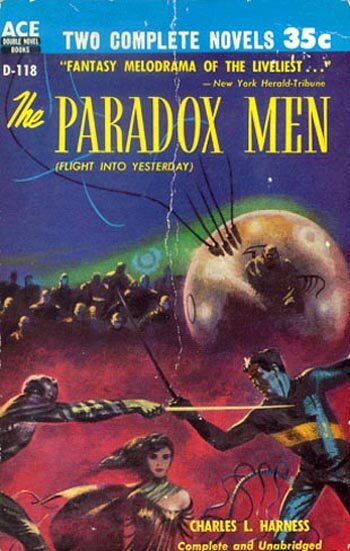
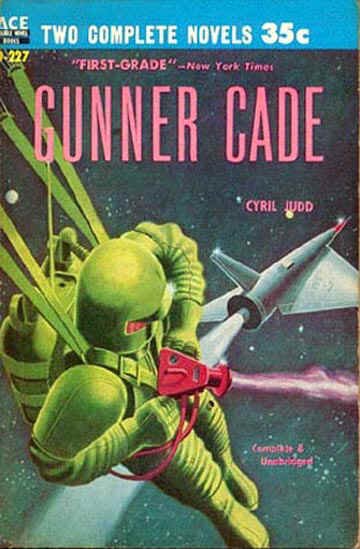
Burroughs tended to write stories in multi-volume cycles, knit together by a unifying hero, the best known of whom is Tarzan of the Apes. Before he began mining his ape-man conceit, however, Burroughs had invented the intrepid John Carter of Virginia, a captain of cavalry under General Lee during the Civil War and, after peculiar events while prospecting for gold in Arizona, no less than Warlord of Mars, Prince of the Twin Cities of Helium, Husband of Princess Dejah Thoris, and Honorary Jeddak of Thark – one of the hordes of barbaric Green Men who roam the dead sea bottoms.[2] In the single, universal tongue of Mars, that world’s inhabitants call their planet Barsoom. Curious parties may learn the details of these matters in A Princess of Mars (1910), The Gods of Mars (1912), and The Warlord of Mars (1913), the first three of what eventually became a ten-title series. The last of them, Llana of Gathol, saw publication in book-form as late as 1948. The local bookseller, Martindale’s in Santa Monica on the old Third Street Mall, stocked the Ballantine editions. When I could get my hands on one, I preferred the Ace editions, which featured cover-art by Roy Krenkel, whose sinewy leaping figures in exotic backgrounds belonged to the same hyper-romantic dispensation as Burroughs’ prose. What the NASA-men intently tore down, Burroughs systematically built up, notwithstanding the fact that he lay fifteen or twenty years dead in his grave while the technocrats, to borrow a phrase, contemporaneously scurried about their affairs, serene in their assurance of their empire over matter.
Aficionados of Burroughs rank the original “Barsoom Trilogy” highest among the John Carter sagas; the three stories qualify together as a coherent epic and establish the heroic-crepuscular milieu in which the subsequent installments take their place. Later books of the series, in Linn Carter’s estimation in Master of Adventure (1965), “pot boilers.” “It is to be expected… that the majority of Burroughs’ works do not contain the creative values of the few best.” A passage from Llana, however, rather than one from A Princess or The Gods, best conveys the magic of the Burroughsian fantasy, perhaps because the author himself, at the terminus of his creativity, feels the nostalgic tug of his own long-established myth. John Carter, taking a sojourn from the burden of duty, penetrates unknown regions of Barsoom in his one-man flyer. “It is always a little saddening,” he says in remembering the aerial view, “to look down… upon a dying world.” Yet even in its planetary decadence, rusty old Barsoom displays a multiplicity of fresh wonders. The archeological layers of the global kitchen midden suggest a mystery that the curious might plumb and which they might decipher. The wise will certainly delve, becoming wiser yet, and the lucky ones of them will indeed decipher.
As in some latter-day Marco Polo’s cosmic Cathay-diary, Carter notes:
It was about noon of the third day that I sighted the towers of ancient Horz. The oldest part of the city lies upon the edge of a vast plateau; the newer portions, and they are thousands of years old, are terraced downward into the great gulf, marking the hopeless pursuit of the receding sea upon the shores of which this rich and powerful city once stood. The last poor mean structures of a dying race have either disappeared or are only mouldering ruins now; but the splendid structures of her prime remain at the edge of the plateau, mute but eloquent reminders of her vanished grandeur….
I am always interested in these deserted cities of ancient Mars. Little is known of their inhabitants, other than what can be gathered from the stories told by the carvings which ornament the exteriors of many of their public buildings and the few remaining murals which have withstood the ravages of time and the vandalism of the green hordes which have overrun many of them…. The magnificent edifices were built not for years but for eternities….
What Williamson writes of Wells’ scientific romances – that “I fondly recall the thrill of widened horizons they gave me in my own teens, when I first found them reprinted in the gray pulp pages of Hugo Gernsback’s then-new Amazing Stories” – applies equally to Burroughs, making allowance for Wells’ wider novelistic range and somewhat more literary character. I like Williamson’s phrase, “widened horizons.” In the Burroughsian passage above, for example, one confronts in its essential form a typical quality of science fiction. The plot in a science fiction story frequently turns on the discovery that time possesses a hitherto unsuspected depth and that sophisticated civilizations existed well before the present one had emerged even in its earliest stage. Plato used this conceit prototypically in the dialogues Timaeus and Critias, where the Atlantis-story makes its debut; that island-nation vanished beneath the waves, Plato’s narrator says, nine thousand years before the heyday of Athens under the regime of the Pericles. “You remember only one deluge,” the Egyptian priest instructs his Greek visitor loftily, “though there have been many.”
The invocation of deep time serves to shock readers out of their parochialism and complacency. The remains of Barsoomian Horz in Llana remind us of the planet’s antiquity, of its layers of succeeding civilizations and polities, and of the struggle of its people against the shrinking resources of their world. The phrase “hopeless pursuit of the receding sea” tells of the heroic determination that takes up the fight not only against implacable natural processes but also against the tendency of people to succumb in advance to the mere suspicion of a defeat. The past is not, therefore, the worthless detritus of empty days that people might as well forget; it is a saga that they should remember, on whose lesson a community may sustain itself in its current hardships.
“The magnificent edifices” of Horz in its prime, Burroughs writes, “were built not for years but for eternities.” The paltry later constructions have already rotted away into the encroaching sands. When one lives in a place as bereft of history as Southern California one imagines the archeological strata; in so doing one compensates spiritually for an actual deficiency in the surroundings. Burroughs lived in the San Fernando Valley, which, while lovely in his day, could not boast of much in the way of history, and of little more today. The name of the San Fernando Valley stands as synonymous with postwar suburban shallowness. In remarking on those fantastic edifices built for eternity, Burroughs might well be aiming an oblique criticism at the cheap construction that prevailed in the Valley in the crass boom-time after World War Two, as along Ventura Boulevard. During this phase of aggressive real-estate development, the Burroughs ranch, much subdivided, became the bedroom community of Tarzana, located not far from Granada Hills, and lying just over the mountains from the twenty-seven-mile-long Malibu shoreline. A cheap, unimaginative architecture prevailed there, too, which sprouted up in the same period, blocking the view of the ocean.
Burroughs’ Barsoom, richly imagined, differs but little in its stratified ancientness from Wells’ implied, although not fully realized, Mars of The War of the Worlds because both begin in the fin-de-siècle vision of the fourth planet from the sun. In the Conclusion of Mars (1894), Lowell writes, “Mars being thus old himself, we know that evolution on his surface must be similarly advanced.” Later he adds: “Quite possibly [the] Martian folk are possessed of inventions of which we have not dreamed, and with them electrophones and kinetoscopes are things of a bygone past, preserved with veneration in museums as relics of the clumsy contrivances of the simple childhood of the race. Certainly what we see hints at the existence of beings who are in advance of, not behind, us in the journey of life.”
Lowell, who saw canals and oases on Ares’ dusky sphere, was a Transcendentalist, after Emerson, while Wells was a Darwinian and a materialist; Burroughs shows elements both of a materialist’s unsentimental skepticism and of a Theosophist’s baroque credulity. This explains their differences with respect to the Martians. All three agree, despite their differences on the other matter, that, where the Martians abide in farsighted ancientness, the human race slumbers in the cradle of its infancy and cannot yet have attained wisdom.

IV
Sensitive interpreters will detect a subtle but pervasive epistemological theme in Wells’ The War of the Worlds. In flight from Horsell Common, where the Martians, emerging from their pit, have unlimbered their heat-ray, Wells’ narrator encounters a trio of young people who not only know nothing of the calamity but also laugh off the notion that anything untoward might alter their existence. The narrator asks, “Haven’t you heard of the men from Mars?” “Quite enough,” says a young woman among them, whereupon “all three of them laughed.” The laughter signifies their perfect complacency. Says the narrator, “You’ll hear more yet.” At Shepperton, on the day after the Martians have begun to move in earnest, “the idea people seemed to have… was that the Martians were simply formidable human beings.” In the Epilogue of the romance, the story-teller remarks that “we have learned now that we cannot regard this planet as being fenced in and a secure abiding place for Man.” Knowledge, which never serves man, divides men into the two great groups of the witting and the unwitting or of the satisfied and the unquiet. Wells’ narrator describes himself as tending habitually to “the strangest sense of detachment from myself and world about me,” which, in such a mood, he watches “from outside, from somewhere inconceivably remote, out of time, out of space, out of the stress and tragedy of it all.” He is himself, so to speak, a Martian, in that he makes objective scrutiny of the situation, if not his modus operandi, at least his invariable opening move. In fact, all his struggles have the Homeric-nostalgic aim of reuniting him with his beloved wife. Wells provides the narrator’s foil in The War in the form of the whining Curate, who, interpreting the alien onslaught as the Biblical Day of Judgment, succumbs to paralytic fatalism. Unable to square himself with reality, he falls victim to the Martians, nearly taking the narrator with him.
In Burroughs, too, one finds a sorting out of truth from falsehood, as in The Gods of Mars (1912) and The Mastermind of Mars (1926), where the hero in each case must, in the course of his ordeal, throw over the empty idols of a sacrificial cult and liberate the people from superstition. But I needed Bradbury’s Martian Chronicles to present me with the rhetorical trope (a word I try to use here precisely rather than profligately) that crystallized and so gave form to the faith with which I invested the genre. The sentence that knocked me flat occurs in the second item of Bradbury’s twenty-six-item episodic forecast of human, all-too-human affairs commencing in January 1999 and concluding in October 2026; the story, called “Ylla” after its golden-eyed brown-skinned lady-Martian protagonist, concerns the arrival on that delicate globe of the First Expedition from earth and its unexpected and violent fate. Let me first offer a few of the contextual details, for the character of Bradbury’s imagery, which exerted a strong pull on me, justifies some exposition. He visualizes his Mars intensely, with tactile vivacity, lending it a kind of palpable, physiognomic truth. I will quote the catalyzing period from “Ylla” at the end of the paragraph after the next one.
Ylla and her husband Yll abide with one another testily “in a house of crystal pillars… by the edge of an empty sea,” an imaginary locale reminiscent both of Burroughsian Horz and of Venice, California, the seaside suburb of Los Angeles, decaying from its original upper-middle-class primness into incipient slum-like desuetude, where Bradbury lived and wrote in the late 1940s and early 1950s. The “hot wind” of Bradbury’s Mars resembles the notorious Santa Ana winds of Southern California, the ones that spark and then drive the hillside conflagrations that my father became expert at fighting as a captain and then as a battalion chief of the City Fire Department in the same decade. As Bradbury first reveals him, Yll sits alone in the library of his house, “reading from a metal book with raised hieroglyphs over which he brushed his hand, as one might play a harp.” The pages speak as Yll strums, reciting legends “of when the sea was red steam on the shore and ancient men had carried clouds of metal insects and electric spiders into battle.” The allusion to ancientness is apt, for Yll’s heroic lays bear a distinct, a directly genealogical relation to those “stories told by the carvings” of age-old Horz in Burroughs’ Llana. In the oceanic “red steam on the shore” Bradbury appears in a mood of self-reference, for his Venusian novella Lorelei of the Red Mist (1944), co-written with Leigh Brackett (1915 – 1978), sets its action against a similar ruddy backdrop.
In the Chronicles story, the husband and wife have grown apart, Ylla yielding herself up to erotic daydreams and Yll to his chansons de geste. The anomie of their marriage serves as an indicator of profound dislocations in Martian culture, which Bradbury represents as, in many ways, degenerate. Ylla reports to Yll a dream she has had about a tall blue-eyed man, arriving on Mars from the third planet in a shining metal conveyance, a man who meets and woos her. Bradbury’s Martians suffer from morbid, uncontrollable telepathy: Ylla’s dreams forecast the actual, imminent advent of astronaut-explorer Nathaniel York and his co-pilot Bert from earth. Quoth the husband, a jealous fellow who seeks any opportunity to belittle an estranged wife more vital and acute than he: “The third planet is incapable of supporting life… our scientists have said there’s far too much oxygen in the atmosphere.”
In 1907, Alfred Russell Wallace (1823 – 1913) published his pamphlet – Is Mars Habitable? This was in response to Mars and Its Canals (1906) by Lowell, which became a cause célèbre among a large popular readership. Wallace, co-discoverer with Charles Darwin of the idea of biological evolution through random selection and the survival of the fittest, anticipated the stone hearts of the Mariner 4 lab-coats by saying, in so many words, what Yll says in Bradbury’s jewel-like chronicle. Bradbury had certainly read Lowell and he had probably read Wallace. Whatever the case, he knew well what an increasingly authoritative scientism had done, under its killjoy imperative, with the variegated living orbs of Nineteenth Century astronomical speculation. He interpreted the scientistic nay saying – accurately – as the symptom of a spiritual malaise, a loss of the capacity to believe, a loss of pneumatic orientation in a universe deliberately denuded of significance. While I hardly qualified as a bright seventh-grader, the celestial assizes must have acknowledged me as one who had steeped himself steadily for some years in books, often a bit over his head, acquiring a respectable lore along the way. I could therefore recognize Yll as a type wedded to a view. Many of my teachers belonged to this type and espoused the same view; they were moral policeman dedicated to rooting out what struck them as eccentric and, I suppose, nasty ideas. In Ether Wave, the ditto mastered “science fiction magazine” that my friends and I produced on school equipment at this time, George Katz had written: “There are people who wouldn’t be caught dead reading what they count as ‘trashy fantasy.’”
On the other hand, George wrote, “there are people who make sure that at least one book out of ten that they read is science fiction,” a marvelous statement for its assumption that reading books by the ten-count is a perfectly normal endeavor. The fading copy of Ether Wave is noteworthy for its grammatical integrity, which was not the result of our teacher-supervisor, Leonard Vincent, rewriting any of the material.[3]
The Martian Chronicles reverses the main device of The War of the Worlds, staging what amounts to an invasion of Mars by terrestrials, who, by a rich irony, bring with them the same bacteria and viruses that the Wellsian Martians cannot resist and to which they (also Bradbury’s) swiftly succumb. Bradbury’s Martians perish pathetically on their own turf, not on territory against which they have aggressed. When, two decades later in graduate school, excited people babbled about the newly discovered critical phenomenon of “intertextuality,” I felt quiet amusement over their fervor. George Katz, the Cunningham brothers, and I had confronted, recognized, and internalized “intertextuality” on our own in junior high school. Without making a pother about it, I expected that one story would absorb another; I also expected that my preceptors on the graduate faculty would take H. G. Wells seriously, which none did. “He’s not literary,” one said.[4] As for The Martian Chronicles: Bradbury’s story-cycle also frequently pits people of faith, in one form or another, against moral policemen – dogmatists and bluenoses and the dispensers of that form of bureaucratic spite nowadays familiar as political correctness. In “The Earthmen,” the Martian psychologist maintains with convinced and rather bored stubbornness that the newly arrived terrestrials of the Second Expedition are simply psychopathological Martians suffering from the insanity endemic to the planet, who infect others with their delusions via incontinent telepathy. The captain naively offers to demonstrate his reality and that of his crew by means of an inarguable datum. They take the Martian clinician to their spaceship. When he kills them to make the spaceship go away – “such cases as yours need special ‘curing,’” he tells them – the machine exhibits an antinomian recalcitrance about its own banishment. In response, unable to square his senses with his theory, the psychologist shoots himself.
In “The Moon Be Still as Bright,” Jeff Spender of the Fourth Expedition reacts with violent outrage to the discovery that earlier arrivals, although expeditionary failures, dosed Mars with smallpox, wiping out the original inhabitants of the world; in a fit of guilt Spender claims to have become a Martian and sets about to avenge the dead against their predators. Spender tells Captain Wilder: “What the Martians had was just as good as anything we’ll ever hope to have.” Spender errs because, from ignorance, he leaves out the defects of Martian society in its surly, bureaucratic last days, but he also gets it partly right. In their creative period, the Martians did address existence through an essentially religious orientation, leavened by their joy in aesthetic refinement – hence the fragile, chess-like beauty of their cities. In the longest disquisition in the Chronicles, Spender speaks of the great spiritual “mistake” that Western Civilization made in its modern phase. Having endorsed Darwin and Freud and Huxley, “all smiles,” Spender says:
We discovered that Darwin and our religions didn’t mix. Or at least we didn’t think they did. We were fools. We tried to budge Darwin and Huxley and Freud. They wouldn’t move very well. So, like idiots, we tried knocking down religion.
We succeeded pretty well. We lost our faith and went around wondering what life was for. If art was no more than a frustrated outflinging of desire, if religion was no more than self-delusion, what good was life? Faith had always given us answers to such things. But it all went down the drain with Freud and Darwin. We were and still are a lost people.
Spender fears that earthmen will remake Mars along the tawdry pattern of their own recent undertakings. He fears, one might say, that they will fail to conserve the delicate Martian achievement while they promiscuously and unimaginatively replicate the postwar San Fernando Valley on an extraterrestrial locus. Spender thinks like a fanatic, but his insight is real: extending our metaphor we might say that there is no place more intrinsically lost than Ventura Boulevard, with its endless cinder-block strip-malls and prefabricated fast-food joints. In Bradbury’s prophecy, humanity goes on grossly and swiftly to insult Mars with boomtown architecture and pointless marketeering without a genuine rationale. The Neanderthal-like Sam Parkhill makes a hobby of smashing the spires of the deserted architecture with pistol shots.
In “Night Meeting,” a beautiful tale of the uncanny, an earthman of the settled (or rather unsettled) post-Martian Mars meets a Martian from the planet’s culturally robust past on a deserted road after dark. Bradbury gives us his version of the epistemological problem in The War of the Worlds. The question, who knows and who does not know, gets replaced by the question of how anyone knows for certain what he thinks that he knows. Tomás Gomez sees nothing but bone-dry ruins under the stars, saying, “that city’s been dead thousands of years.” Muhe Ca, the Martian, looks at the same towers and plazas and sees “canals full of lavender wine… carnival lights… beautiful women as slim as boats.” They argue. “How can you prove who is from the Past and who is from the Future?” So they “agree to disagree,” which is to say that they mutually acknowledge that the faith of each in what his senses tell him surpasses any necessarily parochial empirical test. Neither one can legitimately rule out the other’s perspective; yet it is not relativism, being firmly rooted in a moral principle that makes amicable disagreement possible because it honors imagination. By contrast, in “Usher II,” Mr. Garrett, the Investigator of Moral Climates, comes from earth to condemn and destroy William Stendahl’s architectural homage to the creepy manse of Poe’s famous story. “You know the law,” Garrett reminds Stendahl: “Strict to the letter. No books, no houses, nothing to be produced which in any way suggests ghosts, vampires, fairies, or any creature of the imagination.” As in Bradbury’s novel Fahrenheit 451 (1952), the Moral Climates people have conducted a jihad of puritanical materialism against poetry and faith: “Every man, they said, must face reality. Must face the Here and Now! Everything that was not so must go!” Stendahl turns the tables on Garrett and walls him in a room of Usher II just before the edifice obeys its program and collapses into the Martian tarn.
In the final tale of the Chronicles, the human colonists on Mars having returned home to fight and be immolated in a nuclear war, a few refugees return to the abandoned world. Ritually, a father burns up a mortgage, official papers, tax returns, and a map of the world; he tells his sons that they will shortly see Martians. The final image of the story and of the story-cycle is of the family leaning over the gunwales of their boat and staring into the looking-glass currents of the canal: “The Martians were there – in the canal – reflected in the water. Timothy and Michael and Robert and Mom and Dad… The Martians stared back up at them for a long, long silent time from the rippling water.”
The struggle of faith against its opposite culminates, as is proper, with a conversion, one that redeems the earlier false conversion of Jeff Spender, who suffered contamination by the same ugly traits that he condemned – hence his propensity to murder. To burn those documents is to renounce a used-up and counterproductive self and to embrace a new pattern of existence. The conversion thus exhibits a dialectical character, being reflective in a philosophical, as well as in a merely optical, sense. The “long, long silent time,” finally, reveals that the tally of days to come will be as deep as that of days that have been. Eternity stretches one way and another. Contemplating the book provoked the reader towards a similar comprehension of time and a similar dialectical transformation. He too must become a Martian of the best type, on the order of Muhe Ca in “Night Meeting,” and so receive immunization against mental inflexibility and a wasting of imagination. The Chronicles pricked their devotee with spiritual vaccine in more ways than one. Bradbury’s Mars-saga no more conforms to political correctness, for example, than does the Poe-inspired house in the story “Usher II” from the creepy viewpoint of the Office of Moral Climates. Bradbury understands moral complexity; his analysis matches its object in subtlety. Thus much of the mayhem on Mars after the terrestrial arrival occurs haphazardly, rather than as the result of malicious calculation; the Martians, far from being angelic victims overrun by blue-eyed Viking devils, are a people as pneumatically distorted and self-stymied when the human advent happens as is that twisted oncoming humanity itself.
The stories “Ylla” and “The Earth Men” indicate that the Martian humanity, too, has rigidified into dogmatism, intolerance, and stultification. The Martian psychologist anticipates Mr. Garrett of Moral Climates perfectly, for he is a prig who can call on official power to back up his blue-nosed aversions. Incontinent telepathy, the scourge of the Martian mind, meanwhile resembles nothing so much as television in its leveling, mimetic influence on the culture.
As I had The War of the Worlds, I reread The Martian Chronicles obsessively; for a year I held it on loan, renewal after renewal, from the school library, until I acquired my own copy in the form of the Bantam paperback edition. I read whatever else of Bradbury’s that was available, A Medicine for Melancholy, The Golden Apples of the Sun, The Machineries of Joy, R is for Rocket, S is for Space, The Illustrated Man, Dandelion Wine, Something Wicked This Way Comes. These anthologies collected the items that Bradbury had published in every imaginable venue in the 1940s and early 1950s. It was not all science fiction. Bradbury interspersed his fantastic recitals with odd little stories of the postwar Mexican neighborhoods around downtown Los Angeles, Irish sallies, growing-up-in-Wisconsin narratives, and incidents of small town romance and disappointment.
V
We like to think of science the way that science, as an institution, wants us to think of it, for, being an institution, science inveterately justifies itself in the propaganda that its critics call scientism. We all imbibe this catechism with our public education. Scientism wants us to think of science as exclusive and inarguable in the epistemological realm; it would reduce everything entitled to the moniker of “knowledge” to its own narrow, but selectively applied, canon of experimental validation. Scientism shuns speculation, which means ultimately that it shuns thinking, preferring to rely on quantitative formulas or simply on ex cathedra pronouncements that use the language of science and occasionally refer to a quantitative datum. Darwin, whatever the weakness of his theory, was not a scientistic thinker, but his neo-Darwinian followers are; creationists, even their inveigling cousins the “intelligent design” advocates, despite their rejection of neo-Darwinism, are scientistic in their thinking – or rather in their non-thinking. Like all ideologues, the adherents of scientism (which can take many forms) hold to a theory, from the cozy seduction of which nothing, neither fact nor logic, will move them. Scientism, while cloaking itself in the language of empirical discourse, shows the innards of a Gnostic dispensation, whence its dogmatic quality. Scientism is, then, the opposite simultaneously of faith and of science: knowing what it knows, it seeks safety in the familiar, looks to its neighbor for cues; scurrying about its affairs, it maintains an absolutely epistemologically risk-averse stance vis-à-vis experience. Risk-aversion never marks the real wrestler with reality, as the cases of Aristarchus (Fourth Century BC) and Johannes Kepler (1571 – 1630) amply demonstrate. Neo-Darwinists and creationists huddle together in their respective conformist mobs; like the politically correct and the religiously bigoted, they fear nothing so much as a heretical utterance.
The redoubtable Sir Arthur C. Clarke (born 1917) – author of The Sands of Mars (1951), among many other titles – makes terrific fun of scientism in his “Report on Planet Three,” a Saturday Review piece from the mid-1950s. “Report on Planet Three” purportedly translates a Martian document rescued by archeologists from the ruins left by the defunct Martian race, which destroyed itself in nuclear warfare a thousand years before the arrival of space faring humans; the translated document sets forth the cock-sure opinion of Martian institutional science about conditions on earth. Clarke captures the tone of scientism with scientific fidelity: “To sum up, therefore, it appears that our neighbor Earth is a forbidding world of raw, violent energies, quite certainly unfitted for any type of life which now exists on Mars. That some form of vegetation may flourish beneath that rain-burdened, storm-tossed atmosphere is quite possible.” The document continues: “The question of intelligent life on Earth must be regarded as settled. We must resign ourselves to the idea that we are the only rational beings in the Solar System.” Clarke has picked up on the necessity of the passive voice in such pronouncements, as in the phrase, “must be regarded as settled.” By isolating the judgment from any identifiable judge with whom one might engage in question and answer and by shielding it against dissent, the grammar of the phrase endows the enshrined notion with an indubitable character, which it would be profane to doubt.
Faith has endured much tribulation with respect to the genteel idea of a vital universe, beginning with Eugène Antoniadi’s observations, employing the optically refined thirty-three-inch refracting telescope at the Meudon Observatory, during the planetary opposition of 1909. Antoniadi (1870 – 1944), a genuine scientist, showed that Lowell’s claims for the geometric regularity of the canals jibed badly with careful observation and charting of the relevant details. Antoniadi upheld the possibility of vegetation and even of animal life on Mars as late as his masterly Planète Mars (1930), long the standard work, but he had ditched the canal theory of Lowell and of his and Lowell’s common mentor in astronomy, Camille Flammarion (1842 – 1925). Yet the increasingly desiccated Mars asserted by the JPL and NASA types since the mid-1960s has also, over the decades, strained to preserve its inviolability. The contest has simmered in B-section newspaper stories, obscure scientific periodicals, and slightly cranky websites, noticed only by those attuned through their “Martianiziation” to the vibrations of such recondite matters. A handful of external critics – most vocal among them Richard Hoagland and Michael Bara – have even accused NASA of thirty years of cooking the evidence. In 2002 no less an eminence than Clarke himself made a public point of posing difficult questions for the Space Agency.
A follow-up to Mariner 4, the robotic orbiter called Mariner 9, left earth on 30 Mat 1971; it eased itself into Martian orbit on 14 November of the same year and began snapping photographs. Mariner 9 produced a shock perhaps greater than that produced by Mariner 4, but for the opposite reason. Instead of a moon-like planet, Mariner 9, using better cameras and reconnoitering the globe repeatedly from close orbit, drew back the veil of a complex and (at least) recently active planet. In the region subsequently dubbed Valles Marineris, the orbiter discovered a prodigious canyon to make the Grand Canyon of the Colorado look like a gutter; it also returned images strongly suggestive of past large-scale hydrological activity on the planet. I remember the televised coverage of Mariner 9, which I watched attentively and eagerly. I remember the urgency with which the project scientists sought to downplay or eliminate the obvious hydrological hypothesis for explaining what were, to the eye, obvious flood-plains. That near-oceanic quantities of liquid water had once flowed across Mars one could not acknowledge, even preliminarily, indoors at JPL’s Pasadena campus or before the cameras. But, as all denizens of Highland Park know, Pasadena is a deeply blue-nosed polity, with quaint architecture and a quasi-aristocracy of old money. No one there ever admits to anything. A recurring formulation of the mission’s official interpreters invoked something other than water as the formative agent of the massive erosion, although what else might have flowed they never managed to specify. Flowing water meant atmospheric pressure on Mars at one time equivalent to that on present-day earth, another conclusion officialdom would barely allow. More trouble for orthodoxy came with the Viking missions of 1976, whose main purpose entailed the search for biological activity on the Martian surface, this possibility having become poignant again in the aftermath of the Mariner 9 reconnaissance.
Two Viking probes sailed out across the gulf of space, Viking I starting its voyage on 20 August 1975, its landing module touching down at Chryse Planitia, in the bleak Martian Northern hemisphere, on 20 July 1976. Both Viking landers carried an array of experiments to test for life. The most important of these, the Labeled Release Experiment, would work this way, as described by its designer, Dr. Gilbert Levin: it would place a single drop of water in the center of a scoop of Martian soil from the landing site; on the supposition that wetness abets biological activity, which on earth is water-based, microorganisms in the sample ought to exhibit a metabolic spike, giving off gasses, of the methane group, indicative of organic processes. At both landing sites, the LREs repeatedly yielded gaseous spikes on the introduction of water to the sample. The rationale of the LRE rested on the assumption that the presence of methane normally indicates metabolic activity. Thus, according to the syllogism of the procedure, If methane – then life! Levin describes the NASA reaction in an interview:
There was strong opposition to any biological conclusion…. Then Dr. Orgel came up with his [Hydrogen Peroxide] oxidant theory, after which a plethora of variant oxidant theories were put forth until the present. Many other theories were also put forth. These were all capped with the insistence… that [as] there could be no liquid water on the surface of Mars, [there was] no life…. I followed and refuted all the arguments, as, for example, in my 1986 paper to the National Academy of Science, which concluded with the statement that it was then as probable as not that the [LRE] had detected life. However, this was greeted with derision. I continued to study new data from Mars and Earth relevant to the issue, until, in 1997, it became obvious to me that… the [LRE] had… discovered living microorganisms on… Mars.
Not even the March 2004 NASA announcement that the Mars Express orbiter had detected methane in the Martian atmosphere would alter the Agency’s official position on the Viking LRE results. The photographic evidence of liquid water still at work altering the environment, as reported back by the same source, also failed to dislocate the anti-biological orthodoxy. One could only have expected such recalcitrance. NASA had switched into denial mode after its own Antarctic expedition in 1996, headed by David S. McKay, found a meteorite of Martian origin filled with microfossils. Hoagland and Bara, on their “Enterprise Mission” website, catalogue a long list of other obstreperous or sneaky behaviors on the part of NASA and its administrators: arbitrarily altering the color-values of the Viking surface imagery to give the Martian sky a pinkish, hence strange, rather than an azure, hence earthlike, hue; hiding provocative photographs of unusual features in the Martian topography which private researchers ferret out only after invoking their freedom of information rights; and misreporting quantitative data – to name but a few.
I invite the curious to spend some leisure browsing the “Enterprise Mission.” In fairness, I ought to mention that Hoagland is known as the persistent advocate of the so-called Face on Mars, with which NASA inevitably tars him. In 1987, Hoagland published his book, The Monuments of Mars, which has since gone through many editions. But the Face figures only in a small, if notorious, way in Hoagland’s sweeping reinterpretation of thirty years of remote Mars exploration. The region of Cydonia on Mars includes the anomalous face-like formation, but what emphasizes the apparent non-naturalness of this conspicuous feature is its association with hundreds of other anomalous features in the identical vicinity and elsewhere on the planet. The combination of the quantity of anomalous phenomena with the quality that distinguishes them from natural objects gives pause.
Close inspection of thousands of photographs reveals, for example, what seem to be glassy tubes in what amounts to networks in both Martian hemispheres. Photographs from the region around the Martian South Pole show objects that give every indication of being large clusters of vegetation. This is what any observer would think that they were if the photographs carried the label identifying them as terrestrial rather than Martian in origin. As soon as the Mars label gets attached, our reflexive skepticism tends to kick in. It should. Yet it is essential to be skeptical about skepticism, a fine point of epistemology missed by casual materialists. Clarke’s entry into these matters took its inspiration from the oddness of the glassy tubes and the obviousness of the austral growths and finally from the inadequacy of NASA explanations of these things. A deeply scientific man and a hardheaded skeptic in the best sense, Clarke said in December 2002, while speaking at a conference with Apollo astronaut Buzz Aldrin, that: “I’m fairly convinced that we have discovered life on Mars… There are some incredible photographs from [the Jet Propulsion Laboratory], which to me are pretty convincing proof of the existence of large forms of life on Mars! Have a look at them. I don’t see any other interpretation.”
Now maybe it is so and maybe it is not. My point is not to argue the case for Hoagland. Readers could not trust me if I did, as I have identified myself as one who read The Flying Saucer Conspiracy when he was twelve years old. Supposing Hoagland’s interpretation of the evidence to be rash, however, Mars would still be a more active and interesting place than institutional scientific discourse concedes. One can even invent plausible reasons for NASA to have dissimulated its findings: to gloss the findings positively so as to declare, “we have discovered life on Mars,” would entail taking a terrific risk of later, embarrassing refutation, whereas a negative position pro tempore can always be changed later in such a way that the confession of earlier reluctance itself makes the new, revised announcement appear admirable. Again, an eager bulletin about Martian biology might prompt Congress to suspect a NASA of inventing a wonder to justify increased spending, which might then result in an even stingier purse by way of resentful reaction. If we succeeded we would fail, the thinking would be, so we must never appear to succeed. All this considered, one’s inkling of an orthodoxy insisting on its narrow view of things nevertheless persists. The bigwigs seem to hold to a long-ensconced “anti-biological” notion of the solar system beyond the earth and to ignore evidence that would force them to revise or abandon that notion.
A similar recalcitrance explains why, although forty years of the welfare state have not relieved the problems that Great Society advocates said – and still say – government largesse ought to have relieved, we still have a spendthrift welfare state; it explains why, although for forty years the public schools have failed to teach American children the rudiments of learning, we still have the same dreary public schools, completely reform-resistant. In both cases, the institution cherishes a theory more than it respects reality and the facts. It knows full well what the facts are and what they imply for the theory, so its uses its authority coercively to get people to censor what they know out of their speech. Speaking the facts becomes an offense before the altar. Who expects the Derrideans and Foucaldians in our humanities departments to relinquish their awkward neologisms or their perverse anti-rational perspective? No one who has been there expects it.
To be a Martian does not mean to be a superannuated adolescent who cannot get Dejah Thoris, Princess of Helium, out of his mind, and who has never read Homer or Beowulf because he is perpetually busy reading the latest Star Wars novelization. (On the other hand, Dejah Thoris tends to stick in one’s mind.) To be a Martian indeed has almost nothing to do with Mars, either the fictional planet or the object of scientific dispute. In one case, mine, being a Martian did begin with Mars, but it might just as well have begun – in the case, let us say, of a ten-year-old girl – with the Brontë sisters or Jane Austen. My wife, Susan Dejah Thoris Delaney-Bertonneau, is at least half-Martian (on her mother’s side) and she has traversed a completely different trajectory in life from mine, so much so that the question of how we ever converged abides in mystery. My friend Steve Kogan, no stranger to Praesidium’s pages, stems in equal parts from Russian, Rumanian, and Martian immigration in the first half of the Twentieth Century, in addition to which he has lived in Brooklyn and Manhattan all his life. Whenever I have jaunted to the Big Apple and its environs, I had the sense of being on the moon, or in some place yet more frightening. Steve has a keen Martian sense for the grammar of arguments and can detect the evasion of the passive voice from blocks away. Several years ago he married Carol, a lovely teacher of drama, who, by a piquant coincidence, attended Malibu Park Junior High School in her youth.
Such intersections of the life-trajectories delight but never surprise Martians, who understand that time, being deep, will rehearse many patterns, and reveal spiritual sympathies across continental – or, who knows, even planetary – distances. In crisscrossing the UCLA campus in my second phase as an undergraduate or in my graduate-student years, in the 1980s, the pleasure befell me at least a half a dozen times to run into that Martian of Martians, Ray Bradbury, who always let me belay him for ninety seconds to bother him with flustered compliments. On each occasion, smiling behind his thick lenses, he gave the valediction, “God bless you, young man!” I knew what he meant. “God bless you, young Martian!” Well, “God bless you back, Sir!”
[1] It would have been one of the DC anthology comics – perhaps Unknown Stories. In the tale, whose title and most of whose details escape me, a man falls into a vat of liquid that causes his body first to revert to the earliest form of animate life and then to recapitulate the stages of evolution on the way to Homo sapiens. As a slithering, giant, one-celled creature crawls out of the vat, one of the horrified onlookers remarks that “Steve” – the character-name I do, for some reason, recall – has become a giant paramecium. From the same strange source I knew, and know, that the organs of locomotion of a paramecium bear the name of flagella.
[2] In addition to the John Carter stories set on Mars and the Tarzan stories set in Africa, Burroughs also wrote a Carson Napier series, set on Venus, and a David Innes series, set in an underground world (actually the hollow earth) known as Pellucidar. At the Earth’s Cor,, mentioned above, is the first in the Pellucidar series. Burroughs’ Venusians call their world Amtor. In the Burroughs oeuvre there are several shorter cycles, such as the Caspak trilogy, set on an uncharted South Pacific continent, where evolution has taken strange turns.
[3] My treatment of A. E. van Vogt’s The Space Beagle (1949), while irate and stingy, and thus lacking in decorum, nevertheless manages not to perpetrate too many solecisms: “At times he creates an atmosphere that likens to Poe or Melville,” I wrote of van Vogt. The Poe parallel I see, but what item of the Melville corpus was I thinking of? It is not impossible that I had read The Encantadas, as Melville’s island stories were oddly listed in those days as of interest to boys, and could arise within the curriculum. In the front section of the literary enterprise, defining science fiction, I contribute a discussion of “logical extrapolation” as the defining feature of the genre. Ether Wave contains three necessarily derivative stories, which nevertheless show a vocabulary and a feeling for sentence structure that surpass entirely what I see semester after semester in the work of undergraduates who enroll in my freshman composition classes at SUNY College Oswego.
[4] I must list one exception, Raymond Paredes, then Professor of English specializing in Chicano literature and now a dean of humanities; in my last semester of baccalaureate studies, when I had met all requirements and needed someone to supervise an independent study for credit, Paredes signed off on my proposal to write what amounted to a senior thesis on Lowell’s astronomy and Transcendentalism, which included a section on Wellsian and other fictional adaptations of the inhabited Mars theory. A letter from Paredes, who had been my “Popular Literature” instructor in a summer course, helped me overcome my patchy academic record to get into the UCLA Graduate Program in Comparative Literature, whose Ph.D. has hung around my neck ever since.
***************************
The Narcissus Narcosis: A Platonic Dialogue on the Plight of Culture in Contemporary Society
by
John R. Harris
The following exchange has a little of the tongue-in-cheek—but more of the earnest, probably far more than most readers will find tasteful. After all, the quasi-Platonic dialogue, its participants specially selected for their ability to allegorize a large segment of humanity, hasn’t been in vogue for a few hundred years. If you prefer, then, view this colloquium as mostly ironic—or as the fantasy, perhaps, of a cultural exile starved of good conversation for years.
Conloqui Personae
Pillar of the Community—A middle-aged male who has prospered financially and believes implicitly that a great “moral majority” clears its quiet voice from time to time in national elections.
Philosopher—A man of letters who is not, however, wedded to the ivory tower and its arcane ways; though his speech is often stilted, he is devoted to enduring truth rather than to worldly laurels.
Soccer Mom—A young matron who has not been induced by her prosperous circumstances to embrace the free market; on the contrary, she is deeply distressed by hurt feelings and deplores cutthroat competition.
Student—A young man at one of life’s crossroads; he has advanced just far enough in his studies to wonder why he bothers with them.
Student: It turns my stomach to see how commercialized everything is. Valentine’s Day is almost a sort of mini-Christmas—it’s more than, like, chocolates and roses now, or even diamonds. Easter is the season for all the women to show off their new dresses at church. July 4 is all about food and fireworks—and gas prices shooting up as everybody hits the road for a vacation. Labor Day… more traveling, more gas, more profits for the oil companies. Halloween… candy and costumes. Thanksgiving… a professor told me that Thanksgiving used to be the first Thursday of November, right after Halloween. They were both supposed to be, like, related to getting the year’s harvest in. Now, besides more traveling and more eating, it’s the day before the biggest shopping day of the year. It’s part of Christmas season, which is all about shopping…
Pillar: Well, I believe the moving of Thanksgiving was occasioned by World War Two. Something about FDR not wanting to waste so many daylight hours on a holiday early in the month. Or… was that it, Philosopher?
Philosopher: Something like that.
Pillar: There you go! It wasn’t about selling things at all.
Soccer Mom: No, it was about killing people.
Pillar: No, it was about stopping killers. But in any case, Student, what’s so wrong about selling things? It’s putting you through school, isn’t it? I’ll bet you don’t ask where your dad got the money when it comes time to pay your tuition.
Student: Actually, he doesn’t pay my tuition. He split when I was eight. Evidently, while he was selling all those things, he was buying a lot of things, too. And not just for us.
Soccer Mom: Sounds like my husband’s ex. She didn’t even fight for custody of their son.
Student: I manage to pay most of my bills with my own earnings.
Pillar: Good for you! What’s your line?
Student: If you mean what do I do, I sell cell phones. I started out in a cart at the mall. Now I’m in one of the branch offices.
Pillar: The cell phone—now there’s a business with a future! And where would you be without it? You see, the hunger for new products in our free society is sending you through college.
Student: You should have said, where would college be without my job? Because I don’t know that I’m going to finish college. I’ve already been there four years, and I’m barely a junior.
Soccer Mom: No, you should finish college. You never know what the future might bring.
Pillar: That’s true. A college education can open a lot of doors.
Student: No offense, but… that’s just a bunch of crap. I’m already making good money, and college is just… like, siphoning it out of my bank account. What I learn on the job is more up-to-date than what I learn in my classes—the ones that really mean anything, that is—the ones that might almost be useful. For a while, I enjoyed the social life. But now it’s almost like being back in high school. Just a bunch of kids getting high and oversleeping…
Pillar: Today’s youth! They probably have had some very bad influences in their lives.
Soccer Mom: But I’ll bet you did the same thing when you were their age. We all did.
Pillar: But a voice called us back to the right path. Who knows, young man? Maybe you will be the ambassador of that quiet, gentle voice in the lives of some of your peers.
Philosopher: Over a cell phone?
Pillar: Philosopher! I had almost forgotten…
Philosopher: What? That I was here? No doubt! You had almost forgotten the thrust of your own argument, as well.
Pillar: What do you mean?
Philosopher: Why not let me recover it for you? Student, you say that the commercialization of our holidays revolts you. Yet commercial activity is what puts bread on everyone’s table, and you are so far from renouncing it yourself that you are considering a full-time commitment to it which would simply leave your studies by the wayside.
Student: Yes, but…
Philosopher: But you have no choice. You have to pay your bills, and college is one of the heftiest of these.
Student: Yeah. Exactly. If I could afford to, I’d lie on the beach all day long and read books… or surf the Net, anyway.
Philosopher: And inasmuch as college’s major justification for all the strains it places on your budget is precisely that it will increase your income—yet it continually does just the opposite—you not only have lost patience with it, but you have lost faith in it.
Student: Right. I guess… what do you mean, exactly, by “faith”?
Philosopher: I mean that college lied to you. You can see that it is not only not helping your financial circumstances at the moment, but that there is no reason to suppose it will do so in the future.
Student: Well, if you put it that way… sure, I wish I had my tuition money back for the last two years. The first two were fun. I’d let college keep that much.
Philosopher: It delivered briefly on an initial promise to amuse you, but never on an oft-repeated promise to enrich you.
Student: Right. Exactly.
Pillar: But never is a long time, and this kid is only… what? Twenty-two? Twenty-three? Studies have shown that people who go to college end up making a better living.
Philosopher: But studies have not shown whether the better living is attributable to the effects of college or, rather, to the fact of someone’s having had the money, connections, energy, and discipline to get through college. In the latter case, the college degree merely proves that the person is reasonably intelligent, motivated, and well supported without proving that college itself bestows upon him the keys to success. And by a “better living”, I suppose you and the studies mean a higher income.
Pillar: Well, sure. What else would they mean?
Philosopher: Something suggested by a quiet, gentle voice, perhaps. But let me return to our student. Would it also be fair to say, Student, that college at least implied another promise to you—certainly made much less noisily than the promise of worldly success—and that it broke faith with you there, too?
Student: I… which promise do you mean?
Philosopher: I mean, the promise to enrich your life as a human being rather than as a producer and consumer; to explain life to you—its duties, its possibilities, its limits—and to unveil to you deep places and creative abilities in your spirit. Did you expect college to impart some such revelation when you were admitted into its ivy-covered walls?
Student: Hah! That is how you think about college, you know! When you’re young, I mean. Before you actually go there. You think of old guys in gowns with ivy wound around their heads, like those old philosopher dudes. Yeah, I thought that part of it might be interesting. I made good grades in high school—I’m not stupid. But there were just a few required courses in things like literature, and all the teachers did was test us over names and dates.
Philosopher: I thought you were probably disappointed in that regard. Your first comments about commercialism could only have been uttered by someone who had an inkling that a “good living” should involve more than money—that there should be certain times when one abstains from making money, even though there may be a small fortune waiting to be grabbed.
Student: I do believe that. I said it turned my stomach.
Philosopher: That revulsion does you credit. It shows that you can perceive hypocrisy.
Pillar: Why hypocrisy? I thought we already agreed that everyone has to put food on the table.
Philosopher: Yes, but one can put food on the table by selling cars with faulty engines; and in that case, one is misleading those who placed trust in one’s product—one is selling false assumptions or pipe dreams rather than well-crafted merchandise. And that may be considered robbing the food off someone else’s table—which is not morally permitted in the name of feeding one’s own family.
Pillar: Right, okay. But again, what does that have to do with selling Easter eggs or Halloween candy? Our young friend seemed to be complaining that candy merchants are somehow evil, and I’d like to know why they’re any more evil than cell phone merchants.
Soccer Mom: A cell phone is useful. Candy just makes people grow fat and increases their risk of heart disease. It ruins children’s teeth and shortens the lives of adults.
Pillar: Not if you eat it moderately.
Soccer Mom: But in a grocery store around Halloween or Easter, you can’t take a step without seeing lots of it. In fact, the grocery stores stock it year round at the checkout counters, where you have to wait several minutes with your kids’ noses stuck right on the display. They don’t want you to get out of there with just a little—they want you to empty your wallet and pig out. And they couldn’t care less about how long you live.
Pillar: But… so what do you want us to do—give all the kids trophies for saying “no” to candy? Do you want the government to create squads of candy police because you can’t control yourself or your own children? For that matter, I’ll bet cell phones kill at least as many people as candy. How would you like it if the government outlawed cell phones in cars? There you’d be, driving along in your van with both hands on the steering wheel and no one to talk to… or maybe there’d be someone in the passenger seat. That, too, is dangerous—talking to a passenger while driving. Would you like it if we had laws forbidding people to talk to passengers as they drive?
Soccer Mom: I assume from your sarcasm that you object to every child having a trophy…
Philosopher: As a matter of fact, cars and candy are a very good symbol, taken together, of how we are forced to make a living in our modern economy. I’m not so sure that any of them makes for a good life, even though they may yield a good living. Or cell phones, either.
Pillar: Great. Eliminate them all, and hug a tree.
Philosopher: No, you don’t turn away from brackish water when you’re dying of thirst in the desert. First you have to get out of the desert. But if you want me to tell you how the commercial feeding frenzy preceding holidays is a variety of fraud…
Pillar: Oh, yes, let’s not pass that by! How about a law to forbid that, too?
Philosopher: There’s already a law—in the human heart. It requires that certain times be set aside to retire from the world so that one may seek the big picture, the meaning of existence. When you sell things with the claim that they will make the retreat more fulfilling, you’re lying. For the value of the retreat comes precisely from its being free and clear of things. Sometimes a rare person will even forego food and comfortable shelter at these times—or used to. Now they are exceptionally cluttered with things: no other times of the year are more so. And the lie which has been made of the retreat eventually becomes so noisome—the whole occasion becomes so patently hypocritical, to use that word again—that people at last neither attempt to withdraw a few days nor waste their money on seductive glitter. The cultural practice of exploiting the holiday—the holy day—for material profit leads to its own demise: the bottom falls out of the candied illusion market. Then you have neither spiritual renewal nor monetary profit. The only measurable increases are in cynicism and weariness.
Pillar: I’m not opposed to what you just said. Not at all! In fact, my church—our minister—takes a strong stand every Christmas against commercialism. I think it’s awful.
Philosopher: But what do you do as a result of what you think?
Pillar: What do we do? Well, we… we buy less stuff.
Philosopher: Less than…
Pillar: Less than… other people. And we give. We give to those who have less. We collect toys for needy children, turkeys for needy families, canned goods for the homeless…
Philosopher: So to condition yourself against our cultural inclination to gauge achievement in terms of things acquired and things possessed, you acquire a little less than the man next door, and you bestow more possessions upon people who have few.
Pillar: Yes. Yes, that’s what we try to do. Is there anything wrong with that?
Philosopher: The same thing, maybe, as fighting a fire by opening umbrellas to keep the wind off it.
Pillar: Well, if you get enough umbrellas together…
Philosopher: Then sales of umbrellas will go up. No, no, no, my good fellow, I’m afraid it just won’t do. Water would be a step in the right direction for such firefighters; but more than that, we need to start dwelling in that which is not consumed by fire.
Pillar: And what on earth do you mean by that?
Philosopher: I mean, instead of sharing our possessions, we need to possess less. Freedom from things is not measured by willingness to give others one’s copies of things or surplus of things, but by willingness to live without so many things.
Pillar: But then our whole economy would collapse! Talk about not having any food to put on the table…
Soccer Mom: And then we would have nothing to give the poor. The poor would suffer most, because we would be poor, too—those of us who help them.
Philosopher: Or else we would all be rich. Or all of us, at any rate, who did not resent their poverty, but instead embraced its opportunities.
Pillar: Now I know you’re out of your mind! No heat in the winter, nothing but rice to eat—and that only once a day…
Philosopher: So you’re familiar with destitution—excellent! But I’m not talking about destitution. For that matter, even destitute people can make a meal of roots or, say, insects…
Soccer Mom: Oh, my God!
Philosopher: Which are really very high in protein. But surely your imagination is not so taxed as to picture us all eating crickets just because no one goes to the movies or buys televisions or devours two burgers a day.
Pillar: Okay, so you have something more moderate in mind. But even so… those things you just mentioned—why, everyone goes to the movies and watches TV and eats burgers! And those industries employ millions of people, and not just Americans.
Philosopher: Do you really think that a world whose citizens didn’t devote three or four hours a day—or more—to sitting in front of screens would be less productive? The same people could be out growing tomatoes for their own consumption or, perhaps, raising catfish in a backyard pool to sell to neighbors, or even carpentering furniture for sale in their own garage-turned-workshop.
Soccer Mom: I love fresh vegetables, and I only buy the organically grown ones, so I’m all for that. But I heard that someone had written a book that said that fish have real feelings, so I don’t think I’d be buying your catfish.
Philosopher: As you wish. Perhaps I would find others with fewer scruples.
Pillar: But you’re talking about turning the clock back to… I don’t know. Maybe a hundred years.
Philosopher: Or maybe a thousand. Yes, in some ways.
Student: And we would last just as long in that state as it took the nearest power-hungry dictator to invade us. I’m sorry, Philosopher—I think your idea is real cool in a lot of ways—I’d love to live there—but it just won’t happen. It’d be suicide, with the world the way it is right now.
Philosopher: Which is why we would also keep developing technology. Except that, instead of transforming it constantly into a suicidal amusement where we push buttons to watch wheels turn—there’s more than one kind of suicide, you know—we would be deliberately anticipating how each new stride might destroy us in the wrong hands and devising methods to neutralize the attempt. Some of our research, in due course, would also help to feed us: perhaps we would find that lasering insects would render them both sterilized of germs and pleasantly crunchy to the taste. But the laser would no doubt be approached with more attention for its significance to national security—shooting down nuclear missiles from satellites, that sort of thing. And medical applications would continue to be exploited, too. At present, by transferring all our sensitive information and operating systems to a single, centralized, electricity-dependent framework, we are designing our own coffin—a future where immense catastrophe is always just one bright terrorist, or one twisted computer whiz or natural disaster, away. Control the simple things in your life, and collaborate upon the complexities of modern political survival: work at the particle accelerator by day, harvest your apples and strum a little Chopin in the evening. That’s the kind of citizen I envision.
Pillar: That would be… strange. And you know what? The Student’s right. It wouldn’t work—it still wouldn’t work. People just aren’t made that way. If you invent a laser to zap ICBM’s, some bright guy will figure out a way to market it as… well, a bug-cooker to prepare supper, okay. You say you can live with that. But maybe his brother will market it into a new way to hunt quail. Are you going to have laws that arbitrarily prohibit the kinds of development you don’t like? Then you’ll have an oppressive society with no capital—and with no capital, how are you going to finance all these astronomically expensive projects?
Philosopher: Maybe by astronomy. Private citizens are already lining up to pay a million dollars for a ride on a Space Shuttle equivalent. Or maybe by telescopes. Why couldn’t virtually every home have a high-resolution reflector telescope in the back yard as well as—or instead of—a gas grill?
Soccer Mom: But you want us all to be poor. How are we going to afford those telescopes?
Philosopher: No, I want us all to be poor in spirit—which I understand to mean humble, curious, not given to pomp and circumstance. A person poor in spirit might pay $10,000 to see Jupiter’s moons up close while he wouldn’t pay a dime to see a high-definition close-up on a super-wide screen of a ballplayer spitting out sunflower seeds. I would have people discover the difference between progress toward the intricate and fixation with the trivial—between thoughtful analysis and fantastical frivolity.
Pillar: Again, Philosopher, how on earth do you expect to do that? What you want is for people not to be people.
Philosopher: No, what I want is precisely for people to be more of the human and less of the mesmerized button-pusher into which they have been perverted and seduced. In a civilized society, culture drives the economy: people sacrifice hard-won earnings to constructing a new temple or hearing a new symphony (which, of course, creates employment for bricklayers and violinists). When an economy is allowed to drive culture, on the other hand—when anything goes as long as its makes money—the culture is indeed driven right into the ground, and civilization soon vanishes beneath a mushroom field of cleverly articulated and monstrously profitable industries catering to the indecent.
Student: Yeah, exactly. Like the man said, you want people not to be people. That’s what they are, man—a bunch of jackals on a carcass.
Philosopher: It seems to me, my boy, that at worst you would be depriving yourself of a place around the primal trough if you chose to believe something better—and the mere persistence of a few people in the “better illusion” would disprove the Serengeti simile, I might point out. Are you afraid of getting bitten by a dog—would you rather be a dog yourself? Look, if I have convinced myself and the three of you in civilization’s worthiness—if we four would rather walk home from work watching the stars come out than fight rush-hour traffic to collapse in front of a TV—then why should we constrain ourselves with the observation that people are only people? For we, too, are people. But I will probably surprise you two gentlemen by agreeing with you to this extent: the kind of undertaking I have in mind requires culture—and we do not currently possess a culture, nor am I entirely sure how we might go about inventing one ex nihilo, or indeed if one has ever been so invented.
Student: I thought you were just talking—a few minutes ago—about our cultural practice of ruining holidays, or something like that. You used the word “cultural”, so you yourself must believe that we have some kind of culture.
Philosopher: Yes, I remember saying that, and you’re right to take me to task for it. I spoke sloppily, as we all often do. The truth is that our persistent sabotage of our internal life—our peace and quiet, our reflective moments, our creativity, our spirituality—is an excellent illustration of why we should be considered not to have a culture. Our routine economic activity is deeply counter-cultural.
Pillar: That’s really funny! In the sixties, hippies and radicals would go around saying that they were the counter-culture. And they were saying that for the very reason that they wouldn’t cut their hair, wouldn’t wear a suit, wouldn’t work in an office—all the things that we normally do. Our routine economic activity, as you say! And now you want to call that the counter-culture?
Philosopher: Not the counter-culture. The phrase is presumptuous whenever certain groups use it of themselves. There can be no “counter-culture”, as a distinct entity, any more than there can be a shadow without light. In the absence of light, one has the abyss of chaos: only when light is introduced do objects here and there throw shadows. In the same way, the self-styled radicals of whom you speak could not have existed without the very order they claimed to be overthrowing. They desperately needed that order so that they could define themselves against it: they had no basis in substance, only in the subversion of substance. You may also recall that “subversive” became a very cool, very “groovy” word at the time.
Pillar: Oh, yeah! I can remember that.
Philosopher: Culture is never parasitic in that way. It is never “not-x”—it always asserts. Hopefully, its assertions are rooted in profoundly human motives, though they can seem arbitrary, and they can sometimes even be wicked if they are a response to a vile but very basic fear or lust. Culture is not automatically a moral good.
Student: Are you talking about something like the Aztecs cutting the hearts out of living girls as a sacrifice to their gods?
Soccer Mom: Oh, how awful!
Philosopher: Yes. That’s probably the best example on record of an evil cultural practice with deeply human roots. That kind of thing. More often, the assertions of culture simply seem arbitrary, even if they spring from a fundamental moral motive. For instance, cleanliness is desirable for at least three reasons. First, it promotes health—and health is a moral duty, inasmuch as a sickly person cannot execute other moral duties. Second, it imposes a discipline upon the will, and an undisciplined will cannot accomplish good undertakings of any complexity even if it longs to do so. Third, cleanliness yields to the feelings of other people—it subordinates the individual’s tendency not to inconvenience himself to the reasonable desire of others that their air not be fouled.
Soccer Mom: I wish you’d tell that to smokers!
Philosopher: Smoking, to be sure, can be a dirty habit. When the professed rebels of the sixties refused to wash or address their tonsorial condition, however, they weren’t thinking about violating morality, in particular. Culture had always presented cleanliness to them as a merely arbitrary duty—as an inherited practice, like eating your peas with a fork. They violated what they mistook for a set of arbitrary customs in a society littered with arbitrary customs. They saw themselves as rejecting phoniness—indeed, as attacking hypocrisy, like our young student.
Pillar: You almost sound like you’re defending them.
Philosopher: You should be the one defending them.
Pillar: Me? Hey, I did some wild things in college, I’ll admit. But I never skipped my shower or went to class without a shirt!
Philosopher: But the unbridled economy based upon instant personal gratification which you endorse is the logical extension of the same flawed reasoning. You said it yourself: the soi-disant counter-culture of the sixties is today’s business-as-usual regimen.
Pillar: I couldn’t say that if I wanted to! But I know this much: anybody who walked into my office without a shirt would be fired on the spot.
Philosopher: Maybe… probably. I presume that you know your office’s protocol. But I’ll bet, too, that some of its occupants have rings in their eyebrows and lips, tattoos on their necks and calves, several colors dyed into their hair…
Soccer Mom: But what’s wrong with that? All of that is the very opposite of going without a shower and doing without a comb. It takes a lot of time to prepare. In some parts of the world, things like tattoos are considered classic art. They’re a perfectly mainstream part of culture.
Philosopher: But here they are embraced precisely because they are not mainstream. If everyone suddenly wore nose rings, then the people among us who wear them now would abruptly sport ring-free noses—merely to demonstrate, in the counter-conformist, parasitic manner of the late sixties, that they were different.
Pillar: You might have added that women’s dresses were never cut as low in the sixties as they are now—not even on blouses that went with miniskirts! That should have been your argument.
Philosopher: No, I’m afraid I’ve allowed myself to be pulled slightly off the track of my argument. Which was just this: the supposed radicals of the late sixties were guided by an impulse which they grandly called self-expression. They said what they felt like saying, dressed as they felt like dressing, did what they felt like doing. In all things, they consulted their own convenience and whimsy rather than the wisdom of the past, the sensibilities of their neighbors, or the welfare of the very young and impressionable. They decided that this was very honest of them, and I suppose it was, in a way—in the same way that all moral behavior is hypocritical since, by definition, it has interrupted a spontaneous act long enough to judge it under a principle and calculate its propriety. What I’m trying to say to you, my solid citizen, is that our economic system is utterly dedicated to such honest people—such self-centered, culture-free barbarians. We wish everyone to think only of his immediate personal ease. We wish everyone to indulge every passing whim without a second thought. Where we do not find our populace already clamoring for our services in a barbarian uproar, we seek to seduce it into an appropriately barbarian mentality. As for the dress code at the office, to the extent that it continues to exist at all, its purpose is completely utilitarian. Anything is allowed, that is, until one of the employees grows offended and threatens a lawsuit, or until one of the customers (if your office admits clients) is seen frowning at the receptionist’s spiky, three-toned hair. The limit is where freedom begins to eat into the profit margin. We remain barbarians—or hippies, if you prefer—in our suits, but we postpone our self-expression until we have enough cash to bankroll it.
Student: Which is pretty ironic, when you think about it. I mean, if you need to go buy lots of stuff to express yourself, then how original can your wonderful self be?
Philosopher: I look for great things from you, Student, if the cell phone does not swallow you into its Charybdis-like, cordless vortex. I should note in deference to an earlier objection that pianos and oil paints and, yes, yes, telescopes must also be bankrolled. Cultured self-expression usually does cost money. But then, the cultured person is expressing a universal human self through particular experiences—he is performing a profoundly social act. The artificial rebel doesn’t give a damn about society—the less penetrable his expressions are to others, the better; so his dependency upon the costly and mass-produced paraphernalia of self-expression is a genuine irony.
Student: Getting back to dress codes, if that’s okay… haven’t people always been that way? I mean, haven’t offices always leaned on their employees to look neat just so they’d make more money?
Philosopher: No, I don’t think so. To some extent, I’m sure. But in the degree lies the difference. In the days of your grandfather, or undoubtedly your great-grandfather, people refused to wear certain things or say certain things because “it just wasn’t done.” That was culture. And there were moral reasons behind the taboos: when that happens, we are licensed to speak of “high culture”. Dress codes paid homage to cleanliness and discipline, speech codes bowed at the altars of idealism and humility—the idea that we need not dwell upon the toilet even though everyone visits it several times a day, the idea that we shouldn’t vilify someone than whom we are probably not one iota better. Now there’s an irony for you, Student: the speech code is making a big comeback on college campuses, as if one element of culture might stand without any scaffolding. No taboo has ever looked more arbitrary.
Student: Nobody pays any attention to… you know, the whole speech-code thing. They all say pretty much what they want. Except that sometimes some people—the worst ones, probably, the ones you’re trying to keep in line—haul off and say some racial slur or something exactly because they know it’s bad. And then there might be some big stink in the campus newspaper, and maybe a suspension or expulsion… and then the forbidden just gets… you know, even badder. We’re all trying to act so cool, and our teachers are all trying to prod us to… you know, express ourselves, like you were saying. And then some guys do the most outrageous thing they can think of, and everyone around campus—all the faculty and administrators—are like, “How could you say that? We told you not to do that!”
Philosopher: Hypocritical, isn’t it? And real hypocrisy it is, in these instances. For the generation which succeeded in unraveling our humane culture—our high culture, our true culture—in the glorious name of self-expression is the very last bunch that might be conceived of as having the authority to tell us how to talk. You can’t be part of the guild unless you serve your apprenticeship.
Soccer Mom: But that’s… what you just said, it could be used to keep minority groups like women out of the circle. What’s the difference between a guild and an old boys’ network? What’s to keep the people at the office who don’t want low-cut dresses (and I haven’t heard any guys complaining about them) from deciding they just plain don’t want women around the work place at all?
Philosopher: In fact, our student’s estimable great-grandfather would have complained about low-cut dresses quite vigorously, believe me, though I’m sure he was every bit as virile as his descendants. That’s my very point: cultured people refer behavior to a general principle rather than to their selfish gratification. But your objection is a sound one. Sometimes a merely general principle is mistaken for a universal one. I, for instance, do not like ties around my neck and am not fond of cologne in any form. Yet some people appropriate the solid moral ground of cleanliness which we have already discussed to build a dubious shrine to the neck tie or to fragrances and perfumes. In the same way, women have long suffered from a perfectly just standard of industry unjustly extended—like a barb—at their child-bearing. Pregnant women near their term’s end, or women who have just given birth, are admittedly not entering their career’s most productive moment. The work place has had a bad habit of lumping all women, therefore, into the category of sometimes talented but never fully reliable employees—about the same category as it reserves for men who drink too much. The intelligent man—the man, that is, who divines the moral intent behind the cultural practice of assigning women different chores—should see to it that his competent female employees receive commissions which do not suffer unduly from somewhat unforeseen absences—or receive commissions, shall we say, whose fulfillment may readily be paced to accommodate the exigencies of a happy announcement. There are many such assignments in the professional world nowadays. Yet for the most part, feminism has not interested itself much in securing them for women. Instead, it has tended to force women out of motherhood by convincing them that they are worthless unless they do a man’s job at a man’s pace. It has embraced the foundations of male prejudice. If you could somehow compare the percentage of women denied the careers they longed for a century ago with the percentage of women denied the families they long for today, I have a feeling you’d be looking at about the same figure.
Pillar: I agree with that whole-heartedly!
Soccer Mom: You would. You’re not a woman.
Pillar: No, but I have two eyes, and I can see what’s been happening since women have been entering the work force and leaving the home. The kids get farmed out to day cares, where they have to compete with each other for attention and never learn what it is to have a loving parent.
Soccer Mom: A loving parent? So you’re not just giving Dad a free pass?
Pillar: Oh, fathers are not doing their job, either. But studies have shown that children are more responsive to their mothers…
Philosopher: And that they are not responsive to much of anything when allowed to sit in front of the television for hours on end.
Pillar: Hey, I won’t argue with you there, either. A group at our church took a pledge to turn the TV off for a whole week. Some of them have extended it to a month. I’m thinking of signing on for a week myself next time.
Philosopher: This is a momentous development. You have not only agreed within the last minute that our culture is ailing—if, indeed, we still have a culture; but you have also just confessed that we would be better off without one of our economy’s most lucrative industries.
Pillar: What, the TV? Why, everyone knows that it’s full of garbage! But it’s also full of potential. You notice, I said that I might sign on for a week without it. Basically, I believe in progress.
Philosopher: But, Brother Citizen, you should be watching as much TV as you can possibly stand! Think of all the advertising you’re missing! The economy’s health depends upon your hearing about and craving all the products which pay for Judge Judy and Fear Factor!
Pillar: Now you’re being sarcastic.
Soccer Mom: You deserve it.
Philosopher: No, not in the least! I am calling you to an accounting by your own line of argument. The huge gap between your theory and your practice, I admit, is a ready source of amusing ironies.
Pillar: Look, I just think that good Christian people should get together and boycott the shows that they object to. I never said that money was the be-all and end-all. You can make money doing new episodes of… of Rawhide or Perry Mason as well as grinding out Desperate Housewives. Heck, you could make more money, because more people would watch if the programs were more decent.
Student: No way, man. You’re not going to beat Desperate Housewives with Perry Mason! The guys at your church might tell you they don’t watch the naughty stuff, but what they do when the kids are in bed… that’s another thing.
Pillar: What do you know about the viewing habits of people in my church?
Student: Probably just as little as you do.
Philosopher: The spirit is willing, but the body is weak. You see, I am truly all in favor of such things as boycotts. But where will the spirit come from to drive such a movement? Television, as a medium, is invincibly seductive. It is a narcotic. It enforces passivity, whatever the particular fare: so does all electronic technology. The very essence of electricity is that it does a spectacular amount of work for us with the mere pressure of a fingertip and at the speed of light. Viewing television is a torpid experience. The more TV we view, the more torpid we become, and the more provocative the images must be to wake us up. Changes in the frequency or degree of graphic violence or indecent exposure will not change the triumph of physical torpor and mental stupor over our existence. We still won’t be searching real stars with a real telescope.
Pillar: And your point is…
Philosopher: Is, and has been, that we must somehow recover culture. And in that endeavor, the television itself is the enemy. It is counter-cultural in its rush to satisfy our whimsy instantly and in its relieving our own minds of any significant participation in the process. This is equally so of the TV’s offspring, computer technology—perhaps more so. For the illusion of what is called “interactivity” on the computer blinds us all yet further to the blunt fact that we are responding to a machine’s cues in a code upon which it absolutely insists—not exchanging ideas with another intelligence. It is as if the television’s cleverer descendant refuses even to let us stare out the window when we vaguely sense the tedium and futility of it all: we have to keep punching the channel button and the volume button, so to speak, or risk seeing the capacity to form images which has been sucked from our brain freeze up before our eyes. We are a mere button-clicking appendage of the box, a role far more menial than any ever designed for us by the TV. The whole of screen technology is perhaps the most effectively barbarizing program ever executed upon a human populace.
Soccer Mom: So you don’t like any TV shows at all, or any websites?
Philosopher: In my distress at the state of things, I may have used excessively trenchant terms. But there should be entire evenings passed without television, and entire days without the computer in any form. One should waste no more of one’s time on weak-sinewed fantasies when they appear on a screen than when they are bound between two covers—for I hold in almost the same degree of horror comic-book caliber novels, many of which seem actually to be based upon television serials or to evolve from e-communication’s habits of relentless shock leavened by relentless cliché. The kind of study which our gentleman here likes to cite was once done in an African village. A group of adults was exposed to a film for the very first time. The men jumped up and shook their fists or offered their help at critical moments, and the women shouted warnings or hissed curses. We should recover something of that virgin level of involvement, and the only way to do it is to watch far, far less than we do while clicking and “chatting” far less than we do.
Soccer Mom: By spending every other evening behind a telescope?
Philosopher: Or behind a book—a real book—or before an easel, or over a flute, or in the garden, or even… yes, even in our neighbor’s company, having a live conversation.
Pillar: And the sales of books, easels, flutes, and shovels will go up…
Philosopher: Naturally. And of telescopes.
Student: It… it just won’t happen. People are too far gone.
Soccer Mom: I don’t see why you keep bashing technology as if it isn’t true culture. Your only idea of culture seems to be the one that… well, I don’t mean to be rude, but the one that puts you on top. You’ve obviously read a lot of stuff; so, all of a sudden, culture means being well read, and people who watch TV or surf the Net are barbarians. But how would a barbarian ever invent anything like a TV or a computer? Those have to be among the most miraculous things in the history of the human race.
Philosopher: We should have started by defining culture, shouldn’t we have?
Soccer Mom: No.
Philosopher: I beg your pardon?
Soccer Mom: I said no. You can’t define culture—nobody can. It’s just… it just is. It’s what has made you what you are. And so when you try to define it, all you really do is put you own values in front of others you didn’t grow up with and don’t understand.
Philosopher: So culture is whatever we declare it to be?
Soccer Mom: Your culture is what you declare it to be. You have no right to define anyone else’s culture—you wouldn’t understand it.
Philosopher: And is this true of definitions generally? For instance, is it possible to define squash? Or will the fact of my liking squash lead me to include other things under its category which I like and exclude things I don’t like? If I prefer orange squash to yellow, will I be prone to deny that yellow squash is true squash?
Soccer Mom: You’re being ridiculous. Of course you can define objects! They’re out there in front of us. We can all see them.
Philosopher: But culture is an intangible.
Soccer Mom: Yes. An intangible.
Philosopher: And people will always disagree about intangibles, because their senses cannot arbitrate the truth in such cases.
Soccer Mom: Yes. Yes, you said that very well.
Philosopher: Then if I called someone lazy, I would be saying nothing more than that he isn’t active enough for me, since we cannot refer laziness to a perceptible object standing in abstraction from experience, but only to the deportment of particular persons. And that would simply beg the question, because one can always be more active or less active than he in fact is on a given occasion.
Soccer Mom: Yes. The person you called lazy might be very lively that day by his own standards.
Philosopher: And if I posted a sign by a lake’s shore that warned, “No Diving—Shallow Water,” I would simply be saying that the water is shallow for people of my weight and height.
Soccer Mom: Yes. But… it’s still a good sign, because most people are close enough in weight and height that they would all be at risk jumping into shallow water.
Philosopher: Shallow by our standards.
Soccer Mom: Yes. But by theirs, too.
Philosopher: I see. But what is to keep us, then, from referring culture in the same way to certain objective behaviors?
Soccer Mom: There are none. Everyone’s behavior is unique to him or her.
Philosopher: Really! So it would be untrue to say that everyone must spend several months, at a bare minimum, studying a new language before he—or she—can read a novel in that language. And it would be untrue, as well, to assert that anyone can turn on the TV and understand a show’s drama instantly, like that African village of experimental fame… because some people can learn enough Russian to read Dostoevsky in a few hours, and some people require years before they can follow a TV melodrama.
Soccer Mom: You’re being sarcastic again. That man was right about you.
Philosopher: No, I am applying the reasoning which one of you has recommended to me again; and, once again, the result isn’t pleasing to you. What if I want to be Russian, since that splendid tribe has occurred to me? Let’s say that I haven’t even started my Russian lessons yet, I’ve never been to Russia, none of my ancestors came from Russia, I certainly possess no Russian papers of identification… but I really, really want to be Russian, for reasons that I refuse to offer. The category is fairly abstract: after all, there are hundreds of languages and ethnicities within the region generally understood as Russia. Can you declare to me that I am not in fact Russian, despite my earnest desire?
Soccer Mom: Well… my declaration wouldn’t carry any weight with any officials, if you wanted to be a Russian citizen.
Philosopher: No, no, forget about officialdom. In your mind, would I be a Russian simply because I wanted to be one?
Soccer Mom: I don’t see why not. I mean, if you really wanted to be. You would probably be more Russian, in a sense, than some people who… who…
Philosopher: Who really are Russian? So you do recognize a distinction, don’t you? And your willingness to flatter my Russian caprice is merely a generous impulse, not an impartial judgment. I put it to you that your position on culture is of the same nature. It’s not true that culture cannot be defined—but it is true that the definition must end up wounding the self-love of various parties. Nobody wants to be thought uncultured… or nobody, at any rate, but the quasi-radical parasites whose self-love is all bound up in tearing down culture. So to be generous, you would have us abstain from keeping anyone out of culture’s fold who wants in.
Soccer Mom: No, that’s not true. I really don’t see how anyone cannot consider a society cultured that could create things like TV and the car and the Internet.
Student: And the cell phone.
Soccer Mom: And the cell phone. If anything, the uncultured person would be the one who was arrogant enough to think that these things meant nothing.
Philosopher: Then let me register your definition, and then we’ll see how mine compares. You believe culture to be a spiritual humility before the advance of technology, such that the cultured person never questions the merits of a new line of products.
Soccer Mom: I wouldn’t say never… and I don’t really mean that technology is the center of it. I mean that the cultured person just doesn’t question other people’s way, Period! They have their way, you have yours. That’s called manners.
Philosopher: No, according to you, it’s called culture.
Soccer Mom: Same thing.
Philosopher: So culture is manners, and manners is not posing questions which might arouse discomfort. And this abstinence from putting people on the spot must be taught, must it not? Children certainly don’t have the skill. They must be arduously coached in the difference between hurtful language and acceptable language.
Soccer Mom: That’s true for sure, as well I know.
Philosopher: And that would seem to correspond with the root meaning of the word “culture”, which is “that which must be cultivated; that which does not spring up naturally, but must be nourished wisely and with forethought to the desired end.”
Soccer Mom: Not that nature is all bad…
Philosopher: No. Nature is both bad and good. Left to themselves, the bad and the good fight each other to a draw. The garden produces edible vegetables—but also inedible weeds which tend to choke out the fruit-bearing plants. And the role of culture is to produce more fruit.
Soccer Mom: Wait a minute… I thought we said that the role of culture was to produce more manners.
Philosopher: Yes. Manners are the human garden’s fruit. I speak in metaphor.
Soccer Mom: Okay. I understand.
Philosopher: And the cultivation of manners, to return to the main point, requires work. Culture is not a product of nature: it is labor-intensive.
Soccer Mom: Yes. Like building a car.
Philosopher: Certainly like building a car! Beyond all the mechanical skill and precision required on the assembly line, just think of the engineering that goes into the car’s design, and think of the mathematical calculations which underlie the engineering. The car is the result of century upon century of cultivation.
Soccer Mom: So there you go! But… but what does a car have to do with manners?
Philosopher: Why, nothing, in my opinion—unless it is to sabotage the teaching of manners. Most people who are old enough to remember an existence with fewer cars insist that we have grown more rude as our highways have grown more congested.
Student: I’m the youngest one here, and I have no problem with saying that. I can actually feel myself getting more aggressive when I get into thick traffic. The dirtiest language I use all day is on my drive to school.
Soccer Mom: I agree with that, too. So what are you saying? Are you saying that our culture, which can produce miracles like the car, is really not a culture because cars make us have bad manners?
Philosopher: Yes, something like that. Except it’s a little more complicated. I honestly believe that what we might call the golden age of mathematics and physics was also the golden age of manners. Why, after all, do people show courtesy to each other? Is it because they are threatened with imprisonment or exile if they lapse into discourtesy—or with the suspensions or expulsions which glower over the Student’s stormy campus? Surely not: courtesy is not restraint at gunpoint. It is a respect paid to our common humanity. The liberal arts expose this common humanity. Music, poetry, painting—but also geometry and pure physics—all appeal to that part of our nature which is universal: which, as they would have said in the Golden Age, is rational. For reason, at that time, was not understood as excluding the disinterested feelings which the arts seek to stir. A geometric proof is no more self-evident to human faculties than is the beauty of a well-designed chapel. Our common awareness that we have the capacity to appreciate such things (if only in a very few cases to create them) has moral consequences. It persuades us to treat others as we treat ourselves. It reminds us that we are all brothers and sisters.
Pillar: That’s the golden rule of Christianity: do unto others…
Philosopher: Of course it is.
Soccer Mom: But what does that have to do with cars?
Philosopher: Oh, it has everything to do with cars! We have already noted that cars would never have rolled off assembly lines without great strides in classical mathematics and physics. The problem is that cars have nothing to do with classical culture, in reverse. The flow only moves in one direction. The work of culture to understand how the universal clock ticked was able to yield several insights which, it turned out, could bring less fortunate brethren into a closer harmony with the ticking. The humane impulse of this era, that is, led to applied science, or technology, which allowed the over-worked to do less work and the inhumanly worked to work as humans rather than as beasts. And from that nobly humane motive came a disastrous shift in culture—a shift away from work. After the over-work and the bestial work were alleviated, work of more paltry varieties was attacked. Washing clothes or dishes by hand became ignominious. Walking became a vile chore. Reading became an insufferably tedious way to produce amusing images. The work of the entire culture became the eradication of work from the culture, in every conceivable form. The work of pressing a button will soon be too much work: the televisions and computers of tomorrow will be switched on by a vocalized monosyllable detected by a sensor, the speaker’s identity having been validated by a vocal-fingerprint analyzer.
Student: Cool!
Philosopher: Cool, indeed—cool to ice-cold. Everyone will want the new sensor, will have to possess it, because our “culture”, as some of you are pleased to call it, has conditioned us to believe in the eradication of all work—of all outward signs of human life—as a holy mission. Our brains are literally cooling down as we gape before our screens: brain-wave scans have shown that activity diminishes in areas where complex thought occurs. At this point, I dare to posit that we may no longer correctly be said to have a culture. When our only work is to eradicate work, how may we be supposed to justify the sacrifice of precious leisure hours—hours which we have worked to multiply, and whose satiation is the work of a growing army of chefs and athletes and entertainers—how may we be supposed, I say, to have any time left over for working on manners? For the entire thrust of our new faith, of everything we do and think, is toward the speedier, the more convenient, the more personally accommodating, the more user-friendly. The more narcissistically selfish. And this is the very antithesis of culture.
Soccer Mom: But the cars are still rolling off the lines—more of them than ever. And better ones. We are still creating things that require lots of work.
Pillar: But he’s right about, you know, about us not wanting to do that work. We’re farming more and more of the tough jobs out overseas, or else the skilled technicians required to do them come from overseas to take jobs that native-born Americans can’t handle.
Philosopher: And, as often as not, the skilled technicians handle the assignment by creating more machines. It is the logical solution, after all. When the absolutely vital labor of sustaining an incredibly sophisticated technology simply doesn’t interest the citizens of techno-culture—or when they simply can’t do it, however willing they may be—then the few remaining technicians who understand the whole system are obliged to design robotic supplements. The car of the future will depend increasingly on the well-hidden but utterly indispensable ministrations of inhuman hands and inhuman brains. Eventually, those few technicians who understand the design of the robots which understand the design of cars will themselves dwindle to almost nothing. The day will inevitably come when we stand gaping before the machines which control our food and water supply as a troglodyte might gape at the ruins of a fallen jet. And on that day, we will be witnessing the first scene of an epic about vast starvation and die-off the like of which has not been imagined since the Flood.
Student: Or else that handful of technicians will get together and send out a radio signal that locks everyone in their car, and they won’t let any of them out until they all agree to elect them dictator, and…
Philosopher: Yes, there are several scenarios for the calamity, some of them allowing more scope to natural human depravity—to that nature whose weeds culture was supposed to hold in check. None of you recalls, I’m sure: but I said earlier that our surrender to the speedy electron leaves us equally exposed to the whimsy of the terrorist, the whiz-kid prankster, and Mother Nature. The mad scientist is certainly a risk, too, though a far less likely one. For some reason, barbarity likes to conceive of the gravest threat as posed by the scattered remnants of culture. By “barbarity”, I do not mean you specifically, my young H. G. Wells. I mean the celluloid romances on which you have been force-fed throughout your life. But one way or another, this formula will dictate our future—our bleak future—unless we recover our will and make wiser, stronger decisions.
Pillar: Which formula do you mean?
Philosopher: Stated as a true formula, it might run thus: technology-intensive productivity is directly proportional to catastrophe in the event of malfunction. In other words, the more you depend upon machines, and the better and speedier they do the job which used to be performed by human fingers and human wits, the greater the loss of time, of money, and possibly of life when the machines suddenly refuse to run.
Soccer Mom: Let me see if I have this right. You’re saying that our culture has worked too well—that our cars and TVs and cell phones are so brilliant that we will no longer be able to keep them running in the near future.
Philosopher: Not exactly, no. In fact, that’s not really what I wanted to say at all. The self-engineered collapse of industry is not what places our culture in crisis. At most, it will be the formal cause of our demise, not the efficient one. I’m saying that our culture is already defunct—that our souls are already in rigor mortis. I suppose an ingenious management of the new generation of robots might keep our cars rolling off the assembly line indefinitely.
Soccer Mom: So it’s still the car that you’re hung up on. And the TV, and the cell phone, and the computer, and the microwave…
Philosopher: Yes, you’re right. And let me make a better try at explaining why. Consider a Renaissance painter or sculptor—a Titian, or a Bernini. What is the end of his labor?
Pillar: Oh, I know where this is going! They were all creating beautiful things back then, and we’re all making the world ugly and filthy just for our personal financial gain!
Philosopher: Don’t you think Bernini had bills to pay, too? Didn’t he have to make money?
Pillar: Of course he did! You’re the one who seems to think otherwise.
Philosopher: I think nothing of the kind. It is because Bernini had to make a living that he interests me in this context. He made money by making beautiful things. And if he wanted more money, he strove to make those things more beautiful. There was a market for beauty. People would buy it. Middle-class people would pay more for one of Vermeer’s paintings than they would pay for an SUV in today’s dollars.
Soccer Mom: They didn’t need SUV’s the way we do.
Philosopher: No, because we have constructed our cities, towns, and villages around the car, and we can no more survive without this miracle of speed and ease than a pioneer could without his oxen.
Student: Funny, isn’t it? They’re supposed to make life easier—cars, I mean—and now they’ve made life without them impossible. I couldn’t walk the five miles to school without being killed by the traffic. The Loop has no pedestrian crossing zones at all, as far as I can tell.
Philosopher: And so it goes for our whole… culture. In contrast to Vermeer’s productions, cars do not sell primarily because they are aesthetic. I’m told by connoisseurs of such things that the Corvette and the Mustang of the mid-sixties were masterpieces in that regard. Yet this design is now a distant memory. What do today’s cars have that those ones didn’t, if it is not beauty?
Pillar: Fuel-efficiency—the materials of cars were much heavier forty years ago.
Soccer Mom: And practicality. How would I get my kids and their friends into a Mustang? And it wouldn’t have the DVD -player to occupy them on long trips.
Philosopher: Efficient, practical, entertaining… those are not negligible qualities. But they also beg the question—every one of them—about the devaluation of beauty. For beauty, too, is entertaining, is it not?
Soccer Mom: Not for kids. Not if you mean a painting.
Philosopher: Of course not—how foolish of me! Appreciating a painting requires the study of paintings—which requires time; and sacrifice of time would be inefficient and impractical, would it not?
Pillar: Time is money. If you can maintain quality while increasing output, your profit rises. Even those Renaissance artists of yours would be happy to grind out more paintings in a year if they could figure out how to. I believe your man Vermeer had twelve or fifteen children to feed.
Philosopher: That’s very true—but, as you say, the level of quality must be maintained. For an artist, that quality is beauty. For the creator of cars, speed supplants beauty, and all other qualities are subordinate to it, as well. I’m not talking about the speed of production, which would of course interest a starving artist: I’m talking about the speed of the created object itself. Vermeer would have no interest whatever in creating a canvas whose merits could be adequately assessed in five seconds rather than five minutes, and his patrons would have no interest in buying such a thing. Yet in a car, fuel-efficiency and passenger capacity and seating comfort and multiplicity of electronic diversion would all be of negligible importance if the vehicle would not exceed fifty miles-per-hour, would they not? The essential purpose of having radios and DVD -players on board is not to entertain per se, but to distract attention from the trip’s length—to produce an apparent acceleration in the car’s movement. Surely some of you recall that when motorists were recently posed the choice between saving fuel costs by driving slower and burning more fuel to arrive ten minutes sooner, they consistently opted for the latter.
Student: He’s got you guys there!
Soccer Mom: But the whole point of having the DVD -player is that the kids get bored on long trips. Why make a trip even longer by driving the car at a crawl?
Philosopher: Precisely. And comfort, too, is of importance only because car trips can often take hours, especially with so many cars on the road. Comfort and entertainment are both consolations for a speed which, mercurial though it is, sometimes fails to outstrip tedium. As for the costs of purchase and operation, the very fact that they are so staggering even in the most modest machine—the second largest investment of the typical citizen, as is often said—indicates the primacy of speed in our lives.
Soccer Mom: But you said it yourself: the way cities are built now, it’s impossible not to have a car!
Philosopher: Which brings me to the very crux of the matter. Technology originally spared us exhausting and seemingly endless labors which left us in the state of brutes. Then it applied its magic to lesser labors, and life began to grow easier and easier. With so few dishes to wash and shoes to polish, people found that they had a great deal of time on their hands. In fact, they often found themselves simply waiting—with nothing in the world to do—before the next unavoidable demand upon their time. Portable and instantly activated devices whose purpose was to occupy these moments in suspension soon proliferated. Indeed, the amusement industry boomed. Our citizens eventually managed to cram, ratchet, and backfill so much amusement into their lives that competing amusements themselves started to make conflicting demands upon the day’s hours—which now, paradoxically, seemed fewer than ever. History had never witnessed such a dilemma. The laborer of yesteryear had rushed to get the harvest in before the first freeze or to get the dress cut and stitched before Milady’s ball; afterward, simply to warm one’s feet before the fire over a mug of cider was a delight beyond words. Now we rush to get Jason to the soccer game and Mandy to Kung Fu lessons so that we can pick up the repaired X-Box and have the car inspected before collecting the kids and bending around McDonald’s drive-thru (which now has a speedy spelling) on our way to a movie matinee. We have never had more leisure, or less time. The maximization of ease through technology has multiplied leisurely opportunities, whose glut has accelerated our existence into a roller-coaster ride responsible for half our economy’s jobs, to be sure—and more every day. We cannot slow down. Our income depends upon our not slowing down, yes… but worse than that, we cannot even imagine a slower life. A community where one may walk to work or to market, where residences nestle beside quiet businesses, where people sit and talk on benches.—we might seek such a place out on vacation, but we cannot conceive of applying its lessons to our homeland. Where we live, there are no more benches, no more corner sandwich shops or pharmacies, no more sidewalks. The grocery store is in a specially zoned section of town: without a car to transport us there and back through heavy traffic, we would starve. We are caught in the vortex. Worship speed, or die.
Pillar: But don’t you think the computer revolution could be the answer to much of this? More people working at home, less traffic, less pollution…
Philosopher: And more benches? And more sidewalks?
Student: Virtual benches, sure.
Philosopher: I don’t mean to laugh at you, but… you see, the computer has already won you to accepting keyboards and screens as a fully adequate—almost a natural—form of social exchange, even as the car has won us all to accepting insular residences as the unit of the normal, healthy neighborhood. In fact, these machines are all terribly inefficient. They have only speed. They are completely inept at teaching aesthetic appreciation or moral duty. They efface the faint smile and the faint blush from our arsenal of experiences, so that in the unlikely event that we should actually stand before a Vermeer or read a Henry James novel, we would scarcely know how to relate such gestures to the unvoiced sentiment of another human being. Walled within our enforced communication-by-cue-and-cliché, we never really learn how real people really behave. Virtual reality! The phrase itself betrays a stunning ignorance of a basic moral fact: that between and among people lies non-negotiable truth, and that uncertainty exists only within the individual person separated from that truth by peculiar prejudice, unaddressed sophomorism, temperamental quirk, and so forth. A murder is a murder, and a slaughter is a slaughter. These things have no greater or lesser degree of reality except in the parochial understanding of the ill-informed backwoodsman or the highly managed awareness of the drilled-and-blinkered footsoldier. That we in our sitting rooms and bedrooms should not see the charade behind a few pulsing images and yawning verbal formulas… why, one could only conclude that we are all incipient sociopaths.
Soccer Mom: But the TV… on TV, you can see all kinds of people in all kinds of delicate situations. And with high definition, you can see their faces as well as if they were standing right before you. Better, really.
Philosopher: You pleaded the television’s cause before me earlier, and I backed down. Now I shall surprise you, perhaps, by refusing to do so. I counter with this question: who now writes these dramas which you find to be such a grand stock of exposure to the human condition? What James or Chekhov or Maupassant? The technical projection of images is marvelous, but the televised drama is not a static art form: the images are in motion enacting a story. Who now will write us a great story, full of psychological depth and moral tension, when our closest encounters to real people are via cell phone and e-mail? How many TV shows air so much as five seconds of silence as a character sighs and reflects? How many exceed fifteen seconds—with suggestive music piped in—as a forlorn lover walks aimlessly in the park all afternoon (assuming that forlorn lovers still do such things, or that they could find a park to walk in if they did)? The very fact that you may instantly see every lovely line and curve of an actress’s face when, in real life—not virtual—you wouldn’t dare be so close to any woman you didn’t intend to marry or seduce… what is this but instant access to a voluptuous bride or mistress, sanitized of the actual bedroom caresses which the Internet, for a fee (the oldest fee in the world), seeks to supply?
Pillar: I thought you said a while back that the particular programming on TV doesn’t matter, back when I was talking about boycotts…
Philosopher: It doesn’t, in terms of culture. For the message is speed, speed, speed. And whether you fantasize your virtual dream girl to be a virgin bride or an uninhibited harlot, the true cultural relevance of the experience is that it races. Instant intimacy, instant climax, instant… instant disillusion, once again, that living time is so immensely wider than the great moments of one’s existence, as represented by electrons. Men once had to labor, physically and emotionally, for months—or perhaps years—to win the woman of their dreams, to climb Everest, to defeat a tyrant, to enter the Hall of Fame. Now it happens in an hour. Another hour, another life. After a week, a man’s soul has populated every balcony of heaven and every circle of hell. What gloomy perplexity… what appalling moral stupor.
Pillar: But isn’t the moral part… don’t you think the moral meltdown really comes from the instant gratification, as everyone calls it now? You were saying the car’s speed is more important than its comfort, and that’s probably true. I mean, if you had two garage door openers, and one worked when you just said, “Open!”—but let’s say it needed a full minute to get the door up—and then the other was a lever you had to pull hard, but it would get the door up in ten seconds… why, no one would ever use anything but the lever.
Philosopher: What a very fine example!
Pillar: Thank you. But my real point is… or my question… well, isn’t all this lounging around and indulging pornographic fantasies on TV really about animal pleasure?
Philosopher: Humans, being animals with souls, have the alarming ability to sink lower than animals when they debase themselves. No, there is no merely animal drive in the contemporary fixation with the pornographic and the genius for enlisting electronic media into that fixation’s service. There is a voracious impatience to cut to the action in our sexual relationships now which shows at least as much appetite for speed as for the flesh. Drugs which prepare one instantly for activity are billion-dollar industries—and not, primarily, because their users suffer from any physiological malfunction. First dates have ended in bed for an entire generation: now there is not so much as a date or a bed for the young—only a crowded party with the lights turned down. The kiss has become a drooling assault, even in mass-distributed films. I am convinced that Gable and Gardner never put on such sloppy performances in their most private moments. Whippings and spankings are employed to send blood instantly to the nether regions… orifices are chosen which instantly apply pressures far in excess of anything that old madam, Mother Nature, had in mind for that purpose when she devised the body…
Pillar: Enough, already! There’s a lady present, and also a boy!
Student: You must be kidding.
Soccer Mom: He’s right—it’s disgusting!
Philosopher: Of course it is. And if you allow your disgust to blind you to a ubiquitous reality, then you will be accomplices to the crime. I was asked about speed in the context of the bluntest form of pleasure; and I responded that, even here, our notion of the comfortable has been redefined by acceleration. Love-making has become a breathless attack… and it has killed love.
No, speed is not the same as ease—but it might as well be in our post-cultural setting, for we cannot define ease apart from speed. We cannot think of anything as providing comfort which also keeps us waiting: the wait makes us uncomfortable. How many times have you spied a child champing at the bit while his father lingers before some captivating landscape or impressive work of architecture? When is the last time you watched children in a museum? In a true culture, nothing is more definitive of ease than an intricately crafted object or a minutely refined flow of sounds which absorbs the senses and occupies the mind in a kind of ecstasy. From the outside, the observer of this creation seems merely to wait: he is all stillness and silence. On the inside, however, he has never been more active. The progress of external time has been completely arrested for him: he has utterly forgotten the pressures of his circumstances to dwell in a world without grotesque accident or horrid chaos—where things are just so because they must be so, thanks to the laws of proportion or justice or causality or teleology. He is in contemplation. When he finally puts down his novel or his lute or his abacus, he is likely to cry, “God help me, I'm an hour late for my audience with the King!”
No more. Our children sit rapt before PlayStation instead of Rembrandt, their manual response elicited at a rate of five or six times per second. This is how they are most at ease. Full throttle is the speed at which they idle. Intricate, imaginative speculation has been replaced by a feverish digital activity which actually anesthetizes the higher faculties, much as a monotonous drumbeat or a drug might do. They cannot be easy without speed. They are being turned into electricity, into electrons.
Student: And there’s no way out… you’ve already said that there’s no way out.
Philosopher: There’s no very plausible way out for our… our post-culture, I grant you that. If schools and churches, the conventional means of transmitting culture outside the home, could work together… but, in fact, they’re locked in a tug-of-war to the death, and neither is pulling in the right direction, in any case. The most prosperous churches of our time—and yes, I mean prosperous in a material sense—are seething with the sixties radical’s narcissistic gobbledygook about relevance, if not exactly with his terminology. Push-button convenience and instant gratification: sanctuaries which are multi-media theaters, music magnified to inebriating decibels, orders of worship punctuated by film clips and sexy skits… theology that isn’t theology, but a riveted fixity on certain of the Holy Book’s “relevant” passages which breathlessly “say just what they say” in the New Standard English edition; study and prayer groups which neither study nor pray, but merely draw the group’s predominant concerns to the surface with all the lucidity of shared personal experiences one would expect of a “talk” show; fellowship circles dedicated to bringing people together on anything but a “fellowly” basis—to finding the single ephebe more dates, the recent divorcée a new husband, the newlyweds another couple to do the town with, the retired couple another pair to play bridge with… on and on. Where is the rejection of speed and ease—of the instant order from the drive-thru menu? Great heavens above! Boethius wrote one of the most elegant triumphs of the spirit over mortal fear in human letters, and Dietrich Bonhoeffer also left several moving epistles behind as he awaited execution. What a legacy to the faithful! Perotin the Great is no doubt lost beyond recovery to those who would come to the altar in a meditative frame of mind… but is Bach himself in much better shape? When is any congregant of any denomination ever introduced to any great author or artist of the past two millennia? None of them need ever have existed: they are all “irrelevant” now—or too time-consuming to appreciate, which is entirely the same thing. Instead, your staunch faithful wade through tome after insipid tome of a series of books which savors, with the soap opera’s voyeuristic satisfaction, the travail of various colorful wretches “left behind” after the Rapture.
Soccer Mom: I know the books you mean. You’re right—after the first two or three, they got kind of boring.
Philosopher: Of course, the academy never loses an opportunity to deride and caricature the “religious establishment’s” vainglorious rejection of everything intellectual. Yet wherein have our academics been any different? They are children of the same narcissism, as we have already seen. They want nothing to do with the past, except insofar as it offers a succession of artifacts in evidence that people served oppressive ideologies, time out of mind, until at last resolving—when our scholars were all young hairy things—to do only and always what they damn well pleased. How can the like of these speak against instant gratification? They may ban the car in communities where large campuses can bully the general population; but they’re off on the first jet to San Francisco or London or Madrid for a conference whenever they decide that their latest writing is just too urgent to await publication, and by year’s end (for their writing often has such urgency) their share of jet fuel would power the typical minivan for a decade. A few of them briefly hesitated before the prospect of the Internet’s onslaught, noticing what ungodly profits the private sector was making off the deal. But none could hold out for very long—the appeal of instant relevance resonated too strongly with their formative years, and the alternative would have been to forge an alliance with books, the literary canon, dead white guys, enduring truth, and the rest of that loathsome crowd. So they play tug-of-war with the Religious Right as the ship of culture dips her bow beneath the waves, so engrossed in their haste to win a game of egotistical one-upmanship that the slow disappearance of the deck beneath their feet fails to penetrate their eternal instant… eternal, that is, until it pops like a bubble.
Student: You’ve left us speechless, Teacher. There really is no way out.
Philosopher: For the great amorphous mass of deracinated Westerners? No, probably not. Not after their taste of freedom. Most of them are busily re-designing themselves to be unique, spontaneously self-expressive individuals in all of the ways (and in only those ways) which wheels, wires, and waves are offering them. But you and I, have we not a way out? Why, nothing simpler! Walk. Read. Plant and harvest. Talk and think. Create discomfort. Where there is discomfort, there life lingers. Manners, you know, are not really about making people comfortable, but about elevating their level of discomfort from the personal to the universal. If I am a cultured man, I make you feel uncomfortable not with your nose or your accent or your wardrobe, but with your having sold both your soul and mine a little short. I keep you awake at night, not raging, but wondering. And so we live to fight another day, thanks to our discomfort.
***************************
Traditionalist Themes in Science Fiction and Fantasy
by
Mark Wegierski
The Selective Nature of Today’s World
Many persons today, especially in the most advanced societies of the West, consider the current-day period as postmodern, post-historical, etc. It can generally be accepted that we are living in the period of so-called “late modernity”.
Would it be possible to identify some fundamental characteristics of this period of late modernity? First of all, it is clearly an age of hyper-extremities. On the one hand, the twentieth century has seen at some moments the attempted extermination of entire nations or social groups, carried out in an almost nonchalant way, which have to a large extent been ignored or minimized by the most “enlightened” Western intellectuals, apart from such occurrences which manifestly fit into these intellectuals’ preconceived ideological grids. On the other hand, these very same people have often seen merely the objective enforcement of law, the punishment of duly convicted criminals, or the attempts to maintain the integrity of a nation’s borders in the face of mass, illegal immigration, as symptomatic of “extreme oppression”. The 1990s and the dawn of the Twenty-First Century have not departed from these burgeoning extremities. While, on the one hand, the “human rights” of various gangsters and hoodlums are so scrupulously guarded, on the other hand, persons who express opinions considered politically incorrect or “insensitive” are often subject to great opprobrium. It can be noted that in Canada and the United States today, freedom of speech is sometimes absolute, and sometimes absolutely non-existent. In the same way, the governments in Canada and the United States are sometimes all-powerful, and sometimes completely powerless—a curious state of what could be called “hypertrophy”. It can be generally said (in the words of the ancient Chinese curse) that we are living in the “most interesting of times”.
The second fundamental aspect of late modern Western societies is the highly selective nature of the shaping of the belief-system and personality, or even of the self, of the so-called individual. The word “selective” can be used in three main senses. First of all, in the Western countries, certain easily recognizable opinions and beliefs are imposed to a large extent by the intermeshed systems of mass-media, mass-education and consumptionism. This represents a high degree of selectivity in regard to other possible models or worldviews. Secondly, there is occurring, especially in the West but also in the entire world, the attenuation and dissolution of so-called rooted particularities, i.e., of nation/tribe, religion, family, and traditional gender roles—into the global pop-culture (of American—or rather “bicoastal” origins). The third aspect of “selectivity” is the fact that it is relatively difficult for anyone to live in the “bounded horizons” of his rooted particularity, and there occurs therefore, a process of reconstruction of identity as a kind of “art of selection”. It can be noted, for example, that the process of immigration alone, of the mixing of nationalities and ethnicities, in itself creates problems for the maintenance of “bounded horizons”. For example, a person of Polish descent born in Canada , even if raised in a fine Polish spirit (which is itself, it may be noted, a reflection of the now non-existent Polish Second Republic ), must of course come to terms with the creation of an intermediary Polish-Canadian identity.
The third fundamental aspect of late modernity is the fact that the societies which are ostensibly the most individualist are actually differentiated into a large number of less or more authentic collective identifications. Apart from those rooted particularities, which are respectively cherished by traditionalists everywhere around the world, there has arisen a whole series of new identifications. There are, for example, those identities explicitly connected with the new social movements of the 1960s (feminists, racial and sexual minorities). There are the so-called consumptionist tribes, based on fashion fetishes and the current music genres, which for many younger persons constitute virtually their entire identity (e.g., punkers, gangsta-rappers). It can further be noted that virtual cults arise around some genre fiction (e.g., science fiction) or around television programs (e.g., Star Trek), or even around hobby-type activities (e.g., role-playing games based on the fantasy literary genre, especially Dungeons & Dragons).
For all too many persons, identifications with fictional mass-media constructs (such as Star Trek) take on a far greater meaning than attachments to historically existing nations and religions. A television show which first aired in 1966 (which, until then, was just an idea in the producer’s head) has grown to command a greater allegiance in the hearts and minds and ways of life of its followers than many “actual” (the word must now be used advisedly) religions or nations which have existed for hundreds or even thousands of years. The passion of this attachment, the memorization of every episode down to the last word, the attendance of conventions which strengthen the faith, etc., observed in vast legions of fans and devotees strike one as, at the very least, an over-concentration of time and effort. The message of the original Star Trek may be summarized as unvarnished liberal American cultural imperialism, and that of The Next Generation, Deep Space Nine, and Voyager as virtually unrelenting political correctness—although Deep Space Nine did actually introduce some ambiguities into the liberal triumphalism of Star Trek. The new Star Trek series, Enterprise , which premiered in September 2001, seemed somewhat less politically correct, probably because it was set about a 150 years before the original Star Trek series, in the Star Trek “uture-history” chronology. Pro-traditionalist ideas in Star Trek—if they are not to be seen as manifest parodies—can only be somewhat imperfectly expressed through certain “dissident” identifications, as with nonhuman races such as the Klingons, Romulans, or Bajorans—or, possibly, with some select races and societies that have appeared less frequently, or in only one or two episodes. It is also a curious irony that, in the Star Trek future, the Vulcans have emphatically preserved their traditions, while providing inspiration for the Federation which is devoted to “universal values”. One can also perhaps valorize certain aspects of the original series (e.g., that the human crewmembers’ various national identities are more pronounced, or the greater degree of the then-permissible masculinity and martial virtues, or the more psychologically solid “core” of the show—i.e., Kirk-Spock-McCoy), in contradistinction to its successors. The far less physically ugly Klingons—as portrayed in the 1960s series—also seem in some ways to be more appealing.
Attempts to create a television science-fiction series apart from Star Trek have not been particularly successful. Babylon 5 is probably the best of the lot—and also somewhat less politically correct—but there are also such rather less successful attempts as Space: Above and Beyond (which features long-haired, slovenly looking Space Marines), SeaQuest DSV, Earth Two, Time Trax, Space Rangers, and an especially politically unsubtle pilot-episode called (as far as the author can remember) Space Command. This last venture put “Nazis in space” in the form of the breakaway human planet of Cynosura (virtually all of whose ship-crews were white males, dressed in faux-SS uniforms), fighting a multiracial “Democratic Republic of Earth", where, apart from the thoroughly multicultural, co-ed crews, nearly all of the senior leaders were persons of color. Furthermore, one was asked to accept the premise that a few space cadets in a weaker ship could fight off five comparable enemy ships, staffed by battle-hardened veterans—the usual American propaganda of a few inexperienced “good guys” in possession of the “right” ideas triumphing over numerous villains representing illiberal “evil”.
This program was somewhat reminiscent of V, which showed the arrival on Earth, in the current-day period, of a race 99% of which looked like attractive Europeans, smartly uniformed, disciplined, and with high-level military technology. The tribe turned out to be vicious intelligent reptiles in disguise, who simply wanted to make a meal out of humankind. This brought to the surface certain liberal prejudices: i.e., the demonizing and dehumanization of that which, at least on the surface, could be identified with a generalized “right-wing”. (As Orwell has pointed out, the deliberate avoidance of looking into the differences in the wide spectrum of ideas opposed to one’s own is a feature of the maintenance and extension of totalitarian ideology. So, for example, Pat Buchanan is seen as only one small step away from the archfiend himself, Adolf Hitler.) V was also characterized by various clumsy allusions to the Holocaust (one of the older heroes was portrayed as a concentration camp survivor), which, quite frankly, could be seen as a highly inappropriate trivialization.
Today, even for persons who cherish authentic roots, life invariably takes on the feel of a “pastiche”. A person can, for example, listen for hours to their favorite type of 1980s rock-music (which is today called “retro-alternative”) while writing an essay on Polish history on a computer in a huge multicultural Canadian megalopolis. The creation of one’s personality or even self today seems to invariably be an “art of selection”. It can also be noted that shifting from role to role, depending on whom one is with at a given time, is to a far greater extent possible today, than in earlier societies.
Although of course the system of indoctrination created by the mass-media, mass-education and consumption systems is one of the most cleverly constructed ways of imposing a mindset on persons, in an allegedly consensual fashion, it can be noted that once a person, for whatever reason, survives to adulthood with dissident views, he is certainly not threatened with being sent to the Gulag. Virtually all the persons who diverge from the historically abnormal “norms” of current-day Western society are extremely interesting personalities, non-plastic people, one could even say “authentic human beings”. (As the World-Controller Mustapha Mond in Aldous Huxley’s Brave New World describes the dissidents of his society, “anyone who’s anyone.”) In many cases, such persons are searching for the recreation of some sense of authentic community, living “amid the ruins” of the current-day world.
One of the most obvious characteristics of current-day North American society is the “geek-ification” of the more decent and intelligent white men. One finds ever more such persons, approximately 35-44 years of age, who, despite often having a number of college or university degrees (particularly in the arts), are to a large extent marginalized. They could be called “cuspers”, as they seem to fall “on the cusp” between the much-ballyhooed Baby Boomers (called “yuppies” in the 1980s) and the increasingly ballyhooed Generation X (which is generally characterized as somewhat younger and “hipper”). In many cases they lack a permanent, well-paying job, as well as steady—or any—female companionship. They see around them only the unending valorization of the usual minorities. It is not surprising they are increasingly angry. In North America , nobody is sent to the Gulag: rather they are sidelined and condemned to a tedious, uninteresting life. Even the sharpest minds in the humanities and social sciences—insofar as they are not politically correct—are clearly marginalized and often not permitted entry into, or the successful completion of, Ph.D. studies. Even when admitted, the chances of passing through this kind of purgatory in a more prestigious institution are minimal. And upon the finishing of the doctorate, the chances of finding somewhat appropriate work, let alone landing an academic appointment, are next to nil. Thus the decapitation of possible groupings of more intellectual dissent becomes ever more thoroughgoing.
It can be noted that the science fiction and fantasy genres are especially popular among these kinds of younger men, either those in their twenties to forties who have already been thoroughly “geek-ified”, or those who are now in high schools, who are being subjected to the initial process of “geek-ification”, which is ever more difficult to escape later in life.
One could look at these two related genres in an attempt to discern what traditionalist elements may exist in them.
Utopia, Dystopia, and Reality
Insofar as it can be ascertained that the world today is moving in a generally dystopic direction, one might well ask where hope exists for true social change. One should look not only at such obvious places as the Church (or the traditionalist elements therein), but also at other areas of contemporary society. It might be argued that the genres of science fiction and fantasy constitute, at least to a certain extent, a form of protest against late modernity. One can see a whole series of tensions in these works that move beyond questions of mere artistic form and convention. Of course, there is the writing of overtly Left-liberal tracts. Either such works portray neo-traditionalist societies in the darkest light (e.g., Margaret Atwood’s The Handmaid’s Tale—the film based on the book was equally dreary), or they raise the possibility of even more intensively Left-liberal societies, portrayed as positive, or at least as “not too bad” (e.g., Samuel Delany, Triton). The fact that the society portrayed in Triton is not entirely “utopian” (yet even more radically anti-traditionalist than any currently-existing society) makes it all the more distasteful, as such a society cannot automatically be written off as a “sheer utopia”. Nevertheless, there appears to be in much science fiction and fantasy a real contradiction between the conventionally Left-liberal positions “on the surface” and a deeper level of the work, which seems to somehow attempt to satisfy a more archetypal sense of life. This can even be seen in much of supposedly “feminist-oriented” fantasy (for example, works by Marion Zimmer Bradley) which, in its evocation of a premodern paganism, seems rather remote from latter-day dogmatic feminism. (There was a television mini-series in 2001 based on Marion Zimmer Bradley’s hugely popular Mists of Avalon, her interpretation of the Arthurian legend from the standpoint of Morgan Le Fay.) One way or another, many of these works in both genres appear to move in the direction of a rejection of Left-liberal paradigms. Two outstanding examples are J. R. R. Tolkien’s Lord of the Rings and Frank Herbert’s Dune.
It might well be argued that there is a general tension in these two genres between upholding the Left-liberal status quo and the expression of a hope for “something better”. On the one hand, these genres offer as their main effect only a temporary escape from the soulless world of economic determinism and political-correctness. On the other hand, it seems that these genres, especially science fiction, offer the hope of actually bringing into being some kind of better world.
The fantasy genre often offers honorable and noble ideals and models for living, and is associated with the nostalgia for a “greener and less hurried world”, but its vision is rather directed towards the past. There are, more or less, two main streams in fantasy literature, the so-called “high fantasy” (paradigmatically represented by J. R. R. Tolkien’s Lord of the Rings) and so-called “swords & sorcery” (paradigmatically represented by the Conan stories of Robert E. Howard—on which two fine movies in the 1980s were based). There is also a subgenre of stories largely oriented to children with fantastic elements. The paradigmatic example is C. S. Lewis’s Narnia stories, which clearly influenced Tolkien. The best-known of the Narnia stories, The Lion, the Witch, and the Wardrobe, has seen a number of radio, television, and movie versions, the latest movie being released in November 2005. (C. S. Lewis also wrote a more difficult, science-fiction allegory, the Perelandra series.) The recent, P.C.-driven attacks of Philip Pullman (author of a radically anti-traditionalist fantasy series, His Dark Materials, which is also being filmed) against C. S. Lewis, are snidely deconstructive.
There was, in the early 1980s, a brief boomlet of movies of the swords & sorcery type, including the two aforementioned Conan movies, as well as Red Sonya and The Sword & the Sorceror. Although ostensibly based on Greek mythology, The Clash of the Titans (actually an adaptation of the Perseus/Andromeda story) could easily be classed in this category. There was also the well-produced (but very clichéd) Krull, which, although visually stunning, failed because of its laughable implausibilities and maudlin plot. There were also at least three prominent children’s fantasy-oriented films around this time, The Dark Crystal, Labyrinth (with David Bowie playing the role of Jareth, Prince of Goblins), and The Neverending Story.
Many of the works of Edgar Rice Burroughs, such as the Barsoom (Mars) series (featuring John Carter, Warlord of Mars), as well as the 1930s Flash Gordon and Buck Rogers serials, could probably be classed as somewhat akin to “swords & sorcery”—and certainly as “sci-fi” (i.e., unserious science-fiction). The more recent television revival of Buck Rogers was sci-fi with few fantasy elements. Apart from the rude parody, Flesh Gordon, there was also a more serious, if campy, rendering of Flash Gordon in 1980. Indeed, this subgenre is especially prone to all kinds of “vulgarization”. The voluptuous warrior-women depicted by artists such as Frank Frazetta and Boris Vallejo are typical of this. A rather comic and bawdy fantasy was that represented by Fritz Leiber’s Lankhmar stories (focussing on the daredevil duo of Fafhrd and Gray Mouser). The apotheosis of such vulgarization was probably reached in the works of Lin Carter (e.g., Tara of the Twilight) and John Norman (the interminable “Gor” series, with its portrayals of the ritualized humiliation of women in the “bondage” style). Michael Moorcock’s Elric and Eternal Champion series (he also wrote Conan and John Carter pastiches) often tended to philosophical nihilism.
Role-playing games like Dungeons & Dragons seem to be derived from a slag-heap of many of the most stereotypical and unnaturally florid elements of this literature. However, books based on D & D scenarios, such as the Dragonlance, Forgotten Realms, Greyhawk, and Dark Sun series (which would appear to be uninteresting pastiches) have sales comparable to those of “serious fantasy”. In October 2001, it was announced that there would be a live-action television series produced based on Forgotten Realms. Apparently, over 150 novels (some of which were New York Times bestsellers) and over 100 game books based on Forgotten Realms have been produced to date. Previously, there had been a short-lived live-action television series, as well as a fairly poor animation series based on Dungeons & Dragons. In the year 2000, there was also a big-screen film based on Dungeons & Dragons, which was not especially well-received. It was said that the DVD release of the movie, where extensive new footage would be included, would improve it significantly.
There can be no doubt that true high-fantasy offers a far nobler vision. Since Tolkien is the unquestioned master of the entire fantasy genre, for many people their acquaintance with the genre begins and ends with Tolkien. Tolkien can obviously be seen as cherishing a traditionalist vision. Among the many successors to Tolkien are Terry Brooks (Shannara series), Robert Jordan (The Wheel of Time series), Raymond E. Feist (the Magician series), David Eddings (The Belgariad), Stephen Donaldson (the anti-traditionalist Chronicles of Thomas Covenant the Unbeliever), Guy Gavriel Kay, and George R.R. Martin. A lesser-known high-fantasy series with discernibly traditionalist elements is Anthony Swithin’s Rockall, set on a mythical small continent in the mid-Atlantic, that has maintained a discreet existence up to this day. A newly emergent writer very close in spirit to a Tolkienian traditionalist vision is Mark Sebanc (Flight to Hollow Mountain—the first book of The Talamadh series). This book has recently been extensively re-worked as The Stoneholding, by “Mark James”—along with a new cover by Ted Nasmith, the well-known Tolkien illustrator. A recent new series which typifies a very well-written, but de-ethicized, fantasy is that launched in Steven Erikson’s Gardens of the Moon: A Tale of the Malazan Book of the Fallen.
A high-fantasy movie boomlet coincided with that of swords & sorcery, including Ralph Bakshi’s animated Lord of the Rings, Part 1 (which remains unfinished to this day); Legend and Willow. There is now in existence Peter Jackson’s huge, three-part Lord of the Rings live-action film epic—which is even longer on the generally available DVDs. There were also the fairly successful U.S. television animations of The Hobbit and The Return of the King (the third volume of The Lord of the Rings). Related to this Eighties’ high-fantasy mini-wave is probably the strongest rendering of the Arthurian legend yet seen on the big screen, John Boorman’s Excalibur. The more recent First Knight, which was also based on the Arthurian story, focusing on the central romantic conflict between Arthur, Guinevere, and Launcelot, was less successful.
A rather interesting but ambiguous movie was Dragon Slayer, which portrayed the fading of “magic” and the concomitant rise of Christianity in the Dark Ages with a sense of criticism towards the latter. The movie was also notable in that the hero, a bookish wizard’s apprentice, was portrayed with discernible geekish elements, and was not the one who actually killed the dragon. It was his mentor, who died in the process. The apprentice and his lady-love were forced to flee for their lives at the end, as an all-powerful King and Church claimed credit for the destruction of the dragon, and established their medieval hegemony. The more recent Dragonheart, which featured a talking, “humane” dragon, was also somewhat “revisionist” in regards to the “slaying-the-dragon” legend, but ultimately offered little except the special effects.
An interesting movie from the late 1990s was Luc Besson’s The Fifth Element, a sci-fi movie with pronounced comic and some religious elements. With its possible New Age appeal (featuring a sort of “Goddess”) and numerous pop-culture elements, it was a movie perhaps more about current-day pop-culture than about a seriously hypothesized possible future. It also had a white villain speaking with a “cutesy” Southern U.S. accent.
There has, at the beginning of the Twenty-First Century, emerged the tendency of basing fantasy-type films on prominent videogames, notably Tomb Raider and Final Fantasy: The Spirits Within. Tomb Raider, with Angelina Jolie playing the lead role of Lara Croft, proved quite popular. Final Fantasy, which did poorly at the box-office, was notable in that there were no live actors in it—it was based exclusively on computer-generated imagery. Both of these movies featured the so-called “strong female” figure, which has become a fixture in very many cinematic and television productions of the last few decades. It remains a question whether such super-powerful women, who can defeat almost any man in physical combat, are more wishful fantasy than fact.
In today’s climate of ever fewer truly heroic roles for men, one can nevertheless notice the burgeoning genre of “the lonely, wounded hero”—which often partakes of a high-fantasy spirit—typified by Andrew Lloyd Webber’s musical interpretation of The Phantom of the Opera (his earlier Cats musical, based on the whimsical T. S. Eliot poems, also had pronounced elements of myth, mystery, and romance); the recent Beauty and the Beast television series (with its very sad ending); Tim Burton’s art-deco/gothic reinterpretation of Batman; the first Highlander movie; and Ladyhawke (which showed a single knight dressed in black fighting on behalf of the Church of Rome against an evil heretical bishop and sorcerer of seemingly limitless powers). These could be interpreted as various attempts for “the whole man” to re-emerge, in the face of various contemporary correctitudes that have driven him into “the underground” (or “unconscious”) of current-day society.
Science fiction has a certain heuristic advantage in that it most often is seen to be taking place in some kind of future society, where there exists a higher level of technology than today. The sort of new-old world represented in science fiction could be characterized as one with “feudal values plus high-technology”. The prominent left-wing science fiction writer Judith Merril complained ruefully in 1985 that virtually the whole genre of science fiction, especially in its more popular manifestations like so-called “space opera”, typified by the Star Wars movies, was heavily pervaded by this kind of typology.
A major subgenre in science fiction is so-called military sf. Although, on the one hand, it portrays a very technicized world of “war machines” and various “gadgets”, on the other it also allows for a portrayal of the rebirth of a very “masculine” ethos, of soldiers’ honor, of courage in battle, of loyalty, and of zeal in national-type political-military conflicts, which are practically anathema among Left-liberals today. The paradigmatic example of this subgenre is probably Robert Heinlein’s Starship Troopers. Two well-known settings in this genre include the “BattleTech” series (expressed through board games, miniatures, and a role-playing game, as well as novels); and the “WarHammer 40,000 A.D.” series (expressed mainly through war games played with futuristic miniatures, as well as in novels). Both of these “worlds”, especially the latter, lean towards a dystopia of an excessively militarized and very grim cosmos, but despite this, they contain within themselves some quasi-traditionalist elements. BattleTech portrays futuristic combat based around so-called “Mechs” (huge, human-crewed war-robots, for which the generic term, derived from Japanese animation, is “mecha”) set in a universe of warring feudal Houses and Regiments. These space empires are mostly European- (Russia, Germany, and Scotland) and Oriental- (Japan and China) inspired societies. Warhammer 40,000 A.D. (or 40K) shows a dark, grim universe where heavily armored human Space Marines battle against various grotesque creatures, such as Genestealers and Tyrannids, reminiscent of the Aliens movie series, as well as against the nasty “Orks”, who are shown as talking in a combination of English yobbo and African-American slang.
Another major subgenre of science-fiction, with definite cross-over elements to fantasy is, of course, so-called space-opera. The origins of the space-opera/star-empires subgenre in science fiction can probably be traced to the late Victorian combination of speculations about the possibilities of scientific achievement and the then ever-present reality of empire. Indeed, a number of late Victorian authors wrote works based on the then novel idea of a British-descended “empire of the stars”. One of the most important aspects of this subgenre is that travel between the stars must be assumed to be almost as easy as jet travel between the continents on Earth today. Without a relatively reliable form of faster-than-light travel that can allow for very quick bridging of the interstellar distances, the concept of both the interstellar empire and the space-opera (where, e.g., the hero must reach the heroine before she withers to old age) collapses. The early paradigmatic example of space-opera within science fiction writing is E. E. (Doc) Smith’s Lensmen series. The paradigmatic example of space-opera in film is, of course, George Lucas’ Star Wars series. Although George Lucas’ original Star Wars trilogy clearly contained certain ideational ambiguities, it could nevertheless be fairly safely interpreted as a cheering, heroic series of movies which played not a small part in the renewal of American willingness to resist the Soviet empire in the 1980s. The Battlestar: Galactica television series—which also had notable “Cold War” aspects—and The Last Starfighter were quite similar, although the latter was initially set on current-day Earth. After a fairly strong beginning, the Battlestar: Galactica series faded quickly. There was an attempt to revive it in the Galactica ’80 television series (when the ragtag fleet finally made it to Earth) which moved from inanity to inanity. The introduction of a time-travel sub-theme allowed for some rather artless referencing to the Holocaust.
We should now look at another, rather more serious example of a world of the type “feudal values plus high-technology”—Frank Herbert’s Dune (1965: film by David Lynch in 1984). The film, it should be well noted, was not the best, and indeed introduced many deviations in regards to the original vision of the book—for example, in the book, Baron Harkonnen is a kind of “Mephistophelea” figure—rendered as a hideous “monster” in the film. Lynch also introduced various ugly elements of horror in no way based on the book. In December 2000, there appeared a new rendering of Frank Herbert’s Dune, as a six-hour television mini-series on the U.S. Sci-Fi Channel. This seemed like a more graceful adaptation of the book, and the various East European actors playing in the movie (alongside mostly British actors) gave it a nice touch.
Dune and Current-Day Reality
The noble vision of Frank Herbert, although it takes place in the far future, is strongly based on varied elements of the historical and religious past of humankind—for example, ideas of political messianism, the rise of Islam, the theme of healthy barbarians against a rotting empire, etc. The very fact that the linkage of “feudal values” with "high technology" is so well thought-out does not automatically reduce the vision of the work to the category of a “fairy-tale”. If one could think about Herbert’s “world” in political categories, it would represent an exclusively “right-wing” world. The spectrum of Herbert’s world may be divided into a number of discernible ideologies, today generally considered as right-wing. Such a division may indeed have a certain clarificatory value for current-day political realities. The monopolistic space transport system of CHOAM and the Guild could easily be seen as an oligarchy. The Bene Gesserit Order may be seen as exemplifying theocratic desires. The Star Empire under the rule of the Emperor and its aristocratic families may be seen as so-called “reactionary” conservatism. The Harkonnen Clan, with its unusual level of violence and cruelty, could be characterized as Nazism or fascism, an obvious perversion of right-wing philosophy. The Atreides Clan could represent authentic or truly noble aristocratism, which, although suppressed at the beginning of the book, is slowly reborn with the Fremen, under the leadership of the son of the murdered Duke Leto, Paul. The Fremen are important because they live on the desert planet (called Dune or Arrakis) that is the source of the “spice” that drives interstellar travel. The Fremen society on the planet Arrakis can be taken to represent the sort of right-wing outlook which seems the most accessible today, i.e. populism.
Some further explanation of the term “populism”—as used above—is called for. Whether we like it or not, we are living today in a world where, ostensibly at least, the main form of conferring authority and legitimacy of rule rests with gaining the support of the people through democratic methods. There is no place today for reactionaries. At the same time, it is easily noted that government by the decisions of liberal judges, by state-bureaucracies, and by the special-interest groups, as well as through the systems of mass-media, mass education, and consumptionism, is an “elitist” and objectively anti-democratic form of governance. The only hope for the survival of Western societies would appear to be a populist insurgency through the ballot-boxes, led by the small number of persons who have remained intelligently right-wing. It appears that there will be in America, for example, a brief window of opportunity in the next ten to fifteen years or so when the social bankruptcy of Left-liberalism will be extremely obvious, Euro-Americans will still be a majority, and there will be fair number of persons remembering something from before the Sixties. Can we hope that the will of the people will finally find a political expression? Insofar as this kind of populist revolution does not take place, and certain drastic changes are not enacted, we can probably say farewell to Western civilization, which will probably be consumed by its internal decadence, and summarily swallowed up by Third World immigration.
In Russia and Eastern Europe the situation will unfold differently. All these countries enjoy the advantage of not being targets for wide-scale immigration. However, the fact they are to some extent still tied to history creates the possibility for events like those in Bosnia and Chechnya. On the other hand, it may be suggested that the ideational basis for the recovery of the West may in fact be found in Eastern Europe or even Russia. (In some sense, the already-articulated ideas of Solzhenitsyn—such as those at his 1978 Address at Harvard—have been particularly insightful.)
Outside the European world, probably the greatest hope can be seen in East Asia. There are now being formulated there (for example, through the so-called Singapore School) ideas which clearly see the corruption and corrosive results of Western liberalism. There is expressed a desire for a model which would to a certain extent be able to combine conservative social values with advanced technicization. An Oriental-dominated future has been empathetically explored in David Wingrove’s extravagant, though flawed, Chung-kuo series, and in Maureen F. McHugh’s more understated, China Mountain Zhang.
It could also be argued that another obvious analogy for Dune is the attempts of various Arab and Islamic countries to leverage their control of most of the world’s oil to obtain greater power for themselves and achieve various political objectives. In that sense, Frank Herbert’s Dune could be seen as a prediction of the OPEC crisis of the mid-1970s, when the leading OPEC countries decided to assert greater control over their own resources and use the oil-power to weaken the links between Israel and the U.S.A. And today, a figure like Saddam Hussein or Osama bin Laden would probably like to see himself (inappropriately) as Paul Atreides! One of the major templates for Dune appears to be Islamic civilization, especially the Arab societies of the desert regions, medieval Persia, and the Ottoman Empire—as well as Moghul India. Paul Atreides’ story is also somewhat similar to the exploits of Lawrence of Arabia, which have had an enormous impact on the Western imagination, from Rudolf Valentino’s The Sheik to the superb early 1960s movie. Recently, an American volunteer and convert to Islam has been found in the ranks of the Taliban. There were also numerous late-nineteenth century stories where an exiled and disgraced European adventurer led “the natives” in Asia or Africa in a victorious war against their oppressors (who were either even greater savages or supported by a rival imperial power) and thus regained recognition in his home country. The phrase from Dune—“the spice must flow”—can easily be imaginatively transposed to “the oil must flow”—a substance which is just as critical to America and the entire world as “spice” is in Frank Herbert’s galaxy. Indeed, oil is the basic fuel of virtually all modern transport, just as “spice” is the basis of almost instantaneous travel between star systems in the Dune universe. And the Arab countries currently hold the world’s major supplies of oil—although fortunately they are not its exclusive source. The U.S., for example, produces huge quantities of oil, but its consumption of it is so high that it also requires foreign sources.
One of the many effects of the savage September 11 attacks may be to create a possible constituency for “patriotic ecology”—where energy conservation and the development of practical alternative energy sources may be seen as ways of asserting America’s independence by lessening its reliance on foreign oil reserves.
Of course, it is difficult to say what will emerge out of the current world-historical maelstrom.
Some Notable SF Works
One can find a surprising number of politically interesting works in science-fiction, if one will only look a little. For example, John Maddox Roberts’ Cestus Dei features an interstellar empire based explicitly on religious principles, of an alliance of Earth religions. It portrays the Pope, the Dalai Lama, and other religious leaders as cooperating yet somewhat competing galactic administrators, centered on Earth. The novel concerns a Jesuit who intrigues his way up to the highest circles of a human society on another Earth-like planet, described as “the Rome of the Caesars—with atomic weapons.” Saberhagen’s Berserker series features malevolent machine intelligences, known as “the Berserkers”, sworn to destroy all organic life. Only young humanity is a serious threat to them, as the old races of the galaxy are decadent and impotent. It is an obvious critique of out-of-control technology. Saberhagen has also written a story with manifestly conservative overtones, portraying a dystopic future of regimented birth-control and the near-death of religion.
Patrick Tilley’s Cloud Warrior, a paradigmatic post‑nuclear holocaust story, portrays primitive mystical barbarian tribes living on Earth’s surface (with extrasensory powers), defending themselves against the Amtrak Confederacy, who are more-or-less “techno-authoritarian” descendants of the U.S. military in MX tunnels. It raises interesting ideas about the conflict of “magic” vs. technology.
Piers Anthony has written the Bio of a Space Tyrant series (with the garish covers). Set in a relatively near-future time span, it chronicles the rise of Hope Rodriguez as the dictator of the moons of Jupiter. When he is young, his family is attacked. He becomes a mercenary captain, then overthrows the system, instituting personal dictatorship, and finally becomes an extravagant despot in old age. The works’ interesting subtext is the mirroring of the history of modern Mexico , and partly also of the Hispanic experience in America (at least as some might see it).
F.M. Busby has written the Rissa and Tregare series, which has been characterized as “intelligent space opera”. Rissa is a genetically perfect female rebel leader fighting against the U.E.T. (United Energy and Transport), an evil corporate solar empire. This is a near‑future, Solar System-centered scenario. Tregare is her lover and fellow rebel, once a U.E.T. mercenary commander.
Gordon R. Dickson is renowned for the Dorsai series—the humanity of the future has compartmentalized on different planets into several “races” focussed on different functions: war and politics, art and aesthetics, philosophy, business, etc. A precarious balance exists between them, but the Dorsai, as the warrior part of the race, seek to re‑unite and re‑integrate humankind.
The older author, H. Beam Piper, has written the Imperium series, with a great deal of verve. This is the basic “political‑military empires with star‑drives in conflict” scenario.
Examining (as a sample) the August 1985 issue of Analog, one can find two interesting short stories. The first is “Les Mortes d’Arthur”, by Eric G. Iverson. This is a semi-prescient future history scenario where Siberia is a White Russian state (while the Moscow area remains Red Russian), and Eastern Europe is an independent federation. The story is set at Arthur Crater near Jupiter, where a future Olympics is taking place. The second is “Y‑Games”, by Eric Vinicoff. This story concerns how a very modern society can (or cannot) deal with the problem of psychically interactive “video‑games” which include graphic sex and violence, but which also leave the personality, especially of a young person, permanently scarred. It is perhaps silly in that it assumes that human values will not get any worse before the twenty‑third century, given the extension of current patterns.
Robert G. Collins’ Tolerable Levels of Violence may be read as a basically conservative critique of a dystopian future where civilization has devolved into ceaseless violence and anarchy. The reason for this dissolution is mostly the unwillingness of the government to enforce and uphold law and order.
The Galactic Empires anthology is a particularly good example of the so-called space‑opera genre—space‑opera being the genre which most often combines “feudal values with high‑technology”. Some might say it is really a transposed historical romance. “The Rebel of Valkyr” (Alfred Coppel)—“horses in the starship hold”—should be noted in particular. The premise is that a galactic imperial civilization attacks Andromeda. The even more-advanced Andromedan counter‑attack destroys all sophisticated technology—except for star‑ships. Advanced technology is therefore considered cursed—and its exploration is confined to “warlocks” and “witches”: i.e., scientists working in secret. Society is thus almost entirely medieval—with the exception that interstellar travel is possible on the hulk‑type starships, which are manned by a highly prestigious guild of navigators—quasi‑priests. Through established rituals and memorization, they are somehow able to guide the starships to their destinations. Although the premise may seem ridiculous, the story is nevertheless a celebration of valor, heroism, loyalty, etc.—all those traits that seem to be increasingly disappearing today.
Arthur C. Clarke, one of the best-known science-fiction authors, has made the provocative statement that “any sufficiently advanced technology is indistinguishable from magic.” There are many interpretations one could put on this phrase, ranging from something like the fact of the putative enslavement of most human beings to technologies of which they have no understanding to something like a suggestion that humankind’s powers can be almost infinitely extended through technology. Perhaps these two are not even entirely contradictory interpretations.
There may be an argument to be made that a return to older forms of human organization in the future may not be as unlikely as some might think. During the debate over the nuclear winter theory, the respected popular scientist Carl Sagan suggested that the reason that the universe is not teeming with intelligent life (as some astronomical theories had proposed to be the case) is that as every intelligent species develops technology, it is faced by a developmental crisis, which in most cases results in its extinction. Sagan had suggested that it was nuclear war that was probably the vehicle for this extinction. This is an interesting argument; however, it can also be turned in a quasi-traditionalist direction. If we do not deal with the hypertechnology overwhelming our planet in an orderly fashion, an order that only some form of neo-traditionalism and/or neo-authoritarianism can provide, our human societies are doomed to fly apart and into oblivion from the disintegrating force of too-rapid technological advancement. So “feudal values plus high-technology” may indeed be one possible future for humankind (or for other intelligent species who have to surmount a similar developmental crisis). Whether that planet-wide “feudal” element can be provided by distinctly more humane or very savage religious and national traditions remains to be seen.
Cyberpunk and Other Dystopias or Semi-Dystopias
“Cyberpunk” is a science fiction subgenre (paradigmatic example, William Gibson’s Neuromancer, 1984) which depicts a vision of technological dystopia or semi-dystopia. In the cyberpunk “world”, the planet is dominated by huge transnational corporations; so-called virtual reality or “cyberspace”, which is conceived of as an autonomous electronic “realm”, with which specially equipped “cyberjockeys” can interact, is a central element of life and power-struggles; and there exist multifarious interpenetrations of humankind, the electronic realm, electronics, machinery, and genetic manipulation.
A vision close to that of the “gritty future” of cyberpunk (which is in marked contrast to the antiseptic “utopias” like Aldous Huxley’s Brave New World) can be seen, for example, in John Brunner’s pioneering work, Stand on Zanzibar (1968); in Anthony Burgess’ A Clockwork Orange (film by Stanley Kubrick); in Ridley Scott’s Blade Runner (1982) (loosely based on Philip K. Dick’s, Do Androids Dream of Electric Sheep?); in Verhoeven’s RoboCop, and in many other similar types of works. There are, for example, the films Total Recall (corporate dystopia on Mars), Strange Days (an early 1990s portrait of the millennial turn), and Judge Dredd (based on the popular, “dark-future” comic-book series); as well as Johnny Mnemonic (based on the short story by cyberpunk guru William Gibson). There are the Terminator, Mad Max, and Aliens film series; and the British made-for-television movie and American television series Max Headroom—which takes place “twenty minutes from now”. One can also notice the films Escape from New York and its late-1990s sequel, Escape from Los Angeles. The movie Tron, set more or less in its contemporaneous 1980s period, was interesting only because it represented one of the first big-screen, big-budget American films exploring the idea of “virtual reality” or “cyberspace”, i.e., what “life” might look like “inside” a computer. Two fairly campy treatments of the “post-apocalyptic” theme are Streets of Fire and Tank Girl (based on the comic-book series). Three 1990s movies exploring virtual reality were The Matrix (which became part of a movie trilogy), EXistenZ, and The Thirteenth Floor. In the U.S. 2000-2001 television season, at least two series with a cyberpunk feel were launched—Dark Angel and Freedom, both of which portrayed the future U.S. under a military regime.
From a somewhat earlier period of film, one can think of Outland, with Sean Connery, representing the brutalized life on a mining colony near Saturn. Two other earlier dystopian movies with a cyberpunk feel were Soylent Green (admittedly a travesty of Harry Harrison’s Make Room! Make Room!, but its dark twist of cannibalism secretly administered by the state as the outcome of human overpopulation is perhaps well-aimed) and Rollerball (which portrayed a corporate-run world that uses very violent spectator sports as an outlet for people’s aggression). Also interesting was the film Logan’s Run, representing a sensual “utopia” of the “Brave New World” type—a “utopia” with one little problem: you are scheduled for termination at the age of thirty. There was also a weaker television series based on the film.
The movie Silent Running, although set in space, pointed to a dystopian Earth, where “everyone had a job” but the only wildlife left was in a few large “space domes” in deep space. The seriousness of the conservation theme was undermined somewhat by the unbelievability of the premise (i.e., that the last wildlife on earth would be moved far off-planet, and then uncomprehendingly ordered destroyed).
Other examples of the utopia/dystopia genre can be found in the very interesting movie of Terry Gilliam, Brazil , and in the rather crude satire of “political correctness” and utopian desires, Demolition Man. Two profound movies mirroring contemporary life in an almost surreal fashion were Paddy Chayefsky’s Network and Oliver Stone’s Wall Street.
The movie Millennium, which involved the always problematic concept of time-travel, nevertheless raised the disturbing prospect that the Earth will become so polluted that it will be virtually unable to sustain human life, even with the most sophisticated technologies.
Another variant of the dystopic genre are depictions of near-future (often nuclear) conflicts. Red Dawn, portraying a bunch of American teenagers fighting as guerillas against an invading Soviet army, was a film very much in the spirit of certain sectors of 1980s sensibility. In this same period, there was the highly absurd depiction, in a television mini-series, of a postwar America under Soviet occupation. It was highly characteristic that America was shown in the best possible light (i.e., life in the countryside, in “the Heartland”, was portrayed—which appeared far more traditionalist than it does today). The action took place in small towns and with beautiful scenery in the background. The Soviets were curiously mild—which seemed highly unlikely. “Special occupation units” (commanded by a Nordic-looking German), with black uniforms and helmets, also made an appearance—so there was once again a return to World War II stereotypes. Persons of Eastern European descent would view the plot with incredulity. How likely would it be that the Soviets would consent to the elimination of their shock-troops by the American partisans, while the army of the post-American puppet-state would arrange with the partisans the delayed arrival of support to the shock-troops in order to give the freedom-fighters time to finish them off? It would be safe to assume that the show’s producers had not read, in regard to these sorts of matters, a single serious historical work...
Oliver Stone was given an incredible amount of money to produce the first American “cyberpunk” miniseries, The Wild Palms (based on the comic-strip series which ran in trendy Details magazine). Although rather interesting and worth watching, the miniseries was “buried” by the fact that the decisive moment of the National Hockey League ( NHL ) play-offs took place at the same time. Two television series with somewhat of a cyberpunk feel are The New War of the Worlds and Tek Wars.
The Wild Palms is related to another interesting subgenre in television and film—the so-called “surreal thriller”. The paradigmatic example of this is the superb British series, The Prisoner. The Avengers/The New Avengers are similar in style, albeit more comically oriented. This subgenre has been continued in America , with David Lynch’s Twin Peaks and, of course, The X-Files (the jewel in the crown of the Fox network). A rather pale imitation of the latter, Nowhere Man, had also been launched. In the 1996-1997 U.S. television season three new imitations—Dark Skies, Profiler, and Millennium—appeared on the scene. A fairly interesting 1970s movie, Welcome to Blood City, begins as an odd-seeming Western, but turns out to be a nasty “virtual reality” experiment designed to produce “superkillers” to serve the government. Somewhat related to this subgenre are the Westworld and Futureworld movies, which portray an elaborate entertainment complex staffed entirely by very human-looking robots, a theme which was also explored in The Stepford Wives. David Cronenberg’s Videodrome also has strongly surreal elements, and implicitly expresses some interesting ideas about the effects of media on society. Two very popular old shows containing surreal themes, which were revived at various times, are The Twilight Zone and The Outer Limits. All these shows have served to keep the pot of speculation about nefarious government misdeeds simmering—and it is not impossible to imagine they have had some impact on the political thinking of some persons.
One should also like to mention here the classic science fiction work from the 1950s, Cyril Kornbluth’s and Frederik Pohl’s The Space Merchants (sometimes also titled Gravy Planet). It presents a polluted planet of florid consumptionist capitalism where, for example, oak wood is worth more than gold, as there are very few living trees left. An interesting aspect of this work is that the forces opposing this “world” exist in an underground organization called the World Conservationist Union. They are derided as “Consies”—a word which might equally suggest “Commies” or “conservatives”. In fact, the tendency existing in opposition to this “world” can easily be characterized as embracing both socio-cultural and pro-ecological conservatism, although the authors might not have explicitly intended this as the message of the book.
One could say something here about the ideas which are, to a certain extent, at least, being conveyed in the cyberpunk subgenre. It would not appear at first glance to be a very friendly subgenre to a traditionalist orientation. Nevertheless, certain of its aspects are worthy of attention. What is interesting to note is that, although it portrays such a “gritty world”, many persons reading this kind of work (and they are in many cases persons in the geek category discussed earlier), identify with the independent “cyberjockeys”, and experience a kind of exhilaration in this literature. Many persons having a tedious and uninteresting life are captivated by the sense of adventure in this “world”, although it is more often than not a dystopic world. One could advance the hypothesis that the real reason for cyberpunk’s attractiveness is not so much the gadgets, but the fact that the reader can identify with a “cyberjockey” living a far more interesting life than his own.
In a way, cyberpunk can suggest ideas which could termed neo-Romantic, a Romanticism based only on one’s own humanity rather than on Nature. Nature in fact is virtually non-existent, but the human person himself, in this gritty, poisoned world where there are virtually no other living creatures except cockroaches, must somehow find meaning and sense in life.
Extending this idea to contemporary reality might suggest a kind of solution to the latter-day “crisis of identity”. The human person, who no longer has the sense of roots being “imposed on him”, in the end makes a free to choice to identify with his traditional roots, not excluding at the same time partial identifications with the other collectivities of late modernity. (It would be extremely difficult to demand today total immersion in tradition.) Insofar as we live today in a society which appears to valorize free choice enormously, a free choice of traditionalism constitutes a strong challenge and a not insubstantial problem of ideas for today’s system. It is a form of real opposition against the current-day “air-conditioned nightmare.”
Three Key Works
There exist those kinds of works which, although they could be classified as “science fiction”, contain an enormous profundity in themselves, to the extent they constitute both fine literature and a deep analysis of the problems of the current-day world. Two such paradigmatic works are, of course, Aldous Huxley’s Brave New World (1932) and George Orwell’s Nineteen Eighty-Four (1949).
It may be said that, while Huxley’s work represents “soft totalitarianism”, and Orwell’s “hard totalitarianism”, there are certainly some similarities in the exercise of power in both these dystopias.
Huxley’s work shows how a system of exercising power can be incredibly “soft”, yet extremely totalitarian at the same time. As Mustapha Mond himself points out over various passages, the most important elements of exercising rule in such a consistently modern regime are the negation of God, History, family, and indeed of all “strong emotions”, of all matters over which one has to feel very strongly about.
Although Orwell had focussed on a system which was extremely totalitarian in the openly coercive sense, he pointed out in the “Appendix” that, ultimately, the whole system rested on the appropriate control and steering of semantics and terminology—“Newspeak is Ingsoc, and Ingsoc is Newspeak.” In today’s West, the Left-liberal elites understand that there is no great need to invent all that many new words, or to formally ban the use of old words. There is absolutely no need for book-burnings. All the “old words” seem to be going out of fashion and departing from the world-historical scene of their own accord (albeit with a little help from the mass-media, mass-education, and consumption systems). Often these “old words” gain new meanings, sometimes virtually opposite to their “old meaning ‘. Musty old texts can continue to exist, but almost no one can now understand—or, more importantly, recreate in their own hearts—the words found there. Consider, for example, how a word like “virtue”—for which many persons from years ago were ready to dedicate or give their lives without hesitation—is now only met with a derisive half-smile.
Another highly insightful thought of Orwell, concerns his understanding of the role of “Goldsteinism” (i.e., of a bugbear or bogeyman) in maintaining the cutting-edge dynamism of a ruling ideology. Orwell writes: “...the more the Party is powerful, the less it will be tolerant: the weaker the opposition, the tighter the despotism. Goldstein and his heresies will live for ever. Every day, at every moment, they will be defeated, discredited, ridiculed, spat upon—and yet they will always survive.” Does this not offer us a certain insight into the mentality of some Left-liberals in a society like America? It would seem, on the face of it, that America is a uniquely liberal society when looking at the broad world-historical landscape. But American Left-liberals are always spying out some “dark forces” threatening this society—racism, sexism, homophobia, etc. This gives them the ability to carry out a recurring “morality play” where the “good, decent liberals” are always in danger from “dark forces”—which of course demands a general mobilization of “progressive forces”, culminating in the highly satisfying defeat, and consignment to oblivion, of the insidious bogeyman. New threats always arise, spreading to gargantuan proportions, but are somehow always beaten back “in the nick of time”, and “by the slimmest of odds”. Another insight into some Left-liberals’ unusually vindictive stances is offered in Bertold Brecht’s statement to Sidney Hook about Stalin’s show-trials: “The more innocent they were, the more they deserved to be punished!”
The third work to be mentioned here is the very serious, shattering book of the French author Jean Raspail, Le Camp des Saints (The Camp of the Saints: 1973) which portrays the literal fall of the European world under the tide of uncontrolled Third World immigration. This book is often described as the dystopia closest in spirit to our contemporary times.
Conclusion
One might well ask what the new-old society represented by the term “feudal values plus high-technology” could mean today? It could be seen as a society which would combine the deep wisdom and spiritual satisfaction of premodern societies with the advantages of technology used for humankind, not against it. It would be a society in which persons who seek “the higher things” would be cherished and respected, while at the same time the entire society would be integrated into an overall harmony full of meaning, fulfilling the archetypal desire for that which is truly natural. It might well be admitted that this is a direction appearing rather utopian in the current-day context.
Science fiction, however, offers us a series of warnings as well. If we do not take some kind of course in “a better direction”, there might well await us a whole series of liberal “utopias” (which are actually dystopias) typified by Aldous Huxley’s Brave New World, or coercively totalitarian dystopias typified by George Orwell’s Nineteen Eighty-Four, or the “gritty future” of cyberpunk, or possibly even some kind of technological catastrophe (e.g., through out-of-control nanotechnology or bio-engineering) as a result of which humankind will literally become extinct. It may nevertheless be hoped that perhaps the warnings may indeed be heeded.
Science Fiction, Pop-Culture, and the World-Historical Crisis
Introduction
This is a continuation of the article above, “Traditionalist Themes in Science Fiction and Fantasy.” This second article is oriented in a more “pop-cultural” and “alternative” direction. In this sketch, the author intends to look at numerous other works, especially in science fiction and fantasy, in the hope of exploring different possible futures of humankind. The author thinks that the often unconventional character of science fiction offers certain possibilities to clear the conceptual paths blocked by the worn-out paradigms of various political ideologies.
H. G. Wells
H. G. Wells is one of the most interesting writers of early science fiction, insofar as his writings were often used to convey his political and scientific opinions. In one of his earliest works, serialized for a British newspaper, he shows an Englishman named Graham waking up in a world where his descendants are locked in a battle against “the trusts”. Europe has apparently been subordinated to a world-government, which uses black troops. The story is notable for its prediction of aeroplanes and television. The white workers’ revolt is put down with severity in Paris, but London is saved by Graham’s self-sacrifice—plunging his small aeroplane into a large aircraft transporting thousands of soldiers. Wells’ politically-incorrect accents are often explained as his deliberate catering to a jingoistic audience, unreflective of his own personal opinions, while allowing free reign for his scientific extrapolations.
His very well known story, The Time Machine, was among the first “serious” approaches to time-travel. Implicitly, it voiced a Marxist warning about the division of capital and labor leading to a future of two distinct human species—the decaying, diminutive Eloi and the vicious, monstrous-looking Morlocks. This kind of idea may be seen as a kind of paranoia about traditional class-divisions. Ironically, Britain and the entire West were soon to move onto the path of the consumption-society, where living standards rose for almost everyone, but whatever remained of the traditional aristocracy was eviscerated. The most recent filming of The Time Machine was idiotic beyond belief. Throwing a real spanner into the works of what may have been Wells’ message, it made the Morlocks into blue-eyed, blonde-haired beasts, and the Eloi into diminutive people of color.
The War of the Worlds, which is among the first of many science fiction works to portray an invasion from Mars, is also a rather dystopic work. Apart from the actual invasion, with the ingenious Martian death-ray machinery, there is a long passage where a man who may have gone insane tells his proposals of the how the aliens are to be resisted. The man expresses contempt for bureaucrats and bourgeois, who, according to him, are just waiting for someone to arrange a comfortable but unfree life for them. Having devastated London, the aliens are felled by Earth bacteria, to which they are unaccustomed. The novel certainly displays little of the optimism in humankind, which is said to be a Wellsian trait. One wonders if H.G. Wells’ citing of Divine Providence as the agent of victory is meant to reflect a serious argument about the possible role of divine agency in the fate of our own world.
H. G. Wells also wrote, among many other works, The Shape of Things to Come, which was made into a movie in the late Twenties. In it, one finds some of the nastier edge of his “progressivist” ideas, where a group of scientists ruthlessly imposes an “enlightened” order on the planet in the aftermath of a disastrous world war.
An interesting (if far too flattering) portrayal of a young H. G. Wells occurs in the movie Time After Time. The premise is that H. G. Wells actually builds a time-machine, which the man who is Jack the Ripper steals, escaping to 1970s Los Angeles. Wells is able to follow him. Apart from the chase-plot, there are the humorous (and sometimes harrowing) scenes of Wells coming to terms with what he thought would be a super-scientific utopia. The current-day society is far more to the liking of Jack the Ripper, of course.
The So-called “Yellow Peril” Subgenre
For a certain period in the late nineteenth and earlier twentieth centuries, various books, serials, comics, etc., based on the premise of the so-called “yellow peril” were rather popular. Among the best known examples of this subgenre was the very long book series, Fu Manchu, by Sax Rohmer. One of the masters of American science fiction, Robert Heinlein, wrote a novel somewhat related to this subgenre, Sixth Column (1949). In the last few decades, with the emergence of Eastern Asia on the world scene, this subgenre has been somewhat revived, but on far more sociologically sound principles, and far less “demonizing” of the East.
Fritz Lang’s Metropolis (1926)
This film, partially based on Karel Capek’s play R.U.R.—Rossum’s Universal Robots—is one of the greatest breakthrough movies in history. R.U.R. was one of the major works exploring the theme of machines escaping out the control of human beings. The cityscape of Metropolis can now be seen in many, many places in pop-culture. To take only one example, there is the rock-video of the singer Madonna, “Express Yourself!” A second prominent example is the cityscape of Tim Burton’s Batman film series.
The Wizard of Oz (1939)
One of the best movies of what was probably the banner year of traditional American cinema (1939), The Wizard of Oz is a very charming children’s fantasy, which, because of its spectacular rendering, has become one of the most enduring of American movies.
Asimov’s Foundation Series
The best-known achievement of the highly prolific writer of science-fiction (and of many works of popular science), Isaac Asimov, is probably the Foundation series “future-history”.
The Foundation series begins in a rather benevolent Galactic Empire, where the knowledge of the origins of humankind on Earth has been completely lost. The capital planet of the Empire is near the center of (our) Galaxy. A planet almost entirely covered by urban structures, Trantor, has a population of 40 billion. A humble scientist, Hari Seldon, develops a field called “psycho-history”, according to whose predictions the Empire must finally fall. So he develops a plan of establishing the “Galactic Encyclopedia Foundation” on a planet at the periphery of the Galaxy.
History develops according to Seldon's predictions. When’the process of the disintegration of the Empire begins, the Foundation moves through a series of “world-historical” crises, which in every case leave it stronger. It also transpires that Seldon also established a “Second Foundation” in some unknown part of the Galaxy to keep watch over the actions of the First. The First Foundation excels in technology; the Second in psychology—or rather, psychological manipulation.
One could doubtless see in these mechanisms certain analogies to today’s socio-technical manipulation of society through the so-called managerial-therapeutic regime. History is apparently “happening by itself”; but, despite this, society seems to be in the process of moving in a predetermined direction. Asimov was, of course, in many aspects a “man of the Enlightenment”, and this vision of an intellectual caste, based especially on the social sciences (which are said to virtually reach the hard certainty of the paradigm of the physical sciences) has a long tradition. The concepts of Asimov’s fiction greatly flattered scientists and social scientists, rather openly devalorizing religion.
The fourth book in this series (written many years later), Foundation’s Edge, to a certain extent represented a return of long-suppressed mysticism in the thought of Asimov. He portrayed a planet of so-called “super-telepaths” which resembled, to some extent, Plato’s “ideal World of the Forms”—as everything on the planet found an “appropriate place” in an “organic order”. This looked like a major departure from the “strictly scientific”. It does appear that among many persons working in the physical sciences, who often, for many, many years, profess strong atheism, there is often a return near the end of their lives to some kind of mystical ideas, sometimes of a rather absurd nature. Indeed, it could be argued that the distance from the exaltation of the strictest science to the transition to some kind of pseudo-science is sometimes not that great. People who are willing to recognize from the start the role of mysticism, religion, and of a non-rational element in their psyche, while at the same time retaining a certain degree of respect for reason, are usually less likely to embrace some of the wildly imaginative ideas, which are sometimes found among physical scientists toward the end of their lives.
Nevertheless, the Foundation series, although it may appear today somewhat old-fashioned (as today, even strong Enlightenment optimism can be perceived as old-fashioned), represented at the time it was written (that is, the 1940s) a breakthrough work.
Two SF Classics with a Religious Theme
James Blish’s A Case of Conscience (1958) is a classic work which presents the trip of Jesuit priest to a planet, inhabited by a species of intelligent dinosaurs, which appears to be existing in a state “before original sin”. The priest perceives the planet as a diabolical trap, but the ending of the book is ambivalent.
Walter M. Miller’s A Canticle for Leibowitz (1960) is another classic tale. It is also the sort of work that virtually exhausts the creativity of the author. The pessimism expressed in the book transferred itself to a certain extent to Miller’s life, and after this book, he never really wrote anything outstanding. The main thought of the book is that, after the destruction of current-day civilization in a nuclear war, only the Catholic Church will endure as an institution of continuity. Civilization is slowly reborn, and technological progress begins. The Church senses that the result will be as before. However, the Church resolves to work on the possibility of space travel in order to preserve something when nuclear war breaks out again.
Certain elements of Miller’s vision found their way into the television series of the 1990s, Babylon 5.
Forbidden Planet
Forbidden Planet (1956) is one of the classic science fiction movies. Loosely based on Shakespeare’s play, The Tempest, the action of the film moves slowly, but the fantastic landscapes are impressive (at least for the 1950s). The central idea of the film, the destruction of a scientist by uncontrolled impulses from the unconscious, set free by the technology of an alien planet, may be variously interpreted.
Two Arthurian Movies
There was a prominent 1950s Arthurian movie, King Arthur and the Knights of the Round Table, which was a somewhat unusual interpretation of the Arthurian legend. The main premise was of a sorceress in the High Middle Ages with a son who has to prove himself as a hero—and has as his retainers the Knights of the Round Table, who have been preserved in a spell of sleep for centuries.
In 1977, there appeared the British Arthurian movie, Sir Gawain and the Green Knight (with Sean Connery playing the role of the Green Knight). There was prominent in it the princess who was cursed with a pig’s face, and had to be redeemed by a knight willing to marry her for love, not looks—which then broke the evil spell, and restored her beauty.
The Year 1968
The year 1968 was extremely fruitful in regard to science fiction films. There appeared such variegated films in the genre as 2001: A Space Odyssey, Barbarella, and Planet of the Apes.
2001: A Space Odyssey remains to this day one of greatest science fiction movies ever made. Its concepts, special effects, and nearly everything connected to it were incredibly pioneering, groundbreaking. It was a highly intellectual movie which required the intelligent engagement of the viewer.
The beginning of the movie, set in deep prehistory among “ape-men” on verge of human consciousness, may bring forth different reactions. At the beginning, the life of the “ape-men” is portrayed as difficult, but with an element of love. At one moment, we see a sort of Nativity scene, with father, mother, and child. Love therefore exists before the arrival of “the obelisk”—which may be variously interpreted. “The obelisk” brings increased intelligence to the “ape-men”—but also hatred. It may be noted that the “ape-men” who begin to use tools (that is, pick up large bones of animals in their hands) block the way of another group of thirsty “ape-men” who wish to drink from the stream, and the first murder, or even “genocide”, is carried out by the “ape-men” of increased intelligence. The famous music of Nietzsche’s Also Sprach Zarathustra, may confirm the idea (somewhat related to that of Nietzsche’s) of the link between reason, “evil”, and technology—all of which represent the Nietzschean “will to power”. Representing the leap of millions of years, the large bone thrown into the air is transformed into a spaceship, taking us immediately to 2001!
The idea suggested by the prologue would seem rather problematic for a traditionalist outlook. First of all, it suggests the inevitability of corrosive technological progress. Secondly, it moves the period of so-called “organic life in love” to an early, virtually prehuman time. Should one really accept the idea that homo sapiens is a creature of prey—and nothing more?
The actual world of 2001 is shown in incredible detail. There still exist “Cold War” tensions between America and Russia, which have now also been transferred to the Moon, where there are already large bases. The ability to portray and represent in great detail how life in space or on the moonbase might look is a very strong aspect of the film.
The third part of the movie shows the trip of the spaceship (very realistically portrayed) in the direction of Jupiter. Problems surface with the Artificial Intelligence computer, which—“who”—is guiding the ship…
The fourth part of the movie is a phantasmagoria of surrealism, which allows for very varied interpretations. Some interpret it as essentially the union of the human being with God, which ends with God coming to earth, in the form of the Star Child. However, this doesn’t seem like much of a Christian vision.
Barbarella is an open parody of various “space-opera” stereotypes, while extending, at the same time, some of the erotic elements of the subgenre, which were usually just subtexts in more serious works. The movie made explicit some of the more prosaic reasons for the attractiveness of the subgenre to teenage male adolescents. The great 1980s British pop-group, Duran Duran, took the name of the mad scientist figure in the movie.
In the breakthrough year 1968, there also appeared the film The Planet of the Apes, whose great success inspired a long series of films. It represented the arrival of astronauts from Earth on an unknown planet, ruled by intelligent apes, where human beings lived like animals without the capability of speech. The film doubtless raised many kinds of “taboo” topics.
Spy Thrillers
The never-ending James Bond series may be mentioned here. It should be said that Ian Fleming’s original books (and, indeed, some films from this series) were sometimes rather more anti-Soviet, than is usually considered to be the case. For the most zealous leftist intellectuals, even such a banal series was said to have been “legitimating Cold War attitudes”.
Somewhat more politically correct was the television series, Man from U.N.C.L.E. (the United Network Command for Law Enforcement), which was somewhat a reference to the idealistic concept of the UN. The struggle was against an international criminal organization with the rather harmless sounding acronym, T.H.R.U.S.H., which was supposed to represent the Technological Hierarchy for the Removal of Undesirables and the Subjugation (Salvation?) of Humanity.
Television Series of the 1970s
After his incredible success with the original Star Trek, Gene Roddenberry attempted to begin a new series, under the title, Genesis II/Planet Earth. It presented the Earth in a “post-apocalyptic” period, that is, after a nuclear war and other catastrophes. A scientist from the 1990s, “frozen” in a cryogenic capsule, “awakens” in a new, strange world. One of the technological elements in the series was a superfast underground subway. The first episode of the series portrayed a conflict of a utopian liberal society with a city of cruel mutants, who were not grotesque, but even more physically attractive than human beings, who enslaved normal humans with the help of “electronic wands”. The second episode (which would today be seen as highly politically-incorrect), portrayed a society ruled by women—where the hero, played by John Saxon, resolves the problem of female dominance by simply seducing the queen of the tribe.
The television series, Six Million Dollar Man and Bionic Woman ran for a number of years. The basis for both shows was the reconstruction of a human being after an accident, with various artifiical “enhancements”: for example, artificial legs with the ability to run with the speed of a car. Actually, the series belonged to the “action-adventure” genre. Nevertheless, it presents itself today as a rather conservative show—the clean-cut white hero and heroine are in the “special services” of the American government, fighting against various evildoers. Their boss also looked very serious and clean-cut. The show avoided the massive concentration of minorities, which became virtually de rigueur in American television series in the later 1980s and especially the 1990s. Especially appealing were the episodes portraying the protagonists’ encounter with space aliens and the “Sasquatch” serving them. The space aliens looked simply like highly attractive human beings.
Another series, which moved generally speaking in the direction of parody, was Wonder Woman. The series was memorable only because of the looks of the heroine (Lynda Carter) and her companions (99% of them attractive Europeans) from the “Island of Women". Especially effective was the episode where she met an incredibly attractive male space alien, resembling a Greek god.
The Man Who Fell to Earth (1976)
This film, with David Bowie, the rock superstar, playing the main role, is related, according to some people, to the spirit of cyberpunk. One space alien comes to Earth with the aim of saving his civilization, which is threatened with extinction because of the lack of water. The mission ends in tragedy: the alien is blinded as a result of the brutal treatment meted out by American government scientists, who, in any case, do not help him save his planet. At the end, the alien’s only joy becomes alcohol.
Demon Seed and Saturn 3: Parodies Emerged from Semi-serious Movies
These two films raised a similar theme: that is, the concept of a machine (a computer or a robot) which wants to have sexual relations with an attractive woman. It was doubtless difficult for the films to avoid becoming parodies.
Damnation Alley
This film portrayed the world “after the nuclear holocaust”, with a small group of people riding in a radiation-shielded vehicle across the so-called “danger zones”. The special effects were quite interesting, along with Sean Connery playing the role of an American officer. One wonders if the happy conclusion to the journey does not strain credulity somewhat.
Death Race 2000/Deathsport
These two rather similar movies, portrayed “gladiatorial”-type combat in a dystopic American future. The contest in the first movie depended on the running over of the largest number of pedestrians during a massive race across America. It could be seen as rather sarcastic social commentary.
Andromeda Strain
This film, set in the contemporaneous world, is considered one of the best science fiction films in the “scientific thriller” category. What’s interesting is that, using a minimum of special effects and conventional science-fictional tropes, a very fine and suspenseful movie was made.
Polish Speculative Movies
One of the most prominent fantasy movies of the Polish cinema was Rekopis znaleziony w Saragossie (The Saragossa Manuscript:1965), based on an early nineteenth century fabulation by Count Jan Potocki. This was apparently one of the favorite movies of Jerry Garcia (of the famous rock-group, The Grateful Dead).
A film similar in some ways to the V series was Wojna Swiatow—Nastepne Stulecie (The War of the Worlds—The Next Century: 1982), which was probably a refracted commentary on the imposition of martial law in Poland in 1981.
The film Seksmisja (Sex Mission: 1984) is a light-hearted sci-fi comedy which spoofs “gender wars”, showing a future society consisting only of women which is turned upside down when two men from the past, who are thawed from cryogenic deep freeze, show up.
One of the most prominent Polish science fiction authors is Stanislaw Lem. His metaphysical novel, Solaris, was made into a famous, very intellectual movie by the Soviet director Tarkavsky. There was a new movie from the book made by director Steve Soderbergh a few years ago, although most consider Tarkavsky’s version to be the better rendering.
Two Cinematic Superhits from the Late 1970s/Early 1980s
The traditionalist elements in two very popular American science fiction movies, Close Encounters of the Third Kind and E.T., are rather thin. The first is a concentration of one of the most powerful myths of the second half of the twentieth century: that is, about U.F.O.s or so-called “flying saucers”. In Close Encounters, this is all treated with enormous seriousness. The hero is “moved” to leave everything, in order to meet with the space aliens at the famous butte in Utah. Although, from a more scientific standpoint, the film is full of inconsistencies, on the level of the inspiring “special effects”, it makes a very strong impression on the viewer.
The film E.T., on the other hand, portrays the so-called “human” or pleasant side of an extraterrestrial. In this movie, the powers of the American government virtually play the role of “monsters”, whereas the alien is “human" and pleasant. This very popular film was seen by some as excessively maudlin, and full of scientific inconsistencies.
Traveller Universe
Among various science fiction role-playing game settings or backgrounds, that of Traveller (spelled with the double “l”) is one of the best rendered. It encompasses a complex “future-history” which charts the future of humanity for thousands of years. It is interesting that the posited collapse of the Third Imperium as a result of a massive nanotechnology “plague” was not too popular among the players of the setting. It probably had too many melodramatic, Grand Guignol aspects to it. In more recent renderings of the Traveller universe, that whole nanotechnology “plague” concept has been abandoned in favor of adventure and intrigue on a less grandly apocalyptic level. The rejection of the “plague” concept can be seen as speaking to the greater common sense and “realism” of the typical Traveller players, as Traveller has always made an effort to be a more realistic “science fiction”—rather than “sci-fi”—setting.
Brainstorm and Dreamescape
These two movies raised the theme of the possibility of entering into the dreams or into the mind of people, through technological means. Dreamescape also portrayed the landscape after a nuclear war (in the nightmares of the President of the United States).
Spacehunter: Adventures in the Forbidden Zone
This very poor movie is perhaps a paradigmatic example of “sci-fi”: i.e., silly, unserious science fiction. The movie’s main attraction was probably the young Molly Ringwald.
Xanadu
This very light fantasy movie was notable for its rock soundtrack, notably Olivia Newton-John’s “Magic” and ELO’s title-song. Xanadu is a reference to one of the best-known English Romantic poems.
Two Teenage Movies of Light Sci-Fi from the 1980s
A major characteristic of the films Back to the Future (with Michael J. Fox) and Peggy Sue Got Married (with Kathleen Turner) was the portrayal of the large degree of “innocence” of the 1950s period. This could indeed cause some reflection about whether in fact a true improvement in the human condition had occurred in the last thirty years of American society.
Indiana Jones: Raiders of the Lost Ark; Indiana Jones: The Temple of Doom; Indiana Jones: The Last Crusade
These are among the most famous and most profitable of the movies made by director Steven Spielberg. In them, of course, we can once again see the Nazis as the stereotypical “bad guys”. What was strange, however, was that Italy in The Last Crusade was presented as an entirely normal country, which might lead to certain negative conclusions about the possible sense of history displayed in the movies.
Films and Television Series for Children
The film Short Circuit, with the cute little robot, “Number Five”, is a fairly funny comedy, although the American military and its ethos, is grotesquely caricatured. The film is actually filled—although in a very mild way—with the stereotypes of American Left-liberalism.
Teen Age Mutant Ninja Turtles represented one moment in North American pop-culture for children which of course has departed from the scene, now replaced with numerous other, successive phenomena (such as, Power Rangers and, afterwards, Pokemon). Indeed, pop-culture today often moves through such crazes which, after a year or two, are forgotten. It could also be argued that these turtles in humanoid form (ironically given the names of great European artists), actually have quite a few traits stereotypically associated with very “cool” African-American males.
Some interesting television series oriented to children included: Ark II (a group of ecologically-oriented young people travelling in a “super-bus” tries to reconstruct civilization after a nuclear holocaust); Captain Power (a small group of human super-fighters struggles against a world dominated by cruel machines); and Superhuman Samurai Cybersquad (mostly a comedy with a high school setting).
What could be considered television series for children also include the attempt to bring to the television screen (in a live action series) Dungeons & Dragons (with the wizard Lazarsa, a beautiful sorceress, and the “snake-men”)—and the 1990s series, Hercules, Xena, Sinbad, and Conan. There was also the film from the 1970s, The Golden Voyage of Sinbad.
Freejack
This movie, with Rolling Stones superstar Mick Jagger portraying a bounty-hunter, could be seen as an example of cyberpunk. The main premise is that time travel technology is used to pick up people from the near past who are known to be on the verge of dying in an accident in order to provide bodies to house the minds of very wealthy old people of the future.
Waterworld
This film could be characterized as simply, “Mad Max on water”.
Independence Day (1996)
This film was one of big hits of 1996. It portrayed the invasion of current-day Earth by incredibly cruel and technologically advanced aliens, with their huge spaceships. The special effects were amazing. Nevertheless, the film could be criticized in certain aspects. It’s possible that it represents the stubborn American search for the so-called “ideal enemy” which is to unite all Americans into a harmonious society. It could also be noted that 95% of the resistance to the invasion appears to be conducted by the Americans.
The three heroes leading the American effort are rather symbolic. This is the WASP President, the African-American pilot, and the Jewish scientist. This trio reflects entirely the current “politically-correct” regime—that is, WASP managers or administrators, Jewish thinkers or intellectuals, and African-American fighters or warriors. It could be noted that for so-called “white ethnics” there is no first-rank place in such an arrangement.
Two Films About “Ghosts”
Two very different, but both very popular, movies about ghosts are the comedy Ghostbusters and the romance Ghost.
Superman
Lois and Clark was a television series of the 1990s. One of the most absurd episodes of this series portrayed the attempt to seize the American government by a highly powerful neo-Nazi organization apparently consisting of millions of people. (The series purported to take place contemporaneously.) One of the least pleasant scenes of this episode was when the stereotypical, unfashionably dressed white geek proves to be a hardcore Nazi trying to take over the offices of a mass-circulation newspaper at the time of the “putsch”. He is opposed by, among others, a young, “super-cool” white guy who clearly holds left-liberal views. The episode ends with the call of constant vigilance against “the Nazi threat”—which, it is said, can be lurking anywhere—even among one’s closest friends.
Stargate
This was one of the more interesting films of the 1990s. It portrayed the finding of a “stargate” by American “special services” underneath the pyramid of Cheops in Egypt, after which American soldiers and one scientist use the gate to travel to planets incredibly remote from Earth.
Films and Television Series with a Vampire Theme
One can notice the incredible popularity of the vampire subgenre. One of the earlier movies about vampires was The Hunger (with Catherine Deneuve as well as David Bowie playing the role of a vampire). Three films from the 1990s were Francis Ford Coppola’s Dracula (with its motif, “Love Never Dies”: 1994), Interview with a Vampire (with Tom Cruise), and The Vampire. Two rather romantic and mystical series with vampires from the 1990s were Forever Knight and Vampire: The Masquerade. It could be argued that the current popularity of the vampire figure is probably connected with the problems of maintaining stable concepts of male and female gender roles today. Two fairly interesting horror movies with somewhat different premises were The Keep (set in the period of the Second World War during the German occupation in Romania) and The Warlock (a film that portrayed a warlock as a serious figure of evil—something which is rather rare in American cinema today). Somewhat similar to the vampire concept is “The Phantom of the Opera”. There was an interesting, but rather horror-oriented, movie version of the story (from around the late 1980s) available before, eventually, Andrew Lloyd Webber’s famous musical stage production was rendered into film, with its gorgeous music.
Conclusion
It could be argued that what the science fiction genre offers, in contrast to the usually intellectually lighter efforts of fantasy and similar subgenres, is a possible glimpse into the future of humankind. As can be noted from the descriptions above, the genre of the fantastic in American cinema tends toward lighter productions. (Many of the more serious productions were mentioned in the first article.) Although such less serious works can give an indication of the social attitudes of a certain period, they usually do not engage in theorizing about the future, basing themselves rather on the emotions of people looking for some kind of escape from the world of late modernity.
It may be noted that science fiction in print form is usually rather more subtle and intellectual than most film or television productions. In the more subtle works of printed science fiction, there are indeed raised the perspectives of humankind in the future—an evolution toward “something better”, decline and decay, or even the possibility of human extinction.
One of the not too frequently discussed topics in regard to the future is the so-called “overreach” of West. It is possible, that there is a very deep trend in Western history toward the desire of “crossing boundaries”. It would seem that most social and technological advance in human history is based on this “overreach” aspect of the West, its desire to “transcend limits”. It could be noted that, for example, that rocket ships are an example of the expression of this “overreach” of the West (also sometimes called “Faustianism”). It could be said that “Faustianism” has the tendency to raise up incredibly high “cathedrals” or structures, which rise so high that they must eventually collapse into catastrophic ruins.
The excessive valorization of this “overreach” has probably in the end carried Anglo-American and northern European societies, as well as Germany, to a state of being close to collapse. It could be argued that the Celtic, Latin, and Slavic nations—which could be seen as more “balanced” between “activist” and “passivist” tendencies—may have a greater chance of long term survival.
It is interesting to consider that the Soviet Union, although it left millions of corpses in its wake, had incredible achievements in technology. Indeed, the Soviet Union was a colossus of technology. For example, one can see during the World War II period the almost unbelievable amounts of military hardware which the Soviet Union was able to produce. Apparently, in June 1941, just one Soviet armored army had more tanks than the entire German armed forces. The launching of Sputnik in 1958 enormously frightened America. It is difficult to deny that the schooling in scientific and technical disciplines in the former East Bloc was at a very high level.
It could be noted that both the Soviet Union and Third Reich were, to some extent, regimes that could have been derived from the “science-fictional” visions of that time period. In both regimes, propaganda films showing great dams, power plants, machines, and so forth were very popular. The ultra-extremist vision of the Third Reich was finally suppressed in the wake of a massive conflict which the regime itself had brought about. After a certain return to “normality and quiet” (at least in the West), there occurred in the 1960s something which could be characterized as “the great revolt”. It could be argued that the post-Sixties Western societies are in a state of constant “disturbance” and “agitation”—and life is once again taking on “science-fictional” aspects, albeit of somewhat different science fiction subgenres than in the 1930s.
Perhaps the West in particular, and maybe even the world in general, is in the phase of an approaching collapse of almost everything into ruin. Perhaps there is now needed an incredibly powerful breakthrough effort. To put this into the science fiction idiom, either we will elevate ourselves to the stars, or sink into the swamps. It’s also possible that we may have, in the end, to reject this overreach and find satisfaction with living within limits on Earth itself. It can be pondered whether the image of elevating oneself into space seen in many science fiction works is not shown there as being simply too easy. It may indeed be possible that “… the stars are not for man.” Generally speaking, it could be argued that science fiction offers us certain possibilities of clearing blocked paths of perception and a wide canvas for thinking about the future.
***************************
Some Highly Impolitic Thoughts on Cultural Decay, Peasantry, and the Mexican Diaspora
by
Peter Singleton
Peter Singleton was an early contributor to Praesidium, though he has offered us little of late as he contemplates the world in semi-retirement from the North Texas area. The particular issue of which he writes below has stirred him from a long silence.
Several issues ago, the staff of Praesidium remarked upon how the Spanish verb equivocar has inexorably morphed form its proper original meaning, “to equivocate, to mince words”, into a signification which could only have arisen from the word’s having been too boldly used by ignorant people: “to mistake” (typically reflexive now, though even this stricture is sloppily applied). The ignorant meaning, ominously, has chased the correct meaning from contemporary dictionaries. I was last able to find the verb in its proper use among the pages of Ortega y Gasset’s classic, La Rebelión de las Masas. In other words, the Iberian Peninsula ’s greatest man of letters to inhabit the twentieth century was the last reliable witness, to the victim alive.
This gibes with similar studies I have made before. Rómulo Gallegos was a highly literate Venezuelan novelist who delighted in eloquent style even when composing his captivating adventure stories. I was unable to find the imperfect subjunctive competently used, without any sneer at its “elitist” associations, in any New World literary work later than Doña Bárbara.
The subversion of the Spanish language and its literature, in short, is largely a twentieth-century phenomenon, especially a New World phenomenon, and has observed a geometric acceleration. The Spanish spoken in our hemisphere is now so degenerate—if indeed one may collect all the gibbering from Dallas and Phoenix down to Santiago and Buenos Aires under the heading of a single language—that entire members of its body are falling off in gangrenous atrophy by the year. The plural imperative is forgotten history along the Mexican border: párados (“Stop ye!”) has been entirely supplanted by the polite subjunctive párense (“If you would please stop…”). Needless to say, the nuance of politeness has gone by the board with the other wreckage. One need only listen to a mamacita screaming this and other nominally subjunctive commands at her recalcitrant brood in the grocery store to appreciate the full cultural shift.
May the second-person plural also rest in peace!—a passing surely momentous, one would suppose, in any tongue. But its yawning gap has been more than filled by (once again) a plumped-out polite form. Like Italian, Spanish allows the third-person to be employed in second-person circumstances if one wishes to accentuate formality. (Viz., “Will milady take scones with her tea?”) It is now de rigueur in our hemisphere to say se paran rather than os paráis—with the understanding, again, that no special politeness is intended by the polite form. No, what is intended is something on the order of, “Many ones… stopping,” with a nod or gesture to a group within hearing. Nothing very subtle, in other words.
The death of subtlety. Nay, the rude, bigoted persecution of the subtle all the way to Golgotha—for recall that this supplanting of sensible quotidian forms by “polite” forms has been brought to you by the same generations and localities which jeered the “blue-blooded” imperfect subjunctive right out of existence. I do not say that the Latin hoi polloi have not every reason in the world to loathe their patrician oppressors: more on that later. What I suggest, rather, is that not the least of these reasons is the small educated elite’s calculated collaboration in the language’s gutting, a descent into the unintelligible which costs them little but denies the masses a chance ever to be other than masses. En verdad, it is precisely the elite which cooks up all kinds of compassionate, elite-indicting theories to explain why the horde can’t seem to get person and mood quite right when addressing someone face-to-face. Such academic apologists offer us a portrait of an oppressed peón hanging his head and shifting his feet: the poor creature has been so bullied that, for him, all second-person address has automatically turned abjectly polite! An infinitely more plausible pedigree for the new upside-down Spanish would be television and radio, the Great Educators of contemporary culture—run both by and for the elite, naturally. Over the air waves, the man in the streets with his wrinkled wad of bills is saluted with the newscast’s mandatory stuffiness and wooed with the commercial’s incessant sycophancy: always “may it please his honor to listen,” never “lend thou an ear.”
However you cut it, a prominent player in the hatchet-work has been inferior education—and not just poorly administered public education, let us be clear, but a deeply embedded cultural contempt for learning, for finesse, for the significantly ineffable. To be sure, the forces of erosion which have gnawed away at Spanish are active everywhere in the Western world now, especially in the United States ;. Yet the French, for instance, did at least revere the verdict of the Académie Française until recently, the British were producing fine authors and relicts of good taste like Blackwood’s Magazine until the seventies, and even American grade schools continue to gesture ineffectually but respectfully at grammar in required English classes. The elite of Hispano-American society tend to send their offspring to such places for “finishing”: in native matters, they zealously encourage the ungroomed tastes of the people. There is no New World Hispanic equivalent of masterpiece Theatre or Nova or Evening at the Pops (popularity expressed through the Boston symphony orchestra). There is not even an Hispano-American counterpart to Judy Woodruff, or even Anne Curry or Paula Zahn. Superstar anchorperson Annamaría Candiani appears on camera before a world map in her miniskirt, blows kisses at the end of each newscast, chases down an interview with Sammy Sosa as eagerly as one with Vicente Fox, and battles rival “journalist” María Celeste on Internet polls for the honor of sexiest talking head.
To put it simply: New World Hispanic culture panders to the masses. All of Western culture does so (i.e., all of Western culture is collapsing), but New World Hispanic culture dies so to the greatest degree and at the fastest rate of acceleration in this Slaughterhouse Sweepstakes. No Western society—or no Western fragment of what may once have been a society—is less inclined to hold its public utterances before the magnifying glass of logic. None is more harrowed by demagoguery and policy-by-slogan. Hence, although catch phrases and buzzwords are always mindless, those unleashed in the defense of saturating our border states with undocumented Mexican peasantry are breath-taking both in their initial vapidity and in the fervor and frequency of their repetition. The whole litany has been translated into English, naturally: for once, there is a special desire that the Anglophone audience should understand. Yet the sly Fox and his entourage must take credit for authorship, with the raspy Bush supplying a faithful echo-chamber.1 These millions of new arrivals who refuse to learn English or pay taxes, we are told, “only want what everyone wants.” That is, “they just want a better life.” Now, perhaps it is safe to suppose that no sane person wants a worse life. Many very sane people throughout history have wanted the same terrestrial life as they have, a disposition of the will whose elevation would be lost upon this age of murdered subtleties. Let us go ahead and admit, for the sake of argument, that most people today want a better life. Then our attention must be drawn to “want” and “better”. Since the grammar-challenged immigrés are in want of this betterment, it must not lie within ready reach of their will. A genuinely moral betterment by definition may always be chosen under any circumstances; for conditions beyond our control, not having been chosen, can be said to make us neither good nor bad. Ergo this vast population turns out not to be pining after meaningful human improvement, but only after a change in material circumstances.
Well (you’re bound to say), we all knew that, anyway. That’s the point: everybody these days wants more stuff—bigger cars, more gas, wider TV’s, more movies, faster Internet, more titillation… the “better life”. That so many of us on this side of the border already accept such an outrageous proposition without a peep of protest is (as I shall eventually argue) the very reason why we do not need more of the same sickness as we struggle to recover. Let it be noted for the moment merely that the novi advenae are here for lucre and possessions, not freedom to practice a religion or freedom to discover or express their inner being or freedom to fulfill some high moral duty. Their ambitious are not particularly estimable. I have not heard Sly Fox or anyone else suggest that they are estimable in any way—only that they are the ambitions which “we”, too, have: run-of-the-mill, generally disappointing from an idealist’s point of view.
We are further assured that these people are “hard-working”. This seems to mean that they actually work up a sweat when earning their unreported income; which means, in turn, that they toil out of doors and with their hands. They are manual, largely unskilled laborers. Is such labor particularly hard? Millions of Americans maintain a garden out of doors and consider their devotions both leisurely and delightful; millions more work up a sweat every day to stay fit without, apparently, fearing or resenting these sacrifices to their health. In fact, before the minimum wage made it impossible to peg a task at its true value, millions of adolescents used to pick fruit or mow lawns or shingle roofs every summer while on vacation from school. The “Jobs which Americans refuse to do” are most often jobs for which American employers can no longer afford an extortionate wage.
The “hardness” of this work, then, would seem to depend wholly on a romanticized image of manual labor which white-collar workers entertain. Picking fruit would be a tough way for them to make a living because it becomes so brutally tedious after a few hours—because it would make no demands whatever on their training and intelligence. This is not to imply that all fruit-pickers are unintelligent: it is to clarify, rather, that the “hard work” typically done by illegal laborers is paradoxically hard in appearance because there is nothing at all very hard about it—to arrive at the insight, in short, that the working stiff who really deserves our pity is the Gallegos or the Rubén Darío condemned to a life of filling baskets. We should be trying to create a world where he is identified and sent to school, not one where his illiterate compatriots are given more money for beer and movies as they slowly but surely wear down his ear for a poetic turn of phrase—his and his whole society’s.
Significantly, it is not the campesino himself who has ever claimed that he wants what everybody else wants or that he is a hard worker. Such sweeping generalities and comparative value judgments are beyond his vista. He wants more money for the same old job if he can get it, and he will complete that job reasonably well if he depends upon it for future employment and if not deprived of a lunch break. He would no more speculate about how the swell sees life whose roof he is re-shingling than he would offer up a theory to justify his excommunication of the second-person plural. At most, he likes to picture himself in the swell’s position while daydreaming as more shingles are unloaded—driving the swell’s car, pressing the swell’s wife, emptying the swell’s bank account over the phone.
This is why, when not coached in the dramatic role assigned to him by men of vision, the campesino immediately gets the mindless algarabía of mass marketing all wrong in both diction and tone. For the tendentious plangency of “they just want a better life” comes straight from the high-end hooking of public relations—the cosmetic surgery of the poll-informed prompter and the secretly surveyed focus group. The campesino is like a kid in a candy shop as he finds himself stroked by so much warm, clingy claptrap, but he doesn’t begin to understand the principles behind it all. To be sure, he can hang his head and play the bullied peón afraid even to look his boss in the eye and say “you”. Playing to the gallery, however… he has neither been in a gallery nor performed for one. At most, he has learned that the sheer volume of those like him, if all stand together, can make the expensive seats empty out as if someone had sounded a fire alarm. He knows that special thrill of power in numbers.. It’s the same surge of juices a man feels in his gut when the patron‘s wife, her car broken down in the wrong part of town, realizes that she is better off asking the ten trabajadores who gather around her for help than trying to walk right through them…
And so the demonstrators for “illegal rights” got it all wrong on the last weekend of March, 2006. They waved Mexican flags like pitchforks precisely because they knew that the gringos feared their multitude. They were a myriad rabble who wanted what they wanted, who didn’t really give a damn if people they couldn’t understand wanted the same thing or not, and who knew in their gut that the señora gringa wouldn’t dare try to lift her chin and brush past them. They had smelled the loot across the river, they had come over for a bigger share, and they were highly amused—in that swaggering campesino manner whose stationary poise implies more menace than a raised fist—that the gringo jefe thought he could talk them back off the treasure chest. A massed, static presence: perhaps all the subtlety of which the demos has robbed language in every society had always fled into this one intimidating gesture.
Of course, the silent leers of pirates surprising their captain in mutiny is one thing: the sophistical jargon of reconquista is quite another. Even in so badly misplaying their part, abandoning their “sombrero-in-hand Diego knocking at the door for his lawn-mowing fee” to whistle at convent-school girls from the street corner, these busmen on holiday would not normally have produced placards reading, “It’s our continent, not yours.” What in hell’s a continent? What, for that matter, was the conquista? Which conquista? Most of the camisas blancas in the streets of Los Angeles and Phoenix were far less Spanish than African, and far less African than Mayan or Aztec. If they were to reject the conqueror’s language as well as his laws, they would have to discard their malfunctioning Spanish long before their little bit of English.
There is, in other words, a cell of handlers pulling the strings of these crowds—or trying to—which is infinitely more alien to mass culture than the American candy shop’s talk shows and Internet porn. The talk show selects members of the mob to come forward and (in response to the host’s expert touch) ventilate publicly those daydreams from the re-shingled rooftop. A primitive kind of catharsis occurs which has much of the religious ritual, even though its delivery is strictly high-tech. Released to go its merry way again, the mob would merely wave Mexican flags as it does at fudbol matches. The avant-garde political theory of ethnic vindication looks as bizarre in this midst as a bandoliered Juarista with an AK-47. Ambitious politicos, it would seem, have wasted no time initiating a rabble which, for all its sinister potential, has a kind of innocence into the jargon of revolution. One hears it, for instance, in all the jabber about la raza. Which raza? The campesino had learned painfully well back home that his race was not that of the suited bureaucrat’s whose office he had to bribe just to receive a sales permit. His skin was thick and mottled, part indio and part moreno: his overlord’s was fair and pure, the legacy of castellano breeding. In this new country, however, raza has become code for not gringo.2 It has bestowed upon the immigrant’s class a solidarity which it never enjoyed before, and which has the additional delight of cowing his new hosts, as if the word possessed over them the power of some curandera’s enchantments.
Which, at last, brings us to racism. Is it racist—that is to say, does it reflect a belief in the superiority of one race over another—to assert that analphabetic fruit-pickers do not represent ideal citizens for a democratic republic, especially when admitted to citizenship at thousands of times the rate enjoyed by Russian linguists or Korean technicians? The charge is patently absurd (particularly in view of the typical indocumentado’s complex racial bloodline). On the contrary, the policy now widely advocated in elite Washington circles of granting general amnesty to illegal immigrants—thus clearing the way for them to seek citizenship—is racist in two ways. Superficially, it favors the Hispanic over the Russian and the Korean (not to mention the Ethiopian and the Rwandan, who are in unimaginably worse shape than any paisano respecting “the better life”). More meaningfully, this hypocritical policy—as both major parties have authored it—implicitly assumes that the unwashed hordes from the south may be recruited to vote en masse during election time, the mass’s members being too block-headed to exercise any independence in such matters.
And this assumption, alas, is surely true—but not for the obtuse and arrogant reason accepted by politicos: that Hispanics vote only one way, including your neighbor Mr. Ayala whose great-grandfather legally immigrated to Albuquerque. No, legalized illegals will vote as a block because of their class. They are peasantry. America really doesn’t understand peasantry: it doesn’t know any peasants. Many of our ancestors came here to cease being peasants. The slaves imported into the South and the sharecroppers unable to escape the South were the closest we ever came to having serfs or cafoni; and even the African slave, though condemned to agricultural drudgery, smuggled in memories of a tightly knit tribal society where he, if not a king, was at least a chief’s distant cousin. Thomas Bertonneau wrote in these pages a few months ago of how the young slave Frederick Douglass and others like him risked severe punishment to acquire reading and writing skills.3
The peasant would not share this enthusiasm. Why read—why write? He knows all his sheep by name; and, in any case, he has his fingers and toes to count on. As for signing things, you’re better off not even touching a piece of paper: somebody is always trying to trick you with it. Newspapers are full of lies, and bank notes… what fool would trust a scribble on paper over a good ear that knows the ring of true silver? Bettering yourself? Well, if learning to write means you make more money, pues bien. The abogados make a lot of money off of fools who sign their names to things. If your son can become an abogado, that would be a better life for him, por cierto! And they must educate him, the gringos—they have laws that say so. Just try to keep from gaping at it all. Draw yourself up and stand still like you do on market day: look like you’re trying not to let their offer insult you.
That my ancestors in County Clare or yours in Slovenia may once have danced this stiff dance is worth considering, to be sure. All of us have humble origins: one root or another of the family tree is bound to be deep in the soil. Hence the difference between racism and “classism” in the United States: one’s race cannot be changed, but one’s class can be altered with the “hard work” of education. As the urban poor of the northeast used to say, one can “have class” or be a “class act”. This did not mean, as the Mexican peasant and the Philistine technophile would assume, that one would necessarily make more money. In fact, in some ways it meant the opposite. It meant that one was not obnoxiously assertive in advancing his special interests, that one did not insist on a rigid division between rulers and servants, that one’s behavior manifested (in a word) a sense of humanity. Western civilization has striven after this noble perspective since Socrates refused to value life according to material comfort and habitual prejudice. The Christian faith emphasized that every person is created in God’s image. The liberal reforms which eventually undermined aristocratic privilege sought to open avenues of spiritual betterment—of freedom to express and discuss ideas—to all human beings, with concern for adequate housing and feeding aimed only at achieving the minimal conditions for a life of thoughtful, earnest inquiry.
The peasant, however, was too firmly rooted in European soil for the project to prosper there. These humane liberal ideas ultimately needed new ground to grow unencumbered. Only in the United States did a poor farmer truly enjoy the freedom to rein in his nag and hear a soapbox orator, pose the Cicero a question, blandly remonstrate with him, and finally go his way incubating some personal revelation. This man and his like would tend to vote for the same candidate, but only because of the price of corn or the hatred of taxes—not because other candidates didn’t speak their dialect or because one always voted against the aristos or because a certain candidate had stood everybody several rounds at the tavern. Our peasant forefathers, in becoming American citizens, became a little too thoughtful ever to embrace the peasant’s fatalism again.
Unfortunately, the New World south of our border was not so very new. The conquistadores were the most ruthless exploiters of native populations—the most imperialist, the most ethnocentric, the most racist… choose your favorite term of ivory outrage—ever to sail from Europe. Neither the English nor the French could hold a candle to their rapacity (and the comparatively humane Columbus, let us recall, was Italian). After enslaving and largely exterminating the residents of the Caribbean and Meso-America, the Spanish and Portuguese transported huge numbers of Africans to sweat away their vital spark on sugar plantations and in mines: a hard-working social stratum, indeed! That legacy lives on today. In parts of Hispano-America, the racist loathing of those indigenous peoples who survived is far more virulent and aggressive than anything known in the U.S. For the most part, however, an underclass composed of some parts Indian and some parts African—with very little European mixed in—struggles uniformly under the corrupt, elitist regimes of a privileged few like Mr. Fox. Where popular uprisings have purged the aristocrats, corruption becomes both more thorough and more flagrant, like a tariff to be paid on the mythical passage to the progressive’s utopia. The privileged are very aware of being outnumbered and out-demagogued: they have been on painfully high alert since the Soviet Union and Red China started meddling in their region’s politics during the sixties. Hence their devotion to popular culture, to the panem et circenses which constitute the opiate of every contemporary Western quasi-republican patriarchy. Let the abuses of this system leak out at the local level: let masses slaughter masses in the friction between rival drug cartels or prostitution rings. The masses are very forgiving that way: they hold the presidente responsible for some arcane economic policy which keeps ships from docking in their harbors, but not for their own throat-slittings and gun-downs. All of that is part of la vida.
And so the fatalism remains, even in Mexico City’s megalopolitan nightmare. For most residents of Mexico City are really just campesinos, peasants with no more land to farm. Few Hispano-American countries have any substantial industry not ancillary to or derivative from oil. The very florition of the contraband drug industry in these parts suggests that a great many people still live on the land, growing whatever turns green. And so, when a chance opens up inexplicably to sell a weed for a handful of cash or to stand in line for some state benefice or to sneak across an international border for free medical care, the campesino collects all the weed he can while the sun shine; he stands in line again and again, changing his name each time; he gets his sore back tended in a foreign hospital while claiming to understand nothing—English or Spanish—and refusing to put his true mark on any piece of paper. He eats and dances while the party lasts. For after every rain comes a drouth, after sex comes another mouth to feed, after strength comes old age. Drink the beer while it’s cold. Even a patrón will die one day.
A sudden saturation in such fatalism—take what your pockets will hold, shake the machine till it coughs out its last penny, repeat whatever lines make your employer part with another buck—will prove disastrous to our nation. It will do so because the peasant’s ancestral illiteracy is unhappily melding with our own post-literacy. By the 1970’s, our culture was already showing the effects of a technological revolution which instantly satisfied every whimsy and disguised or delayed the consequences of irresponsibility. Of our free choice, we were deserting the independent and forethoughtful way of life in favor of an egotistical and ephemeral one. Individualism was decaying into narcissism, and sober self-interest into giddy self-titillation. We, too, were beginning to let our classic books pass out of print and to allow indefensibly ignorant misunderstandings of words into our lexicons. If the TV talk show dazzled the Mexican peasant as a really acid flyting or lacrimose keening in non-alcoholic form, we slouched wearily into the genre under the unfinished novel on our paunch as if welcoming the discovery that we weren’t yet as stupid as a large roomful of people. We gave up brooding upon our souls because our electronic amusements convinced us that reality was a fraud, anyway: we went from self-awareness to solipsism. Our impoverished brethren from the south have never really met their souls: in the Dallas area over the past year, they have seen the Virgin Mary in a sandwich, a pancake, a smutty window, and a tree’s peeling bark. Their naïve pre-literate trust in the object’s identity with its suggestion turns out to dovetail nicely with our jaundiced post-literate mistrust of all substance. Both lead to a show, a sensual display that for them is the pot of gold at the end of the rainbow, for us an orgasmic firing of neurons before oblivion. It is a nice fit, indeed: both sides enjoy a fiesta.
I speak hyperbolically, of course; or, at least, I speak of our cultural Left, the pampered elite who feel their pampering and never tire of gestures to the cheap seats. who cannot forgive “culture”—from the symphony to tasteful writing to mere good manners—for having been used by American society as an elite-defining wedge. There was a distinct undercurrent of Après moi, le Déluge about the very blond, very pale-skinned young man in Phoenix who exploited his Aryan coloring to declare to a camera (his Spanish halting but passionate), “Si no quieren mis amigos, no me quieren a mí”—“If they don’t like my friends, then they don’t like me.” This, naturally, is more of the same balderdash as has given us the reconquista. One cannot claim millions of strangers as friends, and one cannot abrogate a third party’s right to pick and choose among one and one’s friends. It is the alternately maudlin and pugnacious babble of an inebriated frat boy. The Left greatly affects it, because the Left has for some time had nothing but inebriation upon which to build fraternity. No doubt, the amigos of this young refugee from Newton or Bedford Hills are happy enough for him to stand them a few cervezas.
The real danger lies in what the Reverend Falwell used to call the Moral Majority—a tribe both threatened and threatening. Denied more conventional intoxicants by an abstemious creed, our moral mainstream has grossly overindulged on plug-in drugs. In many ways, its approach to the peasant mentality is far closer, and far more genuine, than the blond hermano’s. The adolescents who swarm over our upper-middle class suburban campuses, including private “church” schools, are fiercely loyal to their “cliques” or “peers”. They cannot conceive of themselves as individuals, with an existence apart from their social circle. They cannot generalize, let alone abstract. In the hands of a dynamic teacher or some other demagogue, they are forever ready to crucify anyone who makes a member of a protected species “feel bad”. Yet sympathy (or empathy, as we are now urged to say) is not among their easiest registers. They are quite indifferent to how the rest of the world is going outside their fishbowl; and, when forced to look outside, they impose the fishbowl’s distortions upon all which passes before their eyes without tolerating any corrective. They mob and surge in response to unexamined trend, adhering to the pursuit of thrill just as they do when a channel stick or mouse or control pad rests in their fingers. Even their religion must be a multi=media production densely reaffirmed by members of their special set; and, if they do not see with monitor-strained gazes the Virgin beckoning from a soiled carpet, they will pray for an A on the science test or a touchdown in the big game as readily as a Latin ballplayer will cross himself between each pitch. They will not make good voters. Their childishly naïve cynicism will run the tradition of rugged individualism ragged. As adults, they will struggle constantly to sort objective from subjective, public interest from personal caprice. Their post-literate debility of mind and spirit needs dosing with a pre-literate crudity of the same—in massive amounts—about as much as a drug addict needs sleeping pills.
If St. Paul has it right, then what we all really want is to stop wanting what we want. Try twisting a leaf of that into your next cigarillo from down south.
1 I have no irrefragable evidence that a now internationally known stew of catch phrases was concocted on the Fox hacienda, but El Presidente’s affection for such jargon in his speeches is very probably not a salute to the superior eloquence of President Bush. In fact, when Sean Hannity interviewed Fox recently, the latter stuck to these mindless formulations with a highly suspicious tenacity verging upon arrogance or insanity (if one were to refuse the propagandistic motive)—flatly refusing, for instance, to call his nation’s immigrants into the U.S. illegal..
2 An automobile dealership in Dallas advertised for months on the Spanish-only station, Telemundo 39, using the slogan, Su gusto, su raza, su idioma: “Your taste, your race, your language.” (I have perhaps misremembered the list’s first element, but the next two are certain.) That smug neo-conservatives should view such developments in our culture as anything less than a back-door invasion reflects, quite frankly, a basic ignorance of Spanish, of life in affected localities, and of human nature. It should not escape our notice, either, that this nonsensical yet offensive appeal to customers of a particular (and non-existent) race is coupled, not with an assurance that Spanish is spoken on the lot, but with one that “your idiom” is employed; that is, our new neighbors have a contempt of anything not within easy reach of their present intellectual and cultural position, including English and mainstream Spanish. The famous hard-working ethic for which they are internationally celebrated appears not extend to mastering the rules of grammar which would render them intelligible even to a Spaniard or a Venezuelan.
3 See Bertonneau’s “Pessimism au Pied de la Lattre: Ideological Illiteracy and the Vertical Invasion of the Barbarians,” in Praesidium 4.1 (Winter 2004), 5-24, especially 15-17.
***************************
by
J. S. Moseby
Mr. Moseby has composed many "experimental" tales to Praesidium. The present vignette, he insists, is merely half true of himself—or less than three-quarters.
I don’t know that this is going to be a short story. I don’t know how big a role the “story” part will play in it. I’ve been putting off the writing of it for months because its matter just didn’t make my authorial “cut”. Not enough happens. Those journals that send me rejection slips with various boxes checked off on a standardized form—“too predictable”, “lacks complexity”, “no clear ending” (as if an incident without a clear ending could be predictable! what comic strips do these people live in, or dream of?)… they probably wouldn’t even waste ink nixing my present effort.
Not enough happens? But I think the enormity of what happens can also undo a story—or hopefully, in this case, redeem it of deficient “storyness”. There’s such a thing as an immeasurable event.
I had been sleeping: I had just successfully negotiated my first round of sleep. This is always a little triumph in itself, because the days are not too distant (or the nights, I should say) when I was always the big loser in prize fights with insomnia, renewed each evening, the pressure building gradually to the first punch as tables were cleared, dishes scraped, showers taken, teeth brushed, lights switched off… one ritual after another. I had even gotten to the point (sunk to the depth) of creating my own private rituals—a couple of them, then dozens, as it seemed—in a bid to woo the tension out of bed time’s approach. I would check the doors in just so many paces, peek in on my son from just such an angle, turn off or down each lamp in just the right posture over the its shades, fold down my sheets to just the right distance, mash my pillows into just the right wedge between bedpost and wall, turn on the “white noise” (optimistically called a Sleepmaker) to the “winter gale” with my right hand after both feet were under cover to the proper specifications… And if any of these obeisances was down out of sequence or done insecurely—if, for instance, I dialed too far and landed on the Sleepmaker’s “ocean surf” or “distant freight train”—I not only had to repeat the entire motion from scratch, but to backtrack and re-enact the chain’s previous link. Anything less would have augured a night of sleepless horror.
Neurotic? Don’t I know it! But I was hardly in a position to seek magical cerulean pills from a sawbones or to visit a shrink. I had talked my wife into covering me only with catastrophic insurance on her group policy at the office, being perfectly healthy except for mild bouts of paranoia, depression and suicidal daydreaming (if I might so label inspirations which occurred in the dead of a nuit blanche). In other words, unless a truck ran over me, any visit to a pinch-lipped, over-booked, filthy-rich stethoscopist who had spent fewer years in graduate study than I had would be paid for out of my own empty pocket. So I had reconciled myself to the notion that nightly tug-of-wars would be my routine for the foreseeable future. The cerulean pills that I could purchase over the counter introduced a complex counter-rhythm to the prevailing thumps and led to the emergence of a hellish cycle, as if warring drums at either end of the jungle were suddenly discovered (by some poor sod who recognized his death writ in both tattoos) to meet each other after every two dozen beats. The pills would give me a comatose slumber one night, followed by a night or two of fitful sleeps, followed by a torture of apparently waking (but not possibly waking) hallucinations, followed—of necessity—by two or three nights of cold turkey. Shivering-cold turkey, with sweats.
All part of being semi-employed, I suppose. Needless to say, my wife slept in a different bedroom. She had the job which supported the three of us now, which had been the cause of our latest move (after so many other moves intended to fan the flames of my rock-cold academic career)—and we couldn’t afford for her to be kept up as I bounced all over the mattress or jammed my body between floor and dresser or even, on occasion, found sleep by turning on the overhead light. She went to bed early and got up early: I went to bed middling-late and got up a thousand times. It was probably lucky that one bedroom of our new house was on the far side. Otherwise, I might well have awakened her every night with no more than my routine prowls to find a book or use the bathroom or drink a little milk or pace the den floor.
And don’t say it, if you are the kind of reader who would say it: I’ll say it for you, just to get it out of the way. No, I didn’t pray. Not any more. I stopped praying when I found that all my prayers warped into… not exactly into curses (that in itself was a victory), but into very gloomy meditations about why cheaters prosper, liars ascend, cowards pack together, tyrants grind under heel for the joy of grinding—and especially, always and especially, a separate little meditation about why people who pray the most ostentatiously double-deal the most ruthlessly. (For my best shot at a secure job had been at a religious institution where everybody seemed to be praying all the time.) I tried… but I couldn’t keep my own act of prayer distinct from the memory of those other acts, all of which appeared to me in retrospect to whitewash a recent or impending deception or betrayal. Any overt expression of hope in goodness (even if overt only to me as I watched myself) had been incorrigibly sullied by guilty association. It was either give up on prayer entirely or give up on that power of goodness. The two had grown irreconcilable. What would I have prayed for, anyway? For sleep? How? By begging to see the sense in my present tortures? There was no sense in them—no reason why I should have suffered all the self-doubts which inspired them; so praying to divine some spiritual growth spurt within or beyond the misery would just have been another whitewash. My torture was torture: I absolutely would not lie it into anything else (which feat of truthfulness may have preserved my sanity single-handed), and I absolutely refused to worship a god who prized torture. It must be, then, that the real God, too, was tortured… and so I concluded that the best prayer was to endure. Counting your wounds does not help you endure. You fix your mind elsewhere… or nowhere. You calculate the polyrhythmia of the drums signifying your death writ.
The third bedroom was just down a short hallway from mine. It was Keenan’s. We were again fortunate, I suppose (so much luck in one family!), that even modestly priced houses in our area always had three bedrooms, because we were determined to accustom Keenan to sleeping on his own. As it turned out, no other scheme would have worked: my wife would have awakened him when her alarm went off, and my constant flitting and rattling probably would have haunted his innocent sleep on any given night. He was in the third grade—what a bunch of well-auguring threes!—so it was high time for him to let go of some apron strings. Not that anyone in our household lay claim to an apron….
Anyway, as I began by saying what seems a very long time ago now, I had awakened from a relatively good doze. It must have been about one o’clock, maybe 1:30. I got up and plodded to the bathroom between Keenan’s lair and mine, making nothing at first of the lamplight in my office—for it was always left on. (Keenan was terrified of the dark. I doubt that insomnia is hereditary: more likely, getting jacked out of one residence after another produces insecurity in kids as well as adults.) What caught my attention, rather, as I emerged and bent a shoulder back toward my eternal winter gale, was the mellow sound of an eight-year-old voice. Keenan talked in his sleep, too: that was not unusual. Nevertheless, I padded with greater care up the hallway to peer in on him. The voice appeared peaceful for the moment, but it might escalate to a shout if his wool-gathering turned nightmarish. I didn’t want him running to his mom after a bad dream.
A new mumble jerked my head in the other direction, and our eyes met at the same instant, mine squinting into the office’s low-wattage halo, his wide with complete surprise. (Only a young child can express such surprise, unsullied by the mildest guilt. He had never actually been told, “Don’t leave bed in the middle of the night and wander into my office”—it would have been like telling him not to drive off in the car—so there was no sense of trespass on his beautifully slack face. The situation, rather, was wholly anomalous—the two of us in my office at 1:30—and he was simply marveling at where it all might lead.)
Almost in the same instant, I must have noticed that every stuffed animal he owned in the world sat on the office’s carpet, which was all but invisible beneath the glassy-eyed throng. Teddies, a blue elephant, dogs—a big red Clifford—a green gator ridden by a toucan and a baby leopard… the lion had lain down with the lamb, in some carefully orchestrated but (for me) inscrutable order. I should perhaps explain that plush critters were one thing our domestic economy abounded in. As toys go nowadays, they are inexpensive… but the truth is that we had amassed a good few dozen before Keenan was ever born. He was a long time coming: my wife had suffered an exhausting series of miscarriages. Somehow we had fallen into the habit of consoling ourselves with these strangely benevolent aliens about the size of a baby. We had known other couples in our predicament who ended up showering all their frustrated affection upon a living pet. Perhaps we felt that opting for this variety would keep our emotional energies firmly directed toward the little prince who would one day rule them.
And rule them he had! A grand assembly at 1:30 in the morning… every panda and soft tyrannosaur had been summoned from his fuzzy slumber to create a half-an-hour’s worth of pick-up for me in my office tomorrow (for to Dad, no doubt, would fall the more tedious reverse-motion of bundling the crew back into closet corners and piled plastic bins). Yet the thought worked through my mental haze, as well, that the labor of assembly—of so exact an assembly, the couch and a swivel-chair and the thin spaces left along book shelves all sold out to the intent crowd—must have consumed at least half an hour. For crying out loud… how long had the little guy been up?
“Keenan… do you know what time it is?”
“No. There’s a clock behind you.”
“Well… well, it’s time you were in bed. Couldn’t you sleep? Did you have a bad dream?”
He mulled over something infinitely distant from a response with a look at his cast of thousands. “Can’t I do one more team?”
“Team?”
“It’s the Animal League draft night.”
“Oh. Does this happen often?”
“Once a year. Before the season starts.”
I nodded slowly. “Well, you better come on to bed with me. I’ve got room for you. We’ll get the teams sorted out tomorrow.”
“Can I take Sandy?”
Keenan isn’t an easy sleeper, either. He woke me up several times that night with his kicking and flipping. And I always went right back to sleep.
A female full professor of about my age had been forced “by budgetary pressures” to share a corner of her office with what you might call (or what I called) the “revolving adjunct” desk. Three of us adjuncts would occupy this cheap metal fixture at strategically varied hours, calculated never to overlap with themselves and also, as little as possible, with Her Honor’s presence. Such temporal collision proved not at all difficult to avert. To this day, I have had the pleasure of only one protracted, occasionally personal conversation with the mysterious rising star whose elite-approved tastes in movies and rock bands surrounded me—via the glossy poster—for two hours each week. During this memorable chat (as we both stood propped against our very different desks), she somehow, somewhere mentioned a divorce—and I, of course, mentioned my boy several times. In fact, a reference to Keenan awkwardly elicited her reference to an “ex”. “Be glad you have him,” was her final remark as she retreated in her fitted navy suit and tooled leather purse: retreated, for her exit was a shade too hasty and her remark a tad too clipped.
I thought of how many like her I had known. Some of them had cut me to ribbons for sharing their sunlight, as this one no doubt would if I were ever a threat to rise above her shoelaces. And then it struck me that, had I wanted to stare them all in the face and snarl some four-letter word they reserved to demonstrate their “hipness” in a seminar class, I would have poignarded them less deeply than by describing in their august presence the Animal League draft.
I wonder how they sleep? I wonder if any man ever ascends sufficiently far above folly that he can distinguish heaven from hell?
***************************
Friedland, from Confessions of the Creature
by
Gary Inbinder
Gary Inbinder is an attorney practicing in Woodland Hills, CA. He holds a B.A. in English from The University of Illinois, Chicago, and a J.D. from The University of La Verne (California).
Author’s Note: The following is an excerpt from an unpublished first novel, Confessions of the Creature.. The novel is a spiritual quest that begins with a quote from St. Augustine , “What am I to myself but a guide to my own self-destruction?”
Instead of committing suicide on an ice-flow north of the Arctic Circle , the creature of Mary Shelley’s Frankenstein survives and transforms into a handsome man of superhuman strength, intellect, and courage. Arriving in Moscow in the year 1802, the creature becomes the protégé of the wealthy natural philosopher Baron Pavel Ilyich Suvorin, and the lover and then husband of Suvorin’s daughter, Sabrina Pavlovna.
Taking the name Victor Victorov Suvorin, the creature wins acclaim as a hero of the Napoleonic Wars. Victor and Sabrina experience romance, intrigue, and tragedy, and meet Mary Shelley, who bases her novel on Victor’s memoirs.
The excerpt is a narrative of Victor's experiences immediately before, during, and after the 1807 battle of Friedland. Another chapter, which I deleted following a revision, currently appears in The Copperfield Review.
In spring the snows melted, transforming the winter wasteland into a landscape of rolling green hills covered with wildflowers. Birds sang in the trees and circled overhead. The warm sun shone brightly in the azure sky.
Suvorin told us the French had captured the fortress city of Danzig , a strategically important Baltic port. In early June, we received orders to move out of our winter quarters, and go on the offensive. We fought a series of minor skirmishes, and then engaged in two battles near the East Prussian towns of Guttstadt and Heilsberg; our Regiment performed well, but both battles ended in tactical victories for the French. After our loss at Heilsberg, on June 10, we retreated along the west bank of the Alle River to our winter quarters at Bartenstein; the enemy concentrated on the east bank of the river, near Eylau.
On the evening of June 13 Suvorin called his officers together for a briefing. Bennigsen had ordered a retreat to our supply base at the port of Konigsberg . In order to reach our objective, we would have to cross the Alle River ; the nearest bridge was at the town of Friedland , and we would need to move rapidly if we were to cross the river unopposed. Therefore, we assembled and moved out of Bartenstein on a forced night march down the Alle River road to the crossing, while detachments of Cossacks, Hussars, horse artillery and sappers galloped ahead to secure the bridgehead. As we marched, the men maintained strict silence, yet the evening and early morning air filled with the sounds of thousands of marching feet, trotting hooves, and rolling wagon and caisson wheels, punctuated by the crickets’ chirping and the hooting of owls.
The moon was bright; to my left I could see its reflection in the rippling surface of the swiftly moving river, and I heard the soothing sounds of the running waters. Looking across the river, I thought I saw the rapid movement of a troop of French Hussars, racing toward Friedland to reconnoiter. At about 2:00 a.m. we heard shots; our advance guard was skirmishing with the Hussars I spotted no more than a half-hour earlier. Within minutes of the gunshots, I again saw the French cavalrymen; this time they were galloping back to their column.
At dawn, the ebony sky turned to shades of reddish-purple; in the near distance, I saw the spires of a church and the white towers of public buildings emerging from the shadows in the reflected light of the rising sun. Our column backed up as we moved into the town, and across the old bridge. The Generals positioned some of our guns and reserves on the heights behind the town on the west side of the river; the bulk of the army, including our Regiment, crossed the river, some of us on the old stone and wooden bridge, others on two pontoon bridges our sappers had hastily erected during the night and early morning hours. On the east bank, a stream and a lake on either side hemmed in our forces.
Our Regiment, along with a contingent of light cavalry under General Lambert, continued moving right past the lake, toward Heinrichsdorf, a village on the road to Konigsberg . Most of our forces moved in the direction of Posthenen, and the left wing toward a wooded area called Sortlack.
At about 11:00 we halted three quarters of a mile from Heinrichsdorf; it was hot and humid, and I was dusty and soaking with sweat. I took a drink from my canteen, and considered our position. Looking back at the thousands of Russians pouring onto the plain before Friedland, I remembered the morning at Austerlitz when our army marched down the Pratzen heights into the teeth of Napoleon’s trap. This morning we had behind us a plain narrowed by a lake and a stream in a ravine, and a steep-banked river crossed by three narrow, vulnerable bridges. The French stood in front of us, and we did not know how many of them there were. Bennigsen must have assumed we had stolen a march on the enemy, and that we would be up against nothing more than a small advanced guard. However, I had enough campaigning experience to know that the French moved twice as fast as we did, and that Napoleon was a master at deceiving his enemies by concealing his strengths and weaknesses.
The French guns opened fire at 1:00 p.m. The barrage came from the area of Posthenen, about four miles to our left; the targets were our exposed center and left in front of Friedland. Behind us, our guns on the heights on the west bank of the river commenced firing, targeting the French batteries. In the midst of the artillery duel, the French infantry began an attack, marching slowly across the plain, and I could see a large enemy force emerging from the woods at Sortlack. Our bugles sounded the advance, and we moved in the direction of Heinrichsdorf. We approached slowly in formation down the main road and spread out on the wings through fields of wheat, barley, and rye. We passed farm houses and barns; all was quiet until, at about one hundred yards from the village I heard the sound of two well-hidden guns; a hail of balls from grapeshot and canister ripped through our lines, knocking down clusters of horses and men.
The smoke from the artillery gave away the gunners’ position, and we charged in their direction. Within fifty yards of the town, we encountered volleys of musketry that caught us in crossfire. Dismounted cavalry hidden in the fields, in the farmhouses, and behind fences and walls, ambushed us with their carbines. I heard sounds like the buzzing of angry bees, and felt several stings. Musket balls grazed my right cheek and both arms, but I had no time to worry about such minor wounds.
Immediately following the enemy volley, two large formations of Hussars came charging out of the surrounding woods, aiming their attack at our left and right wings. Our Regiment wheeled to the left to meet one division of the Hussars head-on. Within minutes, we were in a desperate melee in the middle of a wheat field; I slashed and thrust at the enemy, who seemed to come at me from all directions. Soon, a dense, choking smoke mixed with falling ash covered the field, but I had no idea as to the source or location of the fire. We fought off the first wave of Hussars, but more came to take their place; we were obviously outnumbered, losing men and horses while the enemy gained strength from reinforcements. After almost an hour of frantic and futile struggle, it became obvious we could neither take, nor get around, Heinrichsdorf: the enemy effectively blocked the road to Konigsberg , and it would require thousands of infantry, supported by artillery and cavalry, to break or turn the enemy position. Our bugles sounded the retreat, and we withdrew in the direction of Friedland.
As we neared the banks of the Alle River , we ran into clouds of smoke; the sky rained ash and cinders that inflamed eyes, throat, and lungs. The hot, fumy air reeked of burning wood, brush and roasting flesh. Friedland was on fire; we could hear the loud crackling of blazing timber and intermittent explosions; vast orange flames leaped into the murky sky. We halted near the lake, and I opened my spyglass, surveying the awful spectacle. The French had destroyed the bridges, and silenced our guns on the ridge across the river. In the distance, I could hear the French artillery, pouring shot and shell into the burning town, and onto the routed Russian army. The enemy fusillade littered the plain with the bodies of dead and dying men and animals; our remaining comrades had the choice of slaughter or surrender on the field, burning alive in the town, or running down the steep banks of the river and swimming to the other side, knowing that most would drown in the attempt.
Our cavalry units on the right had one hope of escape: turn back and withdraw to the Allenberg road along the riverbank, where we might be cut off or pursued by the much larger force of French cavalry we had so recently fled. Nevertheless, it was our only fighting chance, and our leaders did not hesitate. As the blood-red sun set in the smoke-filled sky, we heard the bugles sound retreat; we left the field of carnage in the direction of Allenburg, the sounds of the pounding guns, explosions, the raging fires, and the cries of the wounded and the dying resounding in our ears. We were lucky; the French troops, themselves exhausted by the hard-fought battle at Heinrichsdorf, in which they too took many casualties, failed to pursue us.
The following day, June 15, our defeated army made camp north of Allenburg. The casualties in our Regiment were heavy; Suvorin estimated more than twenty percent. Dmitri treated my flesh wounds with vodka and linen bandages, and I was happy to note that Mezentsev and Komorovsky survived unscathed. However, our Lieutenant Colonel had fallen at Heinrichsdorf, and I temporarily replaced him as second in command. We sent out foragers, and they came back with sufficient food and drink to keep us from starving. Men and horses were filthy and exhausted, and could not move for two days. If the French wanted us, they could have had us.
We lived and slept in the open; on the evening of the 16th Suvorin called a meeting of his officers beneath a tall oak tree. He told us what we already knew: our army was finished; the French cut us off from our supply base at Konigsberg and would probably take the city from the handful of Prussians garrisoned there. We would retreat northeast toward Tilsit, where we would cross the Neman into Russian territory. The French might pursue us, but Suvorin doubted they would waste men and materiel attacking a beaten army. No one commented, and Suvorin dismissed the other officers, asking me to stay.
We stood silently, side by side under the tree, until Suvorin said, “Victor, this is worse than Austerlitz ; Bennigsen is disgraced. He will make excuses, but I expect the Tsar will dismiss him. I also anticipate that the Tsar, who is now at Tilsit on the Russian side of the Neman , will sue for peace. We are in a bad situation; but at least our Regiment performed well, and you have been heroic. Your honors and promotion are secure, and I will do my best to see that you are given permanent rank of Lieutenant Colonel.”
I looked at Suvorin; obviously, he was tired, but he also looked resolute. He was not defeated, and neither was I. “It could be worse, sir. We are alive and well: we can fight again another day. However, I am still worried about Sabrina, and anxious to return home. I wrote to her before leaving Bartenstein, but did not receive a reply. Do you think the post might catch up with us at Tilsit?”
“I doubt it, Victor. However, we should be in Moscow by September, and I expect we will get mail en route after we cross the Neman . If it is any consolation, my daughter may appear delicate, but she has an iron will, as I am sure you know.”
Suvorin was right; I had lived with Sabrina long enough to know her porcelain doll looks were deceiving. I smiled, and said, “Of course, sir. Sabrina is a far better soldier than I am.”
Suvorin put his hand on my shoulder, and said, “Not better, my boy, but your equal in will and courage.”
We bid each other goodnight, and I returned to share some rations with my comrades. I wondered if Suvorin still expected to come out of this failed campaign a Major General, and whether or not my honors and promotion were secure, as he said. Regardless, we were going home, and that was what I wanted most of all.
back to Contents Home Page Recommended Reading
Praesidium Archive More About Us